Determine the necessary mass, volume, or concentration for preparing a solution.
Find and download the COA for your product by matching the lot number on the packaging.
| Lot Number | Certificate Type | 날짜 | 항목 |
|---|---|---|---|
| Certificate of Analysis | Dec 27, 2021 | P141143 |
| 굴절률 | 1.39 |
|---|---|
| 발화점(°F) | 46.4 °F |
| 발화점(°C) | 8°C |
| 끓는점(°C) | 102°C |
| 녹는점(°C) | -78°C |
H225:Highly Flammable liquid and vapor
H370:Causes damage to organs
H301+H311+H331:Toxic if swallowed, in contact with skin or if inhaled
P210:Keep away from heat, hot surface, sparks, open flames and other ignition sources. - No smoking.
P233:Keep container tightly closed.
P240:Ground/bond container and receiving equipment.
P241:Use explosion-proof [electrical/ventilating/lighting/.../] equipment.
P242:Use only non-sparking tools.
P243:Take precautionary measures against static discharge.
P260:Do not breathe dust/fume/gas/mist/vapors/spray.
P264:Wash hands [and …] thoroughly after handling.
P270:Do not eat, drink or smoke when using this product.
P271:Use only outdoors or in a well-ventilated area.
P280:Wear protective gloves/protective clothing/eye protection/face protection.
P330:Rinse mouth.
P301+P310:IF SWALLOWED: Immediately call a POISON CENTER/doctor/...
P303+P361+P353:IF ON SKIN (or hair): Take off Immediately all contaminated clothing. Rinse SKIN with water [or shower].
P304+P340:IF INHALED: Remove person to fresh air and keep comfortable for breathing.
P308+P311:IF exposed or concerned: Call a POISON CENTER/doctor/...
P370+P378:In case of fire: Use ... to extinguish.
P405:Store locked up.
P403+P233:Store in a well-ventilated place. Keep container tightly closed.
P403+P235:Store in a well-ventilated place. Keep cool.
P501:Dispose of contents/container to an approved waste disposal plant.
Not applicable. No antibody/biological assay protocols are associated with this small‑molecule chemical.
This section provides general biochemical context for 2-pentanone; it does not imply biological or clinical use of this product.
Occurrence and metabolism (literature/general)
Biophysical properties of relevance
Laboratory implications
Note: No medical, diagnostic, or therapeutic claims are made. This product is supplied strictly for research use only (per Product Data).
2-Pentanone is not a buffering reagent and is not typically used to prepare aqueous buffer systems.
Selecting greener solvents involves balancing safety, performance, and environmental impact. 2-Pentanone offers moderate polarity and a mid‑range boiling point, but it is a VOC and a flammable ketone. Consider the options below for specific applications.
| Solvent | Boiling point (°C) | Water miscibility | Notes on greenness/performance | |---|---:|---|---| | 2-Pentanone | ~101–102 | Partial (~30–45 g/L) | Good solvency; VOC; flammable | | MEK (2-Butanone) | 80 | Miscible | Higher volatility/VOC; more rapid drying | | Acetone | 56 | Miscible | Low toxicity profile; very fast evaporation; higher VOC emissions | | 2-MeTHF | 80–82 | Immiscible | Bio‑based; good for organometallics; forms peroxides; hydrophobic | | CPME | 106 | Immiscible | Low peroxide tendency vs ethers; hydrophobic; broad utility | | Ethyl acetate | 77 | ~8.3% at 20 °C | Biodegradable; fruity odor; hydrolyzable in base |
Trade‑offs
Practical guidance
No therapeutic or clinical claims are made for this material. Item‑specific pharmacopeial status is not provided.
Item-specific status
General formulation/manufacturing context (literature/general)
Manufacturing considerations
Item-specific specifications are not provided in Product Data. Values below are literature/general references for 2-pentanone to aid method development; they are not product specifications.
Notes
Item-specific grade/purity: Not specified for this item; refer to CoA/Spec Sheet.
How to interpret common grades for solvents (general guidance)
Stabilizers and additives
What to check on receipt
Suitability notes (general)
As an aliphatic ketone, 2-pentanone functions both as a medium‑polarity solvent and as a versatile carbonyl substrate.
As a solvent (general)
As a substrate (literature chemistry)
Derivatization/analysis
Practical notes
Generalized, literature-based conditions for common transformations involving 2-pentanone. Optimize for your system and scale; these are not product specifications.
Reduction to 2‑pentanol
Grignard addition (tertiary alcohol formation)
Enolate generation and alkylation
Aldol condensation
Oxime/hydrazone formation
Baeyer–Villiger oxidation
Notes
Safety information specific to this item’s lot is provided in the SDS. The following is general guidance for 2-pentanone (literature/SDS consensus) and is not a product-specific certification.
Typical GHS classification for 2-pentanone (literature)
Key hazards and controls (general)
PPE and handling
Storage and incompatibilities
First aid (overview; see SDS)
Spill/Fire response (general)
2-Pentanone is a medium‑polarity, dipolar aprotic solvent offering a useful balance of solvency and volatility between acetone/MEK and higher ketones.
Polarity and compatibility (literature)
When to choose 2-pentanone
Alternatives comparison (literature values; typical)
Practical tips
Storage (Product Data)
Handling on receipt
Reconstitution
Stability considerations (general)
Item-specific specifications (e.g., shelf life, assay, water content): Not specified for this item; refer to CoA/Spec Sheet.
Concise identity for a small aliphatic ketone widely used as a medium‑polarity solvent and as a C3–C2 carbonyl building block.
Product Data specifics
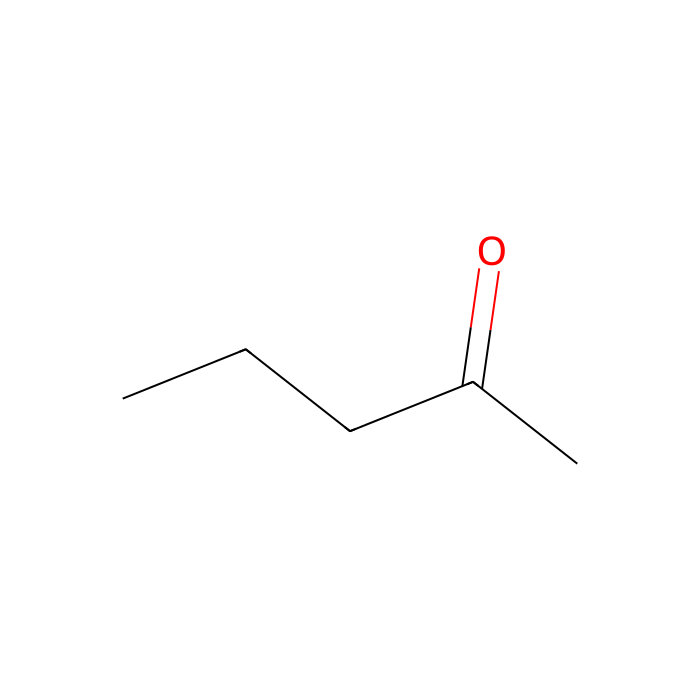
Structure (literature)
Structural features (descriptive, literature)
Implications of structure (general knowledge)
2-Pentanone serves as both a solvent and a reactive carbonyl synthon in organic synthesis.
Functional group leverage (general/literature)
Representative transformations (literature)
Strategic considerations
Not applicable. This product is a small‑molecule chemical (2‑pentanone) and does not target biological epitopes or antigens.