
Determine the necessary mass, volume, or concentration for preparing a solution.
| Activity Type | Relation | Activity value | Units | Action Type | Journal | PubMed Id | doi | Assay Aladdin ID |
|---|
analytical standard, ≥99.7%(GC) 분석 표준물질 for sensitive chromatographic and analytical workflows requiring minimal baseline interference.
Protected from light,Room temperature,Argon charged Ships FedEx DG Service Check lot-specific COA for exact specifications.
SDS, COA, datasheet, and spec sheet available for download. Lot-specific COA accessible via lot number lookup.
Cited in 1524 peer-reviewed publications across chromatography, organic synthesis, and cross-coupling reactions.
Usually used in preparing monodispersed poly (N-isopropylacryamide) (PNIPAM)/AAc microgels.And also used primarily as an intermediate in the production of acrylates.
Comprehensive hazard, handling, storage, and regulatory compliance document.
Download SDS →Lot-specific quality data. Enter your lot number to retrieve the exact COA.
Look up COA →Full quality attributes and acceptance criteria for this grade.
View spec sheet →Taxonomy Tree
| Kingdom | Organic compounds |
|---|---|
| Superclass | Organic acids and derivatives |
| 분류 | Carboxylic acids and derivatives |
| Subclass | Acrylic acids and derivatives |
| Intermediate Tree Nodes | Not available |
| Direct Parent | Acrylic acids |
| Alternative Parents | Monocarboxylic acids and derivatives Carboxylic acids Organic oxides Hydrocarbon derivatives Carbonyl compounds |
| Molecular Framework | Aliphatic acyclic compounds |
| Substituents | Acrylic acid - Monocarboxylic acid or derivatives - Carboxylic acid - Organic oxygen compound - Organic oxide - Hydrocarbon derivative - Organooxygen compound - Carbonyl group - Aliphatic acyclic compound |
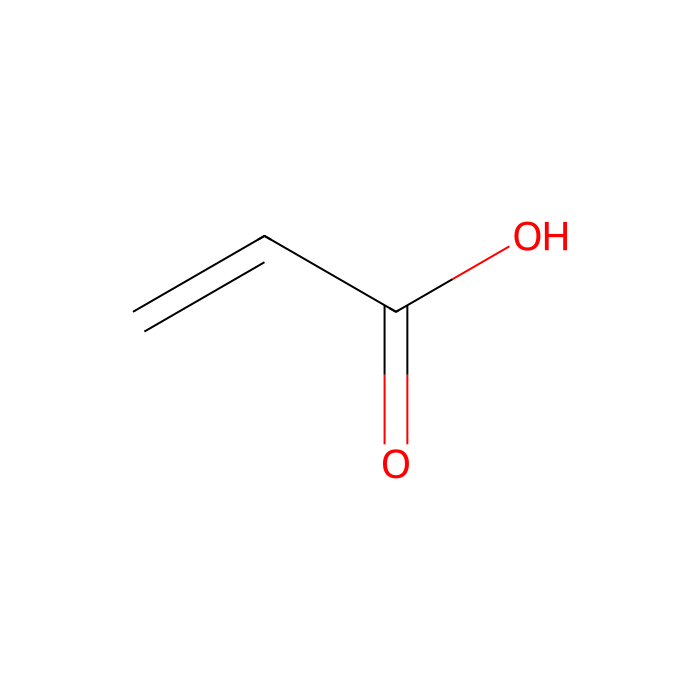
| 설명 | This compound belongs to the class of organic compounds known as acrylic acids. These are organic compounds containing acrylic acid CH2=CHCO2H. |
| External Descriptors | Unsaturated fatty acids |
| Activity Type | Relation | Activity value | Units | Action Type | Journal | PubMed Id | doi | Assay Aladdin ID |
|---|
| Activity Type | Relation | Activity value | Units | Action Type | Journal | PubMed Id | doi | Assay Aladdin ID |
|---|
| Activity Type | Relation | Activity value | Units | Action Type | Journal | PubMed Id | doi | Assay Aladdin ID |
|---|
| Activity Type | Relation | Activity value | Units | Action Type | Journal | PubMed Id | doi | Assay Aladdin ID |
|---|
| Activity Type | Relation | Activity value | Units | Action Type | Journal | PubMed Id | doi | Assay Aladdin ID |
|---|
Find and download the COA for your product by matching the lot number on the packaging.
| Lot Number | Certificate Type | 날짜 | 항목 |
|---|---|---|---|
 L2515110 | Certificate of Analysis | Jul 13, 2026 | A103525 |
| L2515108 | Certificate of Analysis | Dec 19, 2025 | A103525 |
| K2422150 | Certificate of Analysis | Sep 10, 2025 | A103525 |
| H2521159 | Certificate of Analysis | Aug 25, 2025 | A103525 |
| H2521160 | Certificate of Analysis | Aug 25, 2025 | A103525 |
| L2306040 | Certificate of Analysis | Nov 17, 2023 | A103525 |
| L2306041 | Certificate of Analysis | Nov 17, 2023 | A103525 |
| C2323083 | Certificate of Analysis | Mar 14, 2023 | A103525 |
| L2122043 | Certificate of Analysis | Oct 20, 2022 | A103525 |
| L2110237 | Certificate of Analysis | Sep 15, 2022 | A103525 |
| 감도 | Light sensitive;Hygroscopic;Air sensitive |
|---|---|
| 굴절률 | 1.4192-1.4212 |
| 발화점(°F) | 119.3 °F - closed cup |
| 발화점(°C) | 48.5 °C - closed cup |
| 끓는점(°C) | 139°C |
| 녹는점(°C) | 13°C |
| 분자량 | 72.060 g/mol |
| XLogP3 | 0.300 |
| Hydrogen Bond Donor Count | 1 |
| Hydrogen Bond Acceptor Count | 2 |
| Rotatable Bond Count | 1 |
| Exact Mass | 72.0211 Da |
| Monoisotopic Mass | 72.0211 Da |
| Topological Polar Surface Area | 37.300 Ų |
| Heavy Atom Count | 5 |
| Formal Charge | 0 |
| Complexity | 55.900 |
| Isotope Atom Count | 0 |
| Defined Atom Stereocenter Count | 0 |
| Undefined Atom Stereocenter Count | 0 |
| Defined Bond Stereocenter Count | 0 |
| Undefined Bond Stereocenter Count | 0 |
| The total count of all stereochemical bonds | 0 |
| Covalently-Bonded Unit Count | 1 |
Our grade selection guide covers purity, stabilizer status, and application suitability for all variants in our catalog.
View Analytical standard grade guide →