Aluminum oxide - AR , CAS No.1344-28-1

CAS: 1344-28-1 Cat. No.: A102002 분자식: Al2O3 분자량: 101.96 EC 번호: 215-691-6
주문 가능
등급 & 순도 AR ? Analytical Reagent grade — high-purity chemicals meeting strict assay limits for lab analysis. Use when accuracy matters and trace impurities could skew results.
Synonyms
Aluminum oxide (2:3)
Storage
Room temperature,Desiccated
Shipped In
Normal
★
크기
USA
독일 (EU)*
가격
수량
500g
A102002-500g
—
4 재고 있음
US$14.90
12×500g
A102002-12×500g
주문제작 · 8~12주
US$153.90
Enter a quantity for the sizes you want to add.

개요

Essential in protein extraction as a component in the preparation of tissues.

사양

동의어
Aluminum oxide (2:3)
사양 및 순도
AR
생화학 및 생리적 메커니즘
Aluminum oxide is an inorganic compound used as a grinding or blending agent. In addition, Aluminum oxide can be essential in protein extraction as a component in the preparation of tissues. Aluminum oxide is a source of aluminum in reactions, an abrasive
보관 조건
Room temperature,Desiccated
배송
Normal
등급
AR
이름과 식별자
Pubchem Sid
Pubchem Sid Url
https://pubchem.ncbi.nlm.nih.gov/substance/508814059
정식 스마일
O=[Al]O[Al]=O
IUPAC Name
dialuminum;oxygen(2-)
InChIKey
PNEYBMLMFCGWSK-UHFFFAOYSA-N
INCHI
1S/2Al.3O/q2*+3;3*-2
이성체 SMILES
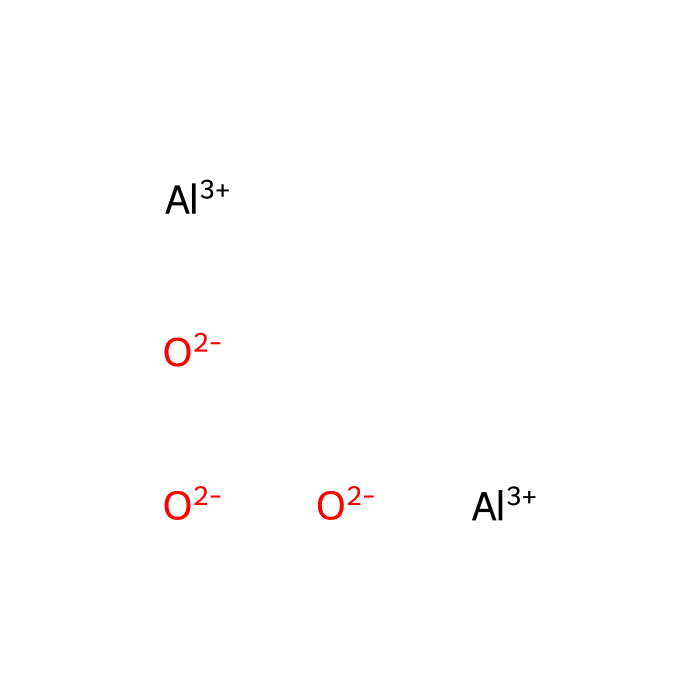
[O-2].[O-2].[O-2].[Al+3].[Al+3]
RTECS
BD1200000
분자량
101.96
Reaxy-Rn
11323344
Reaxys-RN_link_address
https://www.reaxys.com/reaxys/secured/hopinto.do?context=S&query=IDE.XRN=11323344&ln=

고급 데이터

Taxonomic Classification

Taxonomy Tree

KingdomInorganic compounds
SuperclassMixed metal/non-metal compounds
분류Post-transition metal salts
SubclassNot available
Intermediate Tree Nodes Not available
Direct ParentPost-transition metal salts
Alternative Parents Miscellaneous mixed metal/non-metals  Inorganic salts  
Molecular FrameworkNot available
Substituents Inorganic post-transition metal salt - Inorganic salt - Miscellaneous mixed metal/non-metal
설명This compound belongs to the class of inorganic compounds known as post-transition metal salts. These are inorganic halogenic compounds in which the heaviest metal atom is a post-transition metal.
External Descriptors Not available
3D 구조
상호 작용 화학 구조 모델


인증서(CoA, COO, BSE/TSE 및 분석 차트)
C of A & Other Certificates(BSE/TSE, COO):
Analytical Chart:

Find and download the COA for your product by matching the lot number on the packaging.

25 results found

Lot NumberCertificate Type날짜항목
J2619130J2619130Certificate of AnalysisSep 22, 2026 A102002
J2619129J2619129Certificate of AnalysisSep 22, 2026 A102002
H2604356H2604356Certificate of AnalysisJul 22, 2026 A102002
H2604355H2604355Certificate of AnalysisJul 22, 2026 A102002
D2622191D2622191Certificate of AnalysisJan 19, 2026 A102002
E2625643E2625643Certificate of AnalysisJan 19, 2026 A102002
G2606097G2606097Certificate of AnalysisJan 19, 2026 A102002
J2510166J2510166Certificate of AnalysisAug 22, 2025 A102002
J2510167J2510167Certificate of AnalysisAug 22, 2025 A102002
G2524169G2524169Certificate of AnalysisJun 30, 2025 A102002
G2524133G2524133Certificate of AnalysisJun 30, 2025 A102002
C2505682C2505682Certificate of AnalysisFeb 26, 2025 A102002
C2505679C2505679Certificate of AnalysisFeb 26, 2025 A102002
L2411689L2411689Certificate of AnalysisDec 02, 2024 A102002
L2411690L2411690Certificate of AnalysisDec 02, 2024 A102002
H2421037H2421037Certificate of AnalysisAug 03, 2024 A102002
H2421038H2421038Certificate of AnalysisAug 03, 2024 A102002
C2413175C2413175Certificate of AnalysisMar 06, 2024 A102002
C2413174C2413174Certificate of AnalysisMar 06, 2024 A102002
F2310779F2310779Certificate of AnalysisMay 10, 2023 A102002
F2310778F2310778Certificate of AnalysisMay 10, 2023 A102002
I2214275I2214275Certificate of AnalysisAug 04, 2022 A102002
I2214274I2214274Certificate of AnalysisAug 04, 2022 A102002
H2206866H2206866Certificate of AnalysisJul 28, 2022 A102002
H2206865H2206865Certificate of AnalysisJul 28, 2022 A102002
화학 및 물리적 특성
용해성Insoluble in water
감도Hygroscopic.
굴절률1.768
끓는점(°C)2977°C
녹는점(°C)2000°C
분자량101.961 g/mol
XLogP3
Hydrogen Bond Donor Count0
Hydrogen Bond Acceptor Count3
Rotatable Bond Count0
Exact Mass101.948 Da
Monoisotopic Mass101.948 Da
Topological Polar Surface Area3.000 Ų
Heavy Atom Count5
Formal Charge0
Complexity0.000
Isotope Atom Count0
Defined Atom Stereocenter Count0
Undefined Atom Stereocenter Count0
Defined Bond Stereocenter Count0
Undefined Bond Stereocenter Count0
The total count of all stereochemical bonds0
Covalently-Bonded Unit Count5
자주 묻는 질문과 기사
Common Modification Strategies for Lithium Battery Separators
Activated Carbon and Adsorbent Essentials
Molybdenum: Understanding This Key Element
How to Choose Alumina Products? — A Practical Guide from Fundamental Concepts to Application Categories
Immobilized Enzyme Technology and Its Applications in Biocatalysis
Nanowires: Properties, Preparation Routes, and Process Selection (Comprehensive Analysis of Top-Down and Bottom-Up Approaches with Recommended Aladdin Reagents)
Cobalt Catalysts—From Fundamentals to Practice: Mechanistic Insights, Selection Logic, and a One-Stop Aladdin Selection List
Minute-Scale Construction of Fluorinated Nitrogen-Bridged Bicycles: Pd(II)/Pd(IV) Cascade Chemistry and a Pd(IV) “Dyotropic (Paired-Migration)” Rearrangement Driving Strain-Release Ring Expansion
High-Refractive-Index vs Low-Refractive-Index Coating Materials: From AR/Waveguide Principles to a Formulation & Material-Selection Map (Including Product Category Tables A/B/C)
SOFC Solid Oxide Fuel Cells: From “What It Is and How It Generates Power” to a Key Materials Map, Application Scenarios, and Selection Navigation (Electrolytes / Electrodes / Interconnects / Sealing)
Panorama Guide to Lithium-Ion Battery Electrode Materials: Working Principles, Materials Map, and Selection Navigation (incl. Tables 1–4)
Post-Transition Metals and Their Salts: A Classification Guide from Definitions to Value-Chain Applications (Including Product Lists in Tables 1–4)
Optical & Optoelectronic Materials Selection Guide:Positioning materials, key metrics, and validation paths along “Generation → Guiding → Control → Readout” (with product navigation and Tables 1–4)
Ceramic Materials Guide: Basic Definitions, Classification Framework, and Research-Task-Oriented Selection (with Product Navigation and Tables 1–4)
Why Metal Nanocatalysts Can “Save Energy Yet Lose Performance Easily”: Durability Logic from Active Sites to Support/Interface Engineering (Including Selection Guide and Product Tables A–D)
Applications of Self-Assembled Monolayers (SAMs), Microcontact Printing, and Soft Lithography in Surface Functionalization and Micro/Nanopatterning
Self-Assembled Nanodielectrics (SANDs): Self-Assembled Nanodielectric Layers for Low-Voltage Thin-Film Transistors (with Product Selection Guide)
Research Value of Polyelectrolyte Multilayers: Layer-by-Layer Design of Interfacial Composition, Mass Transport, and Function
Polyetherimide (PEI): Structural Features, Main Properties, and Typical Application Directions
Experimental Selection and Outcome Assessment of Heterogeneous Metal Catalysts in Organic Synthesis
Limitations and Future Development of Epoxy Resins: Safety, Environmental Protection, Recycling, Bio-Based Materials, and High-Performance Trends
Four Core Applications of Epoxy Resins: Bonding, Protection, Load-Bearing, and Insulation Protection
Guide to Epoxy Resin Performance Design: System Composition, Key Properties, Process Control, and Application Selection
Guide to Selecting Polyurethane Coating Systems: Application Analysis for Wood, Flooring, Plastics, Automotive, and Industrial Protection
Comprehensive Performance Analysis of Polyurethane Coating Films: Soft/Hard Segment Structure, Microphase Separation, Crosslinking and Curing, and Selection of Representative Chemicals
Structure–Property Relationship of Silicone Resins: Mechanisms of Heat Resistance, Weatherability, Hydrophobicity, and Coating Performance Analysis
Silicone Resin Coating Formulation Design: From Application Conditions to Matching Resins, Pigments and Fillers, Curing, and Substrates
How Should Montmorillonite Be Rationally Modified? Organic Modification, Inorganic Modification, and Application-Oriented Selection and Validation
What Is Silica Sol: Mechanism of Action, Application Scenarios, and Selection Criteria for Nanosilica Dispersions
Diagnosis of Coating Performance Issues and Selection of Resin Modification Routes
Structural Design Logic of Common Resin Modification Technologies: Molecular Chain Structure, Functional Groups, Phase Structure, Crosslinked Networks, and Hybrid/Functional Design
Resin Polarity in Coating Formulations: From Molecular Structure to Dissolution, Compatibility, Interfacial Interactions, and Formulation Design
Signal Transduction Mechanism of Graphene Biosensors: From Molecular Recognition to Electrical/Optical Signal Readout and Materials Selection
Color-Development Mechanisms, Formulation Forms, and Selection/Application Logic of Colorants in Personal Care Products
Vanadium-Aluminum Master Alloy: Vanadium Source Control and Quality Essentials in High-End Titanium Alloy Melting
UVA Absorption Mechanism of Avobenzone: Keto–Enol Tautomerism, Photochemical Instability, and Formulation Photostabilization Strategies
Solid Supports in Packed Gas Chromatography Columns: Definition, Mechanisms of Action, Classification, and Selection
Citations of This Product
솔루션 계산기
리뷰

고객 리뷰

등급 선택에 도움이 필요하신가요?

당사의 등급 선택 가이드는 카탈로그의 모든 변형 제품에 대해 순도, 안정제 상태 및 용도 적합성을 다룹니다.

AR 등급 가이드 보기 →

Shall we send you a message when we have discounts available?

Remind me later

Thank you! Please check your email inbox to confirm.

Oops! Notifications are disabled.