등급 & 순도UPS grade?Ultra-pure-special (UPS) grade — purity above UP for stringent semiconductor steps. Use where UP grade is insufficient for contamination control.Single metal impurity ≤ 1 ppb, 40 wt.% in H2O
Determine the necessary mass, volume, or concentration for preparing a solution.
Dilution Calculator
Determine the dilution needed to prepare a stock solution.
Reconstitution Calculator
리뷰
고객 리뷰
Application Protocols
No antibody/assay-specific protocols are applicable to this product. For laboratory use-cases:
Desilylation screen (general)
Prepare 1.0 M NH4F in MeOH in plastic ware; charge 3–5 equiv vs substrate; stir at rt; monitor by TLC/LC–MS. Adjust temperature (up to 50 °C) if needed. Quench with aqueous bicarbonate; extract and purify.
BOE bath handling (general)
Prepare NH4F solution in DI water in HDPE tank; add HF to achieve target ratio per facility SOP. Record etch rate on standard coupons; use plastic tweezers/holders; neutralize fluoride waste per EHS.
These are literature-style outlines only; adapt to your SOPs and always consult the SDS. This product is for research use only.
Biological Roles
Ammonium fluoride is not a biomolecule, but its constituent ions have well-characterized interactions in biological systems (literature context):
Fluoride ion (F−)
Inhibits a range of metalloenzymes (e.g., enolase) by forming metal–fluoride complexes; can act as a mimic of the hydroxide ion in some active sites.
Forms HF in acidic microenvironments, which is membrane-permeant and highly cytotoxic; careful handling of biological samples is essential.
Ammonium ion (NH4+)
Participates in acid–base equilibria with ammonia (NH3/NH4+) impacting cellular pH homeostasis; at high concentrations disrupts proton gradients and metabolism.
Laboratory relevance
Fluoride-containing buffers are sometimes used to inhibit phosphatases during protein extraction/lysis; however, NH4F is less commonly used than NaF for this purpose. Verify compatibility with downstream assays.
Corrosivity toward glass and some instrument components should be considered when interfacing with bioanalytical equipment.
Note: Any use with biological samples remains for research only. Do not infer safety or efficacy for clinical/diagnostic applications.
Buffer Applications
Ammonium fluoride is not a standard biochemical buffering agent. However, two niche contexts exist (literature):
Buffered oxide etch (BOE/BHF)
Mixtures of NH4F with HF form a chemically buffered etchant for SiO2 and related oxides. This is a process buffer, not a biochemical buffer; handle with extreme caution in plastic systems only.
Acid–base considerations in water
The NH4+/NH3 pair (pKa ~9.25, literature) and F−/HF pair (pKa ~3.2, literature) define multiple equilibria. While solutions of NH4F may exhibit modest buffering capacity near these regimes, NH4F is not typically chosen for analytical or biological buffering due to safety and compatibility concerns.
Practical note: For pH buffering in biochemical assays, use established buffers (e.g., phosphate, Tris, HEPES). If fluoride is needed as an inhibitor, sodium or potassium fluoride salts are more common. Always avoid glassware when preparing any fluoride-containing solutions.
Green Alternatives
Context: NH4F is a solid fluoride source and an alternative to handling anhydrous HF or HF–pyridine. Nonetheless, it poses significant fluoride hazards and can generate HF with acids.
Comparative assessment (literature)
NH4F vs HF(aq)
Pros: Solid, easier to weigh/ship/store; typically less volatile and lower immediate inhalation hazard; enables buffered etches.
Cons: Still corrosive/toxic; releases HF with acids; etches glass/silica; requires plastic hardware and strict waste controls.
NH4F vs NH4HF2 (ammonium bifluoride)
Pros: Lacks the additional acidic proton; often milder etchant; solid handling convenience remains.
Cons: Lower etch aggressiveness; may require combination with acid to reach target performance.
NH4F vs TBAF (tetrabutylammonium fluoride)
Pros: Lower organic solvent waste when used in aqueous/protic media; more stable to handle; avoids quaternary ammonium residues.
Cons: Limited solubility in many organics; may require higher loadings or protic media.
NH4F vs KF/CsF
Pros: Often more soluble/reactive in protic media; ammonium counterion can aid buffering; operationally convenient for MeOH-based desilylations.
Cons: Generally more corrosive to glass; similar fluoride waste burden.
Greener practice tips
Prefer aqueous/protic media at ambient temperature where feasible; minimize excess.
Implement closed-loop etch baths with etch-rate monitoring to extend bath life.
Capture fluoride in waste using calcium salts or specialized fluoride binders; verify local regulations.
Evaluate KF/MeOH or catalytic fluoride protocols when desilylation is the only objective.
Pharmaceutical Uses
No therapeutic or clinical claims are made. The following notes concern manufacturing/formulation contexts only (literature/general):
Compendial/UPS grade
The listed “UPS grade” indicates a compendial-quality material consistent with pharmacopeial monographs (e.g., USP) for identity/assay/impurities. This supports use in method development, system suitability, or process-related studies within regulated environments. Not for human or veterinary administration.
Typical roles (limited)
Process reagent or cleaning/etching aid in device or container surface preparation where fluoride complexation is required (e.g., microfabricated components used in analytical instrumentation).
Analytical reagent in QC assays requiring a defined fluoride source.
Not typical as an excipient
Due to corrosivity/toxicity, ammonium fluoride is generally not employed as a formulation excipient. If fluoride is needed in pharmaceutics, alternative salts and stringent controls are used.
Documentation: For any GMP-relevant work, rely on the batch-specific CoA/Spec Sheet for conformance, and qualify the material per internal SOPs (identity, assay, bioburden as applicable to your use-case).
Physical Properties
Only general/literature values are provided below; they are NOT item-specific specifications.
Appearance: Not specified for this item; refer to CoA/Spec Sheet.
Phase: Ionic solid (literature)
Melting point: Reported near ~126 °C with possible decomposition/sublimation at elevated temperatures (literature)
Boiling point: Not applicable; decomposes prior to boiling (literature)
Density: Reported around ~1.0–1.1 g/cm³ at 20–25 °C (literature)
Solubility (literature)
Water: Highly soluble; exothermic dissolution. Solutions can be corrosive and may etch glass due to silicon–fluoride complex formation.
Alcohols: Soluble to moderately soluble in lower alcohols (e.g., MeOH, EtOH); used operationally for desilylation in MeOH (literature).
Nonpolar solvents: Practically insoluble.
Hygroscopicity: Hygroscopic; absorbs moisture/CO2 from air (literature)
pKa/pH (literature context)
F− is the conjugate base of HF (pKa ≈ 3.2, literature) and undergoes hydrolysis in water; NH4+ (pKa ≈ 9.25, literature) is weakly acidic. Aqueous NH4F solutions are typically near-neutral to slightly acidic/basic depending on concentration and CO2 uptake.
Refractive index, UV cutoff, metals/peroxide/water content: Not specified for this item; refer to CoA/Spec Sheet.
What “USP/compendial” grade generally implies (context; not a clinical claim)
Meets applicable monograph tests in a pharmacopeia (e.g., identity, assay, specified impurity limits, and other quality attributes defined by the compendium). Exact monograph and test limits vary by edition and jurisdiction.
Suitable for analytical/QC, process development, and regulated workflows requiring traceable, compendial compliance documentation when used strictly for research or manufacturing development. Not for human or veterinary use.
Not specified for this item; refer to CoA/Spec Sheet for any specific impurity limits (e.g., heavy metals, iron), loss on drying, and identification/assay methods.
Practical notes for this item
Ammonium fluoride is hygroscopic; quality control frequently includes “loss on drying” and assay by acid–base titration or ion-selective electrode (literature context). Maintain tight closure to preserve grade conformance.
For fluoride-sensitive analyses (ICP-OES/ICP-MS, ion chromatography), confirm background levels and matrix compatibility using the provided CoA.
Reaction and Applications
Selected research and process applications (literature; expand these only with proper safety controls):
Glass/silica etching and microfabrication
Component of buffered oxide etch (BOE/BHF) with HF to controllably remove SiO2 and native oxides on Si wafers. NH4F adjusts fluoride activity and buffering capacity, moderating etch rates and surface roughness.
Desilylation and silicon–oxygen cleavage
Ammonium fluoride in MeOH/H2O is reported to cleave silyl ethers (e.g., TMS, TBDMS) and trialkylsilyl protecting groups by forming strong Si–F bonds. Often milder and more accessible than HF–pyridine; less water-sensitive than TBAF solutions (literature).
Fluoride source in organic synthesis
Can promote reactions requiring catalytic/nucleophilic fluoride, including activation of silyl enol ethers, Brook-type rearrangements, or desilylations prior to further transformations (literature).
Inorganic/materials chemistry
Acts as a mineralizer in hydrothermal/sol–gel syntheses (e.g., zeolites, metal fluorides), influencing crystal morphology and defect density (literature).
Surface chemistry
Removal of metal oxides/contaminants where silicon–fluoride complexation facilitates lift-off or cleaning steps; check substrate compatibility (literature).
Practical guidance
Use plastic labware; avoid glass at all stages.
For desilylation: NH4F (3–10 equiv) in MeOH or MeOH/H2O at rt to 50 °C; monitor by TLC/GC; quench with aqueous bicarbonate and extract if compatible (conditions vary; see Reaction Conditions).
For BOE: Prepare only with appropriate facilities and PPE; document etch rates for your specific composition, temperature, and oxide type.
Reaction Conditions
General, literature-based guidance (optimize for each substrate; not item-specific specifications):
Desilylation of silyl ethers
Typical media: MeOH or MeOH/H2O (80:20 to 100:0). NH4F 1–10 equiv relative to silyl ether.
Temperature: rt to 50 °C. Time: 0.5–12 h depending on sterics (TMS > TBDMS > TIPS).
Workup: Dilute with water, neutralize cautiously (e.g., NaHCO3), extract with organic solvent if compatible; avoid glass funnels/columns.
Buffered oxide etch (BOE/BHF) preparation/use
Representative compositions use concentrated NH4F with HF to achieve defined etch rates for SiO2; temperature commonly 20–25 °C with strict plastic-only hardware. Etch rates strongly depend on bath composition and oxide quality; always calibrate on coupons before device processing.
Mineralizer in hydrothermal synthesis
Add NH4F (0.1–2.0 M fluoride in the gel, literature ranges) to precursor gels; autoclave 120–200 °C for hours–days depending on target phase (zeolite/fluoride-containing frameworks). PTFE-lined vessels recommended.
Solvent: Polar aprotic (MeCN, DMF) or biphasic with phase-transfer; temperature 0–80 °C. Fluoride source may be NH4F or KF/CsF; yields are substrate-dependent and often improved by more soluble fluoride salts.
Notes
Always verify container compatibility; do not heat ammonium fluoride solutions in glassware.
Monitor reactions by non-glass analytics (e.g., plastic vials for TLC eluent storage; polymeric autosampler vials when feasible).
Safety and Handling
Safety details below are general guidance for ammonium fluoride salts and are not a substitute for the product’s SDS. Always consult the SDS and your institutional EHS resources.
GHS classification and pictograms: Not specified for this item; refer to SDS.
Key hazards (general/literature)
Toxic if ingested; harmful by inhalation or skin/eye contact. Fluoride can cause systemic toxicity; eye/skin contact may result in severe irritation or burns.
Corrosive to glass, silica, and silicon-containing materials, especially in the presence of moisture (formation of silicon fluorides/HF).
Reacts with strong acids to release hydrogen fluoride (HF), a highly toxic, corrosive gas/acid.
Incompatibilities
Avoid contact with acids, oxidizers, glass/silica, concrete, and strong bases that may aerosolize/atomize solutions.
Store and handle solutions in plastic (e.g., HDPE, PTFE) rather than glass.
Use in a fume hood; avoid inhalation of dust/mist. Have fluoride exposure protocols readily available.
First-aid overview (general)
Skin/eye exposure: Immediate copious water rinse for ≥15 minutes; remove contaminated clothing; seek medical attention promptly.
Inhalation: Move to fresh air; support respiration; seek medical attention.
Ingestion: Rinse mouth; do not induce vomiting; seek medical attention immediately.
Fire & thermal decomposition
Non-combustible. Thermal decomposition can release toxic fluoride-containing fumes (e.g., HF, NH3). Use appropriate respiratory protection for firefighting.
Spill/cleanup
Avoid dust; collect mechanically while minimizing aerosolization; neutralize/complex fluoride in accordance with institutional procedures; dispose via approved hazardous waste channels.
Solvent Selection
Ammonium fluoride is a solute/reagent rather than an organic solvent. Selection focuses on dissolution medium and material compatibility.
Polarity and miscibility (literature)
Highly soluble in polar protic solvents (water, MeOH, EtOH). Poorly soluble in aprotic/nonpolar media.
Aqueous solutions can hydrolyze silicates; store and handle in plastic (HDPE, PP, PTFE). Avoid glass containers and glass syringes/pipettes.
Choosing a medium by application
Desilylation/Si–O cleavage: MeOH or MeOH/H2O commonly used to activate F− while moderating basicity.
Buffered oxide etch (BOE/BHF): Prepared by combining NH4F with HF to control etch rate of SiO2; use only in compatible plastic ware with proper ventilation.
Zeolite/mineralizer roles: Aqueous or hydrothermal gels with NH4F as mineralizer/templating aid.
Comparison to alternatives (literature)
Versus HF(aq): NH4F is a solid, easier to weigh/handle; considerably safer to transport, but can still release HF with acids and will etch silica.
Versus TBAF (in THF): NH4F is less basic/nucleophilic in aprotic solvents; more effective in protic media. TBAF offers higher solubility in organics but brings moisture sensitivity and decomposition concerns.
Practical tips
Degas if required for sensitive materials; avoid CO2 absorption which acidifies solutions.
For sensitive organic substrates, test cosolvents (MeOH/THF, MeOH/MeCN) while confirming container compatibility.
Storage and Reconstitution
Item-specific (from Product Data)
Storage conditions: Room temperature
Shipped in: Normal
General/literature guidance for ammonium fluoride
Container/material: Store tightly closed in corrosion-resistant plastic (HDPE, PP, PTFE). Avoid glass and silica-containing materials.
Atmosphere: Keep dry; protect from moisture and CO2 to maintain assay and limit solution acidity changes. Consider desiccator storage for frequently opened containers.
Light/temperature: Ambient storage is typical; avoid unnecessary heat. Do not store with acids or oxidizers.
Hygroscopicity: Hygroscopic; promptly recap after use. Track weight changes and consider loss-on-drying checks when critical.
Preparing solutions
Use deionized water or appropriate protic solvent (e.g., MeOH) in plastic vessels. Add solid gradually with stirring; dissolution is exothermic. Allow to cool before use.
Concentration limits depend on application; verify solubility and stability. Label solutions with preparation date and concentration; store in plastic only.
Stability and shelf life
Solid is generally stable under dry, ambient conditions. Aqueous solutions may slowly change due to CO2 absorption and glass etching if mis-stored. For critical work, prepare fresh solutions.
Research Use Note
For research use only. Not for human or veterinary use.
Structure and Identity
Brief overview: Ammonium fluoride is an inorganic ionic salt consisting of the ammonium cation and fluoride anion.
Item-specific (from Product Data)
SKU: A1524006
Product name: Ammonium fluoride
CAS: 12125-01-8
Grade/Purity: UPS grade (compendial; see Quality & Grades)
Storage: Room temperature (see Storage & Reconstitution)
Shipped: Normal
Literature/typical identifiers (informational; not item-specific specs)
Molecular formula: NH4F (literature)
Molecular weight: ~37.04 g/mol (literature)
SMILES: [NH4+].[F−] (literature)
InChIKey: Not specified for this item; refer to CoA/Spec Sheet.
Structural features (general chemistry description)
Ionic compound composed of the tetrahedral, non-coordinating ammonium cation (NH4+) and a hard, basic fluoride anion (F−).
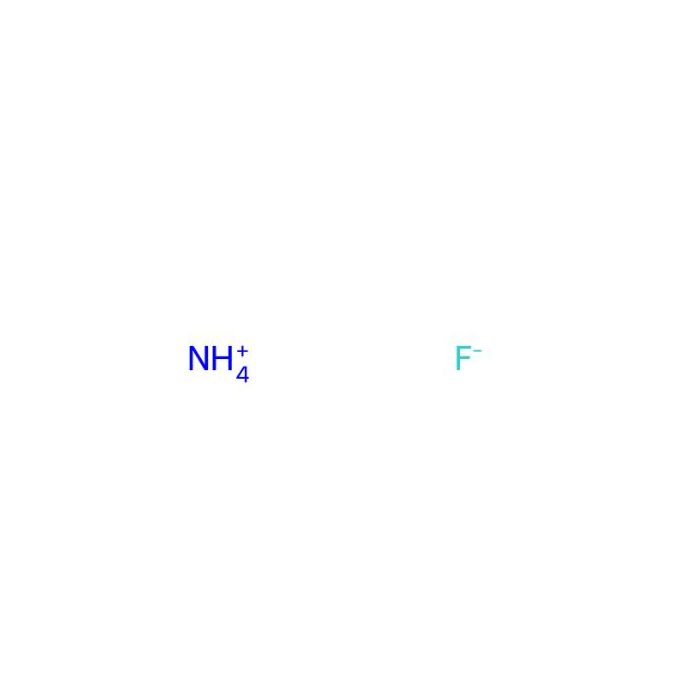
In 2D depiction, one sphere/cation [NH4+] paired with [F−]; no stereocenters; no covalent bonding between N and F in the salt lattice.
As a hard-base fluoride source, F− shows strong affinity for silicon and boron centers and hydrolyzes silicates, underpinning its use in glass/silica etching and silyl ether deprotection.
Synthetic Utility
Functional profile (literature): Ammonium fluoride supplies hard, basic fluoride capable of strong Si–F bond formation, enabling deprotection, etching, and selected nucleophilic roles.
Silyl ether deprotection
Efficient for removing TMS/TBDMS/TIPS groups in MeOH or MeOH/H2O via fluoride attack at silicon, forming stable Si–F and liberating the alcohol/phenol. Often milder than HF–pyridine and operationally simpler than TBAF in moisture-sensitive media.
Silicon-based transformations
Promotes desilylation of silyl enol ethers and cleavage of silylated intermediates, facilitating subsequent carbonyl or C–C bond-forming steps.
Acyl fluoride generation and halogen exchange (reports vary)
Literature reports conversion of acyl chlorides to acyl fluorides with inorganic fluoride sources; NH4F can serve as the fluoride donor under appropriate conditions, though KF/CsF are more common. Verify substrate compatibility.
Inorganic/materials synthesis
Acts as a mineralizer in hydrothermal syntheses (e.g., zeolites, metal–organic frameworks with fluoride nodes), steering crystal growth via transient metal–fluoride complexes.
Retrosynthetic value
Strategic use for late-stage deprotection of silyl groups increases orthogonality in protecting group schemes; NH4F conditions complement acid/base-labile PG landscapes.
Operational notes
Avoid glass; use plastic reaction vessels, stir bars encapsulated in PTFE, and plastic syringes.
Control water content to tune fluoride activity; protic solvents enhance desilylation, whereas aprotic media limit NH4F solubility.
Target Specificity
Not applicable to this inorganic salt. No antigen/epitope or biological target specificity is defined for ammonium fluoride. Refer instead to Reaction & Applications, Synthetic Utility, and Safety & Handling for relevant information.
Products are supplied to verified businesses, institutions, and qualified professionals for research and development use only. Not for use in humans, animals, diagnosis, or therapy.