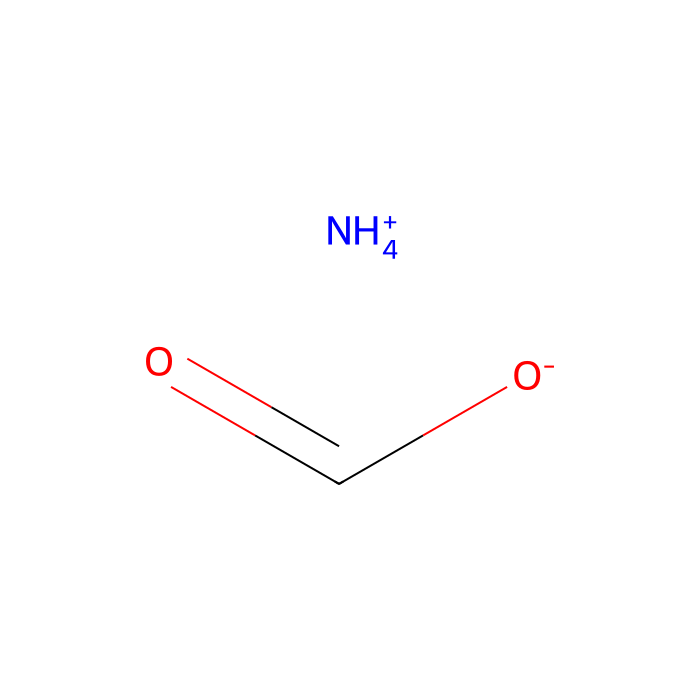
Ammonium formate - 10mM in DMSO , CAS No.540-69-2

CAS: 540-69-2 Cat. No.: A424621 분자식: CH5NO2 분자량: 63.06 Beilstein Registry Number: 3625095 EC 번호: 208-753-9
주문 가능
등급 & 순도 10mM in DMSO
Storage
Store at -80°C
Shipped In
Dry ice packs + Cold packs
★
크기
USA
독일 (EU)*
가격
수량
1ml
A424621-1ml
2 재고 있음
—

US$47.90

US$69.90
저장 US$22.00 (31.47%)
Enter a quantity for the sizes you want to add.

개요

Phenolic benzyl protecting groups are quickly removed by ammonium formate and microencapsulated palladium under microwave irradiation.

사양

사양 및 순도
10mM in DMSO
보관 조건
Store at -80°C
배송
Dry ice packs + Cold packs
이 제품은 콜드 체인 배송이 필요합니다.지상 및 기타 경제 서비스는 사용할 수 없습니다.
이름과 식별자
Pubchem Sid
Pubchem Sid Url
https://pubchem.ncbi.nlm.nih.gov/substance/504760835
SMILES
C(=O)[O-].[NH4+]
IUPAC Name
azanium;formate
InChIKey
VZTDIZULWFCMLS-UHFFFAOYSA-N
InChI
1S/CH2O2.H3N/c2-1-3;/h1H,(H,2,3);1H3
이성체 SMILES
C(=O)[O-].[NH4+]
WGK 독일
1
분자량
63.06
Beilstein
3625095
Reaxys
3625095
Reaxys-RN_link_address
https://www.reaxys.com/reaxys/secured/hopinto.do?context=S&query=IDE.XRN=3625095&ln=

고급 데이터

Taxonomic Classification

Taxonomy Tree

KingdomOrganic compounds
SuperclassOrganic acids and derivatives
분류Carboxylic acids and derivatives
SubclassCarboxylic acids
Intermediate Tree Nodes Not available
Direct ParentCarboxylic acids
Alternative Parents Monocarboxylic acids and derivatives  Organic oxides  Organic nitrogen compounds  Hydrocarbon derivatives  Carbonyl compounds  
Molecular FrameworkAliphatic acyclic compounds
Substituents Monocarboxylic acid or derivatives - Carboxylic acid - Organic nitrogen compound - Organic oxygen compound - Organic oxide - Hydrocarbon derivative - Organooxygen compound - Carbonyl group - Aliphatic acyclic compound
설명This compound belongs to the class of organic compounds known as carboxylic acids. These are compounds containing a carboxylic acid group with the formula -C(=O)OH.
External Descriptors ammonium salt
3D 구조
상호 작용 화학 구조 모델


인증서(CoA, COO, BSE/TSE 및 분석 차트)
C of A & Other Certificates(BSE/TSE, COO):
Analytical Chart:
화학 및 물리적 특성
감도Hygroscopic
녹는점(°C)116°C
분자량63.06
XLogP3
Hydrogen Bond Donor Count1
Hydrogen Bond Acceptor Count2
Rotatable Bond Count0
Exact Mass63.032 Da
Monoisotopic Mass63.032 Da
Topological Polar Surface Area41.100 Ų
Heavy Atom Count4
Formal Charge0
Complexity7.500
Isotope Atom Count0
Defined Atom Stereocenter Count0
Undefined Atom Stereocenter Count0
Defined Bond Stereocenter Count0
Undefined Bond Stereocenter Count0
The total count of all stereochemical bonds0
Covalently-Bonded Unit Count2
안전 및 위험(GHS)
픽토그램(들)
신호
Warning
위험 문구

H315:Causes skin irritation

H319:Causes serious eye irritation

H335:May cause respiratory irritation

주의 문구

P261:Avoid breathing dust/fume/gas/mist/vapors/spray.

P264:Wash hands [and …] thoroughly after handling.

P271:Use only outdoors or in a well-ventilated area.

P280:Wear protective gloves/protective clothing/eye protection/face protection.

P321:Specific treatment (see ... on this label).

P302+P352:IF ON SKIN: wash with plenty of water.

P304+P340:IF INHALED: Remove person to fresh air and keep comfortable for breathing.

P305+P351+P338:IF IN EYES: Rinse cautiously with water for several minutes. Remove contact lenses if present and easy to do - continue rinsing.

P362+P364:Take off contaminated clothing and wash it before reuse.

P405:Store locked up.

P403+P233:Store in a well-ventilated place. Keep container tightly closed.

P501:Dispose of contents/container to an approved waste disposal plant.

P264+P265:Wash hands [and …] thoroughly after handling. Do not touch eyes.

P337+P317:If eye irritation persists: Get medical help.

P332+P317:If skin irritation occurs: Get medical help.

P319:Get medical help if you feel unwell.

WGK 독일
1
Reaxys
3625095
Reaxys-RN_link_address
https://www.reaxys.com/reaxys/secured/hopinto.do?context=S&query=IDE.XRN=3625095&ln=
자주 묻는 질문과 기사
Small-Molecule Inhibitors: A Practical Guide for Research Selection — A Minimal Evidence Chain and Scenario-Based Validation Framework (Including a Selection Matrix, Case Cards, and Product Tables 1–4)
Secondary Effects Behind Chromatographic Peak Tailing and Unstable Peak Shapes: How Residual Silanols (Si–OH) Affect Basic Compounds, and the Shortest Troubleshooting/Remediation Path (with Product Navigation and Tables 1–3)
Plant Omics Panorama: Workflow Frameworks and Multi-Omics Integration from Genomics to Transcriptomics, Proteomics, and Metabolomics
Ferulic Acid: Structural Features, Preparation Routes, and Key Points for Research Applications
Paeonol: Physicochemical Features, Uses, and Key Points for Research Applications
Famotidine: Physicochemical Features, Mechanism of Action, and Key Points for Research Applications
Flavones: Structural Features, Physicochemical Properties, and Key Points for Research and Applications
Roles of the Carboxypeptidase Family in Protein C-Terminal Processing and Experimental Analysis
Methodological Studies on Glycoprotein Structural Characterization and Quality Attribute Analysis
Understanding Cbz (Benzyloxycarbonyl): Selection Logic and Practical Value of a Classical Amino Protecting Group
From the Logic of Deprotection to Protecting Group Choice: Differences Among Bn, PMB, and Dmb in Experimental Design
Research Framework for Multi-Enzyme Digestion Strategies and Optimization of Proteomic Coverage
Technical Comparison and Method Selection for Hydroxyproline Determination
Experimental Assessment of Dibenzyl N,N-Diisopropylphosphoramidite for Alcohol O-Phosphorylation: Coupling, Oxidation, and Debenzylation
Porous Graphitic Carbon (PGC) Chromatography Columns: Creating New Selectivity for Challenging Separations through Molecular Shape and the π-Electron Cloud on the Graphitic Surface
β-Hydroxybutyrate Detection Methods and Metabolic Significance: Comparative Applications of Enzymatic Assays, Blood Ketone Meters, and LC-MS
Citations of This Product
솔루션 계산기
리뷰

고객 리뷰

Shall we send you a message when we have discounts available?

Remind me later

Thank you! Please check your email inbox to confirm.

Oops! Notifications are disabled.