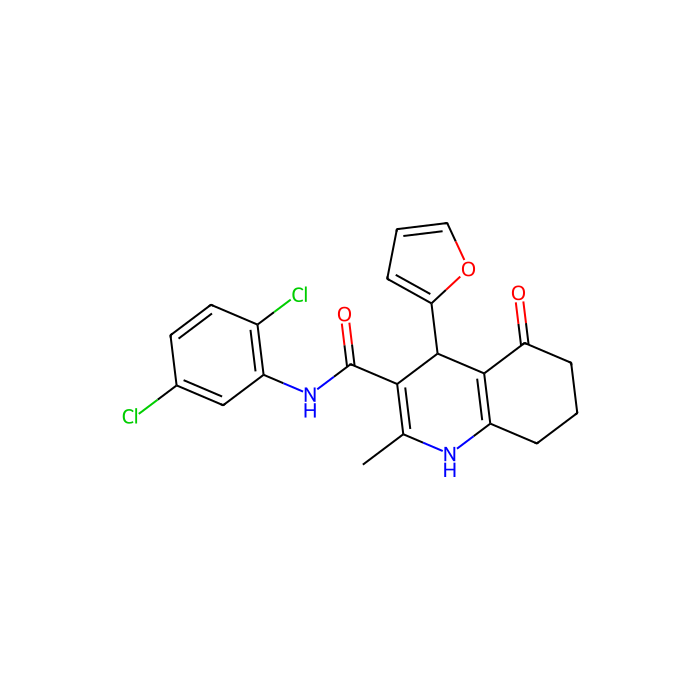
AR420626 is a selective agonist of free fatty acid receptor 3 (FFAR3, GPR41) with IC50 of 117 nM. AR420626 inhibits nicotine and serotonin-induced changes in motility of isolated muscle strips from rat colon and suppresses serotonin-induced fecal output in rats。
FFA3 agonist (pEC50= 5.74). Inhibits nicotine and serotonin induced changes in motility of isolated muscle strips from rat colon. Also suppresses serotonin-induced fecal output in rats.
This compound belongs to the class of organic compounds known as quinoline-3-carboxamides. These are quinolines in which the quinoline ring system is substituted by one carboxamide group at the 3-position.
External Descriptors
Not available
1. Djoumbou Feunang Y, Eisner R, Knox C, Chepelev L, Hastings J, Owen G, Fahy E, Steinbeck C, Subramanian S, Bolton E, Greiner R, and Wishart DS. ClassyFire: Automated Chemical Classification With A Comprehensive, Computable Taxonomy. Journal of Cheminformatics, 2016, 8:61.
Solvent:DMSO, Max Conc. mg/mL: 20.86, Max Conc. mM: 50
분자량
417.300 g/mol
XLogP3
3.800
Hydrogen Bond Donor Count
2
Hydrogen Bond Acceptor Count
4
Rotatable Bond Count
3
Exact Mass
416.069 Da
Monoisotopic Mass
416.069 Da
Topological Polar Surface Area
71.300 Ų
Heavy Atom Count
28
Formal Charge
0
Complexity
733.000
Isotope Atom Count
0
Defined Atom Stereocenter Count
0
Undefined Atom Stereocenter Count
1
Defined Bond Stereocenter Count
0
Undefined Bond Stereocenter Count
0
The total count of all stereochemical bonds
0
Covalently-Bonded Unit Count
1
솔루션 계산기
Molarity Calculator
Determine the necessary mass, volume, or concentration for preparing a solution.
Dilution Calculator
Determine the dilution needed to prepare a stock solution.
Reconstitution Calculator
리뷰
고객 리뷰
Application Protocols
No tested application protocols are provided for this item. The product is intended for general research use in chemistry/biochemistry laboratories.
General protocol framework (for small-molecule stocks):
Prepare a 10–50 mM DMSO stock under inert atmosphere if stability is uncertain. Vortex/sonicate to ensure complete dissolution; filter through 0.2 μm PTFE if required.
Store aliquots at −20°C to avoid repeated freeze–thaw. Thaw at ambient temperature and use promptly.
For assay dosing, dilute into buffer/media to the desired concentration, maintaining a constant final solvent percentage across controls and samples.
Document lot number, preparation date, and storage conditions for data traceability.
Biological Roles
No biological function, pathway involvement, or target annotations are provided for this item. It is supplied strictly for research use as a small-molecule library member.
General guidance (non-clinical):
If the structure becomes available and suggests known pharmacophores, consult databases (ChEMBL, PubChem BioAssay) for literature-reported activities on related scaffolds. Treat any inferred roles as hypotheses until experimentally confirmed for this batch.
For biochemical or biophysical experiments, evaluate potential assay interference (fluorescence, redox activity, aggregation) using counterscreens such as detergent sensitivity, light-scattering, or redox indicator assays.
Compliance note:
This product is not intended for human or veterinary use. Do not infer therapeutic properties from screening results without rigorous validation and safety evaluation.
Buffer Applications
Not typically applicable as a buffer component. This product is a small-molecule research compound rather than a buffering agent.
Practical laboratory notes (general):
If the compound is dosed into aqueous buffers for assays, prepare a concentrated DMSO stock (e.g., 10–50 mM) and perform serial dilutions into the assay buffer to a final DMSO content compatible with the system (commonly 0.1–1% v/v).
Monitor for precipitation upon dilution. Use gentle mixing and a short equilibration period. If needed, include a small co-solvent fraction (e.g., 0.1–0.5% DMF or ethanol) validated not to perturb the assay.
Select buffer composition based on assay requirements (e.g., HEPES pH 7.4, PBS pH 7.4). The compound’s ionization state (unknown here) may influence solubility; avoid extreme pH unless stability is confirmed.
Green Alternatives
Because the compound’s structure and use pattern are unspecified, greener considerations focus on solvent and process choices rather than replacing the molecule itself.
Prefer water and bio-derived alcohols (EtOH, iPrOH) where solubility permits.
Consider 2-methyltetrahydrofuran (2-MeTHF) or cyclopentyl methyl ether (CPME) as greener, less peroxide-prone ethers versus THF/diethyl ether in workups.
Use ethyl acetate over chlorinated solvents for extractions when feasible.
Minimize DMSO volumes in biological assays; validate lower final DMSO percentages to reduce solvent burden.
Small comparison (general):
Chlorinated (DCM, CHCl3) vs EtOAc/MTBE: lower environmental impact with EtOAc/MTBE; assess selectivity trade-offs.
DMF/NMP vs MeCN/green esters: MeCN or propylene carbonate may offer lower reproductive toxicity vs NMP; check solubility.
Process notes:
Scale experiments responsibly; use microscale screening for solubility and stability to curb waste.
Implement solvent recovery and appropriate waste segregation.
Item-specific substitutions or green process changes cannot be recommended until the compound’s functionality and stability profile are known.
Pharmaceutical Uses
No pharmacopeial status, excipient role, or formulation use is specified for this item. It is provided for research use only and is not intended for human or veterinary applications.
General formulation considerations (if used in pre-formulation research only):
Determine solubility and stability across pH 1–10, ionic strengths, and common co-solvents. Assess photostability and oxidative stability where relevant.
Evaluate solid-state form (free base/acid vs salt, solvate, polymorph) once structure is known, as this impacts dissolution and stability.
Any extrapolation to dosage forms must remain within non-clinical, laboratory-scale feasibility studies and must not be used for therapeutic purposes.
Physical Properties
Item-specific physicochemical constants are not supplied in the current listing.
Appearance: Not specified for this item; refer to CoA/Spec Sheet.
Melting point (MP): Not specified for this item; refer to CoA/Spec Sheet.
Boiling point (BP): Not specified for this item; refer to CoA/Spec Sheet.
Density: Not specified for this item; refer to CoA/Spec Sheet.
Refractive index: Not specified for this item; refer to CoA/Spec Sheet.
Solubility: Not specified for this item; refer to CoA/Spec Sheet.
Partition coefficient (logP/logD): Not specified for this item; refer to CoA/Spec Sheet.
pKa: Not specified for this item; refer to CoA/Spec Sheet.
Practical notes (general/literature-style guidance, not item-specific):
Small-molecule library members are commonly provided as solids or in DMSO stock; solubility often spans polar aprotic media (DMSO, DMF, NMP) and selected alcohols (MeOH, EtOH). Confirm experimentally.
If hygroscopicity or polymorphism is suspected, record mass under inert atmosphere and confirm identity via LC–MS and 1H NMR.
When structure becomes available, compute cLogP, TPSA, and pKa to inform solvent selection and assay compatibility (literature/computed).
Quality and Grades
Grade/Purity: Not specified for this item; refer to CoA/Spec Sheet.
Interpretation and guidance (general):
Library compounds are typically supplied at research grade. Purity is often established by LC–MS/UPLC and 1H NMR, with acceptance criteria such as ≥95% area by UV (literature/common practice). Exact specification for this SKU is not provided here.
If chromatographic applications (e.g., standardization, spike-in controls) are planned, request the batch CoA indicating: assay purity method/λ, residual solvents (GC), water content (Karl Fischer), and salt/solvate form.
If an inhibitor/screening hit is anticipated, confirm identity via orthogonal methods (HRMS + NMR) and assess stability under assay conditions (buffer, temperature, light) prior to large screens.
Stabilizers: Not specified for this item; refer to CoA/Spec Sheet. If stabilizers are present, they may influence UV background and bioassay interference; account in controls.
Reaction and Applications
Manufacturer Applications: Not specified in the listing; this SKU is categorized under small molecules and compound libraries for research use only.
General research applications (non-item-specific):
Assay development and screening: Use as a test article in biochemical or biophysical assays to probe assay performance, counterscreens, or structure–activity trends when related analogs are available.
Analytical standardization: Potential internal standard or retention-time marker once identity and purity are verified; confirm stability in chosen mobile phase.
Material science/exploratory chemistry: If functional groups are compatible, can serve as a building block or reference substrate in method development.
Practical tips:
Confirm identity and purity by LC–MS and NMR prior to use in data-generating experiments.
Establish compound stability in the intended solvent system and temperature profile (autosampler at 4–10°C vs ambient; light exposure) before extended runs.
If using in cell-free biochemical assays, maintain DMSO ≤0.5% v/v unless the assay is validated for higher levels.
Note: Specific reactivity classes, named reactions, or mechanistic applications cannot be assigned without structural information. Obtain structure (SMILES/SDF) and basic physicochemical parameters to tailor applications.
Reaction Conditions
Specific reaction conditions are not applicable here because the chemical structure and functional groups of AR 420626 are not provided.
General guidance for method development (once structure is known):
For polar/ionizable substrates, employ polar aprotic media (DMSO, DMF, MeCN) and consider phase-transfer or base selection guided by pKa.
For cross-couplings, typical conditions (literature) include Pd(0/II) catalysts (e.g., XPhos/Pd2(dba)3) in toluene/THF/1,4-dioxane or aqueous micellar media; bases like K3PO4 or Cs2CO3; 25–100°C.
For amide couplings, use modern reagents (HATU, T3P, EDCI/Oxyma) with DIPEA in DMF/MeCN; monitor for epimerization if chiral centers are present.
For reductive aminations, NaBH(OAc)3 or BH3·THF at 0–25°C in DCE/MeOH or THF; avoid over-reduction with careful stoichiometry.
These are generic, literature-style ranges to frame planning once functionality is known; they are not item-specific specifications.
Safety and Handling
Hazard classification details are not provided in this listing; handle under the assumption of unknown acute and chronic hazards.
Item-specific safety data:
GHS classification / pictograms / H-statements: Not specified for this item; refer to SDS.
Signal word: Not specified for this item; refer to SDS.
Storage: Store at −20°C (as provided). Shipments are made in an ice chest with ice pads.
General laboratory precautions (professional guidance; defer to SDS for authority):
PPE: Lab coat, safety glasses, and appropriate chemically resistant gloves (e.g., nitrile). Use in a fume hood to avoid inhalation of dusts/vapors.
Incompatibilities: Unknown for this item; until defined, avoid strong oxidizers/reductants, strong acids/bases, and sources of ignition. Segregate from foodstuffs and incompatible reagents.
Handling: Minimize exposure; weigh quickly to limit moisture uptake. If provided as a solution, prevent aerosol formation; cap promptly.
First aid (overview): Skin/eye contact—rinse with water for ≥15 min. Inhalation—move to fresh air. Ingestion—rinse mouth; seek medical attention. Always consult SDS for detailed measures.
Waste: Dispose as organic chemical waste per institutional and local regulations.
Special risks (general):
Unknown propensity for air/light/moisture sensitivity and dust explosivity; adopt conservative controls (desiccation, amber storage if feasible) until specific data are available.
Solvent Selection
Item-specific solubility data are not provided. The following is general, literature-based guidance for small-molecule library members.
Primary stock solvent: DMSO is commonly preferred for library compounds due to broad solvency and assay compatibility up to 0.1–1% v/v in screening wells.
Secondary solvents: DMF, NMP, MeOH, EtOH, and acetonitrile can be used for solubilization or co-solvent systems. Water solubility is scaffold-dependent.
Polarity class: Not specified for this item; determine experimentally (shake-flask or kinetic solubility).
Dielectric constants (literature, at 20–25°C): DMSO ~47, DMF ~37, MeOH ~33, MeCN ~37, EtOH ~25—use to tune solvent polarity in mixtures.
Practical strategy:
Perform a micro-solubility screen (1–10 mg scale) across DMSO, DMF, MeOH, ACN, aqueous buffer (pH 2–9), and a 1:1 DMSO:buffer blend. Inspect clarity and precipitation over 24 h.
For unstable chemotypes (unknown here), avoid prolonged heating; prefer sonication and incremental solvent addition.
Filter stocks (0.2 μm PTFE) to remove particulates prior to analytical or biological assays.
Comparison (general):
If aqueous assays demand low DMSO, consider cyclodextrin inclusion or mild pH adjustment where compatible with compound ionization state (once pKa is known).
Storage and Reconstitution
Item-specific conditions:
Recommended storage: Store at −20°C (as provided).
Shipping: Ice chest with ice pads (as provided).
Appearance / form: Not specified for this item; refer to CoA/Spec Sheet.
General best practices for small-molecule library compounds:
If solid: Store in a tightly sealed container, preferably under inert gas with desiccant. Allow vial to equilibrate to room temperature before opening to prevent condensation. Re-cap promptly after use.
If supplied in solution (e.g., DMSO): Keep tightly capped, minimize headspace, and avoid repeated freeze–thaw cycles. Prepare single-use aliquots sized to experimental needs.
Reconstitution: When required, dissolve in an appropriate dry solvent (commonly DMSO, DMF, MeOH). Start with a small volume and incrementally add solvent while vortexing/sonicating until fully dissolved. Record final concentration and solvent composition.
Stability: Unknown for this item; perform a short stability assessment (e.g., LC–MS after 24–72 h at storage and working temperatures) before extended studies.
Light/moisture sensitivity: Not specified for this item; as a precaution, store protected from light and moisture until specific data are available.
Always defer to the Certificate of Analysis (CoA) and Safety Data Sheet (SDS) for authoritative, lot-specific instructions.
Structure and Identity
A287232 (AR 420626) is listed as a small-molecule library member intended for research screening. Limited structural metadata are available in the current entry.
CAS: 1798310-55-0 (as provided)
PubChem CID: 91885415 (as provided)
InChIKey: 101687 (as provided; note that typical InChIKeys are 27-character hashes; verify against CoA/SDS)
Molecular formula: Not specified for this item; refer to CoA/Spec Sheet.
Molecular weight: Not specified for this item; refer to CoA/Spec Sheet.
SMILES: Not specified for this item; refer to CoA/Spec Sheet.
IUPAC name / chemical name: Not specified for this item; refer to CoA/Spec Sheet.
Structural features (general guidance):
Without a provided SMILES or formula, specific functional groups, ring systems, or stereochemical elements cannot be confirmed for this item.
For verification and informatics use (registration, ELN), request the full structure file (SDF/MOL) or consult the batch CoA.
2D structure description (general):
Not available from the current listing. If structure is obtained, provide a textual description highlighting core scaffold, heteroatoms, substitution pattern, and any stereocenters or fused rings (literature/computed).
Synthetic Utility
Item-specific synthetic reactivity cannot be assigned without a disclosed structure. Thus, no definitive guidance on functional-group transformations or protecting-group strategies can be provided for this SKU.
General perspectives once structure is available:
Identify key functional handles (e.g., aryl halides for cross-coupling, carbonyls for reductive amination, heteroatoms for N/O/S-alkylation) to plan analog synthesis and SAR expansion.
Consider convergent routes enabling rapid late-stage diversification (e.g., Buchwald–Hartwig, Suzuki–Miyaura, CuAAC, Minisci) if the scaffold supports them.
Evaluate oxidation state and chemoselectivity constraints to map viable disconnections and orthogonal protections.
For medicinal chemistry work, incorporate robust analytics (LC–MS, UPLC-UV, 1H/13C NMR) and purity targets (≥95% by area, literature/common practice) for screening-grade compounds.
Until the molecular structure is provided, treat this item as a terminal test article rather than a synthetic intermediate.
Target Specificity
No target, epitope, or binding specificity is provided for this item. It is not an antibody or biological probe with defined target annotations in this listing.
If used in target-based research (general guidance):
Establish on-target engagement using orthogonal assays (biochemical potency, biophysical binding, cellular readouts) and appropriate negative controls.
Include counterscreens to address assay interference or off-target activity.
Products are supplied to verified businesses, institutions, and qualified professionals for research and development use only. Not for use in humans, animals, diagnosis, or therapy.

 H2218183