
Determine the necessary mass, volume, or concentration for preparing a solution.
| Activity Type | Activity Value -log(M) | Mechanism of Action | Activity Reference | Publications (PubMed IDs) |
|---|
Moligand™, 10mM in DMSO Moligand™ 최소한의 기준선 간섭이 필요한 민감한 크로마토그래피 및 분석 워크플로우용.
Store at -80°C Dry ice packs + Cold packs 출고. 정확한 사양은 로트별 COA를 확인하세요.
SDS, COA, 데이터시트, 사양서를 다운로드할 수 있습니다. 로트별 COA는 로트 번호 조회를 통해 확인할 수 있습니다.
크로마토그래피, 유기 합성 및 교차 커플링 반응 분야의 동료 심사 논문 1편에서 인용되었습니다.
Information
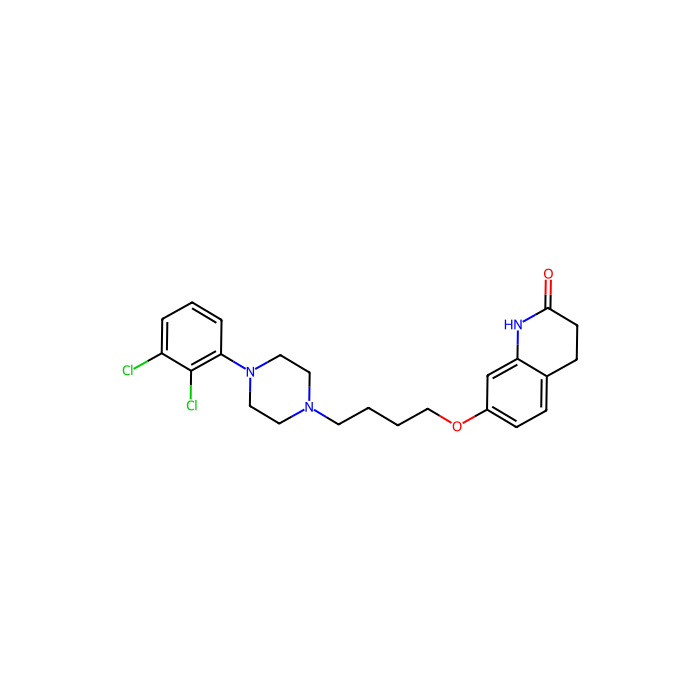
Aripiprazole (OPC-14597) is a novel atypical antipsychotic drug that is reported to be a high-affinity5-HT receptorpartial agonist.
In vitro
Aripiprazole binds with high affinity to both the G protein-coupled and uncoupled states of receptors. Aripiprazole potently activates D2 receptor-mediated inhibition of cAMP accumulation. Aripiprazole has highest affinity for h5-HT(2B)-, hD(2L)-, and hD(3)-dopamine receptors, but also has significant affinity (5-30 nM) for several other 5-HT receptors (5-HT(1A), 5-HT(2A), 5-HT(7)), as well as alpha(1A)-adrenergic and hH(1)-histamine receptors. Aripiprazole has less affinity (30-200 nM) for other G protein-coupled receptors, including the 5-HT(1D), 5-HT(2C), alpha(1B)-, alpha(2A)-, alpha(2B)-, alpha(2C)-, beta(1)-, and beta(2)-adrenergic, and H(3)-histamine receptors. Aripiprazole is an inverse agonist at 5-HT(2B) receptors and displays partial agonist actions at 5-HT(2A), 5-HT(2C), D(3), and D(4) receptors.
In vivo
Aripiprazole reduces extracellular 5-HIAA concentrations in the medial prefrontal cortex and striatum of drug-naive rats, but not in chronic Aripiprazole-pretreated rats. Aripiprazole, 0.1 mg/kg and 0.3 mg/kg, significantly increases dopamine release in the hippocampus of rats. Aripiprazole, 0.3 mg/kg, slightly but significantly increases dopamine release in the medial prefrontal cortex but not in the nucleus accumbens. Aripiprazole, 3.0 mg/kg and 10 mg/kg, significantly decreases dopamine release in the nucleus accumbens but not the medical prefrontal cortex. Aripiprazole, 0.3 mg/kg, transiently potentiates haloperidol (0.1 mg/kg)-induced dopamine release in the medial prefrontal cortex but inhibited that in the nucleus accumbens.
Cell Data
cell lines:
Concentrations:
Incubation Time:
Powder Purity:≥98%
위험성, 취급, 보관 및 규제 준수를 포괄하는 종합 문서.
<<<<<<< HEAD SDS 다운로드 → ======= SDS 다운로드 → >>>>>>> release248-p3| Activity Type | Activity Value -log(M) | Mechanism of Action | Activity Reference | Publications (PubMed IDs) |
|---|
| Activity Type | Activity Value -log(M) | Mechanism of Action | Activity Reference | Publications (PubMed IDs) |
|---|
| Activity Type | Activity Value -log(M) | Mechanism of Action | Activity Reference | Publications (PubMed IDs) |
|---|
| Activity Type | Activity Value -log(M) | Mechanism of Action | Activity Reference | Publications (PubMed IDs) |
|---|
| Activity Type | Activity Value -log(M) | Mechanism of Action | Activity Reference | Publications (PubMed IDs) |
|---|
| Activity Type | Activity Value -log(M) | Mechanism of Action | Activity Reference | Publications (PubMed IDs) |
|---|
| Activity Type | Activity Value -log(M) | Mechanism of Action | Activity Reference | Publications (PubMed IDs) |
|---|
| Activity Type | Activity Value -log(M) | Mechanism of Action | Activity Reference | Publications (PubMed IDs) |
|---|
| Activity Type | Activity Value -log(M) | Mechanism of Action | Activity Reference | Publications (PubMed IDs) |
|---|
| Activity Type | Activity Value -log(M) | Mechanism of Action | Activity Reference | Publications (PubMed IDs) |
|---|
| Activity Type | Activity Value -log(M) | Mechanism of Action | Activity Reference | Publications (PubMed IDs) |
|---|
| Activity Type | Activity Value -log(M) | Mechanism of Action | Activity Reference | Publications (PubMed IDs) |
|---|
| Activity Type | Activity Value -log(M) | Mechanism of Action | Activity Reference | Publications (PubMed IDs) |
|---|
| Activity Type | Activity Value -log(M) | Mechanism of Action | Activity Reference | Publications (PubMed IDs) |
|---|
| Activity Type | Activity Value -log(M) | Mechanism of Action | Activity Reference | Publications (PubMed IDs) |
|---|
| Activity Type | Activity Value -log(M) | Mechanism of Action | Activity Reference | Publications (PubMed IDs) |
|---|
| Activity Type | Activity Value -log(M) | Mechanism of Action | Activity Reference | Publications (PubMed IDs) |
|---|
| Activity Type | Activity Value -log(M) | Mechanism of Action | Activity Reference | Publications (PubMed IDs) |
|---|
| Activity Type | Activity Value -log(M) | Mechanism of Action | Activity Reference | Publications (PubMed IDs) |
|---|
| Activity Type | Activity Value -log(M) | Mechanism of Action | Activity Reference | Publications (PubMed IDs) |
|---|
| Activity Type | Activity Value -log(M) | Mechanism of Action | Activity Reference | Publications (PubMed IDs) |
|---|
| 용해성 | Solubility (25°C) In vitro DMSO: 37 mg/mL (198.65 mM); |
|---|---|
| 녹는점(°C) | 149 °C |
당사의 등급 선택 가이드는 카탈로그의 모든 변형 제품에 대해 순도, 안정제 상태 및 용도 적합성을 다룹니다.
Moligand™ 등급 가이드 보기 →