
Determine the necessary mass, volume, or concentration for preparing a solution.
| Activity Type | Activity Value -log(M) | Mechanism of Action | Activity Reference | Publications (PubMed IDs) |
|---|
Moligand™, 10mM in DMSO Moligand™ for sensitive chromatographic and analytical workflows requiring minimal baseline interference.
Store at -80°C Ships Dry ice packs + Cold packs Check lot-specific COA for exact specifications.
SDS, COA, datasheet, and spec sheet available for download. Lot-specific COA accessible via lot number lookup.
Cited in 0 peer-reviewed publications across chromatography, organic synthesis, and cross-coupling reactions.
Information
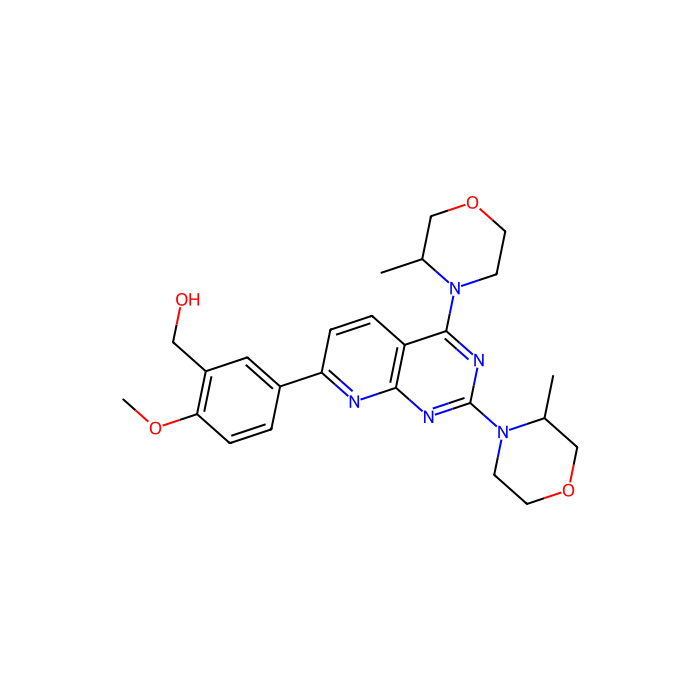
AZD8055 AZD8055 is a novel ATP-competitive mTOR inhibitor with IC50 of 0.8 nM in MDA-MB-468 cells with excellent selectivity (∼1,000-fold) against PI3K isoforms and ATM/DNA-PK. AZD8055 induces caspase-dependent apoptosis and also induces autophagy . Pha
In vitro
AZD8055 shows low activity (∼1,000-fold) against all PI3K isoforms (α, β, γ, δ) and other members of the PI3K-like kinase family (ATM and DNA-PK). AZD8055 inhibits the phosphorylation of mTORC1 (p70S6K and 4E-BP1) as well as phosphorylation of the mTORC2 (Akt) and downstream proteins. The rapamycin-resistant T37/46 phosphorylation sites on 4E-BP1 can be fully inhibited by AZD8055, resulting in significant inhibition of cap-dependent translation. AZD8055 potently inhibits proliferation in U87MG, A549 and H838 cells with IC50 of 53, 50 and 20 nM, respectively. AZD8055 also induces autophagy and increased LC3-II levels in H838 and A549 cells. AZD8055 decreases AML blast cell proliferation and cell cycle progression, reduces the clonogenic growth of leukemic progenitors and induces caspase-dependent apoptosis in leukemic cells but not in normal immature CD34+ cells. AZD8055 indicates inhibitory against the pediatric preclinical testing program (PPTP) cell lines with IC50 of 24.7\u2009nM and induces significant differences in EFS distribution.
In vivo
AZD8055 inhibits the pS6 and pAkt in U87MG and A549 xenografts at 2.5/10 mg/kg, which leads to tumor growth inhibition. AZD8055 shows significant antitumor activity in many xenografts, including U87MG, BT474c, A549, Calu-3, LoVo, SW620, PC3 and MES-SA at a dose of 10/20 mg/kg. AZD8055 induces ~40% reduction in tumour volume, accompanied by ablation of phosphorylation of Akt, S6K and SGK protein kinases. Administration of AZD8055 (5mg/kg, Bid) and SAHA (100 mg/kg/d) results in complete tumor growth inhibition in PTEN+/−LKB1+/hypo xenografts without side effects on mice by inhibition of mTORC1 and mTORC2 signaling.
Cell Data
cell lines:HCT116, A2780, ACHN, MCF7, HL-60, et al.
Concentrations:1 nM - 1 μM
Incubation Time:72 to 96 hours
Powder Purity:≥97%
Comprehensive hazard, handling, storage, and regulatory compliance document.
Download SDS →Lot-specific quality data. Enter your lot number to retrieve the exact COA.
Look up COA →Full quality attributes and acceptance criteria for this grade.
View spec sheet →| Activity Type | Activity Value -log(M) | Mechanism of Action | Activity Reference | Publications (PubMed IDs) |
|---|
Find and download the COA for your product by matching the lot number on the packaging.
| Lot Number | Certificate Type | 날짜 | 항목 |
|---|---|---|---|
 L2214611 | Certificate of Analysis | Jul 03, 2026 | A408287 |
The Product Data do not provide validated, item-specific protocols for this SKU.
General starting points for small-molecule tool compounds (non-item-specific):
For any assay-specific recommendations or positive-control conditions associated with this SKU, please refer to the CoA/Spec Sheet or contact Aladdin Scientific technical support.
This product is a research-use-only small molecule supplied for biochemical and cellular studies. No clinical or therapeutic claims are made.
General, literature-based context (non-item-specific):
Best practices:
Item-specific biological targets, potency values, and selectivity panels are Not specified for this item; refer to CoA/Spec Sheet and primary literature for AZD8055.
AZD8055 is a bioactive small molecule, not a buffering agent. It is not used to establish or maintain pH.
Practical notes for assay buffers (general, non-item-specific):
Item-specific buffering information: Not applicable; no buffer role is intended for this compound.
“Green alternatives” typically apply to solvent selection and process chemistry. For a research-grade screening compound like AZD8055 (used at milligram-to-microgram scales), the environmental leverage lies in solvent and consumable choices rather than replacing the compound itself.
Practical, greener handling strategies (general, non-item-specific):
Illustrative comparison (general):
Item-specific environmental metrics (e.g., E-factor, solvent intensity) are not specified for this item.
This product is for research use only and is not intended for human or veterinary use, clinical diagnostics, or as an active pharmaceutical ingredient.
Formulation and excipient context (general, non-item-specific):
Regulatory note:
Item-specific pharmaceutical/formulation specifications: Not specified for this item; refer to CoA/Spec Sheet if any supportive data are provided.
Item-specific physicochemical data are not provided in the Product Data for this listing.
General/literature guidance for handling similar kinase-inhibitor small molecules (non-item-specific):
Always consult the CoA/Spec Sheet for definitive, item-specific physical constants before designing formulations or assays.
What this means in practice:
Stabilizers/additives:
This product is provided as a bioactive small molecule for screening and chemical biology rather than as a general synthetic reagent.
Good practices (general, non-item-specific):
Item-specific manufacturer application notes were not provided beyond “For research use only.” For any specialized application recommendations for this SKU, consult the CoA/Spec Sheet or contact Aladdin Scientific technical support.
Not typically applicable. AZD8055 is a research-use-only probe compound, not intended as a reagent for synthetic transformations.
If employing the compound in analytical or stability studies (general, non-item-specific):
Item-specific reaction or processing conditions are not applicable and are Not specified for this item.
Safety data specific to this item are not provided in the Product Data.
General laboratory safety guidance for bioactive small molecules (non-item-specific):
Authoritative safety information is provided in the SDS; always consult the SDS for this specific SKU prior to use.
AZD8055 is supplied as a research small molecule where dissolution for bioassays is the primary concern rather than use as a bulk reaction solvent.
Practical guidance (general, non-item-specific for kinase inhibitors):
Comparison notes (general):
Item-specific solubility data are Not specified for this item; refer to CoA/Spec Sheet.
Reconstitution and handling (general, non-item-specific):
Item-specific shelf life, retest date, and solution stability: Not specified for this item; refer to CoA/Spec Sheet and SDS for definitive guidance.
Brief overview: AZD8055 is a research-grade, bioactive small molecule supplied in Aladdin’s Moligand™ format for screening and chemical biology.
Note: Exact constitutive features, stereochemistry (if any), and identifiers used for this specific lot should be confirmed from the supplied CoA/Spec Sheet.
AZD8055 is supplied as a finished bioactive screening compound rather than a synthetic building block, reagent, or catalyst.
If using in analytical method development:
No item-specific functional-group reactivity guidance is provided for this SKU.
Target specificity data must come from the Product Data. For this SKU, item-specific target, selectivity, and binding information are Not specified for this item; refer to CoA/Spec Sheet.
General note (non-item-specific): For bioactive small molecules used in pathway studies, researchers typically confirm on-target activity with orthogonal assays (e.g., enzymatic activity assays, target engagement assays) and evaluate off-target liabilities via panel screening. Consult primary literature for AZD8055 when designing experiments, and validate within your assay context.
Our grade selection guide covers purity, stabilizer status, and application suitability for all variants in our catalog.
View Moligand™ grade guide →