
Determine the necessary mass, volume, or concentration for preparing a solution.
| Activity Type | Activity Value -log(M) | Mechanism of Action | Activity Reference | Publications (PubMed IDs) |
|---|
Information
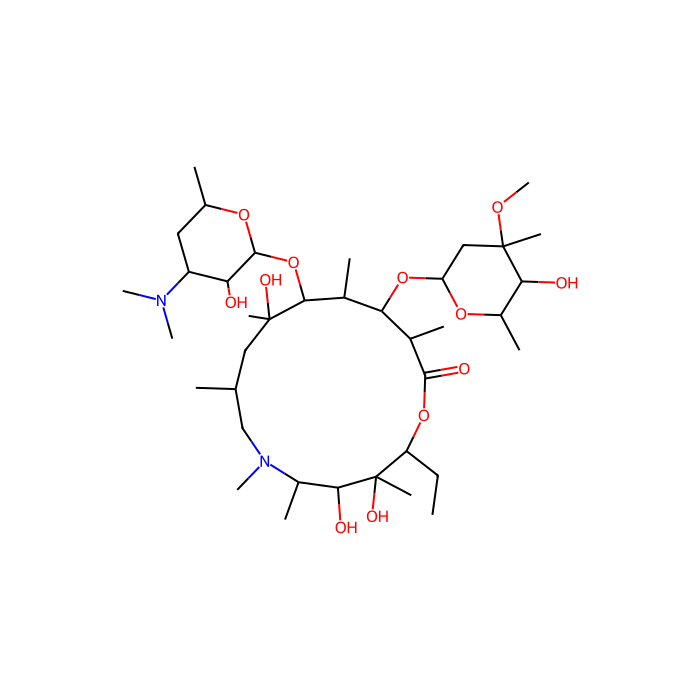
Azithromycin (CP-62993, XZ-450) is an antibiotic by inhibiting protein synthesis, used for the treatment of bacterial infections.
In vitro
Azithromycin reduces about 40% of IL-8 mRNA and protein expression in cystic fibrosis (CF) cells reaching the levels of non-CF cells. Azithromycin results in 50% and 70% reduction of NF-kappaB and AP-1 DNA binding, respectively, leading to levels of non-CF cells. Azithromycin significantly enhances the intensity of a co-stimulatory molecule, CD80, on DCs but not CD86 and CD40 in dendritic cells (DCs). Azithromycin significantly increases the production of IL-10 and Clarithromycin (CAM) significantly inhibits the production of IL-6 by DCs. Azithromycin increases IL-10 and CAM decreases IL-2 productions significantly, when naive T cells derived from spleen are co-cultured with DCs treated in advance with LPS and these macrolides. Azithromycin selectively inhibits fluid-phase endocytosis of horseradish peroxidase and lucifer yellow in J774 mouse macrophages. Azithromycin delays sequestration of receptor-bound transferrin and peroxidase-anti-peroxidase immune complexes into cell-surface endocytic pits and vesicles. Azithromycin down-regulates cell surface transferrin receptors, but not Fc gamma receptors, by causing a major delay in the accessibility of internalized transferrin receptors to the recycling route, without slowing down subsequent efflux, resulting in redistribution of the surface pool to an intracellular pool. Azithromycin inserts into the DOPC lipid bilayer, so as to decrease its cohesion and to facilitate the merging of DPPC into the DOPC fluid matrix.
In vivo
Cell Data
cell lines:
Concentrations:
Incubation Time:
Powder Purity:
| Activity Type | Activity Value -log(M) | Mechanism of Action | Activity Reference | Publications (PubMed IDs) |
|---|
| 용해성 | Solubility (25°C) In vitro DMSO: 25 mg/mL (198.23 mM); |
|---|
H317:May cause an allergic skin reaction
H334:May cause allergy or asthma symptoms or breathing difficulties if inhaled
H400:Very toxic to aquatic life
H410:Very toxic to aquatic life with long lasting effects
H372:Causes damage to organs through prolonged or repeated exposure
P261:Avoid breathing dust/fume/gas/mist/vapors/spray.
P273:Avoid release to the environment.
P280:Wear protective gloves/protective clothing/eye protection/face protection.
P302+P352:IF ON SKIN: wash with plenty of water.
P321:Specific treatment (see ... on this label).
P501:Dispose of contents/container to an approved waste disposal plant.
P264:Wash hands [and …] thoroughly after handling.
P260:Do not breathe dust/fume/gas/mist/vapors/spray.
P284:[In case of inadequate ventilation] Wear respiratory protection.
P270:Do not eat, drink or smoke when using this product.
P304+P340:IF INHALED: Remove person to fresh air and keep comfortable for breathing.
P272:Contaminated work clothing should not be allowed out of the workplace.
P333+P313:IF SKIN irritation or rash occurs: Get medical advice/attention.
P362+P364:Take off contaminated clothing and wash it before reuse.
P391:Collect spillage.
P319:Get medical help if you feel unwell.
P342+P316:If experiencing respiratory symptoms: Get emergence medical help immediately.
당사의 등급 선택 가이드는 카탈로그의 모든 변형 제품에 대해 순도, 안정제 상태 및 용도 적합성을 다룹니다.
Moligand™ 등급 가이드 보기 →