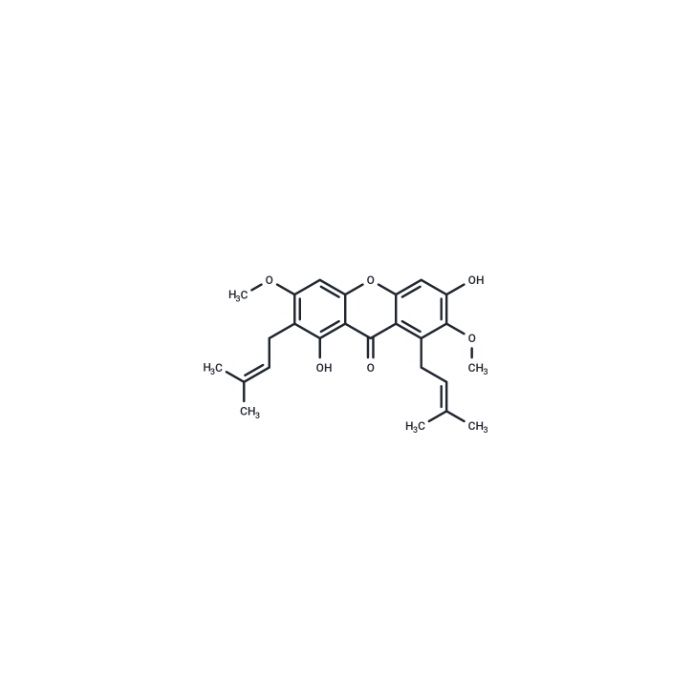
Beta-mangostin (β-Mangostin) is a xanthone compound with antibacterial and antimalarial activities. Beta-mangostin present in Cratoxylum arborescens and exhibits antimycobacterial activity against Mycobacterium tuberculosis with an MIC of 6.25 μg/mL. Beta-mangostin possesses in vitro antimalarial activity against Plasmodium falciparum, with an IC50 of 3.00 μg/mL. Beta-mangostin has potent anticancer activity against various cancers (such as hepatocellular carcinoma, leukaemic).
사양
동의어
1,6-Dihydroxy-3,7-dimethoxy-2,8-bis(3-methyl-2-buten-1-yl)-9H-xanthen-9-one | 9H-Xanthen-9-one, 1,6-dihydroxy-3,7-dimethoxy-2,8-bis(3-methyl-2-butenyl)- | 1,6-dihydroxy-3,7-dimethoxy-2,8-bis(3-methylbut-2-enyl)xanthen-9-one | (2-methyl-1-propyl-1H-indol-3-yl)(naphthalen-1-yl)methanone | 1,6-DIHYDROXY-3,7-DIMETHOXY-2,8-BIS(3-METHYLBUT-2-EN Show more
This compound belongs to the class of organic compounds known as 8-prenylated xanthones. These are organic compounds containing a C5-isoprenoid group linked to a xanthone moiety at the 8-position. Xanthone is a tricyclic compound made up of two benzene rings linearly fused to each other through a pyran ring that carries a ketone group.
External Descriptors
Not available
1. Djoumbou Feunang Y, Eisner R, Knox C, Chepelev L, Hastings J, Owen G, Fahy E, Steinbeck C, Subramanian S, Bolton E, Greiner R, and Wishart DS. ClassyFire: Automated Chemical Classification With A Comprehensive, Computable Taxonomy. Journal of Cheminformatics, 2016, 8:61.
Products are supplied to verified businesses, institutions, and qualified professionals for research and development use only. Not for use in humans, animals, diagnosis, or therapy.

 L2522316