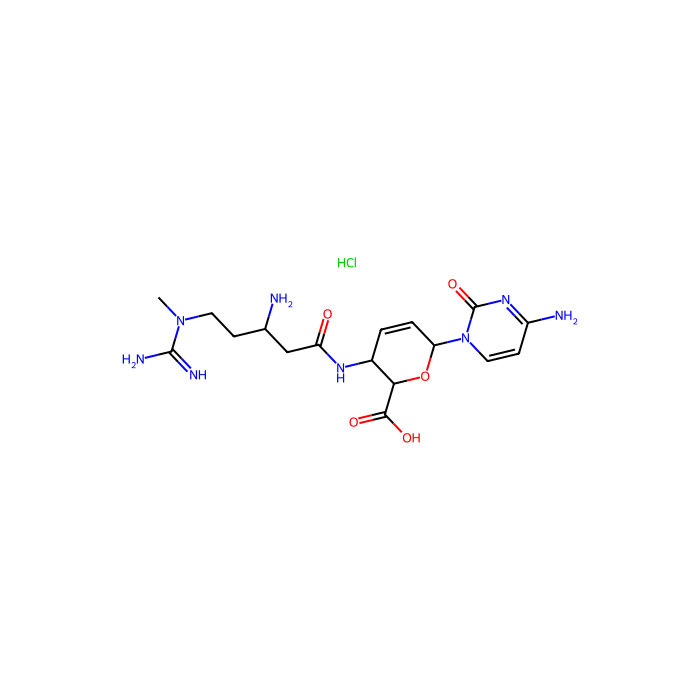
(2S,3S,6R)-3-[[(3S)-3-amino-5-[carbamimidoyl(methyl)amino]pentanoyl]amino]-6-(4-amino-2-oxopyrimidin-1-yl)-3,6-dihydro-2H-pyran-2-carboxylic acid;hydrochloride|blasticidin S HCl|(2S,3S,6R)-6-(4-amino-2-oxo-1,2-dihydropyrimidin-1-yl)-3-[(3S)-3-amino-5-(N-methylcarbamimidamido)pentanamido]-3,6-dihydro-2H-pyran-2-carboxylic acid hydrochloride|BlasticidinShydrochloride|(2S,3S,6R)-6-(4-amino-2-oxopyrimidin-1(2H)-yl)-3-((S)-3-amino-5-(1-methylguanidino)pentanamido)-3,6-dihydro-2H-pyran-2-carboxylic acid hydrochloride|Bla-S; Blasticidin S; Blasticidin S HCl|Blasticidin S (hydrochloride)|Blasticidin S hydrochloride
Blasticidin S Hydrochloride belongs to a group of cytosine amino nucleoside antibiotics. The compound Blasticidin S has a wide spectrum of antimicrobial activity and acts on prokaryotic and eukaryotic organisms by inhibiting protein synthesis. Blasticidin-S is a commonly used tool in genetic engineering. Blasticidin-S inhibits protein synthesis in both prokaryotic and eukaryotic cells. It is common method to include a gene for Blasticidin S resistance into the plasmid being inserted into the target cells, and then to apply Blasticidin S to the culture to select these cells that have acquired that immunity. The Blasticidin S gene resistance gene (BSR), found in Bacillus cereus K55-S1, has been used in multiple studies for its use as a selective compound. Another antibiotic that belongs to the family of nucleosides is puromycin
사양
동의어
(2S,3S,6R)-3-[[(3S)-3-amino-5-[carbamimidoyl(methyl)amino]pentanoyl]amino]-6-(4-amino-2-oxopyrimidin-1-yl)-3,6-dihydro-2H-pyran-2-carboxylic acid;hydrochloride | blasticidin S HCl | (2S,3S,6R)-6-(4-amino-2-oxo-1,2-dihydropyrimidin-1-yl)-3-[(3S)-3-amino-5-(N-methylcarbamimidamido)pentanamido]-3,6-dihydro-2H-pyran-2-carboxylic acid hydrochl Show more
사양 및 순도
10mM in Water
생화학 및 생리적 메커니즘
Blasticidin S Hydrochloride, like puromycin, belongs to a group of cytosine amino nucleoside antibiotics. The compound blasticidin S has a wide spectrum of antimicrobial activity and acts on prokaryotic and eukaryotic organisms by inhibiting protein synthesis. The blasticidin S resistance gene (BSR), found in Bacillus cereus K55-S1, has been used in multiple studies for its use as a selective compound.Broad spectrum nucleoside antibiotic. Inhibits protein synthesis in prokaryotic and eukaryotic organisms.
Products are supplied to verified businesses, institutions, and qualified professionals for research and development use only. Not for use in humans, animals, diagnosis, or therapy.