GRADE & PURITYMoligand™?Moligand™ — Aladdin's line of ligands and bioactive small molecules. Use for receptor, pathway, and binding studies needing defined small-molecule tools.≥98%
Moligand™,≥98% Moligand™ for sensitive chromatographic and analytical workflows requiring minimal baseline interference.
🌡
Storage & shipping
Store at -20°C Ships Ice chest + Ice pads Check lot-specific COA for exact specifications.
📋
Quality documents
SDS, COA, datasheet, and spec sheet available for download. Lot-specific COA accessible via lot number lookup.
📚
Literature proof
Cited in 0 peer-reviewed publications across chromatography, organic synthesis, and cross-coupling reactions.
개요
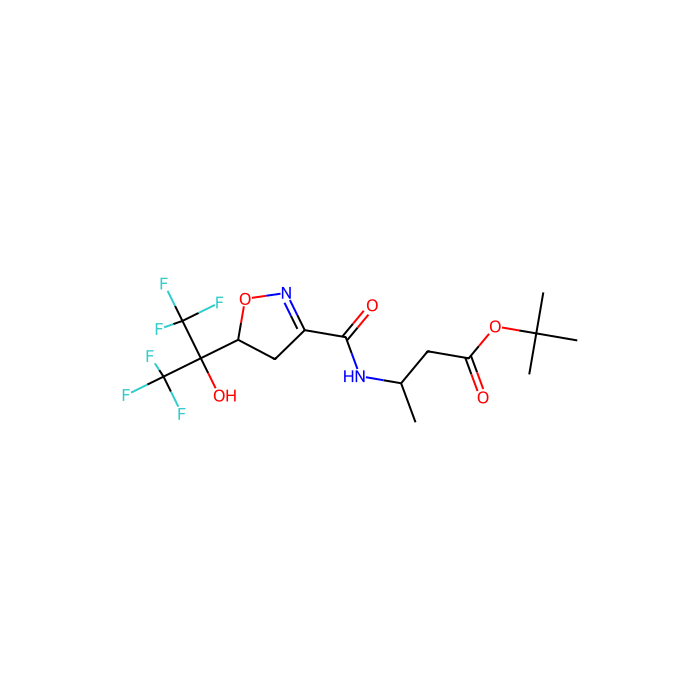
CBM-301940 (compound 5) is a CoA decarboxylase (MCD) inhibitor with IC50 value of 23 nM. CBM-301940 can be used in the study of cardiovascular diseases.
This compound belongs to the class of organic compounds known as beta amino acids and derivatives. These are amino acids having a (-NH2) group attached to the beta carbon atom.
External Descriptors
Not available
1. Djoumbou Feunang Y, Eisner R, Knox C, Chepelev L, Hastings J, Owen G, Fahy E, Steinbeck C, Subramanian S, Bolton E, Greiner R, and Wishart DS. ClassyFire: Automated Chemical Classification With A Comprehensive, Computable Taxonomy. Journal of Cheminformatics, 2016, 8:61.
Solvent:DMSO, Max Conc. mg/mL: 42.23, Max Conc. mM: 100; Solvent:ethanol, Max Conc. mg/mL: 42.23, Max Conc. mM: 100
분자량
422.320 g/mol
XLogP3
2.200
Hydrogen Bond Donor Count
2
Hydrogen Bond Acceptor Count
12
Rotatable Bond Count
7
Exact Mass
422.128 Da
Monoisotopic Mass
422.128 Da
Topological Polar Surface Area
97.200 Ų
Heavy Atom Count
28
Formal Charge
0
Complexity
624.000
Isotope Atom Count
0
Defined Atom Stereocenter Count
0
Undefined Atom Stereocenter Count
2
Defined Bond Stereocenter Count
0
Undefined Bond Stereocenter Count
0
The total count of all stereochemical bonds
0
Covalently-Bonded Unit Count
1
솔루션 계산기
Molarity Calculator
Determine the necessary mass, volume, or concentration for preparing a solution.
Dilution Calculator
Determine the dilution needed to prepare a stock solution.
Reconstitution Calculator
리뷰
고객 리뷰
Application Protocols
No vendor-tested protocols are listed for CBM 301940 in the Product Data. The following are general, non-item-specific recommendations for handling small-molecule ligands in biophysical/biochemical assays.
General handling protocol (guidance)
Equilibrate vial to room temperature in a desiccated environment before opening to prevent moisture condensation.
Prepare a concentrated DMSO stock (e.g., 10–50 mM) using analytical balance and volumetric tools; record exact concentration.
Aliquot into low-bind tubes or assay-ready plates; store at −20°C to minimize freeze–thaw.
Prior to assays, dilute into filtered assay buffer keeping final DMSO ≤1–2% v/v; include vehicle controls.
Inspect for precipitation/turbidity; if present, reduce concentration or increase cosolvent slightly as permitted by assay design.
Confirm integrity by HPLC/LC–MS at start and end of assay where critical.
Assay-specific notes
SPR/BLI: Filter/degass buffers; include detergent (e.g., 0.005–0.01% Tween-20) if compatible; perform DMSO calibration.
DSF/thermal shift: Maintain consistent dye and DMSO across wells; include known stabilizer/destabilizer controls.
ITC: Match buffer between syringes and cell; degas; verify absence of heat-of-dilution artifacts.
Item-specific concentrations, dilutions, and controls: Not specified; refer to CoA/Spec Sheet.
Biological Roles
No biological target, pathway, or mode-of-action details are provided for CBM 301940 in the current Product Data.
General context (for small-molecule ligands in research)
Ligands are used to interrogate protein function, stabilize conformations for structural biology (cryo-EM, X-ray co-crystallography), and probe signal transduction or metabolic nodes in vitro.
In biophysics, ligands can facilitate fragment growth/SAR workflows, mapping binding hotspots and guiding medicinal chemistry.
In proteomics or chemoproteomics (if reactive handles are introduced), ligands can enable target identification via pull-down or activity-based profiling; such adaptations require additional chemistry and are not implied for this item.
Restrictions and scope
This product is labeled For research use only (Product Data). It is not for human or veterinary use and is not intended for diagnostic or therapeutic applications.
For any biological role claims, consult the CoA/Spec Sheet or primary literature associated with the provided identifiers (CAS 902146-11-6; CID 10387489). Absent such data, treat CBM 301940 as a generic screening ligand until specific target data are verified.
Buffer Applications
CBM 301940 is not a buffering agent. However, buffers are central to ligand–protein assays. Without item-specific pKa/solubility data, use standard, low-interference buffers and validate compatibility experimentally.
General buffer guidance for ligand assays
HEPES (pH 7.4–7.5) or PBS (pH 7.2–7.4) are common for enzyme and binding assays; Tris can be used but may coordinate/compete in some metalloproteins.
Keep final DMSO ≤1–2% v/v to preserve protein stability; include vehicle controls.
Additives: 0.01–0.05% Tween-20 or 0.01% CHAPS can reduce nonspecific binding/aggregation; include only if validated for your target.
For metal-sensitive systems, use chelator-free buffers or precisely define metal content.
Filter (0.22 µm) and degas for SPR/ITC; maintain ionic strength (e.g., 150 mM NaCl) for stability.
Not specified for this item
Any buffer formulations or reconstitution requirements unique to CBM 301940 are not specified; refer to the CoA/Spec Sheet for any special instructions.
Green Alternatives
This listing describes a discrete small-molecule ligand (not a solvent or bulk auxiliary). “Green alternatives” are therefore not directly applicable in the conventional solvent-substitution sense.
General greener practice for handling small-molecule ligands
Minimize solvent volumes and favor DMSO–water dilutions over chlorinated or highly toxic organics when compatible with your assay.
Where synthetic modification of the ligand is planned, consider biobased solvents (e.g., 2-MeTHF, CPME, Cyrene) in upstream chemistry, and adopt microscale or flow approaches to reduce waste.
For analytics, employ acetonitrile–water gradients instead of methanol–dichloromethane systems where feasible.
Implement high-concentration stocks to reduce total solvent consumption across screening campaigns.
If your workflow involves re-synthesis or derivatization of CBM 301940, consult solvent-selection guides (e.g., CHEM21/ACS GCI) to prioritize greener media and robust workup strategies (direct crystallization, minimal chromatographic purification).
Pharmaceutical Uses
No pharmacopeial status or excipient role is provided for CBM 301940. The product is supplied For research use only and is not intended for human administration or clinical manufacture.
Research/manufacturing context (general)
As a small-molecule ligand, typical roles include a reference standard for analytical method development or a tool compound in discovery-stage assays.
If used in regulated labs for analytical purposes, ensure appropriate reference standard qualification (identity/purity verification, stability program), as item-specific purity specs are not disclosed here.
No information is provided regarding ICH/USP/EP compliance, residual solvents, elemental impurities, or nitrosamine risk; consult the CoA/Spec Sheet if suitability for GMP-adjacent work is considered.
Summary of item-specific details
Clinical/therapeutic use: Not applicable.
Excipient/formulation role: Not specified.
Compendial listings: Not specified.
Analytical reference use: Possible in principle, but requires lot-specific documentation not included in this listing.
Physical Properties
Item-specific physicochemical constants are not disclosed in this listing. Use the following guidance and confirm with the CoA/Spec Sheet for experimental work.
Appearance: Not specified for this item; refer to CoA/Spec Sheet.
Melting point (literature/computed): Not available here; consult CoA or primary databases for the exact lot.
Boiling point (literature): Not available here.
Density (literature): Not available here.
pKa/logP (literature/computed): Not available here.
Refractive index: Not applicable unless liquid; not specified.
Solubility: Not specified for this item; typical practice for screening ligands is to prepare a concentrated stock in anhydrous DMSO (e.g., 10–50 mM), then dilute into assay buffer. Verify actual solubility and stability empirically (visual inspection for precipitation; LC/UV check).
Practical notes (general guidance)
Begin with a small-scale solubility screen in DMSO, DMF, ethanol, and assay buffer containing 1–2% DMSO. Document any turbidity or crystallization over 24 hours.
For aqueous work, evaluate cosolvent and pH dependence if ionizable moieties are later confirmed from the CoA.
Avoid heating unknowns aggressively; instead, sonicate gently or warm to 30–40°C briefly to aid dissolution.
Quality and Grades
Grade/Purity (Product Data): Moligand™
What Moligand™ typically signifies (general description)
Intended for ligand discovery, screening, and biophysical assays (e.g., SPR, DSF, MST, ITC, NMR binding).
Emphasis on structural identity and cleanliness suitable for target-binding studies and SAR exploration. Vendors commonly support this class with identity confirmation (e.g., LC–MS, 1H NMR) and tight residual solvent/impurity control; however, item-specific methods and limits are not provided here.
Item-specific disclosures
Purity value, assay method, residual solvents/metals, stabilizers, water/peroxide content, and UV cutoff: Not specified for this item; refer to CoA/Spec Sheet.
Appearance and lot-specific test results: Not specified; see CoA for the supplied lot.
Implications for use
For quantitative biophysics or biochemical kinetics, request the CoA and, if available, a chromatogram and MS spectrum to confirm single-major-component status.
If high-sensitivity optical assays are planned, inquire about UV–Vis background/fluorescence characteristics to prevent interference.
For plate-based screening, verify solubility in DMSO at the intended stock concentration (e.g., 10–50 mM) and absence of particulates after dilution into assay buffers.
Reaction and Applications
This Moligand™ product is positioned primarily as a biochemical/biophysical ligand rather than a synthetic reagent. Accordingly, its value is in binding and functional studies with macromolecular targets.
Enzymology: Inhibition/activation profiling and kinetic analyses where a small-molecule modulates activity.
Cell-free or lysate screens: Preliminary activity readouts before cellular assays (for research use only).
Analytical reference: Use as an LC–MS/UPLC retention and response standard when developing bioanalytical methods involving related chemotypes.
Practical considerations
Prepare a concentrated DMSO stock (e.g., 10–50 mM) after confirming solubility and stability; aliquot to avoid freeze–thaw.
Validate assay compatibility at the final cosolvent percentage; include vehicle controls.
Monitor compound integrity over assay time by LC–MS or HPLC-UV to ensure the active species remains unchanged.
If structural alerts (aggregation, redox activity, fluorescence) later emerge from CoA or preliminary tests, implement appropriate controls (detergent screens, redox quenchers, inner-filter effect checks).
Note: No item-specific biochemical targets or potencies are provided in the Product Data.
Reaction Conditions
This section is typically relevant to reagents used in chemical transformations. CBM 301940 is supplied as a Moligand™ research ligand with no disclosed use as a synthetic reagent. As such, reaction condition guidance is not applicable.
If you intend to derivatize or conjugate the molecule, obtain the structure from the CoA and consult reaction conditions that match its functional groups (e.g., amide coupling, click chemistry, SNAr). Without these details, providing temperatures, catalysts, or yields would be speculative and is intentionally omitted here.
Safety and Handling
Always handle under institutional chemical hygiene and risk assessment. No item-specific GHS data are disclosed here; defer to the official SDS.
GHS Classification: Not specified for this item; refer to SDS.
Signal Word / H-Statements / Pictograms: Not specified for this item; refer to SDS.
Primary hazards (general for small-molecule ligands): Unknown toxicity. Treat as harmful if swallowed, inhaled, or in contact with skin/eyes. Dusts/solutions may cause irritation.
Engineering controls: Work in a chemical fume hood or ventilated enclosure. Avoid aerosolization and dust generation.
PPE: Lab coat, safety glasses, disposable nitrile gloves. Upgrade to splash goggles/face shield if preparing concentrated solutions or large volumes.
Incompatibilities: Without structure data, avoid strong oxidizers/reductants, strong acids/bases, and reactive metals until compatibility is verified.
First aid (overview):
Skin/eye contact: Rinse with water for ≥15 minutes; remove contaminated clothing; seek medical attention.
Inhalation: Move to fresh air; support breathing; seek medical attention.
Ingestion: Rinse mouth; do not induce vomiting; seek medical attention.
Spill response: Contain, absorb with inert material, collect in chemically compatible container for disposal.
Waste: Dispose as organic laboratory chemical waste per local regulations.
Storage (from Product Data): Store at −20°C. Minimize freeze–thaw cycles; protect from moisture and light unless otherwise specified on the CoA.
Solvent Selection
With structure and polarity not disclosed, adopt a conservative, data-driven solvent strategy.
General solvent plan (for small-molecule ligands)
Primary stock solvent: Anhydrous DMSO (typical 10–50 mM) owing to broad solubilizing power and assay compatibility at ≤1–2% v/v final.
Alternative organic solvents:DMF (strong polar aprotic), ethanol or isopropanol (more volatile; useful for quick drying/coating), and acetonitrile (HPLC compatibility). Verify chemical stability.
Aqueous buffers: Prepare working solutions by diluting DMSO stocks into assay buffer (e.g., HEPES, PBS, Tris) keeping final DMSO low to maintain protein integrity.
Small comparison (general guidance)
DMSO: Highest solubilizing power; hygroscopic; low volatility; compatible with many assays up to ~1–2%.
DMF: Similar to DMSO but more volatile odor; check protein compatibility (often less favorable than DMSO).
Ethanol: Volatile, easier to remove; can destabilize some proteins at >2–5%.
Acetonitrile: Good for LC; may denature proteins even at modest %.
Practical tips
Pre-warm (30–40°C) and vortex/sonicate to assist dissolution; avoid aggressive heating.
Filter 0.22 µm if needed to remove particulates (confirm no adsorption/loss).
Assess solubility limits and precipitation in the exact assay buffer, across the intended concentration and temperature window.
Storage and Reconstitution
Item-specific storage conditions are provided; reconstitution details are not disclosed.
Storage (Product Data): Store at −20°C.
Shipping (Product Data):Ice chest + Ice pads.
Stability: Not specified for this item; refer to CoA/Spec Sheet for retest/expiry and any light/moisture sensitivity.
Appearance: Not specified for this item; refer to CoA/Spec Sheet.
Reconstitution: Not specified for this item; refer to CoA/Spec Sheet.
General guidance (non-item-specific)
Allow container to reach room temperature in a desiccator before opening to avoid moisture condensation.
Prepare a concentrated stock in anhydrous DMSO if compatible; aliquot into dry, inert tubes to minimize freeze–thaw and moisture uptake.
Protect from light if chromophores are suspected or if later data show photolability.
Record preparation date, solvent, and concentration on each aliquot; monitor integrity periodically by HPLC/LC–MS.
Always defer to the CoA/SDS for authoritative instructions for the received lot.
Structure and Identity
Concise identification details as provided; structural details are not disclosed for this Moligand-series ligand.
SKU: C288481
Product Name: CBM 301940
CAS: 902146-11-6
PubChem CID: 10387489
InChIKey: 331699 (as provided)
SMILES: Not specified for this item; refer to CoA/Spec Sheet.
Molecular Formula: Not specified for this item; refer to CoA/Spec Sheet.
Molecular Weight: Not specified for this item; refer to CoA/Spec Sheet.
Structural features
Item-specific 2D/3D structure, functional groups, and stereochemistry are not provided in the current listing. For rigorous structural work (NMR assignment, docking, QSAR), obtain the vendor CoA/Spec Sheet or consult the PubChem entry associated with the given CID.
CBM 301940 is supplied under the Moligand™ line, which denotes a small-molecule ligand intended for biochemical/biophysical research. Absent explicit disclosure, assume no defined stereochemical assignment for protocol design until confirmed by CoA.
Synthetic Utility
CBM 301940 is offered as a Moligand™ small-molecule ligand for biological research; it is not positioned primarily as a synthetic building block. Without structural disclosure (functional groups, handles), concrete synthetic roles cannot be assigned.
General considerations (if derivatization is planned)
After structure confirmation from the CoA, assess handles for SAR (e.g., amines, acids, halides) enabling analog generation or biotin/fluorophore conjugation.
If a single stereocenter or atropisomerism exists, plan for enantio-/diastereocontrol or resolution strategies to maintain activity profiles.
For analytical synthesis support, the compound may serve as a calibration standard if a related series is being prepared; confirm purity and stability.
Not specified for this item
Functional groups, protecting group strategies, and named-reaction suitability are not specified; avoid assuming compatibility until structure is obtained.
Target Specificity
No target, pathway, or species specificity is provided for CBM 301940 in the Product Data.
Antigen/Target name: Not specified for this item; refer to CoA/Spec Sheet.
Mechanism of action / binding mode: Not specified.
Selectivity profile / off-targets: Not specified.
Species reactivity (if biological): Not specified.
Guidance
For any deployment in biochemical or cellular assays, establish primary target engagement (e.g., SPR/ITC/MST) and verify functional consequences in orthogonal assays. Archive raw data and conditions to support reproducibility.
Need help choosing the grade?
Our grade selection guide covers purity, stabilizer status, and application suitability for all variants in our catalog.
We use cookies to ensure the website functions properly and, where permitted, to improve your experience. You can manage your preferences at any time in Settings. Learn more in our Cookie Policy.
Shall we send you a message when we have discounts available?
Remind me later
Thank you! Please check your email inbox to confirm.
Products are supplied to verified businesses, institutions, and qualified professionals for research and development use only. Not for use in humans, animals, diagnosis, or therapy.