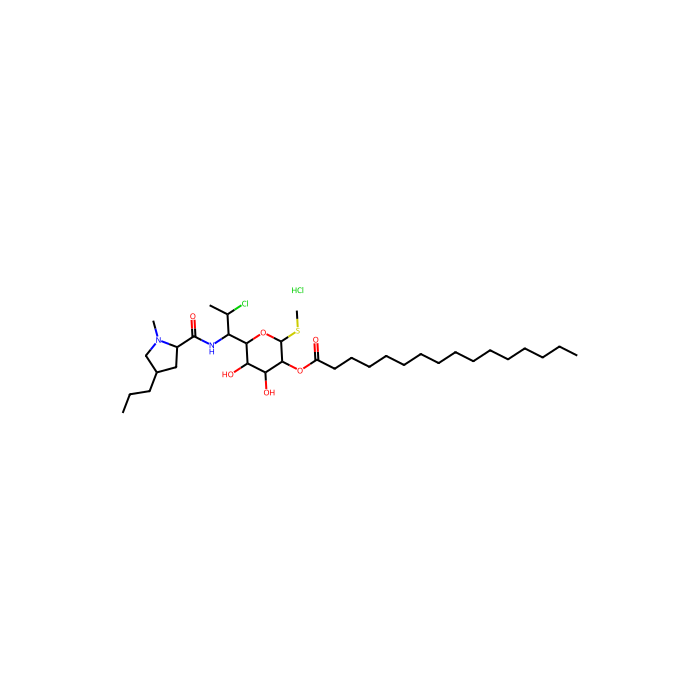
Clindamycin palmitate HCl is a water soluble hydrochloride salt of the ester of clindamycin and palmitic acid and a lincosamide antibiotic.
사양
동의어
CLINDAMYCIN PALMITATE HYDROCHLORIDE [USP-RS] | (2R,3r,4s,5r,6r)-6-((1s,2s)-2-chloro-1-((2s,4r)-1-methyl-4-propylpyrrolidine-2-carboxamido)propyl)-4,5-dihydroxy-2-(methylthio)tetrahydro-2h-pyran-3-yl palmitate | CLINDAMYCIN PALMITATE HYDROCHLORIDE (MART.) | METHYL 7-CHLORO-6,7,8-TRIDEOXY-6-(1-METHYL-TRANS-4-PROPYL-L-2-PYRROLIDINECARBOXAMID Show more
사양 및 순도
≥99%
생화학 및 생리적 메커니즘
Clindamycin palmitate HCl is a water soluble hydrochloride salt of the ester of clindamycin and palmitic acid and a lincosamide antibiotic. Clindamycin palmitate HCl is a bacterial protein synthesis inhibitor by inhibiting ribosomal translocation, in a similar way to macrolides. Clindamycin palmitate HCl does so by binding to the 50S rRNA of the large bacterial ribosome subunit. Clindamycin palmitate HCl inhibits protein synthesis in susceptible bacteria at level of 50S ribosome, thereby inhibiting peptide bond formation and causing cell death.Broad spectrum lincosamide antibiotic agent. Clindamycin derivative. Competitive inhibitor of peptide formation in large 50S ribosomal unit. Orally active.
보관 조건
Store at -20°C
배송
Ice chest + Ice pads
이 제품은 콜드 체인 배송이 필요합니다.지상 및 기타 경제 서비스는 사용할 수 없습니다.
작업 유형
INHIBITOR
작동 메커니즘
Bacterial 70S ribosome inhibitor
참고
Wherever possible, you should prepare and use solutions on the same day. However, if you need to make up stock solutions in advance, we recommend that you store the solution as aliquots in tightly sealed vials at -20°C. Generally, these will be useable for up to one month. Before use, and prior to opening the vial we recommend that you allow your product to equilibrate to room temperature for at least 1 hour. Need more advice on solubility, usage and handling? Please visit our frequently asked questions (FAQ) page for more details.
This compound belongs to the class of organic compounds known as thioglycosides. These are glycoside in which a sugar group is bonded through one carbon to another group via a S-glycosidic bond.
External Descriptors
Not available
1. Djoumbou Feunang Y, Eisner R, Knox C, Chepelev L, Hastings J, Owen G, Fahy E, Steinbeck C, Subramanian S, Bolton E, Greiner R, and Wishart DS. ClassyFire: Automated Chemical Classification With A Comprehensive, Computable Taxonomy. Journal of Cheminformatics, 2016, 8:61.
Products are supplied to verified businesses, institutions, and qualified professionals for research and development use only. Not for use in humans, animals, diagnosis, or therapy.

 D23211674