
Determine the necessary mass, volume, or concentration for preparing a solution.
| Activity Type | Activity Value -log(M) | Mechanism of Action | Activity Reference | Publications (PubMed IDs) |
|---|
Store at -20°C. Store under desiccating conditions. The product can be stored for up to 12 months.
Taxonomy Tree
| Kingdom | Organic compounds |
|---|---|
| Superclass | Organic acids and derivatives |
| 분류 | Carboxylic acids and derivatives |
| Subclass | Amino acids, peptides, and analogues |
| Intermediate Tree Nodes | Peptides |
| Direct Parent | Oligopeptides |
| Alternative Parents | Tyrosine and derivatives Phenylalanine and derivatives N-acyl-alpha amino acids and derivatives Alpha amino acid amides Alanine and derivatives Amphetamines and derivatives N-acylethanolamines 1-hydroxy-2-unsubstituted benzenoids Aralkylamines Fatty amides Tertiary carboxylic acid amides Secondary carboxylic acid amides Primary alcohols Organopnictogen compounds Organic oxides Monoalkylamines Hydrocarbon derivatives Carbonyl compounds |
| Molecular Framework | Aromatic homomonocyclic compounds |
| Substituents | Alpha-oligopeptide - Tyrosine or derivatives - Phenylalanine or derivatives - N-acyl-alpha amino acid or derivatives - Alpha-amino acid amide - Alanine or derivatives - N-substituted-alpha-amino acid - Alpha-amino acid or derivatives - Amphetamine or derivatives - N-acylethanolamine - 1-hydroxy-2-unsubstituted benzenoid - Phenol - Aralkylamine - Fatty acyl - Benzenoid - Monocyclic benzene moiety - Fatty amide - Tertiary carboxylic acid amide - Secondary carboxylic acid amide - Amino acid or derivatives - Carboxamide group - Alkanolamine - Primary amine - Primary aliphatic amine - Organic oxide - Hydrocarbon derivative - Carbonyl group - Organonitrogen compound - Organopnictogen compound - Organooxygen compound - Amine - Organic oxygen compound - Alcohol - Primary alcohol - Organic nitrogen compound - Aromatic homomonocyclic compound |
| 설명 | This compound belongs to the class of organic compounds known as oligopeptides. These are organic compounds containing a sequence of between three and ten alpha-amino acids joined by peptide bonds. |
| External Descriptors | peptide |
| Activity Type | Activity Value -log(M) | Mechanism of Action | Activity Reference | Publications (PubMed IDs) |
|---|
| Activity Type | Activity Value -log(M) | Mechanism of Action | Activity Reference | Publications (PubMed IDs) |
|---|
| Activity Type | Activity Value -log(M) | Mechanism of Action | Activity Reference | Publications (PubMed IDs) |
|---|
| Activity Type | Relation | Activity value | Units | Action Type | Journal | PubMed Id | doi | Assay Aladdin ID |
|---|
| Activity Type | Relation | Activity value | Units | Action Type | Journal | PubMed Id | doi | Assay Aladdin ID |
|---|
| Activity Type | Relation | Activity value | Units | Action Type | Journal | PubMed Id | doi | Assay Aladdin ID |
|---|
| Activity Type | Relation | Activity value | Units | Action Type | Journal | PubMed Id | doi | Assay Aladdin ID |
|---|
| Activity Type | Relation | Activity value | Units | Action Type | Journal | PubMed Id | doi | Assay Aladdin ID |
|---|
| Activity Type | Relation | Activity value | Units | Action Type | Journal | PubMed Id | doi | Assay Aladdin ID |
|---|
| Activity Type | Relation | Activity value | Units | Action Type | Journal | PubMed Id | doi | Assay Aladdin ID |
|---|
| Activity Type | Relation | Activity value | Units | Action Type | Journal | PubMed Id | doi | Assay Aladdin ID |
|---|
| Activity Type | Relation | Activity value | Units | Action Type | Journal | PubMed Id | doi | Assay Aladdin ID |
|---|
| Activity Type | Relation | Activity value | Units | Action Type | Journal | PubMed Id | doi | Assay Aladdin ID |
|---|
| Activity Type | Relation | Activity value | Units | Action Type | Journal | PubMed Id | doi | Assay Aladdin ID |
|---|
| Activity Type | Relation | Activity value | Units | Action Type | Journal | PubMed Id | doi | Assay Aladdin ID |
|---|
| Activity Type | Relation | Activity value | Units | Action Type | Journal | PubMed Id | doi | Assay Aladdin ID |
|---|
| Activity Type | Relation | Activity value | Units | Action Type | Journal | PubMed Id | doi | Assay Aladdin ID |
|---|
| Activity Type | Relation | Activity value | Units | Action Type | Journal | PubMed Id | doi | Assay Aladdin ID |
|---|
| Activity Type | Relation | Activity value | Units | Action Type | Journal | PubMed Id | doi | Assay Aladdin ID |
|---|
| Activity Type | Relation | Activity value | Units | Action Type | Journal | PubMed Id | doi | Assay Aladdin ID |
|---|
| Activity Type | Relation | Activity value | Units | Action Type | Journal | PubMed Id | doi | Assay Aladdin ID |
|---|
| Activity Type | Relation | Activity value | Units | Action Type | Journal | PubMed Id | doi | Assay Aladdin ID |
|---|
| Activity Type | Relation | Activity value | Units | Action Type | Journal | PubMed Id | doi | Assay Aladdin ID |
|---|
| Activity Type | Relation | Activity value | Units | Action Type | Journal | PubMed Id | doi | Assay Aladdin ID |
|---|
| Activity Type | Relation | Activity value | Units | Action Type | Journal | PubMed Id | doi | Assay Aladdin ID |
|---|
| Activity Type | Relation | Activity value | Units | Action Type | Journal | PubMed Id | doi | Assay Aladdin ID |
|---|
| Activity Type | Relation | Activity value | Units | Action Type | Journal | PubMed Id | doi | Assay Aladdin ID |
|---|
| Activity Type | Relation | Activity value | Units | Action Type | Journal | PubMed Id | doi | Assay Aladdin ID |
|---|
| Activity Type | Relation | Activity value | Units | Action Type | Journal | PubMed Id | doi | Assay Aladdin ID |
|---|
| 분자량 | 513.6 |
|---|---|
| XLogP3 | 0.200 |
| Hydrogen Bond Donor Count | 6 |
| Hydrogen Bond Acceptor Count | 7 |
| Rotatable Bond Count | 13 |
| Exact Mass | 513.259 Da |
| Monoisotopic Mass | 513.259 Da |
| Topological Polar Surface Area | 174.000 Ų |
| Heavy Atom Count | 37 |
| Formal Charge | 0 |
| Complexity | 752.000 |
| Isotope Atom Count | 0 |
| Defined Atom Stereocenter Count | 3 |
| Undefined Atom Stereocenter Count | 0 |
| Defined Bond Stereocenter Count | 0 |
| Undefined Bond Stereocenter Count | 0 |
| The total count of all stereochemical bonds | 0 |
| Covalently-Bonded Unit Count | 1 |
P264:Wash hands [and …] thoroughly after handling.
Only application data from Product Data may be listed here.
General suggestion: Establish assay-specific titrations and include solvent controls when implementing this ligand in new experimental systems.
Literature/general knowledge (for research context; not a medical/clinical claim):
Note: Target specificity, tested applications, and potencies for this catalog item are not provided in the Product Data and should be confirmed experimentally under your assay conditions.
DAMGO is not a buffering agent. However, it is routinely prepared and used in buffered media for biochemical and cell-based assays.
Not typically applicable as a buffer: It does not maintain pH and is not used to formulate buffering systems.
Practical preparation in buffers (literature guidance):
Compatibility notes:
Refer to the CoA/Spec Sheet for any item-specific recommendations on solvent choice and concentration limits.
As a bioactive peptide ligand, DAMGO is not a process solvent or commodity reagent where greener substitutions are typically evaluated.
Not typically applicable:
Greener handling considerations (literature guidance):
Comparison concept (ligand selection):
This product is supplied strictly for research use only (as stated in Product Data) and is not indicated for clinical or therapeutic applications.
Not typically applicable:
Research/formulation context (literature guidance):
Any discussion of dosage forms or therapeutic use would be out of scope. For regulated applications, obtain GMP-grade materials and follow applicable quality and regulatory frameworks.
Item-specific physical constants are not provided in the Product Data for this catalog entry.
Item-specific values:
Literature/general properties (for reference; not item specifications):
Notes: Actual solubility and physical constants can vary with counterions, residual moisture, and exact salt/form. Consult the CoA/Spec Sheet for item-specific measurements before preparing stock solutions.
What Moligand™ typically implies (general guidance; not item-specific specifications):
Item-specific notes:
Quality considerations for peptide ligands (general):
Recommendation: Review the batch-specific CoA for purity, identity data (MS/HPLC), residual solvent levels, and salt/counterion information prior to critical assays.
This product is primarily a finished bioactive peptide ligand and is not typically employed as a general synthetic reagent or solvent.
Not typically applicable:
Relevant applications (research use; literature guidance):
Practical notes for use in assays (literature):
For synthetic transformations or named reactions, refer instead to the “Synthetic Utility” section, which discusses SPPS-related considerations for analogous sequences rather than transformations using DAMGO itself.
This product is not intended for use as a reagent in chemical transformations; thus, standard reaction conditions are not applicable.
Not typically applicable:
Contextual notes for related synthesis (literature guidance):
Experimental details should be tailored to the specific synthetic route and validated at small scale before scale-up.
GHS/Classification (item-specific):
General laboratory precautions (peptidic research ligand; literature guidance):
Handling tips:
Incompatibilities/instability (general):
First aid and spill response: For exposure or spills, follow standard laboratory SOPs and consult the SDS for authoritative guidance. Dispose of peptide-containing waste according to institutional and local regulations.
DAMGO is a polar, peptidic ligand best handled in polar protic media or DMSO.
Polarity class and miscibility (literature):
Typical solvent choices and scenarios:
Practical tips:
Alternatives and comparisons (literature):
Item-specific storage and shipping (from Product Data):
Reconstitution (general literature guidance; not item-specific specs):
Handling and storage of solutions (literature guidance):
Additional item-specific details (appearance, exact solubility, counterion): Not specified for this item; refer to CoA/Spec Sheet.
Research Use Note: For research use only.
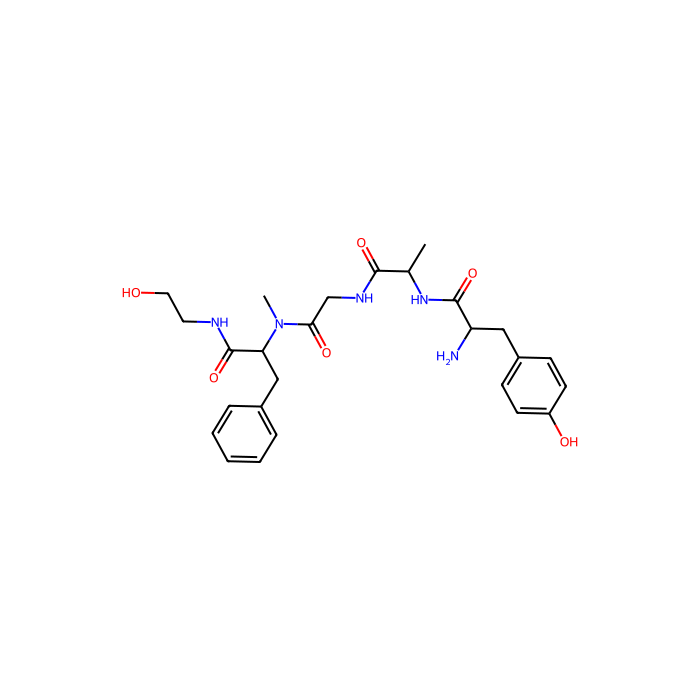
DAMGO is a peptide-based small molecule ligand derived from the enkephalin scaffold, commonly denoted as Tyr-D-Ala-Gly-N-MePhe-Gly-ol.
Item-specific identifiers (Product Data):
Literature/structural description (for reference; not item-specific specs):
2D structure in words: A pentapeptidomimetic chain starting with a phenolic aromatic ring (tyrosine) linked via peptide bonds to D-alanine and glycine, followed by an N-methylated phenylalanine residue, and terminating in glycine whose carboxyl has been reduced to a primary alcohol (–CH2OH). The backbone comprises standard amide linkages, except at the C-terminus where an alcohol replaces the carboxylate.
As supplied, DAMGO is a completed peptide ligand rather than a general-purpose synthetic intermediate. Nevertheless, its structure informs peptide and peptidomimetic synthesis strategies (literature guidance):
For researchers designing analogs, DAMGO serves as a reference template highlighting the impact of backbone N-methylation and C-terminal reduction on receptor engagement.
Only information from Product Data may be listed here.
Note: Although literature discusses DAMGO’s activity in opioid receptor systems, no item-specific target data are provided in this catalog entry.
당사의 등급 선택 가이드는 카탈로그의 모든 변형 제품에 대해 순도, 안정제 상태 및 용도 적합성을 다룹니다.
Moligand™ 등급 가이드 보기 →