
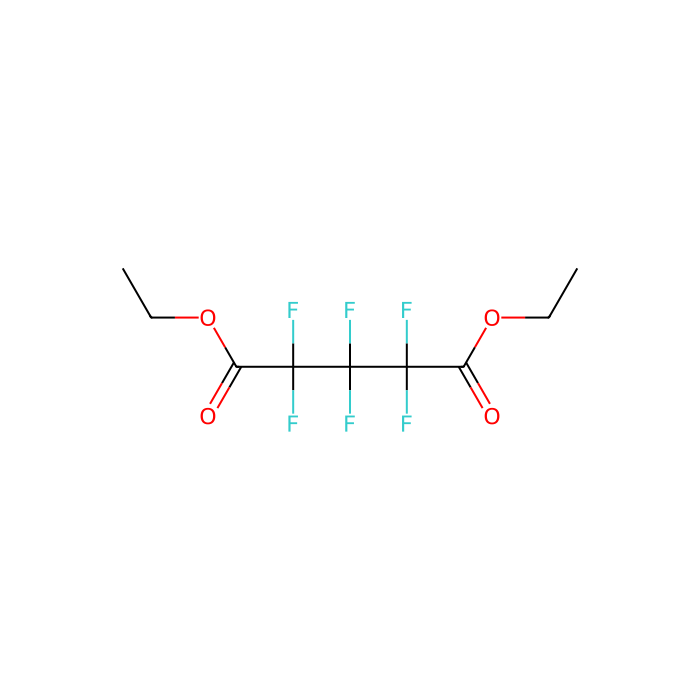
Determine the necessary mass, volume, or concentration for preparing a solution.
Diethyl 2,2,3,3,4,4-Hexafluoropentanedioate - ≥98%(GC) , CAS No.424-40-8
주문 가능
등급 & 순도 ≥98%(GC)
Storage
Room temperature
Shipped In
Normal
Taxonomy Tree
| Kingdom | Organic compounds |
|---|---|
| Superclass | Lipids and lipid-like molecules |
| 분류 | Fatty Acyls |
| Subclass | Fatty acid esters |
| Intermediate Tree Nodes | Not available |
| Direct Parent | Fatty acid esters |
| Alternative Parents | Dicarboxylic acids and derivatives Alpha-halocarboxylic acid derivatives Carboxylic acid esters Organofluorides Organic oxides Hydrocarbon derivatives Carbonyl compounds Alkyl fluorides |
| Molecular Framework | Aliphatic acyclic compounds |
| Substituents | Fatty acid ester - Dicarboxylic acid or derivatives - Alpha-halocarboxylic acid derivative - Alpha-halocarboxylic acid or derivatives - Carboxylic acid ester - Carboxylic acid derivative - Organofluoride - Organohalogen compound - Organic oxide - Organic oxygen compound - Carbonyl group - Alkyl fluoride - Alkyl halide - Organooxygen compound - Hydrocarbon derivative - Aliphatic acyclic compound |
| 설명 | This compound belongs to the class of organic compounds known as fatty acid esters. These are carboxylic ester derivatives of a fatty acid. |
| External Descriptors | Not available |
Find and download the COA for your product by matching the lot number on the packaging.
| Lot Number | Certificate Type | 날짜 | 항목 |
|---|---|---|---|
 H2412552 | Certificate of Analysis | Mar 23, 2024 | D154392 |
| H2412553 | Certificate of Analysis | Mar 23, 2024 | D154392 |
| H2412554 | Certificate of Analysis | Mar 23, 2024 | D154392 |
| G2307782 | Certificate of Analysis | Jun 15, 2023 | D154392 |
| G2307783 | Certificate of Analysis | Jun 15, 2023 | D154392 |
| G2307784 | Certificate of Analysis | Jun 15, 2023 | D154392 |
| G2307785 | Certificate of Analysis | Jun 15, 2023 | D154392 |
| 굴절률 | 1.36 |
|---|---|
| 발화점(°C) | 87°C(lit.) |
| 끓는점(°C) | 84°C/8mmHg(lit.) |
| 분자량 | 296.16 |
| XLogP3 | 2.600 |
| Hydrogen Bond Donor Count | 0 |
| Hydrogen Bond Acceptor Count | 10 |
| Rotatable Bond Count | 8 |
| Exact Mass | 296.048 Da |
| Monoisotopic Mass | 296.048 Da |
| Topological Polar Surface Area | 52.600 Ų |
| Heavy Atom Count | 19 |
| Formal Charge | 0 |
| Complexity | 323.000 |
| Isotope Atom Count | 0 |
| Defined Atom Stereocenter Count | 0 |
| Undefined Atom Stereocenter Count | 0 |
| Defined Bond Stereocenter Count | 0 |
| Undefined Bond Stereocenter Count | 0 |
| The total count of all stereochemical bonds | 0 |
| Covalently-Bonded Unit Count | 1 |
H302:Harmful if swallowed
H312:Harmful in contact with skin
H314:Causes severe skin burns and eye damage
H315:Causes skin irritation
H319:Causes serious eye irritation
H330:Fatal if inhaled
H332:Harmful if inhaled
H335:May cause respiratory irritation
P260:Do not breathe dust/fume/gas/mist/vapors/spray.
P261:Avoid breathing dust/fume/gas/mist/vapors/spray.
P264:Wash hands [and …] thoroughly after handling.
P270:Do not eat, drink or smoke when using this product.
P271:Use only outdoors or in a well-ventilated area.
P280:Wear protective gloves/protective clothing/eye protection/face protection.
P284:[In case of inadequate ventilation] Wear respiratory protection.
P320:Specific treatment is urgent (see ... on this label).
P321:Specific treatment (see ... on this label).
P330:Rinse mouth.
P363:Wash contaminated clothing before reuse.
P301+P330+P331:IF SWALLOWED: Rinse mouth. Do NOT induce vomiting.
P302+P352:IF ON SKIN: wash with plenty of water.
P304+P340:IF INHALED: Remove person to fresh air and keep comfortable for breathing.
P305+P351+P338:IF IN EYES: Rinse cautiously with water for several minutes. Remove contact lenses if present and easy to do - continue rinsing.
P362+P364:Take off contaminated clothing and wash it before reuse.
P405:Store locked up.
P403+P233:Store in a well-ventilated place. Keep container tightly closed.
P501:Dispose of contents/container to an approved waste disposal plant.
P264+P265:Wash hands [and …] thoroughly after handling. Do not touch eyes.
P301+P317:IF SWALLOWED: Get medical help.
P305+P354+P338:IF IN EYES: Immediately rinse with water for several minutes. Remove contact lenses if present and easy to do. Continue rinsing.
P317:Get emergency medical help.
P337+P317:If eye irritation persists: Get medical help.
P332+P317:If skin irritation occurs: Get medical help.
P302+P361+P354:IF ON SKIN: Take off Immediately all contaminated clothing. Immediately rinse with water for several minutes.
P316:Get emergency medical help immediately.
P319:Get medical help if you feel unwell.
No antibody/assay application protocols (WB, IHC, IF, FC) are applicable to this small-molecule reagent. For synthetic transformations, refer to the Reaction Conditions and Synthetic Utility sections for general literature guidance and develop process-specific SOPs as needed.
This product is a synthetic fluorinated diester intended for laboratory research and materials synthesis. It does not have recognized endogenous biological roles.
Research Use Note: For research use only (product data).
Not typically applicable. Diethyl 2,2,3,3,4,4-hexafluoropentanedioate is a neutral, hydrophobic diester and is not used as a buffering agent or pH control component.
This item is a fluorinated diester building block. While indispensable in certain materials applications, organofluorine content poses persistence and environmental concerns. Consider the following strategies when feasible (literature/general):
Comparison (general):
Practical note: If fluorinated performance is required, emphasize solvent recycling, rigorous containment, and waste minimization to mitigate environmental footprint.
No pharmacopeial status or excipient role is specified for this product; it is sold for research use only (product data).
Literature/computed context (for planning only; not item specifications):
Notes for use:
As a perfluoroalkyl-substituted aliphatic diester, Diethyl 2,2,3,3,4,4-hexafluoropentanedioate serves as a versatile fluorinated building block for materials and fluorinated intermediates.
Note: The strong –I effect of CF2 groups reduces α-CH acidity issues (none present) and generally suppresses side reactions that rely on enolization.
General literature guidance for common transformations of dialkyl diesters; verify compatibility with fluorinated substrates and optimize per application:
Notes: The –CF2–CF2–CF2– segment is generally inert under these conditions but avoid strongly reducing/defluorinating environments (e.g., active metals at high T). Always confirm by small-scale trials.
This product is a fluorinated diester reagent, not typically used as a reaction solvent. Solvent selection pertains to its use in transformations (hydrolysis, transesterification, amidation, reduction):
A fluorinated aliphatic diester featuring three geminal difluoromethylene units in a five-carbon backbone, esterified as the diethyl ester at both termini.
Functional group set and reactivity make this compound a concise entry to a family of fluorinated intermediates:
Because α-CH sites are absent between the CF2 centers and the carbonyls, enolate chemistry is not operative, simplifying reaction planning compared with non-fluorinated malonate/glutarate analogues.
Not applicable. This product is a small-molecule fluorinated diester and does not have biological target specificity (no antigen, epitope, clone, or isotype). No item-specific targeting information is provided.