Determine the necessary mass, volume, or concentration for preparing a solution.
Dilution Calculator
Determine the dilution needed to prepare a stock solution.
Reconstitution Calculator
리뷰
고객 리뷰
Application Protocols
No manufacturer-validated biological assay protocols (e.g., WB, IHC, IF, FC) are associated with this small-molecule reagent.
General lab-use examples (literature/guidance):
Preparation of a 100 mM aqueous stock: weigh appropriate mass quickly (hygroscopic caution), dissolve in ultrapure water, optional pH adjustment, sterile-filter (0.22 µm) if required for your workflow, aliquot, and store at −80 °C.
Synthesis of an acylcarnitine standard: dissolve DL-carnitine HCl in dry DMF, add DIPEA, then slowly add the acyl chloride at 0 °C; stir to completion by TLC/LC–MS, quench with aqueous buffer, and purify by RP-HPLC.
For any specific analytical or synthetic procedure, consult the primary literature and adapt to your equipment and scale.
Biological Roles
Background (literature; biochemistry context only, not a product claim):
Carnitine is a carrier of long-chain acyl groups in mitochondrial fatty acid metabolism, enabling translocation across the inner mitochondrial membrane via the carnitine shuttle (CPT1/CPT2/CACT system). The quaternary ammonium confers a fixed positive charge facilitating transporter recognition.
The primary alcohol forms acylcarnitine esters with acyl-CoA thioesters, a reversible transformation catalyzed by carnitine acyltransferases. Acylcarnitine profiles are widely used as biochemical readouts in metabolic research.
DL-carnitine comprises both enantiomers; biological machineries are stereoselective and typically recognize the L-enantiomer. The racemate is therefore often used in analytical or non-enzymatic contexts where chirality is not probed.
Experimental notes for research use:
For enzyme assays or transport studies, select the L-enantiomer unless racemates are specifically required as controls.
In LC–MS metabolomics, carnitine’s fixed charge enhances sensitivity in positive ESI, aiding detection and quantitation of derivatized analytes.
Important: All uses are for research/laboratory purposes only. No medical, diagnostic, or clinical applications are implied.
Buffer Applications
DL-carnitine HCl is not a classical buffering agent. It lacks a conjugate acid–base pair with a pKa in the physiological window suitable for maintaining pH.
Typical role: may contribute to ionic strength and osmolarity in aqueous systems; solutions will be mildly acidic due to HCl content (literature/general).
If pH control is needed, use established buffers (e.g., phosphate, HEPES, MOPS) and add carnitine HCl as a co-solute if desired.
Compatibility: generally compatible with common biological buffers; confirm that chloride is acceptable for your application (e.g., avoid where chloride-sensitive electrodes or corrosion-prone components are present).
Practical guidance:
Dissolve to the target molarity in water, then adjust pH with a base (e.g., NaOH) only if your protocol requires a specific pH; note that neutralization converts some HCl to chloride salt of sodium/potassium.
Filter-sterilize aqueous solutions (0.22 µm) for cell-free biochemical assays, if appropriate for the workflow.
Green Alternatives
While DL-carnitine HCl itself is not a volatile organic solvent, choices around its use can impact process greenness (solvent selection, auxiliary reagents, and counterions).
Greener considerations (literature/guidance):
Solvents: prefer water or water/alcohol mixtures for dissolution and purification. Avoid chlorinated solvents; use DMSO/EtOH where practicable for derivatizations.
Counterion/cosalt choices: if chloride is undesirable (corrosion, detection interference), consider ion exchange to benign anions (e.g., acetate) under aqueous conditions.
DES/NADES: carnitine-based eutectic mixtures with benign HBDs (e.g., glycerol, sorbitol) can replace conventional solvents in specific transformations or extraction tasks.
Comparison (literature; qualitative):
Carnitine HCl vs. choline chloride (DES HBA)
Renewability/biogenic origin: both favorable
Toxicity profile: both generally low; verify SDS and exposure limits
Function: carnitine offers reactive OH/COOH handles; choline is often a more economical, widely validated DES component
Trade-offs:
Water-rich media can slow esterifications; enzymatic catalysis or coupling agents may be required.
Ion exchange to alternative anions adds process steps but can improve compatibility with green processes (e.g., acetate buffers).
Actionable tips:
Use catalytic loadings of carbodiimides with in situ urea removal and aqueous workups.
Favor atom-economical acylations (anhydrides over acid chlorides) and recycle polar aprotic solvents through solvent recovery systems.
Pharmaceutical Uses
Formulation/manufacturing context (literature; no therapeutic claims):
Carnitine salts, including the HCl form, have been used as functional excipients or co-formers in research formulations to adjust osmolarity, ionic strength, or to form salt pairs/co-crystals with APIs bearing complementary functionality.
The fixed positive charge can influence ion-pairing in solution, potentially modulating solubility of certain anionic actives in analytical development settings.
Compendial status: Monographs for L-carnitine and L-carnitine hydrochloride exist in major pharmacopeias (e.g., USP/EP) (literature). Racemic DL forms may not share all monograph specifications; consult the relevant pharmacopoeia.
Development considerations:
Chloride content should be considered for corrosion-sensitive equipment and compatibility with analytical methods.
Water content and hygroscopicity affect handling in dry blend operations; closed transfer and low-humidity rooms are recommended.
For chiral APIs or processes, the DL nature is important—avoid unintended chiral interactions; choose enantiopure grades where stereochemical effects are relevant.
Note: For any GMP or clinical manufacturing use, specific grade qualifications, pharmacopeial compliance, and supplier quality documentation are required. This product is noted as “For research use only.”
Appearance: Not specified for this item; refer to CoA/Spec Sheet.
Grade/Purity: Not specified for this item; refer to CoA/Spec Sheet.
Literature/general values for DL-carnitine HCl (for planning, not item specifications):
Physical state: typically a crystalline, hygroscopic solid (literature)
Melting behavior: often reported near 190–200 °C with decomposition (literature; values vary by form and water content)
Solubility: highly soluble in water; solutions are typically acidic due to HCl. Sparingly soluble to moderately soluble in lower alcohols; essentially insoluble in nonpolar solvents (literature)
pKa: the quaternary ammonium is permanently charged; the carboxyl group behaves as a typical carboxylic acid when protonated in the HCl salt (literature qualitative note)
Partitioning: strongly hydrophilic; very low logP expected (literature qualitative)
Hygroscopicity: quaternary ammonium salts of this type can take up moisture; handle rapidly in ambient air (literature)
Computed/estimation notes:
Refractive index, density: not applicable/reported for solids; depends on crystal form and hydration (literature)
Practical implications:
Prepare aqueous stock solutions freshly or store frozen to limit hydrolysis/bioburden.
For organic-phase operations (e.g., esterification), use polar protic/DMF/DMSO or perform as a salt metathesis to the inner salt/free base form to enhance solubility.
Quality and Grades
Grade/Purity: Not specified for this item; refer to CoA/Spec Sheet for assay, residual solvents, loss on drying, and related-substance limits.
Context and implications (general):
DL designation indicates a racemic mixture (50:50 D and L). For applications sensitive to stereochemistry (e.g., enzymatic assays, chiroselective synthesis), verify whether the DL form is appropriate. If you require a single enantiomer (L- or D-), select an enantiopure alternative and verify enantiomeric excess by polarimetry or chiral HPLC.
Typical analytical controls for salts of this class may include: identity (1H/13C NMR, IR), chloride assay, water content (Karl Fischer), residual solvents, and heavy metal/elemental impurities. Specific limits are item-dependent and must be taken from the CoA.
Stabilizers: Not specified for this item; refer to CoA/Spec Sheet. In general, carnitine salts are offered neat without stabilizers.
UV background: If using in LC–UV quantitation, check the CoA/SDS or measure a blank; quaternary ammonium hydroxy acids typically have minimal absorbance above 210–220 nm.
Practical selection notes:
For quantitative analytical work (e.g., LC–MS calibration of acylcarnitines), prioritize lots with low inorganic residue and tight assay values. For synthetic derivatizations, clarity of water content and chloride content can influence coupling efficiency and stoichiometry.
Reaction and Applications
This racemic hydrochloride salt is commonly used as an ionic, bifunctional building block and as a reference material in analytical workflows.
Synthetic/derivatization uses (literature):
Formation of acylcarnitines via esterification of the primary alcohol with acyl chlorides/anhydrides or via carbodiimide-mediated coupling (e.g., DCC/EDC + DMAP). Useful for preparing standards and probing acyl-transfer chemistry.
Conversion between HCl salt and inner salt/free base by ion exchange or basification, enabling altered solubility or reactivity profiles in nonaqueous media.
Preparation of ionic liquids/deep eutectic solvents (DES/NADES) in combination with HBD partners (e.g., urea, glycerol), leveraging the quaternary ammonium motif.
Use as a fixed-charge tag in mass spectrometry method development (positive-mode ionization), enhancing detectability of derivatized species.
Analytical/processing applications (literature):
As a matrix additive or ion-pairing auxiliary in LC–MS method development for carboxylates and acyl species.
As a calibrant or internal standard scaffold in workflows quantifying acylcarnitines (racemic where chirality is not interrogated).
Practical tips:
Minimize water for carbodiimide-mediated couplings; employ buffered conditions if maintaining HCl salt.
For esterifications with acid-sensitive substrates, pre-form the inner salt to reduce acid catalysis.
The quaternary ammonium ensures strong cationic behavior; consider counterion exchange (e.g., to PF6−/BF4−) if chloride is incompatible with your system.
Reaction Conditions
General literature guidance for typical transformations of DL-carnitine HCl (not item specifications):
Acylation of the primary alcohol (to acylcarnitines):
Solvent: dry DMF, DMSO, or mixed MeCN/DMF; water minimized
Reagents: acyl chloride or anhydride; or EDC/DMAP with the corresponding carboxylic acid
Base: pyridine, Et3N, or proton scavenger (when starting from HCl salt)
Temperature: 0–25 °C; reactions often proceed within 1–6 h depending on acyl donor
Workup: quench with aqueous buffer; purify by ion-exchange or reversed-phase chromatography
Amide coupling at the carboxyl (after converting to inner salt/neutral form):
Solvent: DMF or DMSO; optional aqueous co-solvent
Coupling systems: EDC/HOBt, HATU/DIPEA; 0–25 °C, 2–16 h
Counterion exchange (chloride to acetate, etc.):
Method: pass aqueous solution through a suitable anion-exchange resin (Cl−→ desired anion) or neutralize with the corresponding base/acid
Monitor conductivity/pH; confirm by ion chromatography or 35Cl NMR when appropriate
DES/NADES formation:
Mix carnitine salt with HBD (e.g., glycerol, urea) at 60–90 °C under reduced pressure as needed until a homogeneous phase forms; water content governs viscosity and Tm
Note: Reaction times/yields are substrate-dependent. Validate conditions on small scale; chloride and water content can influence kinetics and catalyst choice.
Safety and Handling
GHS classification and hazard statements: Not specified for this item; refer to SDS for definitive information.
General laboratory safety (literature/good practice):
Expected to be of low acute hazard, but the HCl salt renders solutions acidic; avoid contact with eyes/skin. Use lab coat, gloves, and safety glasses.
Avoid inhalation of dust and ingestion. Handle powders in a fume hood or ventilated enclosure to minimize dust.
First aid (overview; defer to SDS):
Skin/eye contact: Rinse with water for several minutes; remove contaminated clothing; seek medical attention if irritation persists.
Inhalation: Move to fresh air; seek medical attention if symptoms occur.
Ingestion: Rinse mouth; do not induce vomiting; seek medical advice.
Incompatibilities (general): Strong oxidizers; strong bases will neutralize the HCl and may promote salt exchange. Avoid contact with reactive acylating agents unless intentionally performing derivatization.
Thermal decomposition: Organic salts may char/decompose on strong heating; avoid dust formation near ignition sources.
Hygiene measures: Wash hands after handling; avoid cross-contamination of hygroscopic solids.
Storage and transport conditions (item-specific):
Storage: Store at −80 °C (per Product Data). Keep container tightly closed, desiccated, and protected from light if possible.
Shipping: Shipped on dry ice packs + cold packs (per Product Data). Always allow controlled thawing in a dry environment to prevent condensation.
Solvent Selection
DL-Carnitine HCl is a highly polar, ionic organic salt. Solvent choice should reflect its charge and hydrogen-bonding capacity.
Polarity class: strongly polar/ionic; behaves like a quaternary ammonium carboxylic acid salt (literature)
Primary solvents:
Water: excellent solubility; typical choice for stock solutions and biochemical derivatization (literature)
Aqueous buffers: compatible across a wide pH range; note protonation equilibria and chloride content
Polar organics: DMSO and formamide often dissolve well; DMF may be moderate; lower alcohols (MeOH, EtOH) are variably effective depending on water content (literature)
Poor solvents: ethers, acetone, acetonitrile, chlorinated and hydrocarbon solvents generally dissolve little to none of the HCl salt unless water is present (literature)
When to choose what:
Aqueous workflows (ion-pair LC, enzymatic derivatizations): water or water/alcohol mixtures.
Esterification or acylation chemistry: employ DMSO/DMF or generate the inner salt/free base, then proceed in mixed polar media; alternatively, use biphasic systems with a coupling agent and phase-transfer catalyst.
Quick comparison (literature):
vs. inner salt (zwitterion): HCl salt offers better handling in water (clear acidity, defined counterion) but may be less soluble in neat alcohols.
vs. choline chloride: both are ionic; choline chloride is often preferred for DES formation; carnitine HCl offers a hydroxy–carboxy motif valuable for site-specific derivatization.
Storage and Reconstitution
Item-specific conditions (from Product Data):
Storage: Store at −80 °C.
Shipping: Dry ice packs + cold packs.
General handling/reconstitution (literature/guidance):
Hygroscopic caution: allow container to equilibrate to room temperature in a desiccator before opening to prevent condensation.
Reconstitution: dissolve in ultrapure water to desired concentration (e.g., 10–500 mM), optionally adjust pH with base if required for your protocol, and filter-sterilize (0.22 µm) if asepsis is needed.
Aliquoting: dispense into single-use aliquots to minimize freeze–thaw. Label with concentration, pH, and date.
Storage of solutions: for maximal stability, store at −80 °C; short-term (hours to a few days) at 2–8 °C may be acceptable depending on application. Avoid repeated freeze–thaw cycles.
Solid stability: keep tightly capped under dry, inert atmosphere if feasible; return promptly to −80 °C after use.
Note: This product is designated For research use only. For definitive stability limits, water content, and assay, consult the product’s CoA/Spec Sheet and SDS.
Structure and Identity
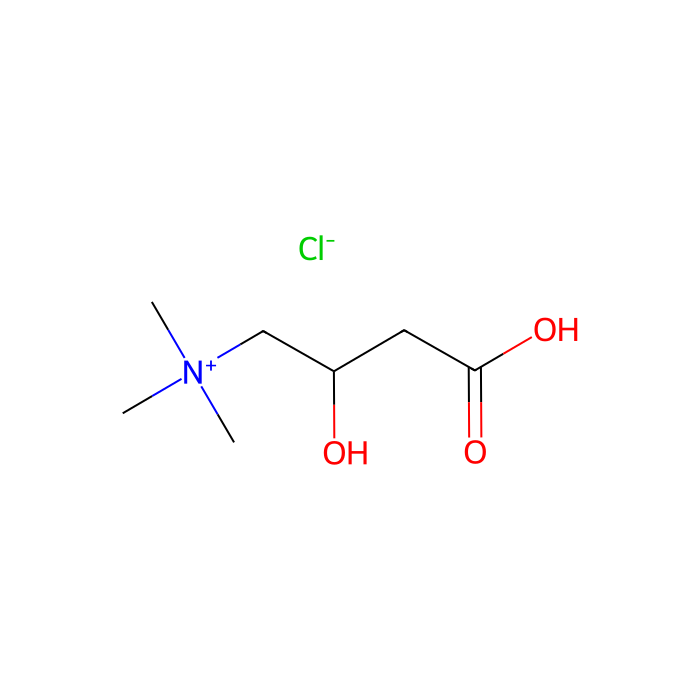
DL-Carnitine HCl is the racemic hydrochloride salt of carnitine, a trimethylammonium-bearing hydroxy acid. The HCl converts the inner salt to an external chloride salt.
Molecular formula: Not specified for this item; refer to CoA/Spec Sheet. (Literature for DL-carnitine HCl: C7H17NO3·Cl)
Molecular weight: Not specified for this item; refer to CoA/Spec Sheet. (Literature for DL-carnitine HCl: ~197.67 g/mol)
SMILES: Not specified for this item; refer to CoA/Spec Sheet. (Typical, literature: CN+(C)CC(C(=O)O)O.[Cl-])
InChIKey: Not specified for this item; refer to CoA/Spec Sheet.
Structural features (general, literature):
Contains a permanently charged quaternary ammonium center (N+(CH3)3), a primary alcohol (–CH2–OH), and a carboxylic acid (as HCl salt; inner salt in free base form).
The molecule is achiral as a racemate (DL); centers of stereochemistry are present in the L or D enantiomers but this product is a 1:1 mixture.
2D description: a four-carbon chain bearing at C-1 a carboxyl group, at C-3 a hydroxyl group, and at the terminal C-4 a trimethylammonium substituent; chloride serves as the counterion.
Synthetic Utility
Functional group set and opportunities (literature):
Quaternary ammonium (fixed charge): enables ion-pairing catalysis contexts and serves as an anchoring handle for phase-transfer-like behavior when derivatized.
Primary alcohol: amenable to acylation (Ac2O, acyl chlorides), carbonate formation, selective oxidation to aldehyde/acid derivatives under mild conditions.
Carboxylic acid (as HCl salt): after converting to the inner salt or neutralization, can undergo amide coupling (EDC/HOBt, HATU) to give amide-linked derivatives.
Applications:
Synthesis of acylcarnitines and tailor-made esters as standards for MS-based lipidomics.
Creation of ionic tags for analytes, improving ionization and detection in ESI-MS.
Building DES/NADES systems to act as alternative media or catalysts; carnitine’s dual H-bond donor/acceptor sites can influence microenvironments.
Retrosynthetic value:
Carnitine skeleton allows introduction of diverse acyl groups at the hydroxyl while maintaining a permanent positive charge—useful for tracking or immobilization.
The carboxyl group can serve as a conjugation point to polymers or surfaces (e.g., via carbodiimide chemistry), yielding zwitterionic coatings after deprotection/neutralization.
Handling tips:
For nonaqueous couplings, perform azeotropic drying of reagents and consider in situ base scavengers; chloride may inhibit certain catalysts—counterion exchange can help.
Target Specificity
This product is a small-molecule reagent, not a biological targeting reagent or antibody. No target specificity data (antigen/epitope/clone/isotype) applies.
Target specificity: Not applicable to this compound type.
Any selectivity in use arises from chemical reactivity (e.g., acylation selectivity at the primary alcohol) rather than biological binding.
We use cookies to ensure the website functions properly and, where permitted, to improve your experience. You can manage your preferences at any time in Settings. Learn more in our Cookie Policy.
Shall we send you a message when we have discounts available?
Remind me later
Thank you! Please check your email inbox to confirm.
Products are supplied to verified businesses, institutions, and qualified professionals for research and development use only. Not for use in humans, animals, diagnosis, or therapy.