This compound belongs to the class of organic compounds known as carboxylic acid hydrazides. These are carboxylic acid derivatives containing a carbonyl group in which the carbon is directly linked to a hydrazide group (N-N).
External Descriptors
Not available
1. Djoumbou Feunang Y, Eisner R, Knox C, Chepelev L, Hastings J, Owen G, Fahy E, Steinbeck C, Subramanian S, Bolton E, Greiner R, and Wishart DS. ClassyFire: Automated Chemical Classification With A Comprehensive, Computable Taxonomy. Journal of Cheminformatics, 2016, 8:61.
React with dodecanedioic dihydrazide in 100 mM acetate buffer, pH 5.0, optionally 10–50 mM aniline, 1–4 h at RT.
Optionally reduce with picoline borane (10–50 mM) for 1–2 h.
Purify by dialysis/SEC.
Waterborne crosslinking of carboxylated latex
Adjust latex pH to ~8; add DDH as aqueous dispersion or DMF solution with vigorous mixing.
Cast film; cure at ambient to 60 °C as required; evaluate MEK double rubs and block resistance.
These are literature-style examples only; optimize conditions to your system. For analytical or bioassay-specific protocols (WB/IHC/IF/FC), none are applicable to this small-molecule reagent.
Biological Roles
This compound is a synthetic aliphatic diacylhydrazide and does not have known endogenous biological roles.
Bioconjugation handle: Terminal hydrazides react with aldehyde groups on oxidized carbohydrates (e.g., periodate-oxidized glycans on glycoproteins or polysaccharides) to form hydrazone linkages; subsequent reduction (NaCNBH3 or picoline borane) yields stable secondary amines.
Surface/biomaterial modification: Useful for coupling to aldehyde-functional hydrogels, polysaccharides (dextran, hyaluronan after mild oxidation), and particles, enabling crosslinking under mild, aqueous conditions.
Selectivity: Hydrazides preferentially target aldehydes over ketones at physiological pH; rate and selectivity improve at mildly acidic pH (4.5–5.5) where iminium/hydrazonium intermediates are stabilized.
All uses are for laboratory research only. No claims are made regarding biological activity, therapeutic utility, or clinical performance.
Buffer Applications
Dodecanedioic dihydrazide is not a buffering agent. However, buffer choice is critical when using it for carbonyl-capture/bioconjugation reactions.
Practical buffers for hydrazone formation (literature/general)
Acetate buffer (50–200 mM, pH 4.5–5.5): Common choice to accelerate hydrazone formation with minimal protein denaturation.
Citrate buffer (20–100 mM, pH 4.5–5.5): Alternative with good metal-chelating capacity; can modulate reaction rates.
MES buffer (50 mM, pH 5.5–6.5): For systems requiring slightly higher pH; slower kinetics.
Additives and conditions
Aniline (10–100 mM) or m-phenylenediamine as nucleophilic catalysts can significantly accelerate hydrazone formation in aqueous media.
Reductive stabilization: After coupling, treat with a mild reductant (e.g., picoline borane, NaCNBH3) to convert the C=N to a stable secondary amine.
Recipe hints (example; adjust as needed)
100 mM sodium acetate, pH 5.0; dissolve dihydrazide with 5–10% DMF if needed; typical reagent concentration 1–50 mM depending on substrate density.
These are general literature guidelines; optimize for your biomolecule and confirm compatibility.
Green Alternatives
Context
Dodecanedioic dihydrazide (DDH) is a non-isocyanate, low-VOC-capable crosslinker for waterborne systems. Selection of greener options depends on balancing performance, toxicity, and processing.
Greener or alternative choices (literature/general)
Adipic dihydrazide (ADH): Shorter chain (C6) analogue; higher water compatibility, widely used in aqueous inks/coatings; can offer faster cure due to greater polarity.
Sebacic dihydrazide (SDH, C10): Intermediate flexibility and hydrophobicity vs ADH and DDH; often improved film properties in WB coatings.
Multifunctional amines (e.g., polyamines): Renewable bio-based options exist but can raise VOC/odor and handling hazards.
Aldehyde-free crosslinking chemistries: Carbodiimides or aziridines (note: aziridines have significant toxicity concerns; not necessarily greener).
Comparison highlights (general; qualitative)
Chain length: Longer chains (DDH) increase flexibility and hydrophobicity, potentially improving water resistance but reducing aqueous solubility relative to ADH.
Safety: Hydrazides avoid isocyanate monomer hazards; nevertheless, standard PPE and exposure controls are required.
Process: Hydrazide crosslinking can proceed in water at ambient conditions, reducing energy use compared to thermal cure routes.
Practical guidance
For maximum “green” profile in waterborne systems, consider ADH or SDH when sufficient flexibility and cure speed are achieved; use DDH when enhanced hydrophobicity and film integrity are needed without resorting to isocyanates.
Pharmaceutical Uses
No pharmacopeial or excipient grade is specified for this item. Do not use in humans or animals; for research use only.
Formulation R&D context (literature/general)
Crosslinker for aldehyde- or carboxyl-activated polymers in hydrogel and coating prototyping (e.g., aldehyde-functional polysaccharides). Enables ambient, aqueous processing without isocyanates.
Derivatization intermediate: Acyl hydrazides can serve as masked acyl groups in synthetic routes to ureas/urethanes after activation.
Regulatory notes
Not described here as USP/EP grade. If excipient use is contemplated in early R&D, users must qualify material, establish impurity and bioburden limits, and secure appropriate GMP-grade supply.
For any preclinical/clinical development, obtain compendial or GMP-compliant material and perform full risk assessment; this catalog item is intended solely for laboratory research.
Physical Properties
Item-specific specifications
Appearance: Not specified for this item; refer to CoA/Spec Sheet.
Grade/Purity: Not specified for this item; refer to CoA/Spec Sheet.
Literature/general properties (for contextual planning; not item specifications)
Physical state: typically a white to off-white crystalline solid (literature, diacylhydrazides).
Acid/base character: weakly basic due to terminal hydrazide nitrogens; amide nitrogens are markedly less basic (general hydrazide chemistry).
Solubility profile: often sparingly soluble in water; increased solubility in polar aprotic solvents (DMF, DMSO) and in aqueous acidic media where hydrazide nitrogens can be protonated (literature, analogous aliphatic dihydrazides). Actual solubility for this item: Not specified; verify experimentally.
Hygroscopicity: hydrazides can absorb moisture to some extent; keep tightly closed under inert gas as provided (general guidance).
Note: Do not treat literature values as specifications for this catalog item. For exact data (mp, elemental analysis, water/peroxide/metal limits, UV cutoff, refractive index), consult the CoA/Spec Sheet for this specific lot.
Quality and Grades
Item-specific quality
Grade/Purity: Not specified for this item; refer to CoA/Spec Sheet.
Stabilizers/Inhibitors: None indicated in Product Data; if present, will be listed on the CoA/SDS.
What grade means in practice (general guidance)
Research grade hydrazides are typically suitable for synthesis, crosslinking, and polymer R&D. If HPLC/LCMS or bioconjugation is intended, users may require low inorganic residue, controlled water content, and low UV background. These attributes, if applicable, will be explicitly stated on the CoA.
Recommended quality checks before critical use
Identity confirmation: 1H/13C NMR (DMSO-d6 or DMF-d7), HRMS, IR (amide C=O ~1650–1680 cm−1; N–H stretches), and melting behavior.
Purity assessment: HPLC/UPLC in polar aprotic eluents; elemental analysis or Karl Fischer if water sensitivity matters.
Residual solvents/metals: Not specified for this item; refer to CoA/Spec Sheet. If needed, perform ICP-MS or GC headspace.
Batch documentation
For every lot, consult the CoA for: assay, identified impurities (if any), moisture content, and recommended re-test date. Where bioconjugation or polymer performance is critical, request tighter specs or application-specific CoAs if available.
Reaction and Applications
Carbonyl capture and conjugation (literature/general)
Hydrazone/azine formation with aldehydes and ketones: terminal –NHNH2 groups react with carbonyls to give hydrazones; with dialdehydes can yield crosslinked networks. Useful for bioconjugation to oxidized glycans, polysaccharides, and surface aldehydes. Rate enhanced at pH 4.5–5.5; aniline catalysts can accelerate.
Polymer and coatings technology
Waterborne crosslinker: Dihydrazides (including dodecanedioic dihydrazide) are widely used to crosslink carboxyl- or aldehyde-functional latexes, acrylics, and polysaccharides, improving block resistance and solvent/chemical durability.
Epoxy curing/chain extension: Hydrazide nitrogens open epoxides at ambient to moderate temperatures; aliphatic spacer tunes flexibility and glass transition.
Derivatization and synthesis
Activation pathway: Acyl hydrazides can be converted to acyl azides by nitrosation (e.g., NaNO2/HCl, 0–5 °C), enabling Curtius-type rearrangements to isocyanates or subsequent urea/urethane formation (exercise appropriate safety controls). With a dihydrazide, this enables difunctional transformations.
Linker chemistry: Serves as a bifunctional spacer in preparing symmetrical diacyl hydrazones, bis-oxadiazoles (upon cyclodehydration with di-carbonyls), or as a handle for further acylation/condensation.
Practical tips
Drying: If water-sensitive downstream chemistry is planned, dry under vacuum at mild temperature before use.
Stoichiometry: For hydrazone formation with monofunctional aldehydes, use slight excess of dihydrazide to drive to completion or cap unreacted end.
Monitoring: IR (C=N ~1610–1640 cm−1 for hydrazones), LC/MS for small-molecule coupling, gel fraction/MEK rub for coatings performance.
These applications are presented as general literature practices for dihydrazides; adjust to your system.
Reaction Conditions
The following are general literature conditions for dihydrazide chemistry; they are not specifications for this product.
Hydrazone formation with aldehydes
Solvent: Aqueous acetate buffer (pH 4.5–5.5), often with 5–20% DMF or DMSO cosolvent.
Temperature: Ambient (20–25 °C) typically sufficient; mild heating (30–40 °C) can accelerate.
Catalysis: 10–100 mM aniline or analogues can dramatically increase rates.
Time: Minutes to hours depending on substrate sterics and loading.
Workup: Optionally reduce the hydrazone to a secondary amine with NaCNBH3 or picoline borane.
Epoxy curing (polymer R&D)
Solvent: DMF, NMP, or aqueous dispersions for waterborne formulations.
Temperature: 25–120 °C depending on latency and formulation; catalysts (tertiary amines) can lower cure temperature.
Stoichiometry: Epoxy:hydrazide active hydrogen equivalents adjusted to target crosslink density.
Reagents: NaNO2 (1.0–1.2 equiv per acyl hydrazide), mineral acid (e.g., HCl) at 0–5 °C.
Conditions: Generate acyl azide at low temperature; rearrange thermally in inert solvent to the isocyanate, then trap with nucleophiles (alcohols/amines) to give urethanes/ureas.
LC/MS or NMR for small molecules; DSC/DMTA for cured networks.
Safety and Handling
GHS/Hazard information for this item
Signal word: Not specified for this item; refer to SDS.
Hazard statements (H-phrases): Not specified for this item; refer to SDS.
GHS classification and pictograms: Not specified for this item; refer to SDS.
General safety considerations for aliphatic diacylhydrazides (literature/good practice)
Likely hazards: May cause irritation to skin/eyes/respiratory tract. Avoid dust generation and inhalation.
Peroxide formation: Not applicable (no ether functionality); however, hydrazide nitrogens are reducing/nucleophilic.
Incompatibilities: Strong oxidizers; strong acids/bases may hydrolyze or decompose hydrazides; carbonyl-containing chemicals may react to form hydrazones/azines.
Handling/PPE
Use in a fume hood to minimize dust exposure.
Wear appropriate PPE: laboratory coat, safety glasses, and chemically resistant gloves (e.g., nitrile). For weighing solids, consider dust mask/respirator per risk assessment.
First-aid overview (seek medical attention; defer to SDS)
Inhalation: Move to fresh air; monitor breathing.
Skin contact: Wash with soap and water; remove contaminated clothing.
Eye contact: Rinse cautiously with water for several minutes; remove contact lenses if present.
Ingestion: Rinse mouth; do not induce vomiting unless directed by medical personnel.
Fire safety
Combustible organic solid; use water spray, CO2, dry chemical, or foam. Combustion may produce NOx/CO/CO2. Firefighters: wear SCBA.
Always consult the product-specific SDS for authoritative safety, spill, and disposal instructions.
Solvent Selection
Dodecanedioic dihydrazide is a polar, bifunctional solid with terminal hydrazide groups and a hydrophobic aliphatic spacer. Solvent choice balances dissolution of the polar ends with the long-chain core.
Bioconjugation/hydrazone formation: Aqueous acetate or citrate buffer (pH 4.5–5.5), optionally with 5–20% DMF/DMSO cosolvent to aid dissolution.
Polymer/epoxy curing: DMF, NMP, or aqueous dispersions for waterborne systems; consider latent curing formulations.
Acyl azide/derivatization chemistry: Anhydrous polar aprotics under low-temperature nitrosation conditions.
Small comparison (general)
DMF vs DMSO: DMF often offers lower viscosity and easier removal; DMSO has higher solvating power but higher bp.
Water vs buffer: Buffers at pH ~5 accelerate hydrazone formation relative to neutral water while maintaining biomolecule compatibility.
Always verify actual solubility and compatibility with your specific lot and application conditions.
Storage and Reconstitution
Storage (from Product Data)
Store at room temperature, under argon (argon-charged container). Keep tightly closed.
Stability considerations (general)
Protect from moisture and strong oxidants. Avoid prolonged exposure to air if the argon headspace is provided, as hydrazides can slowly react with atmospheric carbonyl contaminants.
If long-term storage is planned, consider desiccation and minimizing headspace exchanges.
Reconstitution/dissolution (general guidance; not item-specific specs)
Aqueous buffers: Dissolve in acetate or citrate buffer pH 4.5–5.5; mild warming and stirring can aid dissolution.
Organic solvents: DMF or DMSO typically provide rapid dissolution; prepare concentrated stocks (e.g., 0.1–1.0 M) and dilute into reaction media.
Filtration: If particulates are present, sterile-filter (0.22–0.45 μm) for bioconjugation workflows.
Freeze–thaw guidance
As a solid, no special freeze–thaw precautions are needed. For prepared solutions, store aliquots to avoid repeated freeze–thaw cycles, especially in aqueous media.
For exact shelf life, re-test intervals, and any item-specific stabilizers or allowable water content, consult the product’s CoA/Spec Sheet.
Research Use Note: For research use only.
Structure and Identity
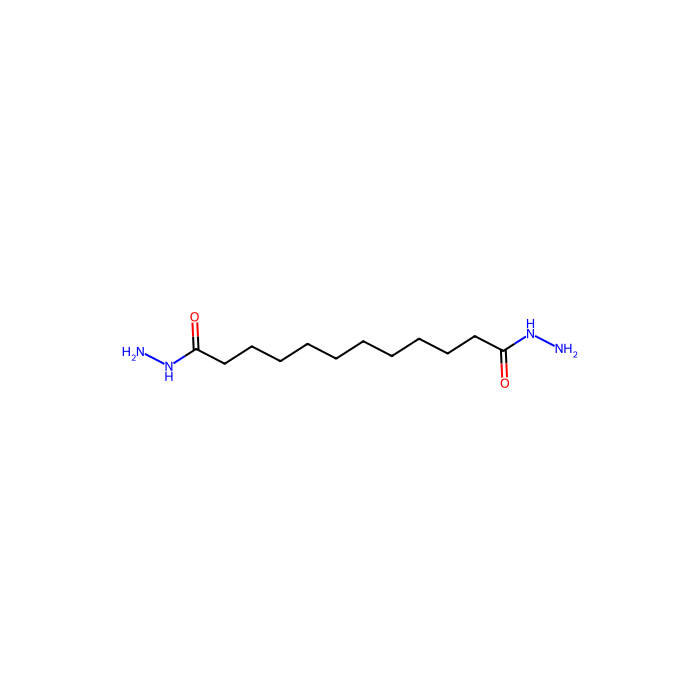
Dodecanedioic dihydrazide is a linear aliphatic diacylhydrazide derived from dodecanedioic acid; each terminal carboxyl is converted to a hydrazide (–CONHNH2), yielding a symmetric bifunctional linker.
Item-specific identifiers (from Product Data)
SKU: D154704
CAS: 4080-98-2
InChIKey: 109468 (as provided)
SMILES: Not specified for this item; refer to CoA/Spec Sheet.
Molecular formula: Not specified for this item; refer to CoA/Spec Sheet.
Molecular weight: Not specified for this item; refer to CoA/Spec Sheet.
Literature/computed identity (for reference only; verify against CoA/SDS)
Common name: Dodecanedioic dihydrazide; 1,12-dodecanedicarboxylic dihydrazide; DDH
Putative formula (computed from structure): C12H26N4O2 (literature)
Functional groups: two terminal acyl hydrazide moieties (–CONHNH2); long C10 methylene spacer
Structural features: symmetric, flexible 12-atom carbon backbone with terminal nucleophilic –NHNH2 (α to carbonyl) capable of forming hydrazones/azines with carbonyl compounds.
2D structure in words (literature description)
A straight-chain decamethylene segment (–(CH2)10–) flanked on both ends by amide carbonyls (–C(=O)–) each bonded to a hydrazide fragment (–NH–NH2). No rings or stereocenters; overall achiral and non-aromatic.
Synthetic Utility
Functional-group reactivity (general)
Terminal hydrazide nitrogens are nucleophilic, enabling condensation with aldehydes/activated carboxyls; the adjacent amide carbonyls are electrophilic under activation (e.g., carbodiimides) for further derivatization.
The difunctional nature affords symmetric or crosslinked products and makes this an effective spacer/linker.
Named/related transformations (literature)
Hydrazone/azine formation with aldehydes/ketones; aniline-catalyzed hydrazone ligation.
Conversion to acyl azides via nitrosation (NaNO2, mineral acid, 0–5 °C) followed by Curtius-type rearrangement to diisocyanates; subsequent formation of polyureas/urethanes (conduct with stringent safety controls).
EDC/NHS-mediated coupling: Carboxylate substrates can be coupled to the terminal –NHNH2 to furnish additional acyl hydrazides or amides.
Retrosynthetic value
As a bifunctional handle, DDH enables modular assembly of ABA-type architectures, crosslinked polymer networks, and symmetrical di-derivatives.
The C10 aliphatic core provides a defined spacer length to tune flexibility, hydrophobicity, and packing in materials.
Practical considerations
Protecting groups are generally unnecessary for stepwise hydrazone formation under pH control, but capping or orthogonal handles may be used to avoid bis-reaction when mono-functional products are desired.
Monitor reactions by IR (loss of carbonyl for activated intermediates; emergence of C=N for hydrazones) and LC/MS or GPC for polymeric products.
Target Specificity
Not applicable. This product is a small-molecule reagent (dihydrazide), not an antibody or biological targeting agent. No antigen, clone, isotype, or species reactivity information applies.
Products are supplied to verified businesses, institutions, and qualified professionals for research and development use only. Not for use in humans, animals, diagnosis, or therapy.

 G2627183