
 G2617010
Determine the necessary mass, volume, or concentration for preparing a solution.
| Activity Type | Activity Value -log(M) | Mechanism of Action | Activity Reference | Publications (PubMed IDs) |
|---|
Moligand™, 10mM in DMSO Moligand™ for sensitive chromatographic and analytical workflows requiring minimal baseline interference.
Store at -80°C Ships Dry ice packs + Cold packs Check lot-specific COA for exact specifications.
SDS, COA, datasheet, and spec sheet available for download. Lot-specific COA accessible via lot number lookup.
Cited in 262 peer-reviewed publications across chromatography, organic synthesis, and cross-coupling reactions.
Information
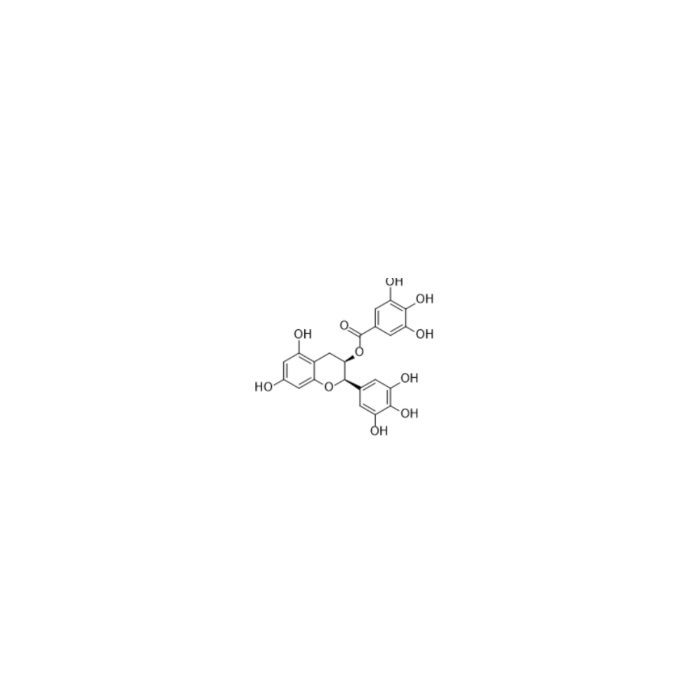
(-)-Epigallocatechin Gallate(EGCG) is the main catechin extraction of green tea that inhibitstelomeraseandDNA methyltransferase. EGCG blocks the activation ofEGF receptorsandHER-2receptors. ECGG inhibits fatty acid synthase and glutamate dehydrogenase act
In vitro
(-)-Epigallocatechin gallate functions as a powerful antioxidant, preventing oxidative damage in healthy cells, but also as an antiangiogenic and antitumor agent and as a modulator of tumor cell response to chemotherapy. (-)-Epigallocatechin gallate shows multiple anticancer effects, such as anti-proliferation, anti-angiogenesis, transformation prevention of various cancer cells, cancer cell cycle arrest and inhibition of tumor metastasis. (-)-Epigallocatechin gallate exerts multi-anticancer effects through regulating several cancer-related cell signal pathways (regulated the function or the expression of key signal proteins, such as nuclear factor-κB, MAPKs and activator protein-1, EGFR, IGF, COX-2 signaling pathway, and so on.), effecting methylation of cancer genes and combination of ligand with membrane receptors. (-)-Epigallocatechin gallate also shows an immunomodulating effects. Several types of immune cells in both the innate and adaptive immune systems are known to be affected in varying degrees by (-)-Epigallocatechin gallate. Among them, the dramatic effect on T cell functions has been repeatedly demonstrated, including T cell activation, proliferation, differentiation, and production of cytokines. Studies using animal models of autoimmune diseases have reported disease improvement in animals treated with green tea/EGCG. (-)-Epigallocatechin gallate displays anti-infective properties. Antiviral activities of (-)-Epigallocatechin gallate with different modes of action have been demonstrated on diverse families of viruses, such as Retroviridae, Orthomyxoviridae and Flaviviridae and include important human pathogens like human immunodeficiency virus, influenza A virus and the hepatitis C virus.
In vivo
Cell Data
cell lines:
Concentrations:
Incubation Time:
Powder Purity:≥99%
| Pubchem Sid | 528776743 |
|---|---|
| 이성체 SMILES | C1[C@H]([C@H](OC2=CC(=CC(=C21)O)O)C3=CC(=C(C(=C3)O)O)O)OC(=O)C4=CC(=C(C(=C4)O)O)O |
| WGK 독일 | 2 |
| RTECS | KB5200000 |
| UN 번호 | 3077 |
| 포장 그룹 | III |
| 분자량 | 458.37 |
| Beilstein | 17(5)8,506 |
| Reaxy-Rn | 375093 |
| Reaxys-RN_link_address | https://www.reaxys.com/reaxys/secured/hopinto.do?context=S&query=IDE.XRN=375093&ln= |
Comprehensive hazard, handling, storage, and regulatory compliance document.
Download SDS →Lot-specific quality data. Enter your lot number to retrieve the exact COA.
Look up COA →Full quality attributes and acceptance criteria for this grade.
View spec sheet →| Activity Type | Activity Value -log(M) | Mechanism of Action | Activity Reference | Publications (PubMed IDs) |
|---|
| Activity Type | Activity Value -log(M) | Mechanism of Action | Activity Reference | Publications (PubMed IDs) |
|---|
| Activity Type | Activity Value -log(M) | Mechanism of Action | Activity Reference | Publications (PubMed IDs) |
|---|
| Activity Type | Activity Value -log(M) | Mechanism of Action | Activity Reference | Publications (PubMed IDs) |
|---|
| Activity Type | Activity Value -log(M) | Mechanism of Action | Activity Reference | Publications (PubMed IDs) |
|---|
| Activity Type | Activity Value -log(M) | Mechanism of Action | Activity Reference | Publications (PubMed IDs) |
|---|
| Activity Type | Activity Value -log(M) | Mechanism of Action | Activity Reference | Publications (PubMed IDs) |
|---|
| Activity Type | Activity Value -log(M) | Mechanism of Action | Activity Reference | Publications (PubMed IDs) |
|---|
| Activity Type | Activity Value -log(M) | Mechanism of Action | Activity Reference | Publications (PubMed IDs) |
|---|
| Activity Type | Activity Value -log(M) | Mechanism of Action | Activity Reference | Publications (PubMed IDs) |
|---|
| Activity Type | Activity Value -log(M) | Mechanism of Action | Activity Reference | Publications (PubMed IDs) |
|---|
| Activity Type | Activity Value -log(M) | Mechanism of Action | Activity Reference | Publications (PubMed IDs) |
|---|
| Activity Type | Activity Value -log(M) | Mechanism of Action | Activity Reference | Publications (PubMed IDs) |
|---|
| Activity Type | Activity Value -log(M) | Mechanism of Action | Activity Reference | Publications (PubMed IDs) |
|---|
| 용해성 | Solubility (25°C) In vitro DMSO: 2 mg/mL (7.8 mM); Water: Insoluble; Ethanol: Insoluble; |
|---|---|
| 특정 회전[α] | -175.5 ° (C=1, EtOH) |
| 녹는점(°C) | 212°C |
| 분자량 | 458.400 g/mol |
| XLogP3 | 1.200 |
| Hydrogen Bond Donor Count | 8 |
| Hydrogen Bond Acceptor Count | 11 |
| Rotatable Bond Count | 4 |
| Exact Mass | 458.085 Da |
| Monoisotopic Mass | 458.085 Da |
| Topological Polar Surface Area | 197.000 Ų |
| Heavy Atom Count | 33 |
| Formal Charge | 0 |
| Complexity | 667.000 |
| Isotope Atom Count | 0 |
| Defined Atom Stereocenter Count | 2 |
| Undefined Atom Stereocenter Count | 0 |
| Defined Bond Stereocenter Count | 0 |
| Undefined Bond Stereocenter Count | 0 |
| The total count of all stereochemical bonds | 0 |
| Covalently-Bonded Unit Count | 1 |
Our grade selection guide covers purity, stabilizer status, and application suitability for all variants in our catalog.
View Moligand™ grade guide →