This compound belongs to the class of organic compounds known as benzoic acid esters. These are ester derivatives of benzoic acid.
External Descriptors
Not available
1. Djoumbou Feunang Y, Eisner R, Knox C, Chepelev L, Hastings J, Owen G, Fahy E, Steinbeck C, Subramanian S, Bolton E, Greiner R, and Wishart DS. ClassyFire: Automated Chemical Classification With A Comprehensive, Computable Taxonomy. Journal of Cheminformatics, 2016, 8:61.
Determine the necessary mass, volume, or concentration for preparing a solution.
Dilution Calculator
Determine the dilution needed to prepare a stock solution.
Reconstitution Calculator
리뷰
고객 리뷰
Application Protocols
Not applicable. No immunoassay or bioanalytical kit applications (e.g., WB, IHC, IF, FC) are associated with this small-molecule reagent in the Product Data. For synthetic procedures relevant to this compound, see the Reaction Conditions and Synthetic Utility sections.
Biological Roles
This product is a synthetic aromatic ester used for chemical research. It is not a biological buffer or metabolite, and no endogenous biological role is expected.
Item-specific
Research Use Note: For research use only (per Product Data)
General chemistry/biochemistry context (literature)
Benzoate esters are encountered in nature predominantly as hydrolysis products of plant-derived benzoic acids and phenolic conjugates; however, 3,4-diethoxy substitution and ethyl esterification are synthetic features and do not correspond to common metabolites.
In a research setting, this scaffold can serve as a protected form of protocatechuate-derived esters; after deprotection, catechol motifs are relevant to metal chelation and redox chemistry in biological studies. Such uses remain strictly non-clinical and mechanistic.
No clinical or diagnostic applications are implied. Any biological testing should be conducted under institutional approvals and appropriate safety protocols.
Buffer Applications
This compound is a hydrophobic aromatic ester and is not used as a buffering agent. It lacks acid/base functionality in water due to esterification and ring ethoxy substitution.
Practical guidance
For aqueous pH control, use established buffer systems (e.g., phosphate, acetate, Tris, HEPES). This compound should not be used to prepare biological or analytical buffers.
If introduced into aqueous systems (e.g., partitioning studies), employ co-solvents (DMSO, MeOH) at minimal percentages and confirm solubility and compatibility.
Green Alternatives
Solvent choices (greener replacements; general guidance)
Replace chlorinated solvents (e.g., DCM, chloroform) used for O-dealkylation or EAS with cyclopentyl methyl ether (CPME), 2-methyltetrahydrofuran (2-MeTHF), or anisole when compatible. These offer lower toxicity and improved sustainability profiles.
For workups and extractions, prefer EtOAc over DCM where solubility permits; EtOAc is readily biodegradable and less hazardous.
Example comparison (general; not product-specific)
DCM vs EtOAc
Pros (DCM): Excellent solvency, low bp for rapid removal.
Pros (EtOAc): Greener, lower toxicity, compatible with silica.
Trade-offs: Some reactions (e.g., BBr3 dealkylations) may require halogenated solvents for optimal control; pilot tests recommended.
Trade-offs: Different polarity/boiling points may alter rates/selectivity; check catalyst/acid compatibility.
Process-intensification options
Solvent minimization via higher substrate loading or continuous-flow microreactors can reduce waste.
Switch from stoichiometric Lewis acids to catalytic alternatives (e.g., Fe- or Bi-catalyzed transesterifications) where feasible to lower E-factor.
Note: Green substitutions must be validated experimentally for this substrate, especially where ester stability and aryl–OEt cleavage selectivity are critical.
Pharmaceutical Uses
Scope
No compendial status or excipient role is provided in the Product Data. This item is offered for laboratory research only and is not intended for human or veterinary use.
Research/manufacturing context (general)
As a synthetic intermediate, ethyl 3,4-diethoxybenzoate can be elaborated into analogs for medicinal chemistry SAR campaigns after functional-group interconversions (e.g., hydrolysis to the acid, O-dealkylation to phenols). Any such use remains preclinical and within research environments.
Aromatic esters may be explored as pro-motif surrogates in discovery settings; however, no claims are made for this specific compound’s suitability as a pro-moiety or excipient.
Regulatory note
Without explicit pharmacopeial listing or GMP documentation, material should not be used in drug product manufacture. Refer to the CoA for available quality data if considering process development screening.
Physical Properties
Item-specific (from Product Data)
Appearance: Not specified for this item; refer to CoA/Spec Sheet.
Literature/estimated properties (for reference; not product specifications)
Molecular formula: C13H20O4 (literature)
Molecular weight: ~240.29 g/mol (literature)
Physical state: typically a colorless to pale liquid or low-melting solid for analogous dialkoxy benzoate esters (literature/generic observation). The exact appearance for this SKU is not specified.
Density, refractive index, UV cutoff: Not specified for this item; refer to CoA/Spec Sheet.
Melting/boiling point: Not specified for this item; refer to CoA/Spec Sheet. Comparable aryl dialkoxy benzoate esters often boil in the 300–330 °C range at 1 atm or distill under reduced pressure (literature, general trend), but do not use as a specification.
Solubility (qualitative, literature): Expected to be sparingly soluble in water; freely soluble in nonpolar and moderately polar organic solvents (e.g., DCM, chloroform, toluene, EtOAc, alcohols). Exact solubility not established for this item.
LogP, pKa: Not specified for this item; refer to CoA/Spec Sheet. The molecule is neutral; phenolic acidity is masked by ethoxy substituents.
Notes
All non-specified values above are provided as general literature expectations for structurally similar compounds and should not be treated as product specifications. Consult the item’s CoA for definitive physical constants.
Quality and Grades
Item-specific (from Product Data)
Grade/Purity: Not specified for this item; refer to CoA/Spec Sheet.
Interpreting grade (general guidance)
If supplied as “research grade,” the material is suitable for synthetic and analytical R&D. Absence of an HPLC or GC assay on the label does not imply low quality; refer to the CoA for assay and impurity profile.
If an “analytical reagent (AR)” or “puriss” grade is indicated on the CoA, expect tighter controls on non-volatile residue and UV absorbance; for chromatographic work (e.g., photochemical studies), low background absorbance is important.
Stabilizers: None listed in the Product Data. If present in a given batch, they will be identified on the CoA. Aryl esters/ethers typically do not require inhibitors, but trace antioxidants may occasionally be used.
Metal content, residual solvents, water/peroxides, UV cutoff: Not specified for this item; refer to CoA/Spec Sheet.
Practical QC considerations (general)
Identification: 1H/13C NMR to confirm diethoxy substitution and ethyl benzoate signals; IR for ester C=O (~1720–1740 cm−1) and aryl–O–C.
Purity control: GC or HPLC with UV detection at 254 nm typically suitable; LC–MS for impurity profiling. Check for starting acid/alcohols and mono-alkoxylated isomers as potential impurities.
Batch homogeneity: Verify appearance and assay on receipt; warm gently if crystallized to ensure representative sampling.
Reaction and Applications
Representative research uses (general; expand beyond catalog line)
Protecting-group strategy: The 3,4-diethoxy pattern can be unmasked to the corresponding catechol ester (ethyl 3,4-dihydroxybenzoate) via Lewis-acid-mediated O-dealkylation (e.g., BBr3), enabling stepwise functionalization of a protocatechuate scaffold.
Electrophilic aromatic substitution (EAS): The diethoxy groups are activating/ortho–para directing, while the benzoate ester is deactivating/meta directing. Net outcome favors substitution at positions unobstructed by existing groups (typically C5). Examples include bromination, nitration (mild), and Friedel–Crafts acylation on the ring (though the ester can be sensitive to strong Lewis acids).
Hydrolysis/transesterification: The benzoate ester can be saponified to 3,4-diethoxybenzoic acid or converted to alternative esters via acid- or base-catalyzed exchange.
Cross-coupling precursor: After halogenation at a favorable ring position, the derivative can serve in Suzuki–Miyaura or Buchwald–Hartwig couplings toward elaborated aryl architectures.
Fragrance/materials intermediacy: Aryl dialkoxybenzoates are encountered as intermediates in liquid-crystal monomer and UV-absorber syntheses (literature, general), though this item is for research use only.
Practical tips
Moisture sensitivity is modest; however, reactions that target the ester or aryl–OEt functionalities should be performed under dry, inert atmosphere to control selectivity.
For BBr3 demethylation-analogous deethoxylation, use anhydrous DCM at −78 to 0 °C, quench cautiously to avoid over-hydrolysis of the benzoate.
When performing EAS, control temperature and acid strength to avoid ester cleavage or polysubstitution; monitor by TLC/GC/MS.
Reaction Conditions
All values below are general literature guidance for similar substrates and are not specifications for this item. Optimize for your system.
Hydrolysis/transesterification
Base hydrolysis: EtOH/H2O with NaOH (1–2 eq), rt to 60 °C, 1–6 h to acid salt; acidify to isolate 3,4-diethoxybenzoic acid. Typical conversions: high yields with careful quench.
Acid-catalyzed transesterification: Alcohol (10–50 eq), catalytic H2SO4 or TsOH, reflux, Dean–Stark if applicable; 4–24 h.
O-Dealkylation to catechol ester
Reagent: BBr3 (1.5–3.0 eq per aryl–OEt), dry DCM, −78 to 0 °C, 1–4 h, then quench with MeOH/H2O at low temperature; work up under basic conditions to avoid ester hydrolysis. Often affords ethyl 3,4-dihydroxybenzoate in good to excellent yields (literature precedent for dialkoxybenzenes).
Alternatives: BCl3 or AlCl3/thiophenol systems; reaction conditions typically harsher and may risk ester cleavage.
Electrophilic aromatic substitution (EAS)
Bromination: Br2 or NBS with catalytic acid (e.g., AcOH/HBr) at 0–25 °C; monitor to avoid polysubstitution.
Nitration: Dilute HNO3/H2SO4 at 0–5 °C; keep acid strength low to preserve ester.
Reductions
Ester to alcohol: DIBAL-H (1.2–2.0 eq) in toluene or DCM, −78 to 0 °C; quench carefully. LiAlH4 in THF/Et2O at 0–25 °C gives primary alcohol.
Purification/analysis
Flash chromatography with hexanes/EtOAc (e.g., 9:1→7:3); HPLC monitoring at ~254 nm; GC possible if thermally stable.
Note: Confirm compatibility of catalysts/reagents with aryl ethers and benzoate ester to minimize side reactions.
Safety and Handling
Item-specific (from Product Data)
GHS Classification: Not specified for this item; refer to SDS.
Signal Word: Not specified for this item; refer to SDS.
Hazard (H-) statements: Not specified for this item; refer to SDS.
Pictograms: Not specified for this item; refer to SDS.
Storage conditions: Room temperature (per Product Data)
Shipping: Normal (ambient)
General safety guidance (literature/good laboratory practice; not a substitute for the SDS)
Likely hazards: Aromatic esters/ethers commonly cause eye/skin irritation and may be harmful if swallowed or inhaled. Avoid aerosol generation.
PPE: Safety glasses, lab coat, nitrile gloves. Work in a fume hood when handling bulk quantities or heated material.
Handling: Avoid contact with strong oxidizers and strong acids/bases. Although aryl ethers are not classical peroxide formers, routine periodic inspection is prudent. Prevent prolonged heating above decomposition temperatures.
Incompatibilities: Strong Lewis acids (e.g., BBr3, AlCl3) will cleave aryl–OEt groups; strong bases/acids can hydrolyze the benzoate ester.
First aid (summary): If on skin/eyes, rinse with water for 15 minutes; remove contaminated clothing. If inhaled, move to fresh air. If ingested, rinse mouth; do not induce vomiting—seek medical attention. Always follow the SDS for authoritative instructions.
Fire safety: Use CO2, dry chemical, or foam for extinguishing. Combustion may produce CO/CO2 and acrid fumes; firefighters should wear SCBA.
Always consult the product SDS for definitive hazard classification and response measures.
Solvent Selection
This compound is a moderately lipophilic aromatic ester with two aryl ethoxy substituents—characteristics that favor dissolution in organic media and poor water miscibility.
Polarity and miscibility (literature/general)
Polarity: Low to moderate; dominated by aromatic and ethoxy groups.
Expected miscibility: Good in DCM, chloroform, toluene, ethyl acetate, acetone, and alcohols; limited in hexanes depending on temperature; negligible in water.
Typical solvent choices by operation
Synthesis/transformations: DCM or toluene for electrophilic substitutions; dry DCM/CH2Cl2 for BBr3-mediated O-dealkylation; EtOH/MeOH or THF for transesterification/hydrolysis setups; acetonitrile for SN1/SNAr-inert medium when needed.
Purification: Flash chromatography using hexanes/EtOAc or toluene/EtOAc gradients; crystallization (if solid) from EtOH/MeOH or EtOAc/hexane.
Analysis: HPLC-grade acetonitrile or methanol with water (isocratic low % organic) often gives sharp UV response near 254 nm; confirm λmax empirically.
Comparison and selection tips (general)
DCM vs toluene: DCM provides better solubility at low polarity with low bp for easy removal; toluene tolerates higher temperatures for sluggish reactions.
EtOAc vs acetone: EtOAc offers greener profile and compatibility with silica; acetone gives higher polarity and water-miscibility for workups.
Alcohols: Useful for solubility and as reagents in transesterifications; can promote side hydrolysis under strongly acidic/basic conditions.
Storage and Reconstitution
Item-specific (from Product Data)
Storage conditions: Room temperature
Shipped in: Normal (ambient)
General guidance for this chemical class
Keep container tightly closed in a dry, well-ventilated place. Protect from moisture and prolonged exposure to strong light/UV which may promote degradation.
If material is a low-melting solid or viscous oil, warm gently to homogenize before sampling. Avoid repeated heating–cooling cycles.
No reconstitution is typically required. If dilution or stock solutions are needed, prepare in an appropriate dry organic solvent (e.g., DCM, EtOAc, MeOH, or acetonitrile) and store aliquots in amber vials at 2–8 °C or −20 °C as dictated by your method. Stability of solutions is user-dependent; verify by HPLC before use.
Avoid contact with strong acids/bases or Lewis acids during storage to prevent hydrolysis or O-dealkylation.
Disposal
Dispose of contents/container according to local regulations for organic chemical waste. Do not release into drains.
Refer to the product’s CoA/SDS for any batch-specific storage notes or stability data.
Structure and Identity
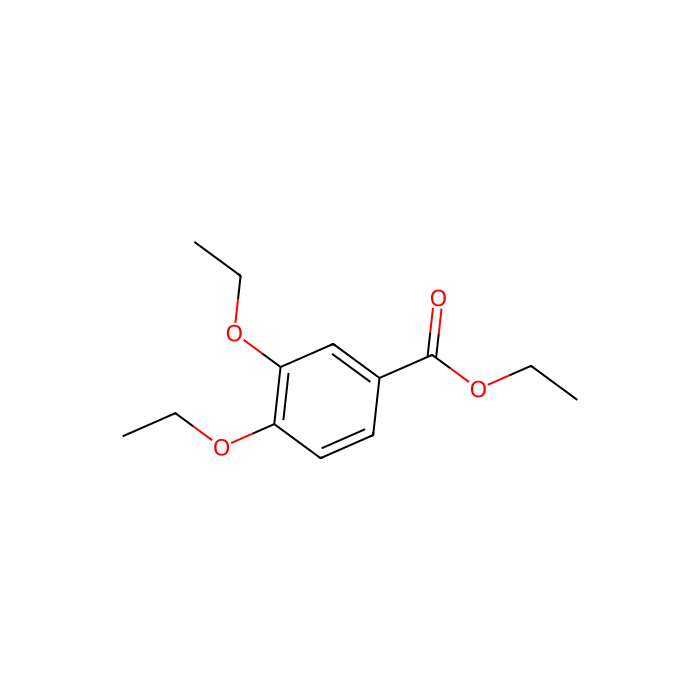
Ethyl 3,4-diethoxybenzoate is an aromatic benzoate ester bearing two ethoxy substituents on the ring (positions 3 and 4) and an ethyl group on the carboxylate.
Item-specific (from Product Data)
CAS: 75332-44-4
CID: 586407
InChIKey (as provided): 371249 (note: this is non-standard length for an InChIKey; verify on CoA/SDS)
SMILES: Not specified for this item; refer to CoA/Spec Sheet.
Literature/computed identifiers and features (informational)
Alternative names: Ethyl 3,4-diethoxybenzoate; Benzoic acid, 3,4-diethoxy-, ethyl ester
2D structural description (words): A benzene core bearing para-related adjacent substituents at C3 and C4 as –OCH2CH3 groups; the carboxyl carbon (C1) is esterified with –OCH2CH3. The ring therefore carries three oxygen-containing substituents: two aryl ethoxy groups on adjacent carbons and one ester linking to an ethyl chain. No stereocenters.
Structural implications (general chemistry)
The diethoxy pattern (3,4-) is strongly electron-donating/activating to the ring by resonance, while the benzoate ester is meta-directing/deactivating. Net reactivity is biased toward electrophilic substitution at positions not blocked by substituents (typically C5). The aryl–OEt groups can be cleaved to phenols under Lewis-acidic conditions (e.g., BBr3).
Synthetic Utility
Functional-group handles
Benzoate ester (–CO2Et): amenable to hydrolysis (acid/base), reduction to alcohol (e.g., DIBAL-H to benzyl alcohol, LiAlH4 to primary alcohol), and transesterification. Can participate in Curtius or Hunsdiecker-type sequences after conversion to acid and suitable derivatives.
Aryl ethoxy groups (–OEt): removable by Lewis-acid-mediated cleavage (BBr3, BCl3, AlCl3) to reveal phenols; can undergo electrophilic iodination/bromination ortho to the ethers due to activation.
Strategic roles
Protected catechol ester equivalent: Convert to ethyl 3,4-dihydroxybenzoate for subsequent O-acylation/O-alkylation or metal-binding motif introduction.
Diversification platform: Halogenate at C5 (typical) then cross-couple (Suzuki–Miyaura, Heck, or Buchwald–Hartwig after further functionalization) to access densely substituted aromatics.
Polarity tuning: The ethyl groups and ester confer lipophilicity; selective deprotection/hydrolysis allows rapid polarity modulation for purification and SAR.
Retrosynthetic value (general)
Readily accessible from 3,4-diethoxybenzoic acid via Fischer–Speier esterification (EtOH/H+, Dean–Stark) or via acid chloride and ethanol. Therefore, it is a convenient branch point for libraries requiring the 3,4-dialkoxybenzene motif.
Analytical verification tips
Distinct quartet/triplet patterns (J ~7 Hz) for three ethyl groups in 1H NMR; aromatic ABX pattern characteristic of 1,2,3-trisubstituted benzenes. Carbonyl at ~166–168 ppm in 13C NMR; IR C=O near 1725 cm−1.
Target Specificity
Not applicable. This product is a small-molecule aromatic ester, not a biological macromolecule or affinity reagent. No antigen/epitope/clone/isotype information is relevant.
자주 묻는 질문
What is the purity of this product?
This product is supplied at ≥98% purity (chemical assay). Lot-specific values are stated on the Certificate of Analysis.
How should this product be stored?
Store at room temperature.
How is this product shipped?
This product ships under standard ambient conditions. No temperature-controlled packaging is required.
What are the CAS number, molecular formula and molecular weight?
The CAS Number is 75332-44-4, the molecular formula is C13H18O4, and the molecular weight is 238.28 g/mol. InChIKey UWWIFSJMLYCVGX-UHFFFAOYSA-N.
What documentation is provided?
Available product documentation, including Certificates of Analysis (COA), Safety Data Sheets (SDS), and specification sheets, is shown in the product document area. Document availability and access follow the current site policy.
Products are supplied to verified businesses, institutions, and qualified professionals for research and development use only. Not for use in humans, animals, diagnosis, or therapy.

 C2318543