Determine the necessary mass, volume, or concentration for preparing a solution.
Dilution Calculator
Determine the dilution needed to prepare a stock solution.
Reconstitution Calculator
리뷰
고객 리뷰
Application Protocols
Not applicable. No biological assay protocols (e.g., WB, IHC, IF, FC) are associated with this small-molecule building block. For synthetic applications, see the Reaction Conditions and Synthetic Utility sections for general procedural guidance.
Biological Roles
This product is intended for research and synthetic use as a small-molecule building block. No inherent biological role is assigned in the Product Data.
General considerations for structure class:
Primary amine, secondary alcohol, and ester functionalities are common motifs in bioactive small molecules and prodrugs; however, any biological activity is context-dependent on the final structure synthesized from this intermediate.
Cyclohexyl-containing fragments can modulate lipophilicity and conformational preferences in medicinal chemistry campaigns.
Note: No claims are made regarding biological function, potency, or selectivity of this item. For research use only.
Buffer Applications
Not typically used as a buffering agent.
Rationale: although it contains an amine (as hydrochloride salt), the compound is a synthetic intermediate rather than a defined buffering system with a known pKa range and buffer capacity.
Recommendation: use established buffers (e.g., phosphate, HEPES, Tris) for pH control. This compound should be handled in the sections focusing on Synthetic Utility and Reaction Conditions.
Green Alternatives
Greener choices primarily concern solvent and reagent selection during transformations of this intermediate.
Couplings: replace DMF/NMP with greener polar aprotics such as Cyrene or propylene carbonate when feasible; use T3P (in EtOAc) to minimize hazardous byproducts vs. carbodiimides in DMF.
Reductive amination: employ aqueous ethanol or 2-MeTHF with NaBH(OAc)3, or hydrogenation over Pd/C in EtOH instead of DCM/MeOH with cyanoborohydride.
Hydrolysis: perform saponifications in water/ethanol or water/2-MeTHF biphasic systems, minimizing dioxane usage.
Protection: Boc protection in EtOAc or MeCN can reduce reliance on chlorinated solvents; consider solid-supported scavengers to reduce solvent volumes in workup.
Comparison snapshot (general):
DMF → Cyrene/PC: lower reproductive toxicity; check solubility and base compatibility.
MeCN → EtOH/i-PrOH (where compatible): renewable feedstock options, but polarity differences may require optimization.
Note: Evaluate LCA and regulatory constraints for your process scale; confirm substrate solubility (salt vs. free base) in the alternative solvent before committing.
Pharmaceutical Uses
No excipient or pharmacopeial status is specified for this item; it is sold for research use only.
Context (general, non-clinical):
Hydrochloride salts of amines are routinely employed for improved handling (reduced volatility/odor, better crystallinity) of intermediates in API development.
The ethyl ester may serve as a temporary protecting/prodrug-like handle during intermediate stages; in development settings it is commonly hydrolyzed or transformed to the desired functional group.
Compliance notes:
If used in process development, confirm residual chloride, water content, and solvent residues meet internal specifications. No medical or clinical claims are made for this product.
Physical Properties
Item-specific physical constants are not provided in the Product Data.
Melting point / boiling point: Not specified for this item; refer to CoA/Spec Sheet.
Density, refractive index, logP, pKa: Not specified for this item; refer to CoA/Spec Sheet.
Appearance: Not specified for this item; refer to CoA/Spec Sheet.
General expectations for this class (literature-based, qualitative):
Amine hydrochloride salts of small aliphatic esters typically are crystalline, non-volatile solids with higher melting points than the corresponding free bases.
Solubility profile: salts are often highly soluble in water and polar protic solvents (MeOH, EtOH) and sparingly soluble in nonpolar solvents (toluene, hexanes). The free-base form, once liberated, becomes more soluble in moderately polar organics (EtOAc, DCM, THF) and less soluble in water at neutral to basic pH.
Ionization: the primary amine is fully protonated in the hydrochloride (ammonium) form; upon basification (pH > 9), the free amine is generated.
Note: For quantitative values specific to SKU E681770 (e.g., MP range, water content, residual solvents), consult the CoA/Spec Sheet for the exact lot supplied.
Quality and Grades
Grade/Purity: Not specified for this item; refer to CoA/Spec Sheet.
Guidance on interpreting quality specifications (general):
Purity (%): indicates chromatographic or titrimetric assay of the major component. For multifunctional building blocks, typical acceptance criteria can include limits for salt content (chloride), water (KF), and residual solvents.
Identity testing: often confirmed by NMR (1H/13C), IR, and MS; chloride content may be verified by argentometric titration or ion chromatography for hydrochloride salts.
Stabilizers: Not specified for this item; refer to CoA/Spec Sheet. Hydrochloride salts generally do not require added stabilizers and often improve storage stability versus free bases (reduced volatility/oxidation).
Lot-specific documentation: request the CoA/Spec Sheet for:
Water content (KF)
Residual solvent panel
Inorganic counterion content (Cl−) and assay for free amine vs. salt
Chiral purity if stereochemistry is controlled (not specified here)
Note: If low-UV or LC-MS suitability is required, inquire about chromatographic grade assessment (baseline noise, metal content) for compatibility with analytical workflows.
Reaction and Applications
This multifunctional cyclohexane derivative is a versatile intermediate for medicinal and synthetic chemistry.
Amide/urea/thiourea formation: the primary amine (after free-base liberation) couples with carboxylic acids (EDC/HOBt, HATU, T3P), acid chlorides, or isocyanates to furnish amides/ureas while retaining the ethyl ester for orthogonal reactivity.
Selective ester transformations: the ethyl ester can be hydrolyzed (LiOH/NaOH, aq. alcohol co-solvent) to the corresponding acid, enabling further coupling or cyclization. Transesterification under acidic/basic catalysis can adjust protecting group strategy.
Alcohol derivatization: the 4-hydroxyl can undergo sulfonylation (MsCl/TsCl) to generate leaving groups, enabling intramolecular cyclizations or SN2 displacements (e.g., to install azide, halide). Oxidation to the ketone (Dess–Martin, PCC) unlocks further aldol/reductive amination chemistry.
Reductive amination/alkylation: the aminomethyl handles reductive alkylation with aldehydes/ketones (NaBH3CN, BH3·THF), or N-alkylation under Mitsunobu-type variants after protection.
Protection strategies: Boc or Fmoc protection of the amine streamlines downstream steps; silyl or carbonate protection for the alcohol provides orthogonality. The HCl salt aids storage and handling prior to protection.
Scaffold elaboration: the cyclohexane core offers conformationally restricted fragments valued in fragment-based and structure–activity (SAR) exploration.
Practical tips:
Convert the HCl salt to free base prior to reactions requiring nonpolar media; quantify salt-to-base stoichiometry for accurate charge balance in couplings.
Maintain ester integrity by avoiding strong bases at elevated temperature when undesired saponification is a risk.
Reaction Conditions
General, literature-style guidance for common operations with amine HCl salts bearing alcohol and ester groups:
Free-base liberation: suspend the HCl salt in water, basify to pH 10–11 with NaHCO3 or Na2CO3 (or to pH 12 with NaOH for complete liberation), extract into DCM/EtOAc; dry and use promptly. Alternative: pass through a basic ion-exchange resin.
Amide coupling (from ester → acid → amide):
Saponification: LiOH (1.2–1.5 eq) in THF/H2O (3:1) at 0–25°C for 1–4 h; monitor by LC. Acidify to pH 2 and extract to isolate the acid.
Coupling: HATU (1.1 eq), amine partner (1.2 eq), DIPEA (2–3 eq) in DMF or MeCN at 0–25°C for 1–3 h. Greener option: T3P (50% in EtOAc), 1.2 eq base in EtOAc.
Oxidation to ketone: Dess–Martin periodinane (1.3 eq) in DCM at 0–25°C, 0.5–2 h; quench with sodium thiosulfate and bicarbonate.
Reductive amination on aminomethyl: aldehyde (1.2–2 eq), AcOH (catalytic), MeOH or 2-MeTHF, NaBH3CN (1.2–1.5 eq) at 0–25°C; or hydrogenation (H2, 1–3 bar, Pd/C 5–10%, EtOH) if compatible with other groups.
Protection:
Boc: Boc2O (1.2 eq), DIPEA (2 eq), DCM or MeCN, 0–25°C, 1–3 h (after free-base generation).
Silylation of alcohol: TBSCl (1.2 eq), imidazole (2 eq), DMF or DCM, 0–25°C.
Notes:
Avoid strong base/heat if ester retention is required. Thoroughly dry solvents for moisture-sensitive steps.
The presence of an ammonium chloride salt reduces nucleophilicity; neutralize to the free base for coupling and alkylation reactions.
Safety and Handling
GHS information is not provided in the Product Data for this item; always consult the SDS for authoritative hazard and precautionary statements.
Signal word / H-statements / pictograms: Not specified for this item; refer to SDS.
Likely hazards (general for amine hydrochloride salts): may cause irritation to skin, eyes, and respiratory tract; hygroscopicity is possible. Salts are typically non-volatile but can be corrosive to metals in the presence of moisture due to HCl.
PPE: wear appropriate lab coat, safety glasses or splash goggles, and nitrile gloves. Use in a well-ventilated hood to avoid dust/aerosol exposure.
Handling notes:
Avoid exposure to bases that liberate free amine and HCl vapors. Open containers carefully to minimize dust.
Prevent contact with strong oxidizers and acylating/alkylating agents unless intended for reaction under controlled conditions.
For moisture-sensitive syntheses, convert to the free base immediately before use and handle under inert atmosphere as required.
First-aid overview (general guidance; defer to SDS):
Inhalation: move to fresh air; seek medical attention if symptoms persist.
Skin/eye contact: rinse with water for at least 15 minutes; remove contaminated clothing; obtain medical advice if irritation persists.
Ingestion: rinse mouth; do not induce vomiting; seek medical attention.
Spill & disposal: collect solid spills by gentle sweeping while minimizing dust; dispose of according to local regulations for organic amine salts.
Solvent Selection
As supplied, this compound is an amine hydrochloride salt with an ethyl ester and secondary alcohol, leading to distinct solubility behaviors between salt and free-base forms.
HCl salt: high solubility in water and polar protic solvents (MeOH, EtOH); variable in DMF/DMSO; poor in nonpolar solvents.
Free base: good in EtOAc, DCM, MeCN, THF, alcohols; lower in water at neutral/basic pH.
Selection tips:
For amide couplings: convert to free base or use in situ neutralization in polar aprotic media (DMF, NMP, DCM) with organic bases (DIPEA, NMM) to avoid salt precipitation.
For ester hydrolysis (saponification): aqueous MeOH/THF or dioxane with NaOH or LiOH promotes dissolution of both phases.
For protection steps (Boc/CBz): use DCM/MeCN for Boc2O or CBzCl with base after liberating the free amine.
Comparison to alternatives:
Water/MeOH enable salt handling and ion-exchange workups.
DCM/EtOAc facilitate extractions once the amine is basified.
DMF/DMSO are powerful solvents for coupling chemistry but require careful workup to remove.
Storage and Reconstitution
Storage conditions (from Product Data): Store at 2–8°C. Shipped on wet ice to maintain cool temperature during transit.
Container: keep tightly closed in the original container with desiccant if available to minimize moisture uptake common to amine hydrochloride salts.
Light/moisture sensitivity: protect from excessive humidity; brief ambient handling is acceptable, but prolonged exposure may lead to clumping or variable assay due to water uptake.
Reconstitution/dissolution (general guidance):
For aqueous work: dissolve directly in deionized water or aqueous alcohols. Gentle warming and stirring accelerate dissolution.
For organic-phase reactions: convert to the free base before dissolution in DCM, EtOAc, THF, or MeCN. Alternatively, dissolve the salt in polar solvents (MeOH, DMF) with an equivalent of organic base (e.g., DIPEA) in situ when compatible.
Freeze–thaw: typically supplied as a solid; if solutions are prepared, store aliquots at 2–8°C (short term) or −20°C (longer term) and avoid repeated freeze–thaw cycles.
Stability: hydrochloride salts generally exhibit improved shelf stability versus free bases. For lot-specific retest/expiry dating and any stabilizers, refer to the CoA/Spec Sheet.
Research use note: For research use only.
Structure and Identity
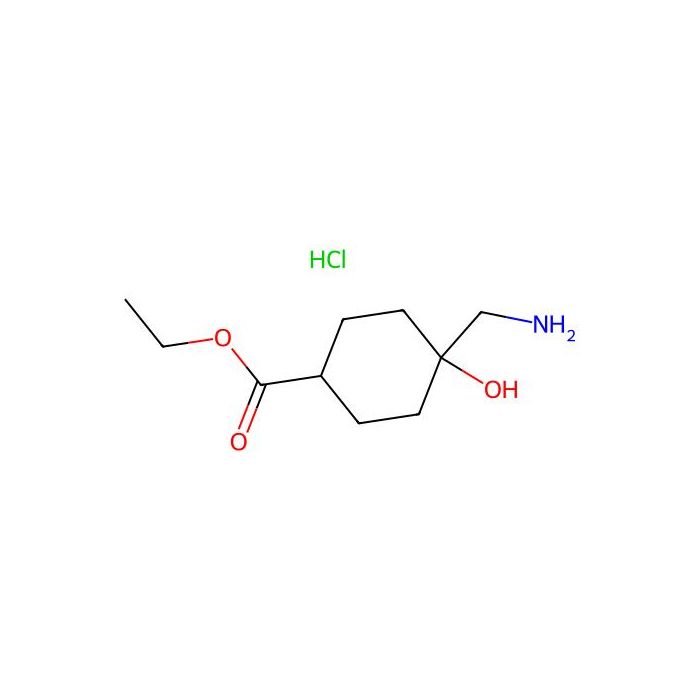
Ethyl 4-(aminomethyl)-4-hydroxy-cyclohexanecarboxylate;hydrochloride is a functionalized cyclohexane building block presented as the amine hydrochloride salt. It combines an ethyl ester (at the cyclohexanecarboxylate position), a tertiary-center-like 4-hydroxyl substituent, and a 4-(aminomethyl) side chain that is protonated as the HCl salt.
SKU: E681770
CAS: 2926675-84-3
Molecular formula: Not specified for this item; refer to CoA/Spec Sheet.
Molecular weight: Not specified for this item; refer to CoA/Spec Sheet.
InChIKey: Not specified for this item; refer to CoA/Spec Sheet.
SMILES: Not specified for this item; refer to CoA/Spec Sheet.
Structural features (interpretation from name; general description):
Substituents: (a) carboxyl-derived ethyl ester at the ring carboxyl position; (b) a 4-hydroxyl substituent on the ring; (c) a 4-(aminomethyl) substituent on the same ring carbon as the hydroxyl (geminal to OH), presented as the hydrochloride salt (–CH2–NH3+ Cl−).
Stereochemistry: not specified; the 4-substituted center may exist as racemic unless otherwise noted.
2D structure in words: a cyclohexane bearing an ethoxycarbonyl substituent at the carboxyl-bearing carbon and, at the 4-position, geminal OH and CH2–NH3+ (Cl− counterion).
Synthetic Utility
Functional group set: primary amine (as HCl salt), secondary alcohol, and ethyl ester on a cyclohexyl scaffold.
Key transformations (general guidance):
Divergent orthogonality: keep the ester intact while transforming the amine/alcohol, or vice versa. Typical sequences include (i) Boc-protect amine → alcohol derivatization; (ii) saponify ester → amide coupling → deprotect amine.
Chemoselective acylation: acylate the amine (acyl chlorides/activated esters) under mild base; mask alcohol as silyl ether or carbonate if needed.
Oxidation level edits: oxidize the alcohol to ketone (DMP, TEMPO/BAIB), enabling intramolecular reductive amination via the aminomethyl group to access bicyclic amines.
C–N bond construction: reductive amination on the aminomethyl; alkylation under phase-transfer after converting to free base.
C–O bond manipulation: convert the alcohol into a sulfonate (Ms/Ts) to allow SN2 substitution (e.g., azide → Staudinger to amine, enabling diamine scaffolds).
Carboxylate handle: hydrolyze the ethyl ester (LiOH/THF–H2O) to the acid; perform peptide-like couplings (HATU/DIPEA in DMF or T3P/EtOAc) to generate amides, then re-esterify if necessary.
Strategic notes:
Work from the HCl salt for storage; generate free base immediately before base-sensitive steps.
Balance protecting-group choices to minimize steps: Boc for amine, silyl or carbonate for alcohol; avoid conditions that risk ester cleavage unless intended.
Target Specificity
Not applicable. This product is a small-molecule chemical intermediate and is not an antibody, enzyme, or affinity reagent. No target, epitope, or species specificity applies.
자주 묻는 질문
What is the purity of this product?
This product is supplied at ≥97% purity (chemical assay). Lot-specific values are stated on the Certificate of Analysis.
How should this product be stored?
Store at 2–8 °C. Refrigerated storage is required to maintain the specified shelf life.
How is this product shipped?
This product ships chilled on wet ice. Unpack on arrival and transfer it to the storage condition stated above.
What are the CAS number, molecular formula and molecular weight?
The CAS Number is 2926675-84-3.
What documentation is provided?
Available product documentation, including Certificates of Analysis (COA), Safety Data Sheets (SDS), and specification sheets, is shown in the product document area. Document availability and access follow the current site policy.
We use cookies to ensure the website functions properly and, where permitted, to improve your experience. You can manage your preferences at any time in Settings. Learn more in our Cookie Policy.
Shall we send you a message when we have discounts available?
Remind me later
Thank you! Please check your email inbox to confirm.
Products are supplied to verified businesses, institutions, and qualified professionals for research and development use only. Not for use in humans, animals, diagnosis, or therapy.