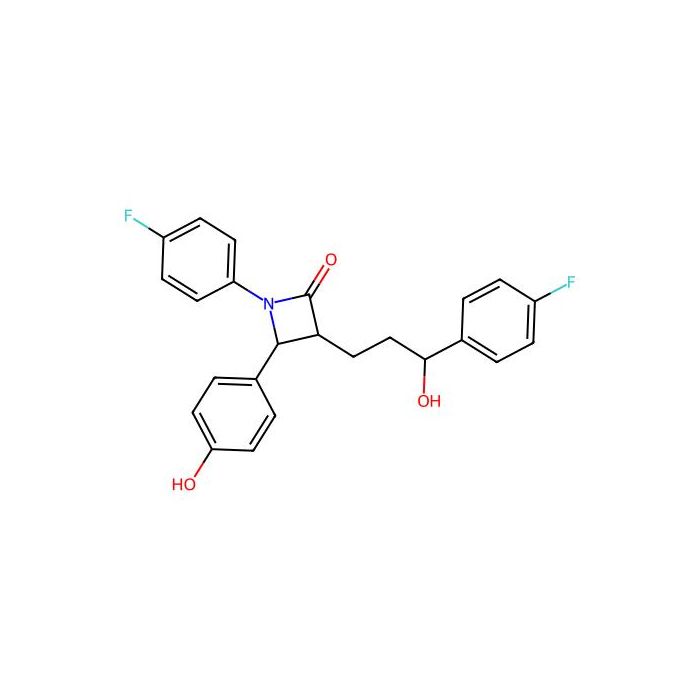
Ezetimibe-d 4 -1 is deuterium labeled Ezetimibe. Ezetimibe (SCH 58235) is a potent cholesterol absorption inhibitor. Ezetimibe is a Niemann-Pick C1-like1 (NPC1L1) inhibitor, and is a potent Nrf2 activator.
In Vitro
Stable heavy isotopes of hydrogen, carbon, and other elements have been incorporated into drug molecules, largely as tracers for quantitation during the drug development process. Deuteration has gained attention because of its potential to affect the pharmacokinetic and metabolic profiles of drugs. MCE has not independently confirmed the accuracy of these methods. They are for reference only.
Form:Solid
사양
사양 및 순도
≥99%
생화학 및 생리적 메커니즘
Ezetimibe-d 4 -1 is deuterium labeled Ezetimibe. Ezetimibe (SCH 58235) is a potent cholesterol absorption inhibitor. Ezetimibe is a Niemann-Pick C1-like1 (NPC1L1) inhibitor, and is a potent Nrf2 activator.
This compound belongs to the class of organic compounds known as monobactams. These are compounds comprising beta-lactam ring is alone and not fused to another ring.
External Descriptors
Not available
1. Djoumbou Feunang Y, Eisner R, Knox C, Chepelev L, Hastings J, Owen G, Fahy E, Steinbeck C, Subramanian S, Bolton E, Greiner R, and Wishart DS. ClassyFire: Automated Chemical Classification With A Comprehensive, Computable Taxonomy. Journal of Cheminformatics, 2016, 8:61.
Determine the necessary mass, volume, or concentration for preparing a solution.
Dilution Calculator
Determine the dilution needed to prepare a stock solution.
Reconstitution Calculator
리뷰
고객 리뷰
Application Protocols
No vendor‑validated protocols are specified for this SKU. The following is a general LC‑MS/MS workflow for using a d4 internal standard with lipophilic analytes such as ezetimibe (method development guidance only):
Materials: Ezetimibe‑d4‑1 stock (DMSO or MeOH), unlabeled analyte standard, MeOH or ACN, water, formic acid or ammonium acetate, biological matrix (e.g., K2‑EDTA plasma), low‑bind tubes/vials.
Stock and calibrators:
Prepare a concentrated Ezetimibe‑d4‑1 master stock in DMSO or MeOH; store aliquots at −20 °C.
Prepare analyte calibration standards in MeOH and spike into blank matrix to create matrix‑matched calibrators and QCs. Spike a fixed amount of d4 IS into all samples, calibrators, and QCs.
To 100 parts matrix, add 5–10 parts of IS working solution, vortex, then add 300–400 parts cold MeOH (or ACN). Vortex and centrifuge; collect supernatant.
Optionally dilute with water or initial mobile phase prior to injection to match LC starting conditions.
LC‑MS/MS conditions (starting point):
Column: C18, 2.1 × 50–100 mm, 1.7–3 µm.
Mobile A: water + 0.1% FA (or 5 mM ammonium formate). Mobile B: MeOH or ACN.
Gradient: 40→95% B over 3–5 min; hold and re‑equilibrate. Flow 0.3–0.5 mL/min; 35–45 °C.
Monitor MRM transitions for ezetimibe and the +4 Da counterparts for the d4 IS; optimize CE and declustering potentials.
Validate all parameters (accuracy, precision, selectivity, carryover, matrix effect, stability) per your lab’s SOPs.
Biological Roles
This product is a stable‑isotope–labeled analytical standard and has no intrinsic biological role. The following points describe its function in biochemical/analytical contexts (not therapeutic uses):
Isotopic tracer for quantitation: The d4 label provides a defined mass offset that enables stable‑isotope dilution assays (SIDA), improving accuracy in the measurement of ezetimibe concentrations in complex biological matrices by compensating for matrix effects and extraction losses.
Matrix effect normalization: Co‑elution with the unlabeled analyte ensures that ion suppression/enhancement in ESI or APCI is proportionally experienced by both, allowing precise correction during quantification.
Process control: When spiked prior to sample preparation (protein precipitation, SPE, or LLE), the d4 standard reports on cumulative losses due to adsorption, incomplete extraction, or degradation, supporting robust method validation.
Metabolic studies (analytical perspective): While not used in vivo, the d4 internal standard can accompany in vitro microsomal or plasma stability assays of the unlabeled analyte to normalize recovery across time points.
Important limitations:
Not intended for biological activity studies or as a probe for cellular pathways.
Not for diagnostic, therapeutic, or clinical use—research and analytical use only.
For biological/biochemical workflows, refer to your institutional SOPs for spiking levels, incubation conditions, and bioanalytical validation criteria (accuracy, precision, selectivity, stability, carryover).
Buffer Applications
This compound is not a buffering agent. However, it is frequently used in LC‑MS/MS assays where mobile phases and sample‑prep buffers impact performance.
Practical notes (analytical context):
LC‑MS mobile phases: Common systems include water with 0.1% formic acid (FA) or 2–10 mM ammonium formate/acetate (pH ~3–6) paired with MeOH or ACN. Mild acidity improves peak shape and ionization for neutral/lipophilic analytes.
Sample preparation buffers: For protein precipitation, add the d4 internal standard to biological matrices before adding cold MeOH or ACN (typically 3–4 volumes of organic). For SPE, condition with MeOH then equilibrate with aqueous buffer (e.g., 5–10 mM ammonium acetate), ensuring the IS is present throughout.
Aqueous solubilization: If an aqueous working solution is required, prepare from an organic cosolvent (e.g., 50:50 MeOH:water) to avoid precipitation.
What is not applicable:
Henderson–Hasselbalch buffer recipes or pH‑specific buffering ranges do not pertain to this analyte/standard.
Always verify that chosen buffers and additives are compatible with your mass spectrometric ionization mode and do not introduce background ions that interfere with the selected MRM transitions.
Green Alternatives
Because Ezetimibe‑d4‑1 is used chiefly as an LC‑MS internal standard, sustainability considerations focus on solvent selection and sample preparation rather than on replacing the compound itself.
Prefer MeOH over ACN where chromatographic performance is acceptable—MeOH is generally rated with a better environmental profile than ACN and is less supply‑constrained.
Replace chlorinated solvents (e.g., dichloromethane, chloroform) in extraction with ethyl acetate, MTBE, or heptane/IPA mixtures when method sensitivity and recovery allow.
Reduce DMSO content in injection plugs (<1–2%) to minimize ESI suppression and facilitate greener, aqueous‑rich mobile phases.
Small comparison (literature/lab practice):
| Use case | Conventional choice | Greener alternative | Trade‑offs |
|---|---|---|---|
| LLE of lipophilic analytes | DCM/hexane | EtOAc/hexane or MTBE | May change recovery/selectivity; validate.
| LC mobile phase (RP) | ACN/water + 0.1% FA | MeOH/water + 0.1% FA | Viscosity ↑ with MeOH; adjust pressure/temperature.
| Protein precipitation | ACN | MeOH | Protein crash less efficient in some matrices; tune ratios.
Operational steps toward greener practice:
Miniaturize calibration and QC volumes to reduce solvent waste.
Employ 96‑well precipitation/SPE formats with vacuum manifolds to minimize solvent usage and improve reproducibility.
Segregate non‑halogenated organic waste streams to enable energy‑efficient disposal.
All changes should be revalidated to confirm accuracy/precision and analyte recovery.
Pharmaceutical Uses
No therapeutic or clinical claims apply to this research product. In pharmaceutical and QC laboratories, Ezetimibe‑d4‑1 serves roles exclusively as an analytical standard:
Internal standard for assay development and batch release testing of ezetimibe‑containing products (e.g., tablets) by LC‑MS/MS or LC‑UV/MS, supporting quantitation, uniformity of dosage units, and dissolution profiling (analytical context only).
Reference material in method validation: used to assess accuracy, precision, selectivity, linearity, and stability in line with ICH/FDA/EMA analytical guidelines.
Stability‑indicating methods: co‑analyzed with the unlabeled drug to ensure peak purity and to monitor degradation pathways during forced‑degradation and shelf‑life studies (analytical perspective).
Cross‑laboratory harmonization: Provides traceable mass spectrometric response factors for inter‑lab comparisons and proficiency testing.
Documentation expectations (best practices):
Certificate of Analysis (CoA) detailing isotopic enrichment, chemical purity, identity (NMR/HRMS), and residual solvents.
Traceability records and storage conditions for GMP/GLP environments.
Note: This product is for research and laboratory analysis only. It is not an API, excipient, or clinical diagnostic and is not intended for administration to humans or animals.
Physical Properties
Item‑specific numerical specifications are not provided in the product data.
Appearance: Not specified for this item; refer to CoA/Spec Sheet.
Melting point: Not specified for this item; refer to CoA/Spec Sheet. (Parent ezetimibe is a crystalline solid; literature reports melting in the mid‑160 °C range, provided here only as contextual literature information and not as a specification for this labeled material.)
Boiling point: Not applicable (decomposes before boiling; solid). Not specified for this item; refer to CoA/Spec Sheet.
Density: Not specified for this item; refer to CoA/Spec Sheet.
Refractive index: Not applicable to solids.
pKa: Ezetimibe has no strongly ionizable basic center; ionization is minimal in neutral water (literature, parent compound). Exact pKa for this isotopologue not specified.
LogP/logD: Parent ezetimibe is lipophilic (literature logP > 3, provided as general context only). Item‑specific value not specified.
Water: Poorly soluble due to lipophilic aromatic/β‑lactam scaffold (general literature for parent compound).
Organic solvents commonly used for stock solutions: DMSO, methanol, acetonitrile, or ethyl acetate (general guidance for analytical standards). Item‑specific solubility limits are not specified; determine empirically.
Hygroscopicity/photostability: Not specified for this item; as a precaution, protect stocks from light and moisture during handling.
Always consult the CoA/SDS for definitive, lot‑specific physical data.
Quality and Grades
Grade/purity: Not specified for this item; refer to CoA/Spec Sheet.
Isotopic enrichment: Not specified for this item; refer to CoA/Spec Sheet. For quantitative LC‑MS/MS, typical enrichments are ≥98 atom % D at labeled positions (literature/common practice), but confirm for this SKU.
Context and implications for this product type (stable‑isotope internal standards):
Isotopic purity matters: Higher deuterium enrichment minimizes interference with analyte channels, reducing need for large mass offsets in MRM windows.
Chemical purity and residual unlabeled analyte: Trace unlabeled ezetimibe in the d4 material can bias quantitation at low LLOQ; CoA should report related substances or unlabeled content.
Positional labeling: The exact location of deuteria affects fragmentation pathways and retention behavior. Verify labeling map (NMR/MS or vendor spec) to ensure consistent MRM transitions and collision energies.
Water/solvent content, residual salts, and counterions (if any) can affect weighing accuracy at low masses. Where available, use Karl Fischer/volatile content data from the CoA.
Acceptance criteria for analytical use: Labs typically require certificate traceability, stated isotopic enrichment, and identification by 1H/13C NMR and HRMS (general best practice). If your method follows GMP/GLP, ensure documentation meets your quality system.
Conclusion: Use the lot‑specific CoA to confirm isotopic enrichment, chemical purity, and impurity profile before method validation.
Reaction and Applications
This material is primarily an analytical standard rather than a synthetic reagent. Typical applications (research/analytical):
Internal standard for LC‑MS/MS quantification of ezetimibe in biological matrices (plasma, serum, tissues) and in solid‑dose formulations (extracts). The d4 label affords a +4 Da mass shift, enabling co‑elution with minimal matrix effect discrepancies (stable isotope dilution assay, SIDA).
Calibration and QC in bioanalytical method validation (per FDA/EMA guidance): prepare multi‑point calibration curves and monitor back‑calculated accuracy and precision using the d4 IS to correct for extraction and ionization variability.
Metabolism and stability studies: track parent analyte vs. d4 standard to assess extraction recovery, hydrolysis, or adsorption losses during sample prep (protein precipitation, liquid–liquid extraction, or SPE).
Instrument performance monitoring: use as system suitability marker for MRM transitions and retention time tracking in routine assays.
Practical tips:
Prepare a concentrated master stock in DMSO or MeOH; generate serial dilutions freshly in MeOH or initial mobile phase to the required working concentrations. Avoid repeated freeze–thaw by aliquoting.
For plasma/tissue workflows, spike the d4 IS into samples prior to precipitation/extraction to capture global process variability.
Choose MRM transitions that mirror the parent ezetimibe’s dominant fragments but are shifted by +4 Da; verify absence of isotopic cross‑talk at the chosen collision energies.
Note: No medical/clinical use—research and analytical use only.
Reaction Conditions
This product is not intended for use in preparative chemical reactions. The most relevant “conditions” pertain to analytical sample preparation and LC‑MS/MS acquisition (general guidance):
Stock solutions: Prepare in DMSO or MeOH at convenient concentrations; mix thoroughly to ensure dissolution. Filter through 0.2 µm PTFE if particulate is suspected.
Working solutions: Dilute into MeOH, ACN, or initial mobile phase. Keep organic content sufficiently high to prevent precipitation (e.g., ≥50% organic for water‑poor analytes). Verify stability over the autosampler run time.
Sample spiking: Add the d4 standard to biological matrices before any extraction step (protein precipitation, LLE, or SPE) to capture total process variability.
LC: Reversed‑phase C18 or phenyl‑hexyl columns commonly provide suitable retention for lipophilic azetidinones. Start with water/MeOH or water/ACN containing 0.1% formic acid or 2–10 mM ammonium formate. Column temperature 30–45 °C can improve peak shape with MeOH (method development practice).
MS: Electrospray ionization (ESI) in negative or positive mode may be evaluated; select the mode that gives the most intense, stable precursor and clean product ions for both analyte and IS. Optimize collision energy for +4 Da–shifted fragments; check for isotopic cross‑talk.
Stability checks: Perform short‑term (bench‑top), autosampler (4–10 °C), and freeze–thaw stability according to your validation protocol. Monitor any loss of deuterium label (rare under neutral conditions) by HRMS if critical.
All parameters above are general literature/practice guidance and should be optimized for your specific instrumentation and matrix.
Safety and Handling
GHS classification: Not specified for this item; refer to SDS.
Signal word / H‑statements / pictograms: Not specified for this item; refer to SDS.
General laboratory safety guidance (professional practice; not a substitute for SDS):
Handle as a research chemical/analytical standard in a fume hood to avoid inhalation of dust/aerosols.
Avoid generating dust; use antistatic measures when weighing microgram–milligram quantities for LC‑MS standards.
Incompatibilities: Strong oxidizers and strong acids/bases may cause degradation of the β‑lactam motif; avoid prolonged exposure. Keep away from reactive acylation/hydrolysis conditions during storage and sample prep.
Thermal hazards: Avoid heating; β‑lactams can undergo ring opening upon strong heating or under strongly basic/acidic conditions (general chemical knowledge of β‑lactams).
First aid (overview; defer to SDS): If inhaled—move to fresh air; if on skin—wash with soap/water; if in eyes—rinse cautiously with water for several minutes; if ingested—rinse mouth and seek medical attention. Provide SDS to medical personnel.
Waste: Dispose according to institutional and local regulations for non‑halogenated organic waste or solid hazardous waste, as applicable.
Always consult the product SDS for authoritative hazard and response information.
Solvent Selection
Ezetimibe‑type scaffolds are lipophilic, weakly ionizable solids. For the d4 standard, solvent choice should prioritize solubility, chemical stability, and LC‑MS compatibility.
Primary stock solvents (analytical practice):
DMSO: Excellent solvating power; stable for concentrated master stocks; dilute into aqueous mobile phase shortly before injection to limit adsorption effects.
Methanol (MeOH): Good solubility; LC‑MS compatible; convenient for working standards and calibrators.
Acetonitrile (ACN): Highly LC‑MS compatible; may show slightly lower solubility than MeOH/DMSO for some lots—verify empirically.
Aqueous systems: Poor intrinsic water solubility; if aqueous working solutions are required, prepare from an organic cosolvent (e.g., 50:50 MeOH:water with 0.1% formic acid or 5–10% DMSO in buffer) to avoid precipitation in autosamplers.
Adsorption/adhesion: Low‑ng/mL standards can adsorb to glass/plastic. Use silanized glass or low‑bind polypropylene vials; include 0.1% organic modifier or 0.01–0.1% surfactant compatible with MS if adsorption is observed (method development practice).
Stability considerations: Avoid strong acid/base; neutral to mildly acidic organic mixtures (e.g., 0.1% formic acid in MeOH/ACN) help maintain integrity during short‑term storage.
Quick comparison (general):
DMSO: maximal solubility; less volatile; can suppress ionization at high % in injections.
MeOH: balanced solubility/volatility; widely used for calibrators.
ACN: best chromatographic peak shape in many reversed‑phase methods; ensure complete dissolution.
Storage and Reconstitution
Storage conditions (item‑specific): Store at −20 °C (from product data). Protect from light and moisture. Keep container tightly closed.
Shipping: Shipped in an ice chest with ice pads (from product data) to maintain low temperature during transit.
Research use note: For research use only (from product data).
Reconstitution/handling (general guidance for stable‑isotope standards):
Allow vial to equilibrate to room temperature in a desiccator before opening to minimize moisture condensation.
Open promptly and prepare a concentrated master stock in dry DMSO or MeOH. Mix thoroughly to ensure complete dissolution.
Filter through a 0.2 µm PTFE syringe filter if particulate is present. Avoid aqueous media for stock solutions due to low water solubility.
Aliquot the stock into low‑bind, amber vials or microtubes. Store aliquots at −20 °C or below. Avoid repeated freeze–thaw cycles.
Working solutions can be kept at 2–8 °C (autosampler) for the duration of analytical runs; confirm stability per your validation plan.
Compatibility: Commonly compatible with MeOH, ACN, and DMSO. Item‑specific solubility and concentration limits are not specified; determine empirically.
Disposal: Follow institutional procedures for organic chemical waste. Do not release into drains. Always consult the CoA and SDS for definitive instructions.
Structure and Identity
Ezetimibe‑d4‑1 is a stable‑isotope–labeled analog of ezetimibe, intended for use as an internal standard and tracer in analytical workflows.
SKU: E647331
Product name: Ezetimibe‑d4‑1
CAS: 1093659-89-2
PubChem CID: 25145485
InChIKey: 261161 (as provided in product data)
SMILES: Not specified for this item; refer to CoA/Spec Sheet.
Molecular formula: Not specified for this item; refer to CoA/Spec Sheet.
Molecular weight: Not specified for this item; refer to CoA/Spec Sheet.
Structural features (general/literature description of the parent molecule and deuteration):
Core scaffold: A 2-azetidinone (β-lactam) ring bearing aryl substituents and a benzylic secondary alcohol (literature, parent ezetimibe).
Aromatic substituents: Two para‑substituted phenyl rings on the azetidinone framework (literature, parent ezetimibe).
Isotopic label: “d4” denotes incorporation of four deuterium atoms; the exact labeling pattern (ring vs benzylic positions) is not specified in this listing and should be confirmed on the CoA/specification sheet for this SKU.
2D structure (verbal depiction, literature/parent): a four‑membered β‑lactam ring bearing a benzylic OH on one side and two para‑substituted phenyl groups, typically one fluorinated, arranged trans about the azetidinone. The d4 version is chemically equivalent but contains four 2H atoms to provide a defined mass shift for MS quantification.
Synthetic Utility
As a deuterium‑labeled analog, Ezetimibe‑d4‑1 is not typically employed as a building block for further synthesis. Its principal utility is as a tracer/internal standard. Nonetheless, the underlying scaffold informs reactivity considerations (general chemical knowledge):
Functional groups: β‑lactam carbonyl (susceptible to nucleophilic ring opening under strong base or with potent nucleophiles), benzylic secondary alcohol (can be derivatized as esters/ethers), and aryl substituents (amenable, in unlabeled precursors, to cross‑couplings/electrophilic substitutions).
Isotopic integrity: Deuterium at non‑exchangeable C–D positions is retained under neutral conditions but may partially scramble under strongly acidic/basic conditions that enable hydrogen–deuterium exchange at activated benzylic or phenolic positions. Preserve label integrity by avoiding prolonged exposure to exchange media (D2O, strong acids/bases) during any derivatization.
Derivatization for analytics: For GC‑MS (if ever pursued), silylation or acylation of the hydroxyl improves volatility; LC‑MS methods typically analyze underivatized material to maintain co‑elution with the unlabeled analyte.
Takeaway: Use this compound primarily as an internal standard; avoid synthetic transformations that could compromise isotopic labeling or generate unlabeled byproducts that confound quantitation.
Target Specificity
Not applicable. Ezetimibe‑d4‑1 is a small‑molecule internal standard and does not possess biological target specificity in the sense of antibodies, enzymes, or receptor ligands within this product context. No antigen/epitope, clone, isotype, or species reactivity applies.
자주 묻는 질문
What is the purity of this product?
This product is supplied at ≥99% purity (chemical assay). Lot-specific values are stated on the Certificate of Analysis.
How should this product be stored?
Store at ?20 °C. Freezer storage is required to maintain the specified shelf life.
How is this product shipped?
This product ships in an insulated container with ice pads. Unpack on arrival and transfer it to the storage condition stated above.
What are the CAS number, molecular formula and molecular weight?
The CAS Number is 1093659-89-2, the molecular formula is C24H17D4F2NO3, and the molecular weight is 413.45 g/mol. InChIKey OLNTVTPDXPETLC-GMASCKFGSA-N.
What documentation is provided?
Available product documentation, including Certificates of Analysis (COA), Safety Data Sheets (SDS), and specification sheets, is shown in the product document area. Document availability and access follow the current site policy.
Products are supplied to verified businesses, institutions, and qualified professionals for research and development use only. Not for use in humans, animals, diagnosis, or therapy.