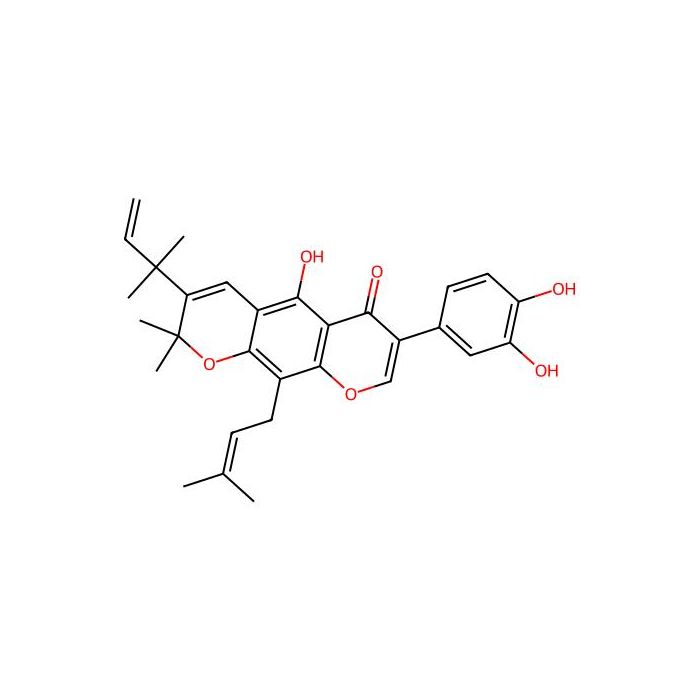
This compound belongs to the class of organic compounds known as 6-prenylated isoflavanones. These are isoflavanones featuring a C5-isoprenoid unit at the 6-position.
External Descriptors
Not available
1. Djoumbou Feunang Y, Eisner R, Knox C, Chepelev L, Hastings J, Owen G, Fahy E, Steinbeck C, Subramanian S, Bolton E, Greiner R, and Wishart DS. ClassyFire: Automated Chemical Classification With A Comprehensive, Computable Taxonomy. Journal of Cheminformatics, 2016, 8:61.
Determine the necessary mass, volume, or concentration for preparing a solution.
Dilution Calculator
Determine the dilution needed to prepare a stock solution.
Reconstitution Calculator
리뷰
고객 리뷰
Application Protocols
There are no product-specific, validated application protocols provided in the Product Data. The following generalized procedures apply to small-molecule handling; adapt to your assay or workflow.
Stock preparation (general)
Weigh the compound quickly under low light. Dissolve in anhydrous DMSO to prepare a concentrated stock (e.g., 10 mM). Vortex and, if needed, sonicate briefly. Filter through 0.2 µm PTFE for LC–MS uses.
Aliquot into amber vials or plates, purge with inert gas, and store at −80 °C. Avoid repeated freeze–thaw.
Working solutions (general)
Dilute into assay buffer or media, ensuring final organic cosolvent ≤0.5–1% v/v unless otherwise validated.
Include vehicle controls and, where possible, positive controls relevant to the assay endpoint.
Analytical confirmation (general)
Verify concentration by UV–Vis (if chromophore known) or quantitative NMR/LC–MS using an internal standard.
These are non-binding, general recommendations. For any protocol-specific requirements, consult your method SOPs and the compound’s CoA/SDS.
Biological Roles
No item-specific biological function data are provided in the Product Data. The following notes provide general context relevant to small-molecule research compounds and natural products; they are not specific claims about Flemiphilippinin A.
General context (not product-specific)
Many natural products and their analogs are investigated for interactions with enzymes, receptors, ion channels, or as modulators of cellular pathways in vitro. Such studies require well-characterized stocks, appropriate controls, and concentration–response designs.
If the compound is of plant origin (as some similarly named entities are), researchers often investigate antioxidant capacity, enzyme inhibition, or metabolic stability. These activities are assay-dependent and must not be presumed.
Experimental best practices
Confirm identity and purity by orthogonal methods (LC–MS, NMR) prior to biological testing.
Establish solubility and aggregation thresholds in assay buffers (use DLS or detergent controls) to avoid false positives.
Track stability under assay conditions (light, temperature, protein binding) using time-course LC–MS.
Reporting and compliance
Document solvent percentages (e.g., final DMSO ≤0.5–1% v/v), plate map layouts, and controls (vehicle, positive, negative) to ensure reproducibility.
Item-specific pharmacology, targets, or pathway roles are not specified for this item; consult the literature tied to the CAS/CID if needed. For research use only.
Buffer Applications
This product is a small organic molecule and is not a buffering reagent. No item-specific pKa or buffering range data are provided.
Applicability
Not typically used to prepare buffer systems.
Practical note (general)
When formulating assay media that include small-molecule stocks, select an appropriate buffer (e.g., PBS, HEPES, Tris) based on the biological target and pH requirement. Maintain low levels of organic cosolvent (e.g., DMSO ≤1% v/v) to minimize perturbation of buffer capacity and biological readouts.
For buffering recipes and pH ranges, refer to standard buffer components; this compound is not intended for that purpose.
Green Alternatives
In the absence of item-specific solvent and process requirements, the following green chemistry considerations apply generally to handling small molecules in research settings.
Solvent selection hierarchy (general; not product-specific)
Prefer bio-based or lower-toxicity solvents where feasible: 2-MeTHF over THF; CPME or EtOAc over DCM; MeCN or EtOAc over chloroform; supercritical CO2 for extractions when applicable.
Comparison summary (general)
2-MeTHF vs THF: 2-MeTHF is derived from renewable resources, exhibits lower miscibility with water, and can offer improved phase separations. Tradeoff: different peroxide formation profile; still monitor and test for peroxides.
CPME vs DCM: CPME reduces halogenated waste and often supports similar reaction profiles with better safety; watch for azeotrope behavior and boiling point differences.
EtOAc/IPA mixtures for workups: Reduce reliance on chlorinated solvents while maintaining extraction efficiency.
Energy and waste minimization
Run reactions at ambient temperature and concentrate under reduced pressure at the lowest practicable bath temperature to reduce thermal stress on light/air-sensitive compounds.
Use microscale screening to minimize material use during solvent selection and condition scouting.
Stabilization and storage
Employ amber vials, low-temperature storage, and minimal headspace to extend shelf life, thereby reducing the need for repeated syntheses or purchases.
Note: No process-specific greener substitutions can be made for this item without a defined use case and structural data.
Pharmaceutical Uses
No item-specific excipient role, compendial status, or GMP grade is provided in the Product Data.
Applicability
This product is supplied for research use only. It is not indicated as an excipient, not accompanied by pharmacopeial monographs, and not suitable for human or veterinary use.
General laboratory/pharmaceutical research context (not product-specific)
Small molecules like this may serve as analytical reference standards, discovery leads, or tool compounds in preclinical studies. Any formulation exploration (e.g., solubilization with cyclodextrins, lipid vehicles) should remain strictly non-clinical and comply with institutional policies.
If conducting preformulation research, characterize solubility across pH, stability (hydrolysis, oxidation, photolysis), and polymorphism where applicable.
Documentation
For any regulated or GLP-adjacent activity, obtain a batch-specific CoA, SDS, and traceability documents. No such designations are stated for this item.
Physical Properties
Only item-specific properties listed in Product Data are reported as such. Where general method guidance is offered, it is explicitly labeled as general practice and not a specification for this item.
Item-specific (Product Data)
Appearance: Not specified for this item; refer to CoA/Spec Sheet.
Molecular Weight: Not specified for this item; refer to CoA/Spec Sheet.
Thermophysical (literature/general guidance; not product-specific)
Melting point, boiling point, density, refractive index, logP/logD, pKa: Not specified for this item; refer to CoA/Spec Sheet or primary literature associated with the CAS/CID above.
Solubility (general laboratory approach; not product-specific)
Begin with analytical-grade DMSO to prepare a concentrated stock (e.g., 10–50 mM) for bioassays or screening; if incompatible, screen polar protic (MeOH, EtOH), polar aprotic (MeCN, DMF), and nonpolar (EtOAc, toluene) systems.
For aqueous work, consider cosolvent systems (DMSO or EtOH at 0.5–2% v/v) or cyclodextrin inclusion as general strategies. Final solvent selection should be verified experimentally.
Analytical characterization (general guidance)
Use LC–MS and high-resolution MS to confirm identity; 1H/13C NMR where solubility permits. Record temperature and solvent to enable reproducibility.
Note: All numerical property values (mp, bp, solubility limits, extinction coefficients, etc.) are not specified for this item; consult the CoA/Spec Sheet.
Quality and Grades
Item-specific (from Product Data)
Grade/Purity: Not specified for this item; refer to CoA/Spec Sheet.
Guidance on interpreting grade/purity (general; not product-specific)
Research-grade vs. analytical grades: Research-grade materials are typically suitable for discovery biology/chemistry. Analytical (HPLC/LC–MS) grades emphasize low nonvolatile residue and minimal UV-absorbing impurities for trace analysis.
Purity reporting: For small molecules, purity is often reported as HPLC area% with a specified method. Confirm the detection wavelength(s) and gradient used, as these strongly influence reported values.
Residual solvents/water: Karl Fischer moisture, GC residual solvent panels, and TGA can be relevant to solid natural products; obtain these from the CoA if critical.
Identity confirmation: Corroborate via LC–MS (ESI±), 1H/13C NMR, and HRMS (exact mass) per your method requirements. Compare against reference spectra if available.
Stabilizers/additives: If the item contains stabilizers or is supplied as a solution, this would be declared on the CoA. None are specified in the Product Data.
Practical recommendations
Request the batch-specific CoA before regulated use or for method validation.
If optical purity or regioisomeric composition matters, confirm via chiral HPLC or 2D NMR techniques as appropriate.
For screening libraries, document the exact lot and analytical trace used to derive concentration and purity assumptions.
Reaction and Applications
Item-specific (from Product Data)
Category: Small-molecule/compound library entry for research use.
Manufacturer applications: Not specified beyond research use; expandability discussed below as general guidance.
General research applications for small-molecule natural products/analogs (not product-specific)
Reference standard: Use as a reference compound for analytical comparison (LC–MS retention, MS/MS spectra) when studying plant extracts or biosynthetic samples bearing the same CAS/CID.
Chemical biology screening: Evaluate in phenotypic or target-based assays. Prepare well-characterized DMSO stocks, confirm identity by LC–MS, and monitor stability over the assay window.
Metabolite identification and biotransformation: Employ as a substrate for enzyme panels or microbial cultures to map transformation products; analyze with HRMS.
Derivatization studies: If functional groups allow, perform selective acylation, methylation, or hydrogenation to generate SAR-relevant analogs. Reaction feasibility must be confirmed once the exact structure is in hand.
Practical tips (general)
Verify purity and identity immediately upon receipt (LC–MS, 1H NMR). Record chromatographic conditions to aid reproducibility.
If photosensitive, keep reactions and assays shielded from light (amber glassware, low-light conditions). Work under inert atmosphere if oxidation is a risk.
Note: Without the explicit structure, specific named transformations or reactivity patterns cannot be asserted for this item; consult primary literature for Flemiphilippinin A once structural details are confirmed.
Reaction Conditions
No reaction condition data are specified for this item. The following general considerations apply when handling small, potentially sensitive organic molecules in synthesis or analytical sample prep; they are not specifications for this product.
Environmental control (general)
Light/oxygen sensitivity: Work under subdued light in amber glassware; consider inert atmosphere (N2/Ar). Maintain low temperatures during prolonged manipulations.
Solvent and temperature selection
Start with mild, anhydrous conditions in polar aprotic media (DMSO, DMF, MeCN) for coupling or derivatization reactions, or alcohols (MeOH/EtOH) for solvolysis/esterification chemistry as appropriate once the structure is known.
Typical screening ranges: 0–40 °C for stability assessments; 20–80 °C for mild transformations. Higher temperatures only after confirming thermal stability.
Catalysts/reagents (illustrative, not product-specific)
For acylations/alkylations of phenolic/alcoholic groups: carbodiimides (EDC/DIC) with DMAP, or alkyl halides with base (K2CO3, Cs2CO3) under anhydrous conditions.
For hydrogenation of alkenes/aromatics: Pd/C or PtO2 at 1–3 bar H2, room temperature to 50 °C; monitor closely.
Analytical monitoring
Use LC–MS and TLC for rapid assessment; quench and work up under low light if photolabile. Record exact conditions for reproducibility.
All numeric yields, times, and specific conditions must be established experimentally for this item; none are provided in the Product Data.
Safety and Handling
Safety data specific to this catalog item are not provided in the Product Data; therefore, treat Flemiphilippinin A as a research chemical of unknown hazard profile. Follow institutional chemical hygiene plans and consult the SDS when available.
Item-specific (from Product Data)
Storage: Protect from light; store at −80 °C.
Shipping: Dry ice packs + cold packs.
GHS classification, signal word, pictograms, H-statements: Not specified for this item; refer to SDS.
General laboratory precautions (not product-specific)
PPE: Lab coat, safety glasses, and suitable chemical-resistant gloves (e.g., nitrile). Handle in a fume hood to minimize inhalation exposure.
Avoid contact with skin/eyes and inhalation of dust or aerosols. Prevent environmental release.
Incompatibilities: Until known, segregate from strong oxidizers, strong acids/bases, and reactive reducing agents. Avoid prolonged exposure to light, heat, and moisture.
First-aid overview (general)
Inhalation: Move to fresh air; seek medical attention if symptoms develop.
Skin/eye contact: Rinse with water for at least 15 minutes; remove contaminated clothing; obtain medical advice.
Ingestion: Rinse mouth; do not induce vomiting; seek medical attention.
Handling tips for light/temperature-sensitive small molecules (general)
Work quickly on ice or at reduced temperature when feasible. Use amber vials, foil wrapping, and low-light conditions. Purge headspace with inert gas (N2/Ar) for long-term stability.
Definitive safety classification must be taken from the product SDS.
Solvent Selection
Item-specific solubility data are not provided. The following is a structured, non-binding approach suitable for many small organic molecules; confirm empirically for this compound.
General polarity considerations (not product-specific)
Start with high-donor-number polar aprotic solvents (DMSO, DMF) for stock solutions, given their broad solvating power.
If insoluble, test polar protic (MeOH, EtOH), then acetonitrile/acetone, and finally moderately polar organics (ethyl acetate, dichloromethane) or nonpolar aromatics (toluene) when appropriate.
Aqueous work
Use cosolvent systems (e.g., 0.5–2% DMSO or EtOH) or solubilization aids (surfactants, cyclodextrins) after verifying compatibility with the assay.
Practical workflow (general)
Perform a microscale solvent screen (ca. 1 mg in 1 mL) with gentle warming (<40 °C) and sonication. Record concentration at visible clarity.
Filter through 0.2 µm PTFE prior to chromatographic applications.
Choosing among common vehicles
DMSO: Broad solubility; compatible with many bioassays at ≤0.5–1% v/v final.
MeOH/EtOH: Useful for spectroscopy and TLC prep; volatile for easy removal.
MeCN: LC–MS friendly, lower viscosity than DMSO.
Stability considerations
Given the specified need for light protection and −80 °C storage, prepare aliquots in amber vials, minimize freeze–thaw cycles, and consider inert atmosphere storage to preserve integrity.
Note: No item-specific solubility numbers are supplied; refer to CoA/Spec Sheet.
Storage and Reconstitution
Item-specific (from Product Data)
Storage conditions: Protect from light; store at −80 °C.
Shipping: Dry ice packs + cold packs.
Reconstitution (not product-specific; general guidance)
Solvent: If no solvent is specified on the CoA, begin with anhydrous DMSO to prepare a concentrated stock (e.g., 10 mM). Alternative solvents (MeOH, EtOH, MeCN) may be screened if DMSO is unsuitable.
Technique: Allow container to equilibrate to room temperature in the dark before opening to avoid moisture condensation. Weigh quickly, dissolve with gentle vortexing/sonication, and filter for analytical use if needed.
Aliquoting: Dispense single-use aliquots in amber vials/microtubes. Minimize headspace; optionally blanket with inert gas (N2/Ar).
Stability (general considerations)
Light/air sensitivity suggested by storage instructions: minimize exposure during handling, use amber glassware/foil, and limit time at ambient temperature. Avoid repeated freeze–thaw cycles; thaw on ice and refreeze promptly.
Shelf life
Not specified for this item; refer to CoA/Spec Sheet. Periodically re-check purity by LC–MS or HPLC after extended storage.
All item-specific parameters not explicitly listed above are Not specified for this item; refer to CoA/Spec Sheet and SDS for authoritative guidance.
Structure and Identity
Brief overview: Flemiphilippinin A is listed as a small-molecule research chemical. Structural identifiers in the Product Data are incomplete; therefore, only verified catalog facts are reported below and all other values are left unspecified or discussed as general/literature context.
Item-specific (from Product Data)
SKU: F646545
Product Name: Flemiphilippinin A
CAS: 140366-64-9
PubChem CID: 10074228
InChIKey: 374928 (as provided; note: not in standard 27-character InChIKey format)
SMILES: Not specified for this item; refer to CoA/Spec Sheet.
Molecular Formula: Not specified for this item; refer to CoA/Spec Sheet.
Molecular Weight: Not specified for this item; refer to CoA/Spec Sheet.
Structural features
2D/3D description: Not available in the Product Data. No structure-diagram or stereochemical assignment is provided here.
Notes
If a definitive structure (SMILES/InChI) is required for cheminformatics or analytical method development, request the current CoA/Spec Sheet or consult the cited CAS/CID records to retrieve a vetted structural representation before use.
Any substructure, ring system, or stereochemical commentary would be speculative in the absence of a provided structure; none is given here.
Synthetic Utility
Without a provided structure, specific synthetic transformations for Flemiphilippinin A cannot be asserted. The following outlines general strategies for leveraging small molecules of unknown or literature-defined structure in synthetic and analytical workflows.
General utility (not product-specific)
Reference/benchmark material: Validate analytical methods (LC–MS retention, MS/MS spectra, derivatization profiles) relevant to the compound’s class once structure is confirmed.
Semisynthesis/derivatization: If functional handles are present (e.g., phenols, alkenes, carbonyls), typical modifications include O-alkylation/acylation, hydrogenation/oxidation of alkenes, or formation of carbamates/urethanes to probe SAR.
Protecting-group strategies: Phenolic groups (if present) can be masked (Bn, MOM, silyl) to enable site-selective transformations; deprotection conditions should be selected to preserve sensitive motifs.
Analytical synthetic support
Prepare isotopically labeled surrogates (e.g., 13C/2H) where mass-balance studies or quantitative LC–MS are required.
Caution
All derivatization plans must be validated against the actual structure and stability profile. Given the storage guidance (light-sensitive, −80 °C), avoid harsh conditions and consider inert, low-temperature protocols.
Item-specific functional group reactivity, named reactions, and retrosynthetic disconnections are not stated here due to lack of structural data; consult literature tied to CAS 140366-64-9.
Target Specificity
Target specificity is not applicable to this product in the immunoassay/biologic sense.
Item-specific (from Product Data)
No antibody/biologic attributes (antigen, clone, isotype, species reactivity) are provided or expected for this small-molecule item.
Note
If used as a chemical probe in target-based studies, specificity must be determined empirically (binding assays, enzymology, chemoproteomics). No target information is provided here.
자주 묻는 질문
What is the purity of this product?
This product is supplied at ≥98% purity (chemical assay). Lot-specific values are stated on the Certificate of Analysis.
How should this product be stored?
Store at ?80 °C, protected from light. The material is light-sensitive — keep it in its original opaque or amber container.
How is this product shipped?
This product ships frozen with dry ice and cold packs. Unpack on arrival and transfer it to the storage condition stated above; handle dry ice with insulated gloves in a ventilated area.
What are the CAS number, molecular formula and molecular weight?
The CAS Number is 140366-64-9, the molecular formula is C30H32O6, and the molecular weight is 488.57 g/mol. InChIKey VBTMMYSERQFPPK-UHFFFAOYSA-N.
What documentation is provided?
Available product documentation, including Certificates of Analysis (COA), Safety Data Sheets (SDS), and specification sheets, is shown in the product document area. Document availability and access follow the current site policy.
Products are supplied to verified businesses, institutions, and qualified professionals for research and development use only. Not for use in humans, animals, diagnosis, or therapy.