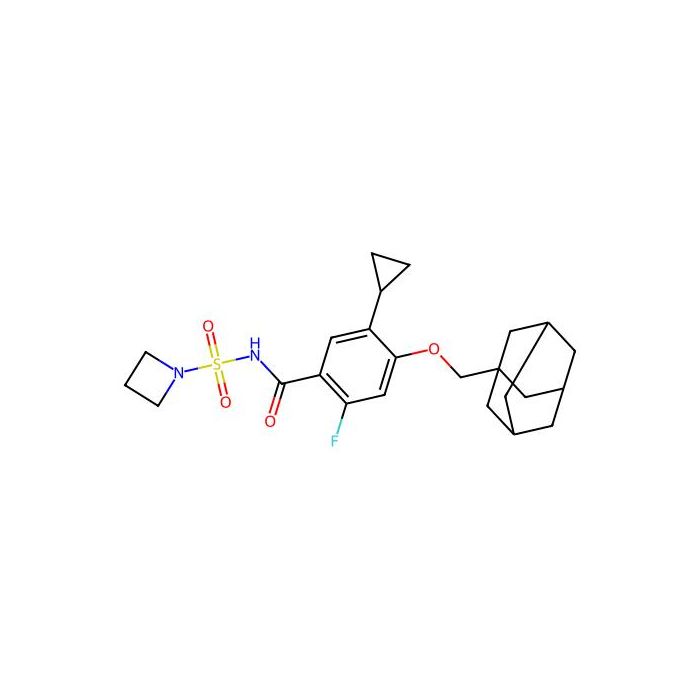
GDC-0276 is a potent, selective, reversible and orally active NaV1.7 inhibitor with an IC 50 value of 0.4 nM. GDC-0276 is well tolerated and exhibits a good pharmacokinetic profile. GDC-0276 has the potential for the treatment of pain and to address shortcomings of existing pain medications, such as addiction and off-target side effects
In Vivo
GDC-0276 (oral adminstration; 0.5-5 mg/kg) shows enrichment of 14 C with observed specific activities of 22.6 µCi/mg. GDC-0276 is not detected in urine; however, metabolites in urine were enriched in 14 C with observed specific activities of 19.6 µCi/mg. MCE has not independently confirmed the accuracy of these methods. They are for reference only. Animal Model: Six drug-naïve beagle dogs Group 1 four dogs (n=2 per sex) and Group 2 2 BDC dogs (n=2 male)Dosage: 0.5, 1, 2, 3, 4, 5 mg/kg Administration: Oral adminstration Result: Showed mean specific activities of 12.2 µCi/mg (a 24% enrichment) (n=4 animals) and 23.5 µCi/mg (a 139% enrichment) (n=2 animals) for Groups 1 and 2, respectively.
IC50& Target:Nav1.7
사양
사양 및 순도
10mM in DMSO
생화학 및 생리적 메커니즘
GDC-0276 is a potent, selective, reversible and orally active NaV1.7 inhibitor with an IC 50 value of 0.4 nM. GDC-0276 is well tolerated and exhibits a good pharmacokinetic profile. GDC-0276 has the potential for the treatment of pain and to address short
보관 조건
Store at -80°C
배송
Dry ice packs + Cold packs
이 제품은 콜드 체인 배송이 필요합니다.지상 및 기타 경제 서비스는 사용할 수 없습니다.
작업 유형
INHIBITOR
이름과 식별자
분자량
462.58
고급 데이터
인증서(CoA, COO, BSE/TSE 및 분석 차트)
C of A & Other Certificates(BSE/TSE, COO):
Analytical Chart:
솔루션 계산기
Molarity Calculator
Determine the necessary mass, volume, or concentration for preparing a solution.
Dilution Calculator
Determine the dilution needed to prepare a stock solution.
Reconstitution Calculator
리뷰
고객 리뷰
Application Protocols
No tested/validated application protocols are provided in the Product Data for this item. The following are not specifications.
Validated applications (WB, IHC, IF, FC, enzymology, etc.): Not specified for this item; refer to CoA/Spec Sheet.
Recommended concentrations/dilutions: Not specified for this item; determine empirically for your assay format.
Users should develop assay-specific SOPs that include:
Vehicle-matched controls, solubility/stability checks, and documentation of final co-solvent levels.
Verification of linear response ranges and replication to support reproducibility.
For any formal protocol, rely on your lab’s validated methods and the product’s CoA/SDS.
Biological Roles
Item-specific biological targets, pathways, and roles are not provided in the Product Data for GDC-0276.
General context for small-molecule research compounds:
Such compounds are used to probe cellular pathways, enzyme function, protein–protein interactions, and phenotypes. Without verified target information, GDC-0276 should be treated as an uncharacterized probe within your experimental system.
Biological roles (e.g., participation in metabolic networks or signaling cascades) are not inherent to this compound absent a known endogenous counterpart or validated target.
If published data exist for CAS 1494581-70-2, consult the primary literature for target annotations, off-target profiles, permeability, and metabolic stability. Do not extrapolate from other GDC-series compounds.
Good practices:
Use orthogonal assays (biochemical vs. cellular) to evaluate on-target effects versus general cytotoxicity or assay interference.
Maintain solvent-matched controls and include counter-screens against common assay artifacts (e.g., redox cycling, aggregation). Detergent (0.01–0.05% Triton X-100 or Tween-20) can help diagnose aggregation-based effects.
Confirm dose–response reproducibility across biological replicates and, where relevant, in multiple cell lines or enzyme isoforms.
This product is for research use only and not intended for diagnostic, therapeutic, or clinical use.
Buffer Applications
GDC-0276 is not a buffering agent and has no specified acid/base properties in the Product Data.
Practical considerations for using this compound in buffered assays (general guidance):
Prepare a concentrated organic stock (commonly DMSO) and dilute into the assay buffer to achieve the desired final concentration with ≤0.1–0.5% organic co-solvent where possible.
Confirm solubility upon dilution; monitor for precipitation or turbidity. Gentle sonication and slow addition with vortexing can help.
If ionizability is suspected but unknown, evaluate solubility and activity in bracketed pH buffers (e.g., citrate pH 3–6, phosphate pH 6–8, borate pH 8–10) to identify pH effects, taking care not to infer pKa without data.
Include vehicle controls matched for DMSO percentage and pH.
No specific buffer recipes or pH ranges are provided for this item. For definitive compatibility and stability information, refer to the CoA/Spec Sheet and perform small-scale pretests.
Green Alternatives
In the absence of item-specific solvent requirements, greener choices can be considered for stock preparation and processing where feasible.
General comparison (literature-based):
| Use-case | Conventional option | Greener alternative | Notes |
|---|---|---|---|
| Concentrated stock solutions | DMSO | DMSO (already comparatively favorable) | DMSO is widely accepted and relatively benign; ensure low assay carryover. |
| Dissolution screening for hydrophobic compounds | DMF, NMP | Cyrene (dihydrolevoglucosenone), GVL | Check chemical stability and assay compatibility; viscosity may affect handling. |
| Mid-polar solvation | Acetonitrile | Ethyl acetate, Propylene carbonate | EA not water-miscible; PC is polar aprotic with favorable EHS profile. |
| Hydrophobic handling | THF | 2-MeTHF, CPME | Lower peroxide tendency vs Et2O; still assess peroxide formation and stability. |
Trade-offs to consider:
Assay compatibility: Some greener solvents (e.g., Cyrene, GVL) may impact enzyme activity or cell health at low percentages; validate carryover limits.
Stability: Verify chemical stability of GDC-0276 in any alternative solvent by LC–MS/NMR (no assumptions can be made without structure).
Supply chain and purity: Ensure analytical-grade material with known residuals and low UV background for detection-based assays.
Greener operations beyond solvent choice:
Minimize solvent volumes via high-concentration stocks, miniaturized assays, and automation to reduce waste.
Employ closed containers and cold storage to extend solution lifetime, thereby reducing re-prep frequency.
Pharmaceutical Uses
No pharmaceutical, clinical, or excipient uses are provided or implied for this product.
Status: For research use only. Not for human or veterinary use, not for diagnostic or therapeutic applications.
Pharmacopeial status: Not specified for this item; refer to CoA/Spec Sheet if relevant to your internal QA documentation.
Research/development context (general):
Compounds of this class may be utilized in preclinical discovery workflows (e.g., target validation, mechanism studies, SAR). However, no claims are made here regarding GDC-0276’s suitability for formulation, ADME, or in vivo use.
If formulation studies are undertaken internally, establish fit-for-purpose analytical methods (potency assay, purity profile, residual solvents, stability indicating methods) and observe institutional EHS governance.
No medical or therapeutic claims are made. Use is restricted to controlled laboratory research settings.
Physical Properties
Key item-specific physical property data are not included in the provided Product Data.
Appearance: Not specified for this item; refer to CoA/Spec Sheet.
Melting point (mp): Not specified for this item; refer to CoA/Spec Sheet.
Boiling point (bp): Not specified for this item; refer to CoA/Spec Sheet.
Density: Not specified for this item; refer to CoA/Spec Sheet.
Refractive index: Not specified for this item; refer to CoA/Spec Sheet.
Solubility: Not specified for this item; refer to CoA/Spec Sheet.
LogP / cLogP: Not specified for this item; refer to CoA/Spec Sheet.
pKa: Not specified for this item; refer to CoA/Spec Sheet.
Practical handling notes (general, literature-based for discovery compounds):
Many library compounds are non-volatile solids at room temperature and are often handled as DMSO stock solutions (e.g., 1–50 mM) for screening. Actual solubility limits for GDC-0276 must be verified experimentally or via the CoA.
If aqueous work is required, solubilization typically uses co-solvent systems (e.g., DMSO → aqueous buffer with 0.1–1% final DMSO), or pH adjustment if the compound possesses ionizable groups. Do not assume ionizability for this item in the absence of structure.
Hygroscopicity, polymorph form, and thermal stability are not specified. Avoid moisture and heat until item-specific data are confirmed.
Always rely on the product’s CoA/Spec Sheet and SDS for definitive, item-specific physical properties and handling limits.
Quality and Grades
Item-specific quality attributes are not disclosed in the Product Data.
Grade / Purity: Not specified for this item; refer to CoA/Spec Sheet.
Stabilizers / Additives: Not specified for this item; refer to CoA/Spec Sheet.
Form (solid, film, solution): Not specified for this item; refer to CoA/Spec Sheet.
Interpretation and best practices (general for screening compounds):
Discovery/library compounds are typically supplied at research grade, suitable for in vitro assays and medicinal chemistry workflows. When HPLC or LC–MS purity is required (e.g., ≥95%), confirm the numeric specification on the CoA.
If provided as a dry film or lyophilized solid, brief equilibration to room temperature before unsealing minimizes condensation. If supplied as a DMSO stock, confirm concentration and any stabilizers.
For sensitive bioassays (enzymology, cell-based screening), request or review supporting analytical data (HPLC trace, LC–MS, NMR) and residual solvent information as needed.
Absence of specified metal content, water content, peroxides, or UV cutoff means these parameters are not controlled for this item; verify fitness-for-use experimentally if your application is sensitive.
For definitive specifications, consult the product’s Certificate of Analysis (CoA) or specification sheet.
Reaction and Applications
This product is positioned as a research compound within a small-molecule/compound library rather than as a synthetic reagent. Accordingly, its primary use-cases are in discovery and screening workflows rather than as a stoichiometric or catalytic component in chemical transformations.
Typical research applications (general guidance):
Biochemical/biophysical assays: Evaluate activity in enzyme inhibition/activation, binding studies (e.g., SPR, MST, DSF), or target engagement assays. Confirm assay compatibility with any organic co-solvents.
Cell-based assays: Probe phenotypes, pathway modulation, or cytotoxicity. Maintain consistent DMSO carryover in controls and treatment wells to decouple solvent effects.
Profiling and counterscreens: Use diverse panels (off-targets, orthogonal readouts) to delineate specificity and mechanism hypotheses. Apply dose–response curves with appropriate hill-slope models.
Chemical biology: If derivatizable, consider photoaffinity or biotinylated analogs for pulldown/chemoproteomics (requires known structure; not available here).
Practical tips:
Prepare fresh aliquots of concentrated stock (e.g., 10–50 mM in DMSO), protect from moisture/light as prudent, and avoid repeated freeze–thaw.
Confirm compound integrity over assay timelines (e.g., LC–MS stability in buffer ± co-solvent; adsorption checks in plastic vs glass).
Note: No target class or mechanism is specified for GDC-0276 in the Product Data; avoid inferring biological activity without direct evidence or documentation.
Reaction Conditions
Not typically applicable. GDC-0276 is offered as a research compound, not as a reagent or catalyst for chemical synthesis.
General notes if chemical manipulation is attempted (structure-dependent; not item-specific):
Choose anhydrous, oxygen-free conditions only as justified by the known functional groups. Many drug-like molecules are compatible with mild coupling (amide formation, SNAr) but may not withstand strong acids/bases or oxidants.
Solvent choice should follow empirical solubility: DMSO/DMF/Acetonitrile for polar chemistry; 2-MeTHF/CPME/Toluene for hydrophobic scaffolds. Confirm stability by LC–MS.
Reaction temperatures, catalysts, and times are wholly structure-dependent and cannot be prescribed without the disclosed scaffold.
Because no structure or reactivity is provided for this item, no literature yields or named-reaction conditions are presented here.
Safety and Handling
No GHS hazard classifications or statements are provided in the Product Data for this item.
Signal Word: Not specified for this item; refer to SDS.
H-Statements: Not specified for this item; refer to SDS.
GHS Classification: Not specified for this item; refer to SDS.
Pictograms: Not specified for this item; refer to SDS.
General laboratory safety guidance (use until SDS is reviewed):
Handle as a potentially hazardous research chemical. Use in a chemical fume hood and avoid inhalation, ingestion, and skin/eye contact.
Wear appropriate PPE: lab coat, safety glasses, and suitable chemical-resistant gloves (e.g., nitrile). Change gloves frequently when working with DMSO solutions due to enhanced dermal penetration of solutes.
Prevent exposure to oxidizers, strong acids/bases, and incompatible materials; unknown reactivity profiles warrant conservative segregation.
Avoid aerosolization and dust formation. For solutions, cap tightly to limit volatilization of co-solvents and water uptake.
In case of skin/eye contact, rinse with water for at least 15 minutes and seek medical attention per institutional protocols. If inhaled, move to fresh air; if ingested, seek medical assistance. Always follow your institution’s emergency procedures.
Dispose of waste according to local regulations; treat as organic chemical waste unless otherwise specified by SDS.
Authoritative safety information resides in the Safety Data Sheet (SDS). Always consult the SDS provided for your specific lot.
Solvent Selection
With no structure or solubility data provided, solvent choice should follow a tiered, empirical approach suitable for small-molecule library members.
Recommended decision path (general):
Start with DMSO for primary stock solutions due to broad solvency for drug-like molecules and cell-compatibility at low carryover (≤0.1–0.5%).
If DMSO is inadequate, screen polar aprotics: DMF, NMP, Acetonitrile, Acetone. For particularly lipophilic compounds, consider THF, 2-MeTHF, or CPME. Verify chemical compatibility.
For aqueous use, introduce stock solutions into buffer with gentle vortexing/sonication; keep final organic co-solvent ≤0.5–1% for sensitive cells/enzymes.
Where ionizable groups are suspected, test buffered systems at pH 2–3 (acidic) and pH 9–10 (basic) to identify pH-enhanced solubility (do not assume ionizability for this specific item).
Compact comparison (general literature attributes):
DMSO: very broad solvency; biologically tolerated ≤0.5–1% v/v; hygroscopic; can enhance dermal absorption.
DMF/NMP: strong solvents; use caution for toxicity and regulatory constraints; not preferred for biological assays.
Acetonitrile: volatile, miscible with water; moderate solvency for mid-polar compounds.
2-MeTHF/CPME: greener ethers; limited water miscibility; good for hydrophobic molecules; check stability.
Always verify absence of precipitation after dilution, and filter (0.2 µm PTFE/NYLON) only if the compound is not adsorptive/unstable to the membrane.
Storage and Reconstitution
Item-specific storage conditions and shipping modalities are provided; reconstitution details are not.
Storage (as supplied): Store at -80°C (per Product Data). Keep container tightly closed. Protect from moisture and, if applicable, light (not specified—protect as a precaution).
Shipped in:Dry ice packs + Cold packs (per Product Data) to maintain low temperature during transit.
Appearance: Not specified for this item; refer to CoA/Spec Sheet.
General reconstitution guidance for small-molecule library compounds (not item-specific):
Allow the vial to equilibrate to room temperature in a desiccator before opening to minimize condensation.
Prepare a concentrated stock in a suitable solvent (commonly DMSO). Filter sterilization only if required and compatible.
Aliquot into single-use portions (e.g., 10–50 µL) in low-bind tubes to avoid repeated freeze–thaw.
Store solutions at -80°C when possible; avoid more than 2–3 freeze–thaw cycles. Record preparation date, solvent, and concentration on the vial label.
Inspect for precipitation or discoloration before use; confirm integrity by LC–MS or HPLC if data quality is critical.
For authoritative instructions on stability, shelf life, and reconstitution solvents/concentrations, consult the CoA/Spec Sheet and SDS for this specific lot.
Structure and Identity
Brief overview: GDC-0276 is offered as a research-only small-molecule/compound-library member. Structural details for this specific SKU are not disclosed in the provided Product Data.
Product Name: GDC-0276
SKU: G656623
CAS: 1494581-70-2
Category: Small molecules and compound libraries (研究/筛选用途)
Molecular Formula: Not specified for this item; refer to CoA/Spec Sheet.
Molecular Weight: Not specified for this item; refer to CoA/Spec Sheet.
SMILES: Not specified for this item; refer to CoA/Spec Sheet.
InChIKey: Not specified for this item; refer to CoA/Spec Sheet.
CID: Not specified for this item; refer to CoA/Spec Sheet.
Structural features (general notes):
Item-specific functional groups, ring systems, stereochemical elements, and 2D/3D depictions are not provided in the Product Data and should be obtained from the item’s CoA/Spec Sheet or primary literature associated with CAS 1494581-70-2.
Compounds labeled with the GDC- prefix are typically small-molecule research tools developed during discovery programs; however, without an item-specific structure here, no assumptions are made about pharmacophore or target class.
2D structure in words:
Not available for this listing. Please consult the Certificate of Analysis or specification sheet for definitive structure and identifiers.
Synthetic Utility
The Product Data position GDC-0276 as a finished small-molecule tool rather than a synthetic building block. Without a disclosed structure, specific functional-group-based reactivity or named-transformation utility cannot be assigned.
General considerations if derivatization is contemplated in your lab (structure required):
SAR exploration: Install conservative modifications (e.g., halogen swaps, methyl scans, heteroatom substitutions) to map potency vs. physicochemical property changes.
Tagged analogs: Design biotinylated, fluorophore, or photoaffinity derivatives by identifying solvent-exposed vector positions via modeling or crystallography (when available).
PROTAC/Degrader leads: If a robust warhead is identified, introduce a linker attachment handle (e.g., anilide, ether, amide, or aliphatic amine) at a metabolically stable position.
Isotopic labeling: 2H/13C/15N incorporation aids in metabolic tracing and quantitative MS.
Caveats:
Lacking the structure, avoid assuming reactive handles or stability to common conditions (acid/base, oxidation, hydrogenation).
Confirm synthetic feasibility and maintain the core scaffold to retain activity; verify by parallel biological testing.
Conclusion: In standard use, treat GDC-0276 as a research probe rather than a synthetic reagent. Any derivatization program requires access to the definitive chemical structure.
Target Specificity
Target information is not provided in the Product Data and should not be inferred.
Primary target / pathway: Not specified for this item; refer to CoA/Spec Sheet or primary literature for CAS 1494581-70-2.
Selectivity profile / off-targets: Not specified for this item; refer to CoA/Spec Sheet.
Species reactivity / cell line suitability: Not specified for this item; determine empirically based on your assay system.
Only validated, item-specific data from the manufacturer or peer-reviewed literature should be used to assign target specificity.
자주 묻는 질문
How should this product be stored?
Store at ?80 °C. Ultra-low temperature storage is required to maintain the specified shelf life.
How is this product shipped?
This product ships frozen with dry ice and cold packs. Unpack on arrival and transfer it to the storage condition stated above; handle dry ice with insulated gloves in a ventilated area.
What are the CAS number, molecular formula and molecular weight?
The CAS Number is 1494581-70-2, the molecular formula is C24H31FN2O4S, and the molecular weight is 462.58 g/mol.
What documentation is provided?
Available product documentation, including Certificates of Analysis (COA), Safety Data Sheets (SDS), and specification sheets, is shown in the product document area. Document availability and access follow the current site policy.
Products are supplied to verified businesses, institutions, and qualified professionals for research and development use only. Not for use in humans, animals, diagnosis, or therapy.