
Determine the necessary mass, volume, or concentration for preparing a solution.
| Activity Type | Activity Value -log(M) | Mechanism of Action | Activity Reference | Publications (PubMed IDs) |
|---|
Information
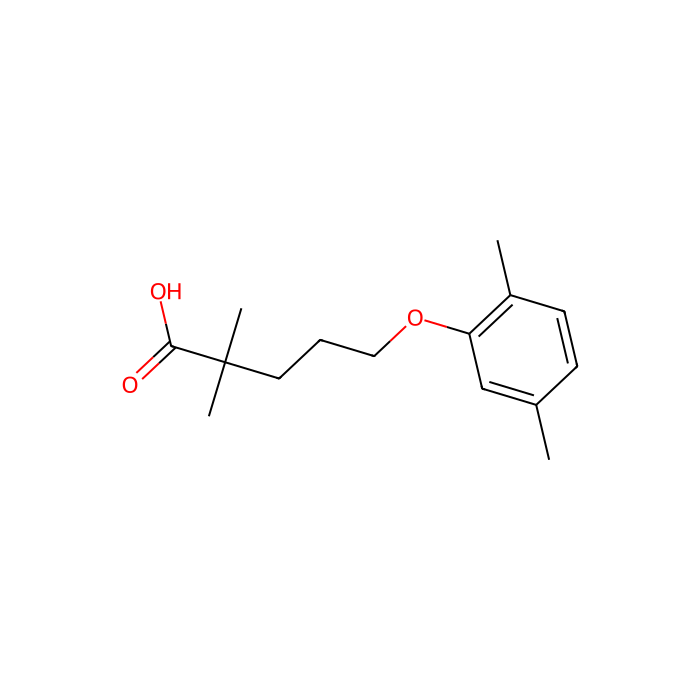
Gemfibrozil (CI-719) is an activator of peroxisome proliferator-activated receptor-alpha (PPARα), used for the treatment of hypercholesterolemia and hypertriglyceridemia.
In vitro
Gemfibrozil exerts a minimal inhibitory effect on CYP3A-mediated simvastatin hydroxy acid (SVA) oxidation, but does inhibit SVA glucuronidation in dog and human liver microsomes. Gemfibrozil markedly inhibits M-23 formation, with a K(i) (IC(50)) value of 69 (95) mM, whereas inhibition of M-1 formation is weaker with a K(i) (IC(50)) value of 273 mM in human liver microsomes. Gemfibrozil strongly and competitively inhibits CYP2C9 activity, with a K(i) (IC(50)) value of 5.8 (9.6) mM. Gemfibrozil exhibits somewhat smaller inhibitory effects on CYP2C19 and CYP1A2 activities, with K(i) (IC(50)) values of 24 (47) mM and 82 (136) mM, respectively. Gemfibrozil, a lipid-lowering drug, inhibits cytokine-induced production of NO and the expression of inducible nitric-oxide synthase (iNOS) in human U373MG astroglial cells and primary astrocytes. Gemfibrozil induces peroxisome proliferator-responsive element (PPRE)-dependent luciferase activity, which is inhibited by the expression of DeltahPPAR-alpha, the dominant-negative mutant of human PPAR-alpha. Gemfibrozil strongly inhibits the activation of NF-kappaB, AP-1, and C/EBPbeta but not that of gamma-activation site (GAS) in cytokine-stimulated astroglial cells.
In vivo
Gemfibrozil treatment significantly reduces (2-3-fold) the plasma clearance of SVA and the biliary excretion of SVA glucuronide (together with its cyclization product SV), but not the excretion of a major oxidative metabolite of SVA in dogs.
Cell Data
cell lines:HCT116, NCI-H460, BRO, GRANTA-519, HL-60, THP-1, and Raji
Concentrations:
Incubation Time:
Powder Purity:≥99%
| Activity Type | Activity Value -log(M) | Mechanism of Action | Activity Reference | Publications (PubMed IDs) |
|---|
| Activity Type | Activity Value -log(M) | Mechanism of Action | Activity Reference | Publications (PubMed IDs) |
|---|
Find and download the COA for your product by matching the lot number on the packaging.
| Lot Number | Certificate Type | 날짜 | 항목 |
|---|---|---|---|
 C2308520 | Certificate of Analysis | Oct 16, 2026 | G408708 |
| 용해성 | Solubility (25°C) In vitro |
|---|---|
| 끓는점(°C) | 159 °C/0.02 mmHg |
| 녹는점(°C) | 61 °C |
H351:Suspected of causing cancer
H411:Toxic to aquatic life with long lasting effects
H302:Harmful if swallowed
H361:Suspected of damaging fertility or the unborn child
P273:Avoid release to the environment.
P280:Wear protective gloves/protective clothing/eye protection/face protection.
P405:Store locked up.
P501:Dispose of contents/container to an approved waste disposal plant.
P264:Wash hands [and …] thoroughly after handling.
P270:Do not eat, drink or smoke when using this product.
P391:Collect spillage.
P330:Rinse mouth.
P203:Obtain, read and follow all safety instructions before use.
P301+P317:IF SWALLOWED: Get medical help.
P318:if exposed or concerned, get medical advice.
당사의 등급 선택 가이드는 카탈로그의 모든 변형 제품에 대해 순도, 안정제 상태 및 용도 적합성을 다룹니다.
Moligand™ 등급 가이드 보기 →