등급 & 순도Carrier Free?Carrier-free — supplied without added carrier protein/stabilizer. Use when carriers (e.g. BSA) would interfere with conjugation or sensitive assays.ExactAb™?ExactAb™ — Aladdin's antibody line emphasizing precision and validated quality. Use for reliable, specificity-validated antibody applications.Azide Free?Azide-free — without sodium azide preservative. Use in conjugations, cell work, or assays where azide is toxic or inhibitory.Validated?Validated grade — performance confirmed in defined applications before release. Use when you want documented assurance the reagent works as stated.High Performance?High-performance grade with optimized purity and performance characteristics. Use for sensitive analyses where ordinary grades fall short.PBS Only?PBS-only formulation — supplied in phosphate-buffered saline with no other additives. Use when you need a clean PBS buffer free of stabilizers/carriers.1.0 mg/mL
Carrier Free,ExactAb™,Azide Free,Validated,High Performance,PBS Only,1.0 mg/mL Azide Free,Carrier Free,ExactAb™,High Performance,PBS Only,Validated 최소한의 기준선 간섭이 필요한 민감한 크로마토그래피 및 분석 워크플로우용.
🌡
보관 및 배송
Store at -20°C,Avoid repeated freezing and thawing Ice chest + Ice pads 출고. 정확한 사양은 로트별 COA를 확인하세요.
📋
품질 문서
SDS, COA, 데이터시트, 사양서를 다운로드할 수 있습니다. 로트별 COA는 로트 번호 조회를 통해 확인할 수 있습니다.
📚
문헌적 근거
크로마토그래피, 유기 합성 및 교차 커플링 반응 분야의 동료 심사 논문 0편에서 인용되었습니다.
Recombinant full length protein corresponding to human GFAP
포지티브 제어
WB: Mouse Brain tissue lysate
변화
Unconjugated
등급
Azide Free, Carrier Free, ExactAb™, High Performance, PBS Only, Validated
아이소타입
IgG2a
라이트 체인 유형
lambda
SDS-PAGE
150 KDa
정화 방법
Protein A purified
집중력
1.0 mg/mL
Product Line
생물 제품
보관 및 배송
모양
Liquid
보관 조건
Store at -20°C,Avoid repeated freezing and thawing
배송
Ice chest + Ice pads
안정성 및 스토리지
Store at 4°C short term (1-2 weeks). Store at -20°C or -80°C. Avoid freeze / thaw cycle.
이미지
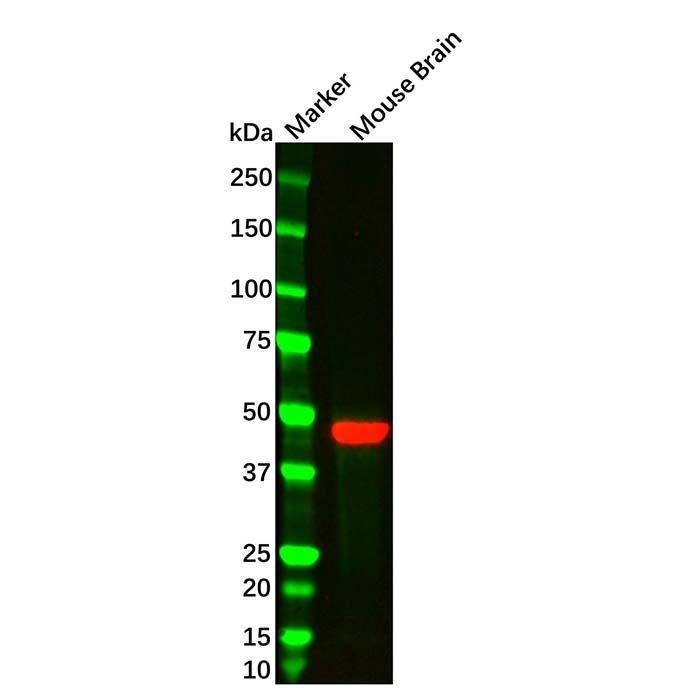
GFAP Mouse mAb (Ab156546) - Western Blot All lanes: GFAP Mouse Antibody (Ab156546) at 1/10000 dilution Samples: Lysates at 20 µg per lane Secondary: Goat Anti-Mouse IgG H&L (HRP) at 1/20000 dilution
Predicted band size: 50.0 kDa Observed band size: 45.8 kDa Exposure time: 60.5 s
Determine the necessary mass, volume, or concentration for preparing a solution.
Dilution Calculator
Determine the dilution needed to prepare a stock solution.
Reconstitution Calculator
리뷰
고객 리뷰
Application Protocols
Only item-specific, manufacturer-tested applications and parameters may be listed here.
Tested applications: Not specified for this item; refer to CoA/Spec Sheet.
Recommended dilutions/loads/incubations: Not specified for this item; refer to CoA/Spec Sheet.
Positive control materials: Not specified for this item; refer to CoA/Spec Sheet.
Secondary antibody guidance: Not specified for this item; refer to CoA/Spec Sheet.
Note: The product is labeled Validated / High Performance in Product Data, but the specific validation methods, sample types, and use conditions are not provided for this SKU.
Biological Roles
Target overview (literature/general)
GFAP (glial fibrillary acidic protein) is a type III intermediate filament protein predominantly expressed in astrocytes and certain glial cell types. It contributes to cytoskeletal integrity, cell shape, and mechanical resilience of astroglial networks.
Molecular and cellular roles (general)
Structural scaffold: Integrates with vimentin and other IF proteins to form dynamic networks that support organelle positioning and cellular polarity in astrocytes.
Signaling interfaces: Associates with kinases, phosphatases, and adaptor proteins, modulating responses to stress, injury, and developmental cues. Post-translational modifications (e.g., phosphorylation, cleavage) regulate filament assembly/disassembly.
Developmental context: GFAP expression patterns shift during gliogenesis and astrocyte maturation; often used as a lineage and differentiation marker in developmental neurobiology.
Neurobiology workflows: Widely deployed as a robust astrocytic marker in tissue mapping, cell sorting (after permeabilization), and quality control of stem cell–derived neural cultures.
Assay implications (general)
Epitope accessibility can differ between filamentous and soluble pools; fixation and retrieval conditions strongly influence detection in IHC/IF.
Item-specific note
This SKU targets GFAP per the product name. Species cross-reactivity, clone, epitope, and isotype are not specified for this item; consult CoA/Spec Sheet for those details.
Buffer Applications
Item-specific (from Product Data)
PBS Only formulation. Exact pH and ionic strength are not specified for this item; refer to CoA/Spec Sheet.
General buffer guidance for antibody workflows (literature/general)
Stock handling: Maintain the stock in PBS at neutral pH (≈7.2–7.4). For working solutions, PBS or TBS with 0.05% Tween-20 commonly reduces nonspecific binding in washes.
Blocking: Use 1–5% BSA, casein, or appropriate normal serum to block nonspecific sites in ELISA, WB, or IHC. Select blockers that do not introduce carrier proteins if you require carrier-free conditions at the stock level.
IHC/IF buffers: For permeabilization, 0.1–0.5% Triton X-100 or saponin may be used when compatible with epitope preservation; optimize fixation (PFA vs. methanol) for GFAP exposure.
pH range: Most IgG antibodies are stable near neutral pH; avoid prolonged exposure below pH ~6 unless using brief elution in affinity workflows followed by rapid neutralization.
Sterility: Azide-free formulations benefit from sterile filtration (0.22 µm) of working buffers and preparation of single-use aliquots to prevent microbial growth.
Recipes (general examples; adjust as needed)
PBS 1×: 137 mM NaCl, 2.7 mM KCl, 10 mM Na2HPO4, 1.8 mM KH2PO4; pH 7.4.
TBS 1×: 150 mM NaCl, 25 mM Tris; pH 7.5.
Note
When high-sensitivity detection is required, verify that buffer components do not interfere with your secondary/detection chemistry.
Green Alternatives
Applicability
Green chemistry substitution is generally less relevant for aqueous antibody reagents; however, sustainable practices can be applied to buffers and workflows.
General considerations (literature/general)
Preservatives: This item is Azide Free. If antimicrobial protection is needed, prefer low-toxicity alternatives (e.g., sterile filtration, small aliquots, refrigeration) over chemical preservatives. Sodium azide presents aquatic toxicity and waste-disposal concerns.
Buffer preparation: Use concentrated buffer stocks to minimize packaging/waste, and prepare working solutions with ultrapure water on demand to reduce expired waste.
Detergents: When surfactants are required, select readily biodegradable options at the lowest effective concentration.
Solid waste minimization: Employ low-bind, recyclable plastics where compatible; consolidate shipments to reduce cold-chain footprint.
Illustrative comparison (general)
Sodium azide (traditional) vs. sterile technique/aliquoting: Azide provides antimicrobial stability but poses toxicity and disposal burdens; sterile technique and aliquoting avoid chemical preservatives at the cost of increased handling discipline.
Item-specific note
Being Carrier Free and Azide Free, this SKU already avoids common additives with environmental and assay-interference liabilities. No further formulation substitutions are specified for this item.
Pharmaceutical Uses
Not a therapeutic product; for research use only (per Product Data). No clinical or medical claims are made.
General, non-clinical roles of research antibodies in pharmaceutical R&D and manufacturing (literature/general)
Analytical reagents: Employed in identity/purity assays, biomarker quantitation, and process development analytics (e.g., ELISA, Western blot) for cell lines and biologics characterization.
Potency/impurity monitoring: Used as capture/detection reagents in QC-like research assays to track process consistency or impurity carryover in bioprocess development (non-GMP unless otherwise qualified).
Companion reagents in phenotypic screens: Support target validation and phenotypic profiling in discovery research, particularly in neurobiology where GFAP serves as a lineage marker for astrocytic content in cultures or tissues.
Item-specific notes
No pharmacopeial status, endotoxin level, or GMP suitability is provided for this item. If use in regulated workflows is contemplated, obtain detailed specifications and qualification data from the CoA/Spec Sheet and perform in-house validation.
Physical Properties
Item-specific (from Product Data)
Formulation: PBS only; Carrier Free; Azide Free. Exact buffer composition, concentration, and excipients beyond PBS are not specified for this item; refer to CoA/Spec Sheet.
Appearance: Not specified for this item.
Molecular weight: Not specified for this item.
Literature/general values for monoclonal IgG antibodies (for context; not item-specific specifications)
Typical molecular mass: ~150 kDa for full-length IgG; heavy chain ~50 kDa; light chain ~25 kDa (under reducing SDS-PAGE).
Isoelectric point (pI): Commonly ~6–9 depending on isotype and sequence.
Solubility: Highly soluble in aqueous buffers (PBS, TBS) at mg/mL concentrations; sensitive to low pH and high ionic detergents.
Stability: Enhanced by neutral pH (≈7.2–7.4), low to moderate ionic strength, and cryoprotectants (e.g., 10–50% glycerol) when compatible; note this item is azide-free and carrier-free by specification.
Storage sensitivity: Repeated freeze–thaw can cause aggregation and activity loss.
Notes
Exact biophysical parameters (concentration, extinction coefficient, isotype-dependent properties) are not specified for this item; consult the CoA/Spec Sheet for item-specific values.
For accurate spectrophotometric quantitation, determine A280 and specific E(1%, 1 cm) if sequence/isotype information is provided (not supplied here).
Quality and Grades
Item-specific (from Product Data) and their implications
Carrier Free: No protein carriers such as BSA or gelatin are added. Advantages: precise conjugation/labeling, reduced background in cell-based assays, exact mass balance for quantitative work. Note: Increased sensitivity to adsorption—use low-bind plastics and include inert protein or detergents only if compatible with your assay.
Azide Free: No sodium azide preservative. Advantages: compatible with live-cell applications and enzyme-based detection systems that are azide-sensitive. Note: Reduced antimicrobial protection—prepare small aliquots and maintain sterility.
PBS Only: Formulated solely in phosphate-buffered saline (pH not specified). Advantages: assay compatibility and low matrix effects. Note: Buffer pH/ionic strength not specified for this item; verify on CoA if critical.
Validated / High Performance: Indicates the product has undergone performance verification by the manufacturer; exact validation panels, tested applications, species reactivity, and lot-specific metrics are not specified for this item.
ExactAb™: Denotes the manufacturer’s platform/standard for high lot-to-lot consistency and performance (general description; specific process details not provided).
What is not specified for this item
Clone, isotype/subclass, concentration, purity method (e.g., Protein A/G), endotoxin level, and tested applications are not specified; refer to CoA/Spec Sheet.
Best practices (general)
Record lot numbers and verify performance in your assay with positive/negative controls upon receipt. Qualify working dilutions empirically when item-specific recommendations are not provided.
Reaction and Applications
Scope
Classical organic “reaction chemistry” is not typically applicable to intact antibodies. For this GFAP Mouse mAb, the relevant applications are immunochemical.
General research applications for anti-GFAP antibodies (literature/general; not item-specific validations)
Immunoblotting (WB): Detection of GFAP monomer and filament-associated forms in lysates from astrocyte-rich tissues or GFAP-expressing cell lines. Denaturation and reduction conditions influence banding patterns.
Immunohistochemistry/Immunofluorescence (IHC/IF): Visualization of astrocytic networks and intermediate filament architecture in fixed tissues or cells. Antigen retrieval strategies (HIER vs. enzymatic) should be optimized.
ELISA/Immunoassay: Capture/detection of GFAP in biochemical samples; matrix effects from serum or CSF analogs require blocking/standards optimization.
Flow cytometry (less common for GFAP due to intracellular localization): Requires permeabilization protocols.
Practical tips (general)
Sample prep: For cytoskeletal proteins, extraction buffers and fixation conditions critically affect epitope accessibility. Pilot different fixatives (PFA vs. methanol) for IF/IHC.
Controls: Include GFAP-positive and -negative biological controls and secondary-only controls to assess specificity and background.
Titration: Empirical titration in the intended assay is essential when item-specific working dilutions are not provided.
Item-specific note
The manufacturer lists this antibody as Validated/High Performance, but specific tested applications are not provided for this SKU; see CoA/Spec Sheet for any lot-specific application data.
Reaction Conditions
Not typically applicable in the context of chemical synthesis. For experimental conditions relevant to this antibody’s use (e.g., incubation times, temperatures, buffers), see Application Protocols. Because item-specific, tested protocols are not provided for this SKU, users should consult the CoA/Spec Sheet and optimize empirically for their assay format (WB, IHC/IF, ELISA, etc.).
Safety and Handling
Item-specific (from Product Data)
GHS/CLP classification, signal word, pictograms, H-statements: Not specified for this item; refer to SDS.
Storage: Store at −20°C; avoid repeated freeze–thaw cycles. Shipped on cold packs.
General guidance for laboratory handling of antibodies (literature/general)
PPE: Use lab coat, gloves, and safety glasses. Handle as a research-use biological reagent; avoid ingestion, inhalation, or skin/eye contact.
Biosafety: Although recombinant/ascites-derived antibodies are generally low hazard, handle using good microbiological practice. Avoid microbial contamination—work aseptically when aliquoting.
Incompatibilities: Avoid strong acids/bases, oxidizers, and organic solvents that denature proteins. Minimize exposure to elevated temperature and repeated temperature cycling.
Spill/cleanup: Absorb with inert material, clean with water/detergent. Dispose according to institutional and local regulations for laboratory biological materials.
First aid (overview): If on skin/eyes, rinse with water; if inhaled, move to fresh air; if ingested, rinse mouth. Seek medical attention if symptoms persist. Defer to SDS for authoritative instructions.
Special notes
Azide-free formulation removes the preservative hazard associated with sodium azide but reduces antimicrobial protection; practice sterile technique and consider sterile filtration of working dilutions if appropriate.
Solvent Selection
Applicability
As an aqueous biological reagent, solvent selection equates to buffer selection rather than organic solvent choice.
Item-specific (from Product Data)
Formulation: PBS Only; Carrier Free; Azide Free.
General guidance (literature/general)
Buffer choice: PBS (pH 7.2–7.4) is broadly compatible with most immunoassays (WB, IHC/IF, ELISA). TBS can be preferable for phospho-epitope work or if phosphate interferes with certain detection chemistries.
Additives: In the absence of carriers, consider adding inert protein (e.g., 0.1–1% BSA) or 0.01–0.05% nonionic surfactant (Tween-20) to working buffers to reduce nonspecific adsorption—only if such additives are compatible with your assay. Note: This item ships carrier-free; any additives are user-supplied.
Avoid: Organic solvents (e.g., methanol, acetonitrile), extremes of pH, and high concentrations of chaotropes/denaturants that may compromise antigen binding.
Small comparison (general)
PBS: Excellent physiological compatibility; may precipitate with divalent cations in some contexts; can inhibit alkaline phosphatase-based detection if phosphate competes.
TBS: Useful alternative when phosphate is problematic; slightly different ionic strength/pH buffering range.
Note
Exact PBS composition (pH, ionic strength) for this item is not specified; confirm on CoA if assay sensitivity to buffer conditions is expected.
Storage and Reconstitution
Item-specific (from Product Data)
Storage temperature: Store at −20°C.
Handling: Avoid repeated freezing and thawing.
Formulation: PBS Only; Carrier Free; Azide Free.
Shipment: Ice chest + ice pads.
General best practices (literature/general; not item-specific specifications)
Aliquoting: Upon first thaw, divide into single-use aliquots in low-bind tubes to prevent activity loss from freeze–thaw and surface adsorption (particularly important for carrier-free proteins).
Short-term storage: 2–8°C for hours to a few days may be acceptable for working aliquots; monitor for microbial growth given azide-free status.
Long-term storage: −20°C or below as specified. For some workflows, addition of sterile glycerol (final 10–50%) enables storage at −20°C without freezing; assess compatibility with your assays before use. This SKU is shipped carrier-free and azide-free; any additives are user-supplied if chosen.
Thawing: Thaw on ice. Mix gently—avoid vortexing and foaming.
Reconstitution: Not specified for this item; refer to CoA/Spec Sheet. If lyophilized (status not specified), reconstitute with sterile PBS to the desired concentration and allow complete dissolution on ice.
Documentation
For concentration, isotype, pH/ionic strength of PBS, stability, and any preservative details, consult the lot-specific CoA/Spec Sheet.
Research use
For research use only.
Structure and Identity
Item-specific (from Product Data)
Product name: GFAP Mouse mAb (monoclonal antibody)
Grade/Purity: Carrier Free; ExactAb™; Azide Free; Validated; High Performance; PBS Only
Storage: Store at −20°C; avoid repeated freezing and thawing
Shipped: Ice chest + ice pads
Small-molecule identifiers (CAS, CID, InChIKey, SMILES): Not applicable to antibodies; not specified for this item; refer to CoA/Spec Sheet.
Molecular formula / Molecular weight: Not specified for this item; refer to CoA/Spec Sheet.
General structural information (literature/general)
Antibody class: Typical mouse monoclonal IgG (isotype not specified for this item).
Quaternary structure: Two heavy chains and two light chains forming a Y-shaped heterotetramer stabilized by inter- and intrachain disulfide bonds.
Domains: Variable regions (VH/VL) confer antigen recognition (paratope); constant regions (CH/CL) define isotype and effector functions.
Antigen: GFAP = glial fibrillary acidic protein (intermediate filament protein) as indicated by product name. Epitope and clone not specified for this item.
2D/primary-structure description (general)
Linear polypeptides (heavy ~450 aa each; light ~215 aa each) folded into immunoglobulin domains (β-sandwich). Antigen-binding sites reside at the complementarity-determining regions (CDRs) at the tips of the Fab arms. Fc domain mediates constant-region properties (e.g., Fc receptor binding), but specific isotype/subclass for this item is not provided.
Synthetic Utility
Not typically applicable. As a monoclonal antibody reagent, this product is not used as a building block or reagent in small-molecule synthesis. For practical relevance, see Reaction & Applications and Application Protocols for immunochemical uses.
Target Specificity
Only item-specific details from Product Data are provided here.
Antigen/Target: GFAP (glial fibrillary acidic protein), inferred from product name.
Clone: Not specified for this item; refer to CoA/Spec Sheet.
Isotype/subclass: Not specified for this item; refer to CoA/Spec Sheet.
Species reactivity (tested/expected): Not specified for this item; refer to CoA/Spec Sheet.
Epitope: Not specified for this item; refer to CoA/Spec Sheet.
Cross-reactivity: Not specified for this item; refer to CoA/Spec Sheet.
Conjugate/label: Not specified for this item; refer to CoA/Spec Sheet.
자주 묻는 질문
What does ExactAb? mean?
ExactAb? indicates the product has been validated for use in rigorous antibody validation workflows. Validation may include positive/negative control samples, signal-to-noise testing, and protocol-specific QC. Lot-specific test data is published on the Certificate of Analysis where available.
What does Carrier Free mean?
Carrier Free indicates that the material has been processed and tested for specialty industrial processing. Specifications focus on the impurities that affect performance in that application — for example, metal content for electronics, particle size for batteries, refractive index for optics, or moisture content for moisture-sensitive processes.
How should this product be stored?
Store at ?20 °C. Avoid repeated freeze–thaw cycles. Aliquot into single-use volumes before freezing.
How is this product shipped?
This product ships in an insulated container with ice pads. Unpack on arrival and transfer it to the storage condition stated above.
What documentation is provided?
Available product documentation, including Certificates of Analysis (COA), Safety Data Sheets (SDS), and specification sheets, is shown in the product document area. Document availability and access follow the current site policy.
Which species reactivity has this antibody been validated against?
Validated reactivity is listed on the PDP and on each lot's datasheet. We validate against the most commonly tested species for the target (GFAP Mouse mAb); cross-reactivity in untested species may exist but is not guaranteed. Contact technical support for specific species inquiries.
등급 선택에 도움이 필요하신가요?
당사의 등급 선택 가이드는 카탈로그의 모든 변형 제품에 대해 순도, 안정제 상태 및 용도 적합성을 다룹니다.
Products are supplied to verified businesses, institutions, and qualified professionals for research and development use only. Not for use in humans, animals, diagnosis, or therapy.

 ZJ24F1114022