등급 & 순도Moligand™?Moligand™ — Aladdin's line of ligands and bioactive small molecules. Use for receptor, pathway, and binding studies needing defined small-molecule tools.≥98%(HPLC)
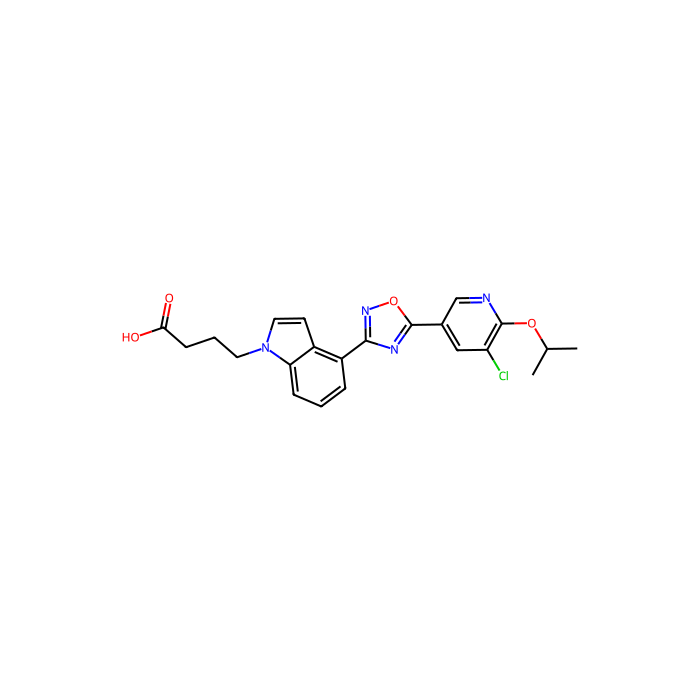
This compound belongs to the class of organic compounds known as n-alkylindoles. These are compounds containing an indole moiety that carries an alkyl chain at the 1-position.
External Descriptors
Not available
1. Djoumbou Feunang Y, Eisner R, Knox C, Chepelev L, Hastings J, Owen G, Fahy E, Steinbeck C, Subramanian S, Bolton E, Greiner R, and Wishart DS. ClassyFire: Automated Chemical Classification With A Comprehensive, Computable Taxonomy. Journal of Cheminformatics, 2016, 8:61.
Solvent:DMSO, Max Conc. mg/mL: 44.09, Max Conc. mM: 100
분자량
440.900 g/mol
XLogP3
4.000
Hydrogen Bond Donor Count
1
Hydrogen Bond Acceptor Count
7
Rotatable Bond Count
8
Exact Mass
440.125 Da
Monoisotopic Mass
440.125 Da
Topological Polar Surface Area
103.000 Ų
Heavy Atom Count
31
Formal Charge
0
Complexity
612.000
Isotope Atom Count
0
Defined Atom Stereocenter Count
0
Undefined Atom Stereocenter Count
0
Defined Bond Stereocenter Count
0
Undefined Bond Stereocenter Count
0
The total count of all stereochemical bonds
0
Covalently-Bonded Unit Count
1
솔루션 계산기
Molarity Calculator
Determine the necessary mass, volume, or concentration for preparing a solution.
Dilution Calculator
Determine the dilution needed to prepare a stock solution.
Reconstitution Calculator
리뷰
고객 리뷰
Application Protocols
No validated, item-specific protocols are provided in the Product Data. The following are general, non-item-specific procedures suitable for small-molecule ligands; adapt to your system.
DMSO stock preparation (general)
Allow vial to equilibrate to room temperature in a desiccator. 2) If solid, quickly weigh the required amount. 3) Add anhydrous DMSO to achieve a 10 mM stock (e.g., 1.0 mg at MW 500 → 2.0 mL for ~1 mM; calculate precisely once MW is known). 4) Vortex/sonicate to dissolve. 5) Sterile-filter (0.22 µm PTFE) if required for cell work. 6) Aliquot into low-bind tubes; store at −20°C.
Plate-based dilution (general)
Prepare serial dilutions (e.g., 3-fold, 10-point) in assay buffer maintaining constant DMSO (e.g., 0.3% across the curve). Mix gently to avoid precipitation and bubbles.
Biochemical assay setup (general)
Combine enzyme/protein, buffer, cofactors, and compound; preincubate as needed (e.g., 10–30 min). Initiate the reaction; monitor by appropriate readout (fluorescence, absorbance, MS). Include vehicle, positive, and negative controls.
Post-assay QC (general)
Inspect wells for precipitation. Confirm compound integrity by LC–MS from a parallel-treated sample.
Item-specific concentrations, incubation times, and readouts are not specified for this product and should be determined empirically.
Biological Roles
Item-specific
No biological target or pathway information is provided in the Product Data for GSK 2018682. Any specific mechanism of action, target class, or pathway engagement is not specified; refer to CoA/Spec Sheet and primary literature for details.
General considerations for small-molecule ligands in research (not item-specific claims)
Potential interactions: Small organic ligands can bind to protein active sites or allosteric sites, modulate protein–protein interactions, or affect nucleic acid/ligand interfaces depending on structure.
ADME-relevant properties: Ionization state, polarity, and aromaticity influence permeability, nonspecific binding, and distribution in cellular systems. Empirically determine compound behavior (e.g., cell uptake, plasma protein binding) if relevant to your studies.
Assay interference risks: Some chemotypes can act as PAINS, redox cyclers, or form colloidal aggregates. Employ counterscreens (e.g., detergent sensitivity, redox reporter assays) and orthogonal modalities (SPR/MST/ITC) to validate hits.
Target deconvolution: If phenotypic activity is observed, consider chemoproteomics, CETSA/TPP, genetic knockdown/knockout, or CRISPRi/a synergy profiling to identify the molecular target(s).
No medical or clinical claims are made. This product is supplied strictly for research use only.
Buffer Applications
This product is not a buffering agent. However, buffers are commonly required when evaluating small-molecule ligands in biochemical or cell-based assays.
Not item-specific; practical guidance
Biochemical assays: Use well-defined buffers (e.g., HEPES 10–50 mM, Tris 25–50 mM, or phosphate 10–50 mM) with pH carefully matched to the target enzyme/protein stability. Maintain ionic strength (e.g., 100–200 mM NaCl) to minimize nonspecific interactions.
Cosolvent limits: Keep final DMSO at the lowest effective level (often 0.1–1% v/v) to avoid perturbing protein stability or cell physiology; confirm tolerance experimentally.
Additives: Include reducing agents (e.g., 0.5–2 mM TCEP/DTT) and divalent cations only if required by the target; consider 0.01–0.05% nonionic detergent to reduce aggregation/adhesion.
Adsorption control: Use low-bind plastics or add 0.1% BSA when permissible to mitigate nonspecific adsorption of hydrophobic ligands.
Preparation notes
Filter buffers (0.22 µm) and degas where needed for biophysical methods (ITC, SPR, MST).
Equilibrate temperature and pH before compound addition; pH can drift upon DMSO addition.
Item-specific buffer compatibility and stability are not specified for this item; establish empirically for your assay system.
Green Alternatives
As a small-molecule ligand used at milligram–microgram scales, the major environmental footprint often comes from solvents and plastics used during dissolution, assay preparation, and cleanup rather than the compound itself.
Greener solvent practices (general; not item-specific)
Prefer aqueous assay buffers with minimal DMSO (≤0.1–0.5% v/v) where assay tolerance allows.
Use DMSO over DMF where possible due to lower volatility and better handling; consider bio-based solvents (e.g., Cyrene) for synthetic derivatization steps when applicable.
Implement miniaturization (384-/1536-well) to reduce solvent volumes and waste.
Example comparison (general)
DMSO vs DMF: DMSO typically offers broader solubility with lower vapor pressure; DMF is more problematic from a regulatory and EHS perspective.
Aqueous buffers with cosolvent vs neat organics: Dilute organics into buffered systems to reduce total VOC use; validate compound stability and avoid precipitation.
Operational waste reduction
Adopt sealed-source plate formats to lower evaporation and repeat dispensing.
Use reusable glassware where compatible to reduce microplastic waste from tips and reservoirs.
Item-specific green metrics (E-factor, solvent scorecards, LCA) are not specified for this item; consult your institutional green chemistry guidelines for workflow optimization.
Pharmaceutical Uses
No pharmacopeial status, excipient role, or formulation specifications are provided for this product. It is offered strictly for research use.
Item-specific
Pharmaceutical/clinical use: Not for human or veterinary use. For research use only (as stated in Product Data).
General discovery/formulation context (not item-specific claims)
Tool/reference compound: Such ligands are frequently used as controls or comparators in in vitro and ex vivo experiments during target validation and lead optimization.
Pre-formulation studies: If progressing toward in vivo research (where permitted), typical experiments include solubility profiling across pH, cosolvent screening, and stability testing (chemical/photolytic). These are user-run studies; no item-specific data are provided here.
Analytical methods: LC–MS/MS for quantitation; stability-indicating HPLC to monitor degradation pathways. Solid-state characterization (DSC, PXRD) may be used if the compound is supplied as a solid.
For any regulated or clinical application, obtain appropriate grade, documentation, and approvals. This Moligand™ product is not intended for clinical or diagnostic use.
Physical Properties
Item-specific data are not disclosed in the Product Data for this SKU.
Item-specific (from Product Data)
Appearance: Not specified for this item; refer to CoA/Spec Sheet.
Molecular weight: Not specified for this item; refer to CoA/Spec Sheet.
Literature/general expectations for small-molecule screening ligands (not item specifications)
Physical state: Often supplied as a solid or concentrated DMSO solution for screening collections; exact state for this item is not specified.
Solubility (qualitative, general): Many drug-like ligands are readily soluble in anhydrous DMSO at 10–50 mM and variably soluble in ethanol, methanol, or aqueous buffers with cosolvent/surfactant (literature, general). No solubility is specified for this item; verify experimentally.
LogP/pKa: Not specified for this item; refer to CoA/Spec Sheet or determine experimentally.
Melting/boiling point, density, refractive index, UV cutoff: Not specified for this item; refer to CoA/Spec Sheet.
Notes for practitioners
If solid, pre-dry under vacuum and weigh quickly to minimize atmospheric moisture uptake (general best practice).
Establish solubility by small-scale trials in DMSO, DMF, and EtOH before preparing assay stocks. Record exact solvent lot and water content for reproducibility (general guidance).
For spectroscopic work (e.g., UV–vis, HPLC detection), determine compound-specific λmax empirically; no item-specific optical data are provided.
Quality and Grades
Item-specific (from Product Data)
Grade/Purity designation: Moligand™
Storage: Store at −20°C
Shipped: Ice chest + ice pads
Purity, residual solvents/water/metals, stabilizers, and analytical release tests: Not specified for this item; refer to CoA/Spec Sheet.
What Moligand™ typically implies (general grade description; not item-specific specifications)
Curated for molecular recognition studies, screening campaigns, and chemical biology assays.
Emphasis on structural identity confirmation (e.g., LC–MS, HRMS, and/or NMR) and chromatographic purity suitable for discovery research.
Packaging intended to minimize contamination and moisture uptake; often amenable to plate-ready or DMSO-stock preparation workflows.
Practical quality considerations for users (general guidance)
Verify identity and purity locally before critical studies (e.g., LC–MS/MS purity check; orthogonal method such as 1H NMR).
Record water content of DMSO and any cosolvents used for stock solutions; water can affect assay outcomes.
For stability, track freeze–thaw cycles; consider single-use aliquots.
Documentation
For item-specific acceptance criteria, impurity profiles, and analytical chromatograms, consult the lot-specific CoA/Spec Sheet. These documents supersede any general statements above.
Reaction and Applications
This product is positioned as a research ligand for screening and chemical biology, not as a synthetic reagent. Accordingly, classic reaction roles (e.g., base, nucleophile, coupling partner) are not typically applicable.
Item-specific
Manufacturer Applications: Not specified in the Product Data; use in discovery research as a Moligand™ small molecule is implied.
Discovery/assay applications (general guidance, not item-specific claims)
Tool compound workflows: Use in mechanistic enzyme assays, binding assays (e.g., SPR, MST), phenotypic cell assays, or selectivity panels to build structure–activity relationships once a target hypothesis exists.
Orthogonal readouts: Combine biochemical IC50 determinations with biophysical binding (Kd) and cellular potency to triangulate activity while controlling for assay interference (e.g., redox cycling, aggregation).
Analytical confirmation: Validate concentration by quantitative 1H NMR or UV if extinction coefficient is known; confirm integrity by LC–MS before and after assays to detect degradation.
Not typically applicable
Named organic reactions (e.g., Suzuki, Mitsunobu, Grignard) are not relevant unless you are derivatizing the scaffold for SAR; see “Synthetic Utility” for medicinal chemistry adaptations.
For item-specific application notes or known target class, please consult the CoA/Spec Sheet and any associated reference sheets.
Reaction Conditions
Classical organic reaction conditions are not applicable to this product as sold since it is intended as a screening ligand rather than a reagent. Instead, the most relevant “conditions” concern preparation and use in assays.
Item-specific
No assay conditions or concentration ranges are provided; consult the CoA/Spec Sheet. Storage at −20°C is specified.
General assay preparation guidance (not item-specific specifications)
Stock solutions: Prepare 10 mM in anhydrous DMSO as a common starting point. If solubility limits are encountered, warm gently (≤37°C), vortex, or sonicate briefly. Avoid prolonged heating or light exposure without stability confirmation.
Working concentrations: Typical screening windows span 0.1 nM–100 µM depending on assay sensitivity and mechanism. Titrate across log-spaced points and include vehicle controls matched for DMSO content.
Plates and plastics: Use low-binding plates and tips to mitigate adsorption. Seal plates to minimize evaporation and DMSO creep.
Stability checks: Re-assess by LC–MS after incubation in assay buffer (e.g., 1–24 h at room temperature or 37°C) to detect hydrolysis/oxidation.
Data quality controls (general)
Include positive and negative controls; establish Z′-factor for HTS. Run counterscreens to exclude assay interference (fluorescence quenchers, redox cycling, aggregation).
Safety and Handling
Safety details are not specified in the Product Data and must be verified in the SDS.
Item-specific hazard data (from Product Data)
Signal word: Not specified for this item; refer to SDS.
H-statements: Not specified for this item; refer to SDS.
GHS classification: Not specified for this item; refer to SDS.
Pictograms: Not specified for this item; refer to SDS.
General laboratory precautions for small-molecule ligands (not item-specific)
Handle in a fume hood; avoid inhalation of dust/aerosols and skin/eye contact.
Wear appropriate PPE: lab coat, safety glasses, and chemically resistant gloves (e.g., nitrile). Change gloves regularly when working in DMSO, which can enhance dermal absorption of solutes.
Avoid uncontrolled heating; many organic ligands may decompose upon strong heating or prolonged light exposure.
Incompatibilities (general): strong oxidizers, strong acids/bases depending on functional groups; verify in SDS once structure is confirmed.
First-aid overview (general)
Skin/eye contact: Rinse with water for ≥15 minutes. Remove contaminated clothing. Seek medical attention if irritation persists.
Inhalation: Move to fresh air; seek medical attention if symptoms occur.
Ingestion: Rinse mouth; do not induce vomiting; seek medical advice.
Spill and waste (general)
Contain with inert absorbent; collect as hazardous organic waste. Dispose according to institutional and local regulations.
Always consult the item’s SDS for authoritative safety information prior to use.
Solvent Selection
GSK 2018682 is intended as a small-molecule ligand for screening/assay use rather than as a bulk reaction solvent. No item-specific solubility data are provided.
Item-specific
Solubility: Not specified for this item; refer to CoA/Spec Sheet and verify experimentally.
General guidance for dissolving small-molecule ligands (not item-specific specifications)
Primary solvent: Anhydrous DMSO is the default for preparing 10–50 mM stocks for HTS/biochemical assays due to broad solvating power and low volatility.
Secondary solvents: DMF, ethanol, or methanol can be used for pre-dissolution prior to buffer dilution if compatible with assays.
Aqueous use: Dilute DMSO stocks into assay buffer; keep final DMSO ≤0.1–1% v/v as permitted by the biological system.
Surfactants and cosolvents: 0.01–0.1% nonionic surfactants (e.g., Tween-20) or 1–5% PEG-400 can aid solubilization and reduce aggregation (verify assay compatibility).
Comparison (general)
DMSO vs DMF: DMSO is less volatile and more commonly accepted in bioassays; DMF may offer similar solubility but can be more cytotoxic and hygroscopic.
DMSO vs EtOH: Ethanol is more volatile and often limited to lower percentages in sensitive assays; solubility may be lower for hydrophobic ligands.
Always confirm solubility and assay tolerance experimentally with your specific system.
Storage and Reconstitution
Item-specific (from Product Data)
Storage conditions: Store at −20°C.
Shipping: Ice chest + ice pads.
Appearance: Not specified for this item; refer to CoA/Spec Sheet.
Reconstitution (general guidance; not item-specific specifications)
Preferred solvent: Anhydrous DMSO for primary stock solutions unless item-specific solubility contraindicates. Start at 10 mM; adjust as needed based on actual solubility.
Technique: Warm to room temperature in a desiccator before opening to prevent moisture condensation. If necessary, vortex or briefly sonicate to aid dissolution. Avoid strong light if the compound contains chromophores (unknown here).
Filtration: For sterile applications, filter through 0.22 µm PTFE. Avoid cellulose ester membranes with strong organic solvents.
Aliquoting and stability (general)
Prepare single-use aliquots to minimize freeze–thaw cycles. Store aliquots tightly sealed at −20°C or below. Record preparation date, solvent, and concentration.
Short-term handling: Keep solutions on ice or at 4°C during assay setup to reduce degradation and evaporation of volatile cosolvents.
Shelf life
Item-specific stability/shelf-life data: Not specified for this item; refer to CoA/Spec Sheet. Reassess integrity by LC–MS/HPLC at defined intervals during extended storage.
Always defer to the item’s CoA and SDS for definitive storage, handling, and reconstitution instructions.
Structure and Identity
Brief overview: GSK 2018682 is listed in Aladdin’s Moligand series as a small-molecule screening ligand. Structural descriptors are not disclosed in this item’s Product Data.
Item-specific (from Product Data)
SKU: G288907
Product name: GSK 2018682
CAS: 1034688-30-6
PubChem CID: 24988201
InChIKey: 237083 (as provided)
SMILES: Not specified for this item; refer to CoA/Spec Sheet.
Molecular formula: Not specified for this item; refer to CoA/Spec Sheet.
Molecular weight: Not specified for this item; refer to CoA/Spec Sheet.
Structural features (general statement)
Specific ring systems, functional groups, and stereochemistry are not disclosed in the provided Product Data. The compound is cataloged as a small-molecule ligand; typical members of this class are drug-like organic molecules containing heteroatoms (e.g., N, O, S) and one or more aromatic/heteroaromatic rings (literature, general).
2D structure description (general)
Without a provided SMILES/InChI or structure image, a definitive 2D description cannot be given for this specific item. Please consult the CoA/Spec Sheet or SDS for the definitive structural representation associated with this SKU.
Synthetic Utility
GSK 2018682 is supplied as a screening ligand and is not primarily intended as a building block or reagent. The absence of disclosed structure precludes item-specific synthetic guidance.
Item-specific
Functional groups available for derivatization: Not specified for this item; refer to CoA/Spec Sheet.
General medicinal chemistry considerations (not item-specific)
Scaffold diversification: If structural information is available, SAR can be explored via modular modifications (ring substitutions, bioisosteres, linker edits) using standard cross-couplings (e.g., Suzuki, Buchwald–Hartwig), amide couplings, or heterocycle annulations as applicable to the scaffold.
Late-stage functionalization: C–H activation, Minisci-type alkylations/acylations, or photoredox-mediated substitutions can expedite analogue generation when handles are limited.
Protecting-group strategy: Choose orthogonal protections to tolerate any basic or nucleophilic motifs typical of drug-like molecules (e.g., Boc, Cbz for amines; TBDPS for alcohols).
Verification
Confirm structure/purity of any synthesized analogues with multi-technique characterization (1H/13C NMR, HRMS, HPLC/UPLC). Benchmark activity against the original ligand under identical assay conditions to maintain continuity in SAR.
Target Specificity
Item-specific
No specific molecular target, binding site, or selectivity profile is provided for GSK 2018682 in the Product Data. Species selectivity, off-target panels, and MoA are not specified; refer to CoA/Spec Sheet and primary literature if available.
General guidance for establishing specificity (not item-specific)
Primary evidence: Determine potency (IC50/Ki/Kd) against the hypothesized target using orthogonal assay formats (enzymatic, biophysical).
Selectivity profiling: Screen representative off-target panels (e.g., kinome, GPCR, ion channels, proteases) relevant to the target class to identify liability hotspots.
Cellular confirmation: Evaluate on-target engagement via CETSA/TPP, CRISPR-based dependency mapping, or target occupancy assays.
Counterscreens: Incorporate assays to detect colloidal aggregation, redox activity, or fluorescence interference.
Without item-specific target data, no claims of selectivity or specificity can be made for this product.
자주 묻는 질문
What is the purity of this product, and how is it determined?
This product is supplied at ≥98% purity, determined by HPLC. Lot-specific values are stated on the Certificate of Analysis.
How should this product be stored?
Store at ?20 °C. Freezer storage is required to maintain the specified shelf life.
How is this product shipped?
This product ships in an insulated container with ice pads. Unpack on arrival and transfer it to the storage condition stated above.
What are the CAS number, molecular formula and molecular weight?
The CAS Number is 1034688-30-6, the molecular formula is C22H21ClN4O4, and the molecular weight is 440.88 g/mol. InChIKey NFIGDBFIDKDNIG-UHFFFAOYSA-N.
What is Moligand??
Moligand? is one of Aladdin Scientific's premium product lines, formulated for high-purity applications across multiple workflows. Compared to standard grades in the same workflow, Moligand? products typically offer tighter specifications, more rigorous QC, and stronger lot-to-lot consistency.
What documentation is provided?
Available product documentation, including Certificates of Analysis (COA), Safety Data Sheets (SDS), and specification sheets, is shown in the product document area. Document availability and access follow the current site policy.
등급 선택에 도움이 필요하신가요?
당사의 등급 선택 가이드는 카탈로그의 모든 변형 제품에 대해 순도, 안정제 상태 및 용도 적합성을 다룹니다.
Products are supplied to verified businesses, institutions, and qualified professionals for research and development use only. Not for use in humans, animals, diagnosis, or therapy.

 I2623057