
Determine the necessary mass, volume, or concentration for preparing a solution.
| Activity Type | Relation | Activity value | Units | Action Type | Journal | PubMed Id | doi | Assay Aladdin ID |
|---|
Store at +4°C. Store under desiccating conditions. The product can be stored for up to 12 months.
Taxonomy Tree
| Kingdom | Organic compounds |
|---|---|
| Superclass | Organoheterocyclic compounds |
| 분류 | Diazines |
| Subclass | Pyrimidines and pyrimidine derivatives |
| Intermediate Tree Nodes | Not available |
| Direct Parent | Pyridinylpyrimidines |
| Alternative Parents | Beta amino acids and derivatives Benzazepines Dialkylarylamines Azepines Aminopyrimidines and derivatives Pyridines and derivatives Imidolactams Benzenoids Heteroaromatic compounds Carboxylic acid esters Monocarboxylic acids and derivatives Azacyclic compounds Organic oxides Hydrocarbon derivatives Carbonyl compounds |
| Molecular Framework | Aromatic heteropolycyclic compounds |
| Substituents | Pyridinylpyrimidine - Benzazepine - Beta amino acid or derivatives - Dialkylarylamine - Aminopyrimidine - Azepine - Imidolactam - Benzenoid - Pyridine - Heteroaromatic compound - Carboxylic acid ester - Azacycle - Carboxylic acid derivative - Monocarboxylic acid or derivatives - Hydrocarbon derivative - Organonitrogen compound - Organooxygen compound - Carbonyl group - Organic oxygen compound - Organic nitrogen compound - Organic oxide - Amine - Aromatic heteropolycyclic compound |
| 설명 | This compound belongs to the class of organic compounds known as pyridinylpyrimidines. These are compounds containing a pyridinylpyrimidine skeleton, which consists of a pyridine linked (not fused) to a pyrimidine by a bond. |
| External Descriptors | Not available |
| Activity Type | Relation | Activity value | Units | Action Type | Journal | PubMed Id | doi | Assay Aladdin ID |
|---|
| Activity Type | Relation | Activity value | Units | Action Type | Journal | PubMed Id | doi | Assay Aladdin ID |
|---|
| Activity Type | Relation | Activity value | Units | Action Type | Journal | PubMed Id | doi | Assay Aladdin ID |
|---|
| Activity Type | Relation | Activity value | Units | Action Type | Journal | PubMed Id | doi | Assay Aladdin ID |
|---|
| Activity Type | Relation | Activity value | Units | Action Type | Journal | PubMed Id | doi | Assay Aladdin ID |
|---|
| Activity Type | Relation | Activity value | Units | Action Type | Journal | PubMed Id | doi | Assay Aladdin ID |
|---|
| Activity Type | Relation | Activity value | Units | Action Type | Journal | PubMed Id | doi | Assay Aladdin ID |
|---|
| Activity Type | Relation | Activity value | Units | Action Type | Journal | PubMed Id | doi | Assay Aladdin ID |
|---|
| Activity Type | Relation | Activity value | Units | Action Type | Journal | PubMed Id | doi | Assay Aladdin ID |
|---|
| Activity Type | Relation | Activity value | Units | Action Type | Journal | PubMed Id | doi | Assay Aladdin ID |
|---|
| Activity Type | Relation | Activity value | Units | Action Type | Journal | PubMed Id | doi | Assay Aladdin ID |
|---|
| Activity Type | Relation | Activity value | Units | Action Type | Journal | PubMed Id | doi | Assay Aladdin ID |
|---|
| 용해성 | Soluble in DMSO to 100 mM |
|---|---|
| 분자량 | 417.5 |
| XLogP3 | 4.300 |
| Hydrogen Bond Donor Count | 1 |
| Hydrogen Bond Acceptor Count | 7 |
| Rotatable Bond Count | 8 |
| Exact Mass | 417.216 Da |
| Monoisotopic Mass | 417.216 Da |
| Topological Polar Surface Area | 80.200 Ų |
| Heavy Atom Count | 31 |
| Formal Charge | 0 |
| Complexity | 546.000 |
| Isotope Atom Count | 0 |
| Defined Atom Stereocenter Count | 0 |
| Undefined Atom Stereocenter Count | 0 |
| Defined Bond Stereocenter Count | 0 |
| Undefined Bond Stereocenter Count | 0 |
| The total count of all stereochemical bonds | 0 |
| Covalently-Bonded Unit Count | 1 |
P264:Wash hands [and …] thoroughly after handling.
No vendor-validated application protocols are provided in this product record.
General practice (for small-molecule control probes):
If you require a validated, stepwise protocol for a specific assay platform, contact our technical support with your intended application details.
GSK-J5 itself is used as a negative control compound in epigenetics research and does not serve a known endogenous biological role.
Important limitations:
Good practice:
This item is a small-molecule probe control and is not a buffering agent. However, practical considerations for using it in buffered systems include:
Buffer specifications (pH ranges, capacities) are unrelated to this item and not applicable.
As a specialized chemical probe control, GSK-J5 is not readily substitutable by a “green” alternative the way commodity solvents or reagents are. However, greener practices can be applied to its use:
Alternatives within study design (general):
Environmental notes:
This product is sold for research use only and is not intended for human or veterinary use, drug substance, or excipient applications.
Formulation context (research only):
Manufacturing/CMC considerations: Not applicable; no item-specific data on residual solvents, elemental impurities, or controlled specification attributes are provided in this record.
If a laboratory-scale preformulation assessment is required (e.g., solubility screening, stability in media), document all conditions, vehicles, and concentrations. Do not extrapolate research findings to clinical settings.
Item-specific physicochemical data are not provided in the product record.
Notes for use (general guidance, not item specifications):
Always verify lot-specific property data and solution stability on the CoA and SDS before experimental use.
Interpretation and implications:
Documentation best practices:
This product is supplied as a research chemical probe control rather than a synthetic reagent. It is not commonly used as a reagent or solvent in preparative organic chemistry.
Research applications (general, literature/practice):
Practical tips:
Synthetic chemistry use: Not typically applicable. If needed for SAR or analytical benchmarking, employ under dry conditions. No item-specific reactivity data are provided.
Not applicable in the conventional synthetic sense. GSK-J5 is used as a control compound rather than as a reagent or catalyst.
Assay deployment conditions (general guidance for research use):
Expected outcomes: As a negative control, GSK-J5 should not reproduce the on-target pharmacology of the active probe; nonetheless, confirm this experimentally under your exact conditions.
Item-specific kinetic/thermodynamic parameters: Not specified for this item; refer to CoA/Spec Sheet and literature.
Safety data specific to this SKU are not provided in the product record.
Recommended PPE and engineering controls:
Handling and hygiene:
Storage incompatibilities and precautions:
First-aid overview (general):
Always consult the official SDS for authoritative hazard, exposure limits, and emergency guidance.
GSK-J5 is typically handled as a DMSO stock for biochemical and cell-based assays.
Selection tips:
Comparison (general):
Item-specific solubility values: Not specified for this item; refer to CoA/Spec Sheet.
Storage (product data):
Container handling:
Reconstitution (general guidance for small-molecule probes; item-specific solubility not provided):
Working solution preparation:
Stability:
For research use only.
Overview: GSK-J5 is widely used in epigenetics research as the structurally related negative control compound for GSK-J4. It is a small-molecule chemical probe control intended strictly for research.
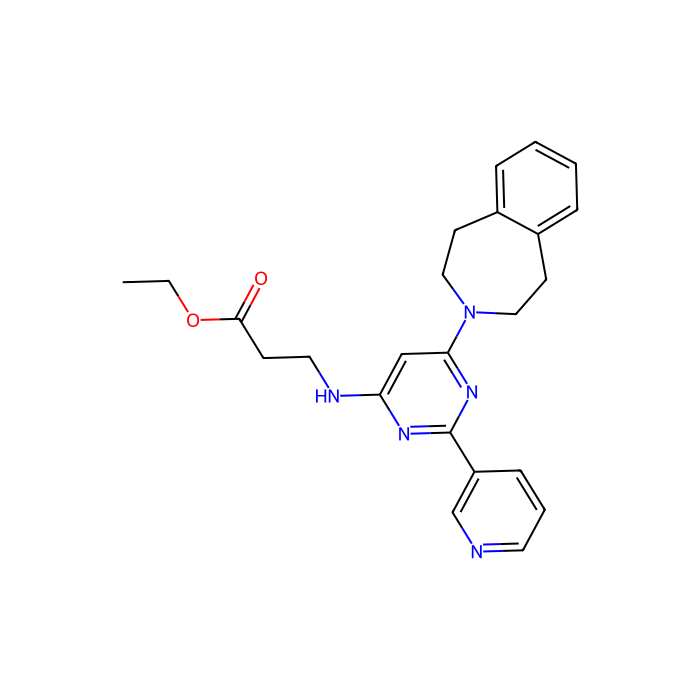
Structural features (general/literature context):
2D structure description (general):
GSK-J5 is not typically employed as a reagent or intermediate in synthetic organic chemistry; it serves as a control probe in chemical biology. Consequently, classical synthetic transformations, protecting-group strategies, and reagent roles are not applicable.
However, in a medicinal chemistry or SAR context (general):
Functional-group reactivity and named reactions: Not applicable for this catalog item; no item-specific reactivity, pKa, or redox information is provided. If derivatization or tagging is desired for mechanistic studies, consult primary literature for precedented handle positions and perform new analytical qualification.
Target, selectivity, and potency data are not provided in the product record for this SKU.
For rigorous studies, determine inactivity/orthogonality under your assay conditions and report the exact concentrations and protocols used.