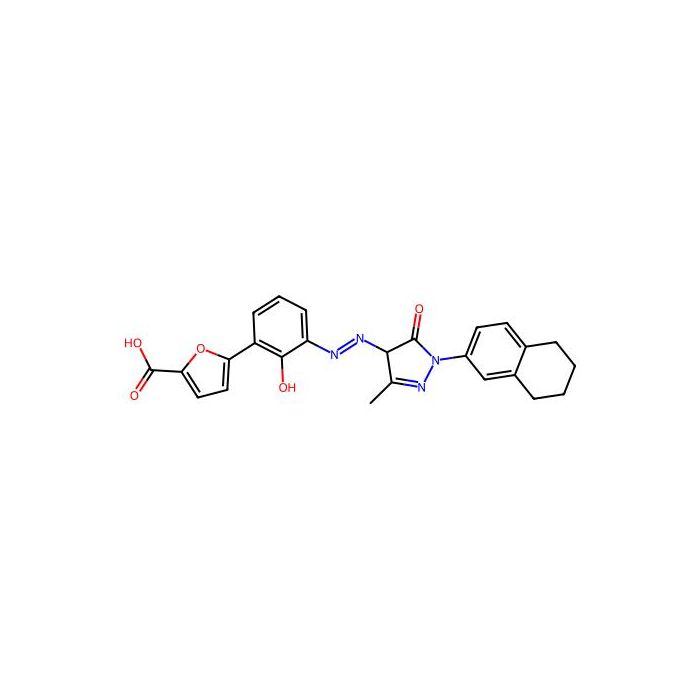
Hetrombopag is a potent thrombopoietin receptor agonist. Hetrombopag is efficacious and well tolerated with a manageable safety profile. Hetrombopag has the potential for the research of immune thrombocytopenia.
Form:Solid
사양
생화학 및 생리적 메커니즘
Hetrombopag is a potent thrombopoietin receptor agonist. Hetrombopag is efficacious and well tolerated with a manageable safety profile. Hetrombopag has the potential for the research of immune thrombocytopenia.
보관 조건
Store at -20°C
배송
Ice chest + Ice pads
이 제품은 콜드 체인 배송이 필요합니다.지상 및 기타 경제 서비스는 사용할 수 없습니다.
작업 유형
AGONIST
이름과 식별자
분자량
458.47
고급 데이터
인증서(CoA, COO, BSE/TSE 및 분석 차트)
C of A & Other Certificates(BSE/TSE, COO):
Analytical Chart:
화학 및 물리적 특성
용해성
DMSO : 5 mg/mL (10.91 mM; ultrasonic and warming and heat to 60°C)
솔루션 계산기
Molarity Calculator
Determine the necessary mass, volume, or concentration for preparing a solution.
Dilution Calculator
Determine the dilution needed to prepare a stock solution.
Reconstitution Calculator
리뷰
고객 리뷰
Application Protocols
Tested applications, recommended concentrations, and validated protocols are not provided in the product data for this item.
No vendor‑validated protocols are available; consult peer‑reviewed literature relevant to your assay system.
General best practices: include vehicle controls, perform concentration–response experiments, and confirm on‑target activity with orthogonal methods.
For lot‑specific handling or protocol suggestions, refer to the CoA/Spec Sheet or contact technical support with your application details.
Biological Roles
Item‑specific biological targets are not stated in the product data. The following provides general context relevant to small‑molecule tools used in thrombopoietin (TPO) receptor biology.
General context (literature)
The thrombopoietin receptor (MPL, also called c‑Mpl) is a type I cytokine receptor crucial for hematopoietic stem cell maintenance and megakaryopoiesis. Its endogenous ligand, TPO, induces receptor dimerization and activates JAK2, leading to downstream STAT5, PI3K/AKT, and MAPK/ERK signaling.
Small‑molecule receptor agonists are widely used as chemical probes to interrogate MPL signaling, decouple ligand–receptor binding from cytokine networks, and study lineage specification and platelet biogenesis in vitro.
Experimental readouts (typical)
Rapid signaling: phosphorylation of JAK2, STAT5, ERK1/2, and AKT (western blot or phospho‑flow) within minutes to 1 hour.
Functional outcomes: cell proliferation/survival in MPL‑expressing lines (e.g., Ba/F3‑MPL, UT‑7/TPO), upregulation of megakaryocytic markers (CD41/ITGA2B, CD61/ITGB3), proplatelet formation in primary cultures.
Genetic/chemical controls: MPL knockout/knockdown lines, JAK inhibitors, and TPO protein as orthogonal comparators.
Important caveats
Potency, efficacy, receptor selectivity, and species cross‑reactivity are compound‑specific and are NOT specified for this item; consult peer‑reviewed literature and the CoA before experimental design.
Buffer Applications
This product is not a buffering agent and is not typically used to formulate buffer systems. For biological assays, standard buffers (e.g., PBS, HEPES, or culture media) may be used as vehicles when diluting an organic stock solution, but no item‑specific buffer system is provided.
Green Alternatives
As a bioactive screening compound, the primary environmental considerations center on solvent use, scale, and waste minimization rather than replacing the compound itself.
Greener handling strategies (general)
Prefer aqueous assay media with minimal DMSO (≤0.1–0.5% v/v) consistent with assay performance.
When organic sample prep is required, favor ethanol or methanol over DMF/NMP where solubility permits.
Use micro‑scale assays (96/384‑well formats) to reduce chemical consumption and waste.
Implement closed‑cap autosampler vials and low‑evaporation plates to reduce VOC emissions.
Consolidate waste streams and use solvent recycling where feasible.
Illustrative comparison (general)
DMSO vs DMF/NMP: DMSO offers strong solvency with a better EHS profile than DMF/NMP.
MeOH/EtOH vs ACN: Methanol/ethanol are more benign but may reduce chromatography performance; ACN often superior for LC‑MS but consider recovery/recycling.
Note: No item‑specific green alternative chemistry applies, as this product is not a process solvent or reagent.
Pharmaceutical Uses
No pharmacopeial status, excipient role, or formulation guidance is provided for this item.
Intended use: For research use only (as stated); not for human or veterinary use.
Potential research contexts (general): may serve as a reference standard for analytical method development/validation, stability studies, or in vitro assay controls in a discovery setting.
Regulatory note: Do not infer suitability for clinical applications, GMP manufacture, or diagnostic use from this listing. Any such use would require separate qualification and documentation.
Item‑specific pharmaceutical/formulation information: Not specified for this item; refer to CoA/Spec Sheet if available.
Physical Properties
Item-specific physical constants are not provided in the product data.
Appearance: Not specified for this item; refer to CoA/Spec Sheet.
Melting point: Not specified for this item; refer to CoA/Spec Sheet.
Boiling point: Not specified for this item; refer to CoA/Spec Sheet.
Density: Not specified for this item; refer to CoA/Spec Sheet.
Solubility: Not specified for this item; refer to CoA/Spec Sheet.
LogP/logD: Not specified for this item; refer to CoA/Spec Sheet.
pKa: Not specified for this item; refer to CoA/Spec Sheet.
Refractive index: Not applicable (typically a solid) unless otherwise stated.
General laboratory guidance (literature/practice)
Many bioactive small molecules are sparingly soluble in water but dissolve in polar aprotic solvents (e.g., DMSO) for stock solutions. Confirm actual solubility for this item experimentally or from the CoA.
For analytical development, start with 10 mM DMSO stock as a screening concentration and serially dilute into assay medium, ensuring final DMSO ≤0.5% v/v unless your assay tolerates higher.
Quality and Grades
Grade/Purity: Not specified for this item; refer to CoA/Spec Sheet.
Interpretation and guidance
Screening/library compounds are commonly supplied at high chemical purity (e.g., ≥95% by HPLC) to support biological assays; however, this is not guaranteed for this item without the CoA.
Documentation typically provided: HPLC chromatogram, mass spectrum, and occasionally 1H NMR. Verify what is included with the specific lot.
UV background/LC compatibility: If using for LC‑MS bioanalytical work, ensure purity and UV background meet your method requirements; low‑UV impurities can interfere with quantitation.
Salt form/solvate state: If applicable, confirm the exact form (free base/acid, salt, solvate, hydrate) on the CoA, as it impacts molecular weight, solubility, and dosing calculations.
Impurity control: For mechanistic biology, consider additional purification (prep HPLC or recrystallization) if off‑target effects are suspected from minor impurities.
Recommendation
Request lot‑specific CoA and, if needed, a full specification sheet detailing purity, residual solvents, water content, and identity tests. Do not assume unstated specifications.
Reaction and Applications
This product is supplied as a bioactive research compound rather than a synthetic reagent; classical organic reactions (e.g., cross‑couplings, reductions) are not the typical use case.
Research applications (general, non‑item‑specific)
Chemical biology probe for thrombopoietin receptor (MPL) pathway studies in vitro.
Positive control/benchmark in receptor activation assays alongside endogenous ligand (thrombopoietin) to calibrate dynamic range.
Tool compound in signal transduction mapping (e.g., STAT5, ERK, AKT phosphorylation time‑courses) and transcriptional profiling.
Reagent for developing and validating bioassays (cell proliferation, megakaryocytic differentiation markers) and for method development in LC‑MS/MS quantitation.
If you require a synthetic intermediate or building block version, contact us; this listing is intended for biological screening, not for multistep synthesis.
Reaction Conditions
Classical chemical reaction conditions are not applicable; the product is intended for use as a bioactive probe or screening compound, not as a reagent.
General laboratory handling conditions (non‑reaction)
Stock solutions: Common practice is to prepare 10–50 mM solutions in dry DMSO, then dilute into aqueous media. Actual solubility/stability for this item is not specified and should be verified experimentally.
Assay incubation: Optimize concentration–response curves across several logs (e.g., 0.1 nM–30 µM) with appropriate vehicle controls; exact potency for this item is not provided.
Stability: Protect from light and repeated freeze–thaw; assess by LC‑MS or HPLC over your assay time course.
Item‑specific reaction parameters: Not applicable.
Safety and Handling
Safety data specific to this item have not been provided in the product listing.
GHS classification, Signal Word, Pictograms, H‑Statements: Not specified for this item; refer to SDS.
General precautions for small organic research compounds:
Use in a fume hood; avoid inhalation of dust/aerosols and skin/eye contact.
Avoid ingestion and environmental release; collect waste in an appropriate organic hazardous waste stream.
Storage incompatibilities: Segregate from strong oxidizers and strong acids/bases unless stability is documented. Keep container tightly closed, desiccated, and protected from light as prudent practice.
Thermal sensitivity: Unknown for this item; avoid elevated temperatures. Follow provided storage at −20°C.
First‑aid overview (general):
Skin/eye contact: Rinse with water for ≥15 minutes; remove contaminated clothing; seek medical advice.
Inhalation: Move to fresh air; seek medical attention if symptoms persist.
Ingestion: Rinse mouth; do not induce vomiting; obtain medical attention.
Spill response: Avoid dust generation; collect solids using damp disposable towels or HEPA vacuum; dispose of as hazardous waste.
Always consult the product’s SDS for authoritative hazard classification and response procedures.
Solvent Selection
No item‑specific solubility data are provided.
General strategy for bioactive small molecules
Primary stock solvent: DMSO is typically preferred due to broad solvating power and assay compatibility. Begin with 10–50 mM trial stocks and verify clarity and stability.
Alternative co‑solvents: DMF or NMP (strong solvation but higher toxicity), or mixtures such as DMSO:water or DMSO:buffer (5–20% DMSO final) to aid aqueous delivery.
Aqueous use: If aqueous work is required, pre‑dissolve in DMSO, then dilute into buffer with vigorous mixing; maintain final DMSO within assay tolerance.
pH effects: If the compound is ionizable (check CoA), modest pH adjustment (e.g., phosphate or HEPES buffers) can improve apparent solubility. Avoid strong base/acids unless stability is known.
Adsorption mitigation: For low‑ng/mL work, minimize nonspecific binding by using low‑bind plastics or adding carrier proteins/surfactants compatible with your assay.
Comparison (general)
DMSO: highest solvency; widely compatible; potential effects >0.5–1% v/v in some cell assays.
DMF/NMP: similar solvency; use sparingly due to cytotoxicity/regulatory concerns.
EtOH/MeOH: greener, but may not solubilize highly lipophilic scaffolds; tighter assay tolerances.
Always confirm actual solubility and stability for this item experimentally.
Storage and Reconstitution
Storage
Store at −20°C (per product data). Keep container tightly sealed, dry, and protected from light. Minimize headspace to reduce oxidative and hydrolytic degradation.
Shipped in: Ice chest + ice pads.
Reconstitution (general guidance; item‑specific solubility not provided)
Solubility: Not specified for this item; refer to CoA/Spec Sheet.
Suggested approach: Prepare a small‑scale trial stock in an anhydrous organic solvent (commonly DMSO). Vortex and, if necessary, sonicate briefly. Inspect for clarity and absence of particulates.
Filtration: If particulate persists and the compound is stable, pass through a 0.22 µm PTFE filter into an amber vial.
Aliquoting: Dispense single‑use aliquots to avoid repeated freeze–thaw. Store aliquots at −20°C (or colder) in amber containers.
Stability monitoring
Track storage time and conditions. Verify integrity by HPLC/LC‑MS at first use and periodically thereafter, especially for long‑term studies.
Note: Always defer to the lot‑specific CoA/SDS for definitive storage, stability, and handling instructions.
Structure and Identity
A small‑molecule research compound supplied for screening and chemical biology.
SKU: H651696
Product Name: Hetrombopag
CAS: 2114365-78-3
Molecular Formula: Not specified for this item; refer to CoA/Spec Sheet.
Molecular Weight: Not specified for this item; refer to CoA/Spec Sheet.
SMILES: Not specified for this item; refer to CoA/Spec Sheet.
InChIKey: Not specified for this item; refer to CoA/Spec Sheet.
Structural description
Item-specific structural features (ring systems, heteroatoms, stereochemistry): Not specified for this item; refer to CoA/Spec Sheet.
General literature context: Hetrombopag is reported in the literature as a small‑molecule agonist used to probe thrombopoietin receptor (MPL) signaling pathways; exact structural motifs should be verified against the certificate of analysis (CoA) or supplier SDS.
Identity verification guidance (general)
Recommended orthogonal checks: HRMS, 1H/13C NMR, HPLC/UPLC purity profile, and, when applicable, LC–MS retention time matching to a qualified reference.
If a reference standard is unavailable, confirm by combined analytical evidence (e.g., exact mass ±5 ppm, diagnostic NMR signals, and single major peak by HPLC >95% area) following your lab’s QA practices.
Synthetic Utility
This listing is a finished bioactive small molecule rather than a synthetic intermediate. It is not typically employed as a building block in organic synthesis.
Functional‑group reactivity, named‑reaction participation, and derivatization strategies are not applicable without a disclosed structure.
If derivative synthesis or SAR expansion is desired, request structural data and consider procuring intermediate analogs specifically designed as building blocks.
Item‑specific synthetic utility: Not applicable.
Target Specificity
Item‑specific target(s), binding constants, and selectivity data are not provided in the product data for SKU H651696.
Target, epitope, species reactivity, clone/isotype (if antibody): Not applicable.
For small‑molecule target confirmation, consider orthogonal assays (e.g., receptor knockout/knockdown, pathway inhibition, and direct binding where feasible).
Refer to the CoA/Spec Sheet or primary literature for any available target specificity data.
자주 묻는 질문
How should this product be stored?
Store at ?20 °C. Freezer storage is required to maintain the specified shelf life.
How is this product shipped?
This product ships in an insulated container with ice pads. Unpack on arrival and transfer it to the storage condition stated above.
What are the CAS number, molecular formula and molecular weight?
The CAS Number is 2114365-78-3, the molecular formula is C25H22N4O5, and the molecular weight is 458.47 g/mol.
What documentation is provided?
Available product documentation, including Certificates of Analysis (COA), Safety Data Sheets (SDS), and specification sheets, is shown in the product document area. Document availability and access follow the current site policy.
Products are supplied to verified businesses, institutions, and qualified professionals for research and development use only. Not for use in humans, animals, diagnosis, or therapy.