등급 & 순도Carrier Free?Carrier-free — supplied without added carrier protein/stabilizer. Use when carriers (e.g. BSA) would interfere with conjugation or sensitive assays.ExactAb™?ExactAb™ — Aladdin's antibody line emphasizing precision and validated quality. Use for reliable, specificity-validated antibody applications.Azide Free?Azide-free — without sodium azide preservative. Use in conjugations, cell work, or assays where azide is toxic or inhibitory.Validated?Validated grade — performance confirmed in defined applications before release. Use when you want documented assurance the reagent works as stated.High Performance?High-performance grade with optimized purity and performance characteristics. Use for sensitive analyses where ordinary grades fall short.PBS Only?PBS-only formulation — supplied in phosphate-buffered saline with no other additives. Use when you need a clean PBS buffer free of stabilizers/carriers.≥95%(SDS-PAGE)1.0 mg/mL
Carrier Free,ExactAb™,Azide Free,Validated,High Performance,PBS Only,≥95%(SDS-PAGE),1.0 mg/mL Azide Free,Carrier Free,ExactAb™,High Performance,PBS Only,Validated 최소한의 기준선 간섭이 필요한 민감한 크로마토그래피 및 분석 워크플로우용.
🌡
보관 및 배송
Store at -20°C,Avoid repeated freezing and thawing Ice chest + Ice pads 출고. 정확한 사양은 로트별 COA를 확인하세요.
📋
품질 문서
SDS, COA, 데이터시트, 사양서를 다운로드할 수 있습니다. 로트별 COA는 로트 번호 조회를 통해 확인할 수 있습니다.
📚
문헌적 근거
크로마토그래피, 유기 합성 및 교차 커플링 반응 분야의 동료 심사 논문 0편에서 인용되었습니다.
WB: HEK293, HeLa, A549, K562, MCF-7, HepG2, THP-1 and U-2 OS Whole cell Lysates
변화
Unconjugated
등급
Azide Free, Carrier Free, ExactAb™, High Performance, PBS Only, Validated
아이소타입
Mouse IgG1
라이트 체인 유형
kappa
SDS-PAGE
150.0 KDa
정화 방법
Protein A purified
집중력
1.0 mg/mL
Product Line
생물 제품
보관 및 배송
보관 조건
Store at -20°C,Avoid repeated freezing and thawing
배송
Ice chest + Ice pads
안정성 및 스토리지
Store at 4°C short term (1-2 weeks). Store at -20°C or -80°C. Avoid freeze / thaw cycle.
이미지
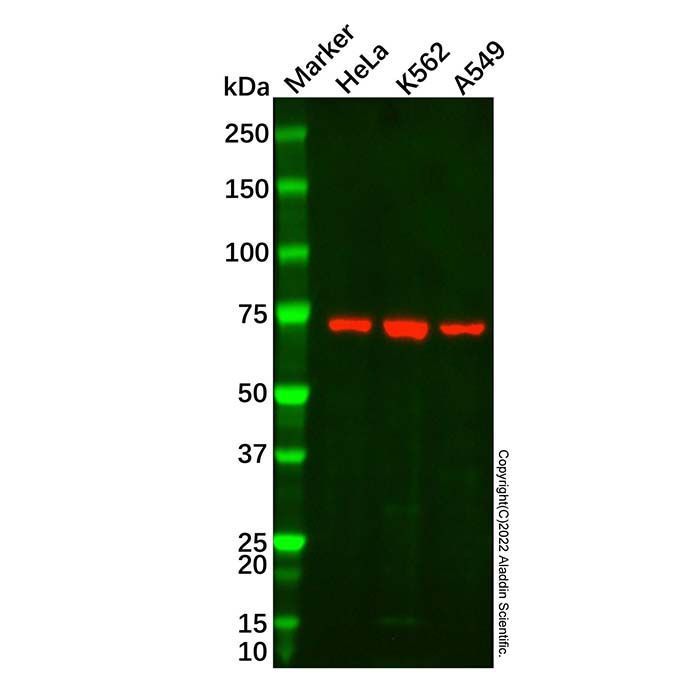
Hsp70 Mouse mAb (Ab156210) - Western Blot All lanes: Hsp70 Mouse Antibody (Ab156210) at 1/20000 dilution Samples: Lysates at 20 µg per lane Secondary: Goat Anti-Mouse IgG H&L (HRP) at 1/20000 dilution
Predicted band size: 70 kDa Observed band size: 70 kDa Exposure time: 6.5 s
Hsp70 Mouse mAb (Ab156210) - Western Blot All lanes: Hsp70 Mouse Antibody (Ab156210) at 1/20000 dilution Samples: Lysates at 20 µg per lane Secondary: Goat Anti-Mouse IgG H&L (HRP) at 1/20000 dilution
Predicted band size: 70 kDa Observed band size: 71 kDa Exposure time: 57.4 s
Hsp70 Mouse mAb (Ab156210) - Western Blot All lanes: Hsp70 Mouse Antibody (Ab156210) at 1/20000 dilution Samples: Lysates at 20 µg per lane Secondary: Goat Anti-Mouse IgG H&L (HRP) at 1/20000 dilution
Predicted band size: 70 kDa Observed band size: 68 kDa Exposure time: 16.2 s
Determine the necessary mass, volume, or concentration for preparing a solution.
Dilution Calculator
Determine the dilution needed to prepare a stock solution.
Reconstitution Calculator
리뷰
고객 리뷰
Application Protocols
No tested/validated application protocols are provided in the Product Data for this item.
Not specified for this item; refer to CoA/Spec Sheet for any validated applications, recommended dilutions, sample preparation, and positive controls.
General recommendation: establish in-house titration curves and control panels (positive/negative samples, secondary-only controls) to qualify performance in your specific assay matrix.
Biological Roles
Hsp70 (heat shock protein 70) is a highly conserved molecular chaperone central to protein quality control and cellular stress responses.
Core functions (general, literature):
Assists co-/post-translational protein folding, prevents aggregation, and facilitates refolding of stress-denatured proteins through ATP-dependent binding and release cycles.
Partners with co-chaperones (e.g., Hsp40/DnaJ and nucleotide exchange factors) to regulate substrate affinity and ATPase activity.
Participates in proteostasis pathways, including targeting irreversibly misfolded proteins for degradation via the ubiquitin–proteasome system and contributing to autophagic quality control.
Involved in protein translocation across membranes (e.g., mitochondrial and ER import) and assembly/disassembly of protein complexes.
Regulation and expression (general):
Induced by heat shock, oxidative stress, heavy metals, and other proteotoxic stressors via heat shock factor (HSF)–driven transcriptional programs; basal expression varies by tissue and cell cycle stage.
Research significance (general):
Serves as a robust marker for cellular stress in diverse organisms and experimental systems.
Interacts with nascent chains and many disease-relevant client proteins, making it a focal point for mechanistic studies of folding, aggregation, and degradation.
This product targets Hsp70; species reactivity, epitope specificity, and cross-reactivity details are not specified for this item and should be confirmed via the CoA/Spec Sheet or user validation.
Buffer Applications
This product is an antibody reagent, not a buffering agent. It is supplied in PBS only (per Product Data) and is intended to be used within established immunoassay buffers.
Not typically applicable: designing buffer systems or pH control with this product.
Practical note: Ensure assay buffers (blocking, wash, and incubation buffers) are compatible with antibody stability and antigen binding. Because this item is carrier-free and azide-free, incorporate appropriate blocking agents and antimicrobial measures as compatible with the intended assay.
For buffer recipes and pH ranges, refer to standard immunoassay protocols (e.g., PBS/TBS with suitable blockers); item-specific buffer composition beyond “PBS only” is not specified for this product.
Green Alternatives
While antibodies are biologics rather than organic solvents/reagents, sustainability considerations still apply.
Azide-free formulation (item-specific):
Benefit: eliminates sodium azide, a toxic preservative, reducing hazardous waste concerns and enabling peroxidase-based systems without azide interference.
Trade-off: shorter open-vial stability; rigorous aseptic technique is needed to prevent microbial growth.
Carrier-free (item-specific):
Benefit: avoids animal- or petroleum-derived stabilizers (e.g., BSA, glycerol) in the supplied vial, simplifying waste streams and downstream processing.
Trade-off: may require user-added stabilizers (compatible with application) to extend working stability, which can offset some green gains.
Packaging and cold chain (general):
Shipped cold (ice chest + pads). To reduce cold-chain impact, consolidate orders, and promptly transfer to storage to minimize re-icing/transport repetition.
Process alternatives (general):
Consider on-demand conjugation rather than purchasing multiple pre-conjugates to reduce inventory and expired waste.
Use low-binding, recyclable plastics where feasible; minimize single-use consumables via validated cleaning protocols.
Buffer choices (general):
PBS is benign and widely acceptable. Avoid biocides where not necessary and use minimal effective concentrations when they are required, following institutional green chemistry/waste guidelines.
Pharmaceutical Uses
No therapeutic or clinical use is claimed. For research use only (per Product Data).
General roles in pharmaceutical R&D and manufacturing (literature/generic):
Analytical reagent: detection/quantitation of Hsp70 in cell banks, stress-challenge studies, and process-characterization samples via immunoassays once validated in the specific matrix.
Reference/control material: positive controls for assay qualification and platform bridging during method transfers.
Affinity reagent: immunoaffinity enrichment of Hsp70 and associated complexes in proteomics.
Compliance and documentation:
For GMP-adjacent workflows, users typically establish incoming QC (identity, purity, bioburden/endotoxin, functional fit-for-use) and maintain full traceability. Such specifications and certifications are not specified for this item; consult CoA/Spec Sheet and institutional QA policies.
Formulation/excipient status: Not applicable; this product is not an excipient and is not intended for administration to humans or animals.
Physical Properties
Item-specific physicochemical specifications (exact MW, extinction coefficient, concentration, pI, etc.) are not provided for this product and may vary by clone and production lot.
Not specified for this item; refer to CoA/Spec Sheet:
Concentration, protein content (mg/mL)
Exact molecular mass distribution (glycoprotein), isoelectric point, aggregation state, endotoxin
Optical properties (A280/A260), preservative content (confirmed azide-free per Product Data)
General (literature/typical for IgG-class mAbs; not item-specific):
Apparent molecular mass: ~150 kDa for IgG monomer by SDS-PAGE (non-reducing); ~50 kDa heavy and ~25 kDa light chains under reducing conditions.
Solubility: readily soluble in aqueous buffered saline (e.g., PBS), with stability enhanced by neutral pH and low ionic strength; avoid extremes of pH and high shear.
Isoelectric point (pI): commonly ~6–9 depending on sequence/glycosylation.
Stability considerations: sensitive to repeated freeze–thaw; prolonged storage above freezing can increase aggregation and activity loss.
Formulation (item-specific from Product Data): PBS only; carrier-free; azide-free. Absence of carriers (e.g., BSA/glycerol) and azide favors downstream conjugation or cell-based assays but places greater emphasis on sterile technique and microbial control.
Quality and Grades
This product is designated Carrier Free, Azide Free, PBS Only, ExactAb™, Validated, and High Performance.
Item-specific implications (from Product Data):
Carrier Free: no added carrier proteins (e.g., BSA) or stabilizing excipients (e.g., glycerol). Advantages include clean conjugation chemistry and reduced background in proteomic workflows. Users should minimize adsorption losses (low-bind plastics) and maintain asepsis.
Azide Free: no sodium azide preservative. Safer for azide-sensitive applications (e.g., live-cell assays, peroxidase reactions). Requires careful sterile handling or addition of user-selected antimicrobial measures if compatible with the intended assay.
PBS Only: formulated exclusively in phosphate-buffered saline; no other buffers or additives are included.
Validated, High Performance: internal designations indicating the product has undergone performance evaluation. Specific test methods, acceptance criteria, and validated applications are not specified here; consult the CoA/Spec Sheet for lot-specific details.
ExactAb™: Aladdin product line designation for this monoclonal antibody. For program details and quality attributes associated with this mark, refer to product literature.
Not specified for this item; refer to CoA/Spec Sheet:
Isotype, clone, purity by SEC/SDS-PAGE, endotoxin, binding affinity (KD), cross-reactivity, and species reactivity.
Practical note: The carrier-/azide-free formulation prioritizes downstream chemical modification (e.g., labeling) and sensitive bioassays. Plan storage and handling accordingly (aliquoting, sterile filtration if needed).
Reaction and Applications
Classical organic/organometallic reaction families (e.g., Grignard, cross-coupling) are not applicable to an antibody reagent. For Hsp70 Mouse mAb, the relevant context is immunoassay application rather than chemical synthesis.
Applicable scientific uses (general, literature):
Antigen detection/quantitation of Hsp70 in cell/tissue lysates or purified protein preparations using immunoassays (e.g., Western blot, ELISA, immunofluorescence, immunoprecipitation) when validated for such methods.
Monitoring cellular stress responses by tracking Hsp70 abundance and localization in basic research models.
Immunocapture of Hsp70-containing complexes for proteomic analyses.
Item-specific claims of tested/validated applications are not provided. Do not infer suitability without consulting the CoA/Spec Sheet or performing in-house validation.
Practical tips (general):
Because the product is carrier-free and azide-free, it is well-suited to chemical conjugation (enzymes, fluorophores, beads) using amine-reactive chemistry, provided the buffer remains PBS without competing amines.
Titrate antibody concentration empirically in each assay matrix; include appropriate positive/negative controls.
Reaction Conditions
Classical reaction condition guidance (solvent, temperature, catalysts, yields) does not apply to antibody function. For immunoassays, conditions are assay-specific and must be empirically optimized.
Not specified for this item; refer to CoA/Spec Sheet for any tested applications and conditions.
General immunoassay guidance (literature, not item-specific):
Western blot: common incubation at 4°C overnight or 1–2 h at room temperature in PBS/TBS with blocker; primary antibody dilution requires titration.
Immunofluorescence/IHC: fixation/permeabilization and antigen retrieval parameters vary widely by specimen; optimize to preserve Hsp70 epitopes.
ELISA/IP: optimize capture vs detection formats, bead/buffer compositions, and washing stringency.
These are illustrative only and not validated for this item.
Safety and Handling
GHS/SDS:
Not specified for this item; refer to SDS for authoritative hazard classification, GHS pictograms, and H-statements.
General laboratory safety for antibody proteins:
Handle using standard microbiological practices; wear appropriate PPE (lab coat, gloves, safety glasses).
Avoid ingestion, inhalation of dried residues/aerosols; prevent contact with skin and eyes.
Use sterile technique to minimize microbial contamination, especially because this product is azide-free and carrier-free.
Storage and stability considerations (from Product Data):
Store at -20°C.
Avoid repeated freezing and thawing. Aliquot upon first use to minimize freeze–thaw cycles.
Shipped in an ice chest with ice pads; upon receipt, store as directed.
Incompatibilities and precautions (general):
Avoid strong oxidants, extreme pH (<5 or >9), and organic solvents that can denature proteins.
Presence of sodium azide is a common biocide in antibodies; this product is azide-free (per Product Data), which reduces azide-related hazards but increases the importance of aseptic handling.
First-aid overview (general):
Skin/eye contact: rinse with water; remove contaminated clothing.
Inhalation of aerosols: move to fresh air.
Ingestion: rinse mouth; seek medical advice.
Always consult the SDS for detailed guidance.
Solvent Selection
For monoclonal antibodies, “solvent” selection is effectively buffer selection. This product is supplied in PBS only (per Product Data), which is generally compatible with most immunoassays.
Buffer context (item-specific):
PBS Only; Carrier Free; Azide Free. This favors conjugation chemistries (e.g., NHS ester labeling) that are incompatible with primary-amine buffers (like Tris) or azide-containing formulations.
Use caution: primary-amine buffers (Tris, glycine) during NHS-ester conjugation; high-salt (>500 mM) or low pH (<6) environments can affect binding and stability.
Avoid: organic cosolvents and detergents unless validated for the intended assay, as they may denature or alter antigen–antibody interactions.
Additives (general):
If long-term refrigerated storage is anticipated, users sometimes add carrier proteins (e.g., BSA) or gentle sugars (e.g., trehalose). This item is carrier-free by design; add only if compatible with downstream use.
Comparison (general):
PBS vs TBS: PBS is widely used and compatible with many Hsp70 immunoassays; TBS may be preferred for some phospho-epitope work or HRP-based blots to mitigate phosphate effects. For this item, the supplied PBS simplifies standard workflows.
Not specified for this item; refer to CoA/Spec Sheet: exact buffer composition (pH, ionic strength) and any surfactants.
Storage and Reconstitution
Storage conditions (item-specific from Product Data):
Store at -20°C.
Avoid repeated freezing and thawing; aliquot upon first use to minimize freeze–thaw cycles.
Shipped in an ice chest with ice pads; transfer to specified storage immediately upon receipt.
Formulation (item-specific): PBS only; Carrier Free; Azide Free. Absence of azide increases the need for aseptic handling and may shorten open-vial stability.
Reconstitution and handling:
Physical state, fill volume, and concentration are not specified for this item; refer to product label/CoA. If buffer exchange or concentration adjustment is required for your workflow, use low-binding plastics and gentle centrifugal filters; validate recovery and activity.
Mix gently by inversion; avoid vortexing and foam formation. Keep on ice during handling.
Working aliquots (general best practice):
Prepare small, sterile aliquots sized for single use; store at -20°C or below as compatible with your assay timeline.
For short-term storage at 2–8°C, limit to the minimal time necessary and maintain sterility; consider adding user-selected stabilizers only if compatible with downstream applications.
Do not refreeze thawed aliquots. Always consult the CoA/Spec Sheet for lot-specific stability and any additional storage instructions.
Research use only (per Product Data).
Structure and Identity
Hsp70 Mouse mAb is a mouse-derived monoclonal antibody directed against heat shock protein 70 (Hsp70). As an immunoglobulin reagent, it is a large glycoprotein that recognizes peptide/epitope determinants on the Hsp70 antigen.
Typical IgG architecture: two identical heavy chains and two identical light chains forming a Y-shaped homodimer-of-heterodimers stabilized by disulfide bonds.
Variable domains (VH/VL) contain complementarity-determining regions (CDRs) that confer specificity for Hsp70 epitopes; constant domains mediate Fc-related functions (isotype-dependent; not specified here).
Post-translational glycosylation on Fc Asn residues may be present; extent depends on production system (not specified for this item).
2D description in words (general): central hinge/Fc stem with two Fab “arms,” each comprising paired β-sandwich immunoglobulin domains; antigen binding occurs at the distal variable regions.
Synthetic Utility
Not applicable. This product is a biological antibody reagent rather than a small-molecule building block or catalyst.
For synthetic chemists working at the biology–chemistry interface (general):
The carrier-free, azide-free PBS formulation is compatible with common bioconjugation chemistries (e.g., NHS-ester, isothiocyanate, or click-based methods) after ensuring buffer compatibility and, where necessary, gentle buffer exchange.
Any conjugation should be validated to preserve antigen-binding function; item-specific conjugation performance is not specified.
Target Specificity
Only information from Product Data is provided here.
Antigen/Target: Hsp70 (heat shock protein 70)
Antibody type: Mouse monoclonal antibody (mAb)
Clone: Not specified for this item; refer to CoA/Spec Sheet.
Isotype: Not specified for this item; refer to CoA/Spec Sheet.
Epitope: Not specified for this item; refer to CoA/Spec Sheet.
Species reactivity: Not specified for this item; refer to CoA/Spec Sheet.
Cross-reactivity: Not specified for this item; refer to CoA/Spec Sheet.
Applications tested: Not specified for this item; refer to CoA/Spec Sheet.
자주 묻는 질문
What is the purity of this product, and how is it determined?
This product is supplied at ≥95% purity, determined by SDS-PAGE. Lot-specific values are stated on the Certificate of Analysis.
What does ExactAb? mean?
ExactAb? indicates the product has been validated for use in rigorous antibody validation workflows. Validation may include positive/negative control samples, signal-to-noise testing, and protocol-specific QC. Lot-specific test data is published on the Certificate of Analysis where available.
What does Carrier Free mean?
Carrier Free indicates that the material has been processed and tested for specialty industrial processing. Specifications focus on the impurities that affect performance in that application — for example, metal content for electronics, particle size for batteries, refractive index for optics, or moisture content for moisture-sensitive processes.
How should this product be stored?
Store at ?20 °C. Avoid repeated freeze–thaw cycles. Aliquot into single-use volumes before freezing.
How is this product shipped?
This product ships in an insulated container with ice pads. Unpack on arrival and transfer it to the storage condition stated above.
What documentation is provided?
Available product documentation, including Certificates of Analysis (COA), Safety Data Sheets (SDS), and specification sheets, is shown in the product document area. Document availability and access follow the current site policy.
Which species reactivity has this antibody been validated against?
Validated reactivity is listed on the PDP and on each lot's datasheet. We validate against the most commonly tested species for the target (Hsp70 Mouse mAb); cross-reactivity in untested species may exist but is not guaranteed. Contact technical support for specific species inquiries.
등급 선택에 도움이 필요하신가요?
당사의 등급 선택 가이드는 카탈로그의 모든 변형 제품에 대해 순도, 안정제 상태 및 용도 적합성을 다룹니다.
Products are supplied to verified businesses, institutions, and qualified professionals for research and development use only. Not for use in humans, animals, diagnosis, or therapy.

 ZJ24F0607470