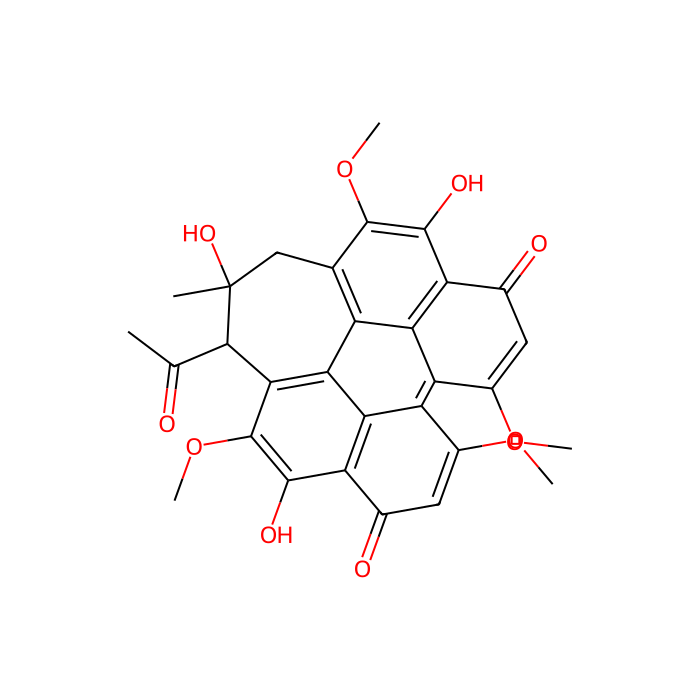
Hypocrellin A, a naturally occurring PKC inhibitor, has many biological and pharmacological properties, such as antitumour, antiviral, antibacterial, and antileishmanial activities. Hypocrellin A is a promising photosensitizer for anticancer photodynamic therapy (PDT).
사양
동의어
1-Acetyl-2,6,11-trihydroxy-4,8,9,13-tetramethoxy-2-methyl-2,3-dihydro-1H-cyclohepta[ghi]perylene-5,12-dione | (12R,13S)-12-acetyl-9,13,17-trihydroxy-5,10,16,21-tetramethoxy-13-methylhexacyclo[13.8.0.0^{2,11.0^{3,8.0^{4,22.0^{18,23]tricosa-1(15),2(11),3(8),4(22),5,9,16,18(23),20-nonaene-7,19-dione | hypocrellin a | Isohypocrelline
사양 및 순도
≥98%
생화학 및 생리적 메커니즘
Potent PKC inhibitor. Photosensitizing agent. Potent antileishmanial agent. Selective class II-MHC restricted presentation of exogenous antigen inhibitor. Shows antitumor, antifungal and antiviral effects in vivo.
보관 조건
Store at 2-8°C
배송
Wet ice
이 제품은 콜드 체인 배송이 필요합니다.지상 및 기타 경제 서비스는 사용할 수 없습니다.
작업 유형
INHIBITOR
참고
Wherever possible, you should prepare and use solutions on the same day. However, if you need to make up stock solutions in advance, we recommend that you store the solution as aliquots in tightly sealed vials at -20°C. Generally, these will be useable for up to one month. Before use, and prior to opening the vial we recommend that you allow your product to equilibrate to room temperature for at least 1 hour. Need more advice on solubility, usage and handling? Please visit our frequently asked questions (FAQ) page for more details.
This compound belongs to the class of organic compounds known as perylenequinones. These are heterocyclic compounds characterized by two 8-hydroxy-1,4-dihydronaphthalen-1-one moieties joined together one or two CC-bonds.
External Descriptors
Not available
1. Djoumbou Feunang Y, Eisner R, Knox C, Chepelev L, Hastings J, Owen G, Fahy E, Steinbeck C, Subramanian S, Bolton E, Greiner R, and Wishart DS. ClassyFire: Automated Chemical Classification With A Comprehensive, Computable Taxonomy. Journal of Cheminformatics, 2016, 8:61.
Determine the necessary mass, volume, or concentration for preparing a solution.
Dilution Calculator
Determine the dilution needed to prepare a stock solution.
Reconstitution Calculator
리뷰
고객 리뷰
Application Protocols
No vendor-validated protocols or application-specific parameters are provided for this item. The following general outlines may assist in planning research use; adjust empirically.
Stock solution preparation (general):
Dissolve Hypocrellin A in anhydrous DMSO to 1–10 mM under dim light. Vortex/sonicate briefly if needed. Aliquot into amber microvials, sparge with inert gas if feasible, and store at 2–8°C per item guidance.
Prepare substrate solution in acetonitrile or buffered aqueous media with ≤1% DMSO. Add Hypocrellin A to desired micromolar concentration. Illuminate with a defined LED band matching its absorption. Monitor oxidation by UV–Vis or HPLC.
Membrane/micelle model studies:
Incorporate from DMSO stock into preformed liposomes or detergent micelles at low dye:lipid ratios. Equilibrate in the dark, then irradiate while measuring fluorescence or tracking oxidation of reporter probes.
Controls:
Include dark controls, light-only controls, oxygen-variation experiments, and ROS quenchers to verify mechanism.
These are general research templates; follow institutional SOPs and adapt to your apparatus.
Biological Roles
General/biochemical context (literature):
Hypocrellin A is a fungal perylenequinone pigment. Such metabolites act as potent photosensitizers: after visible-light absorption, they generate singlet oxygen and other ROS, leading to oxidative modification of nearby biomolecules.
In biological membranes, the hydrophobic polyaromatic core promotes partitioning into lipid phases, which affects localization, photobleaching rates, and ROS diffusion length scales.
Phenolic groups can participate in hydrogen bonding and redox cycling, influencing interactions with proteins and nucleic acids.
Mechanistic notes:
Photophysical pathway: S0 → S1 excitation → efficient intersystem crossing (ISC) to T1 → Type II energy transfer to O2 (1O2) or Type I electron/proton transfer processes generating superoxide/peroxides.
Biological readouts include oxidative adducts on amino acids (e.g., histidine endoperoxides, methionine sulfoxide), lipid peroxidation markers, and nucleic acid strand damage under illumination.
Research applications (non-clinical):
Model for studying phototoxicity, oxidative stress signaling, antioxidant defenses, and membrane biophysics under light-stimulated ROS production.
Probe for mapping oxygen distribution and diffusion in complex matrices by monitoring photooxidation kinetics.
Note: All uses are for research and laboratory purposes only. Avoid clinical or in vivo therapeutic interpretation without appropriate regulatory approvals and safety evaluations.
Buffer Applications
Hypocrellin A is not a buffering reagent and is not used to set or maintain pH. Consequently, standard buffer system recipes (e.g., phosphate, HEPES, Tris) are not applicable.
Practical note (general):
When using Hypocrellin A in aqueous buffers for biological assays, ensure the compound is delivered via a compatible vehicle (e.g., DMSO stock, cyclodextrin inclusion, protein binding) and that the buffer is oxygenated/deoxygenated per experimental design. Maintain low light during preparation to avoid premature photosensitization.
Green Alternatives
While Hypocrellin A itself is a specialized research photosensitizer, greener choices are relevant in two dimensions: (1) selecting safer solvents/vehicles for experiments and (2) considering alternative photosensitizers with improved handling profiles. The following are general comparisons for planning purposes.
Solvent choices (general):
Prefer bio-based or lower-toxicity solvents where compatible with solubility and photophysics.
Comparison overview (literature/general; not item-specific):
Greener option vs Common choice — Notes
2-MeTHF vs THF — 2-MeTHF is bio-based, higher boiling, and less peroxide-prone; assess solubility/photophysics for your system.
Ethyl acetate vs Dichloromethane — Lower toxicity and environmental impact; limited polarity may affect solubility of polyaromatics.
Cyclodextrin aqueous complexes vs neat DMSO — Enable water-based delivery, reduce DMSO content; may alter photophysics and binding equilibria.
PEG-400 or glycerol co-solvent vs DMF — Improved safety profiles; viscosity and optical properties must be considered for photometry.
Alternative photosensitizers (contextual):
Rose bengal or riboflavin: water-compatible and widely characterized green-compatible sensitizers for 1O2 generation; lower hazard profiles but different spectra and reactivity.
Methylene blue: cationic, water-soluble; strong red absorption; distinct binding/selectivity compared to perylenequinones.
Trade-offs:
Hypocrellin A offers strong absorption and membrane affinity; greener alternatives may sacrifice lipophilicity-driven localization or spectral overlap required for specific setups. Validate performance and safety case-by-case.
Pharmaceutical Uses
Item-specific pharmacopeial status/grade: Not specified for this item; refer to CoA/Spec Sheet.
Formulation context (general, non-clinical):
As a hydrophobic photosensitizer, Hypocrellin A can be explored in research formulations such as lipid emulsions, liposomes, polymeric micelles, and cyclodextrin inclusion complexes to improve dispersion and control localization under illumination.
Co-solvent systems (e.g., small percentages of DMSO, ethanol) may assist solubilization in development studies; verify stability and photobleaching under intended storage and light conditions.
Manufacturing considerations (research scale):
Protect from light throughout compounding and filling (use amber glassware, reduced lighting). Limit headspace oxygen if formulating for controlled ROS generation studies.
Establish validated analytical methods (HPLC-UV/Vis, fluorescence, and impurity profiling) to monitor potency and degradants.
Disclaimer: No therapeutic or clinical claims are made. This material is supplied strictly for research use only, as stated by the manufacturer.
Physical Properties
Item-specific physicochemical specifications have not been provided for this catalog entry.
Item-specific values:
Appearance: Not specified for this item; refer to CoA/Spec Sheet.
Molecular weight: Not specified for this item; refer to CoA/Spec Sheet.
Molecular formula: Not specified for this item; refer to CoA/Spec Sheet.
Melting point, boiling point, density, refractive index, UV cutoff: Not specified for this item; refer to CoA/Spec Sheet.
Literature/general characteristics of perylenequinone photosensitizers (context, not item-specific specifications):
Strong visible absorption with bands in the green–red region due to extended π-conjugation; high molar absorptivity.
Poor aqueous solubility; typically soluble in polar aprotic organic solvents (e.g., DMSO, DMF) and moderately in chlorinated aromatics.
Photolabile under strong illumination and in the presence of oxygen (generates reactive oxygen species upon photoexcitation).
Amphiphilic surface functionality from phenolic/alkoxy groups can enable association with lipids, micelles, or serum proteins.
Practical notes (general):
Prepare stock solutions in dry, oxygen-limited, amber vials; minimize light exposure during handling to preserve integrity.
For spectral work, record absorption/emission under subdued light; confirm extinction coefficients in the chosen solvent system if quantitative photophysics are required.
Quality and Grades
Item-specific grade/purity: Not specified for this item; refer to CoA/Spec Sheet.
Interpreting grades (general guidance):
Research-grade natural products are typically supplied with identity confirmation (e.g., HPLC chromatogram, UV–Vis, NMR) and an assay indicating purity by HPLC or qNMR. If your application is quantitative photophysics or photooxidation kinetics, prioritize lots with documented high purity and low impurity fluorescence.
Low residual solvent and well-characterized water content help ensure reproducible photophysical behavior; request the latest CoA for details.
Stabilizers/additives: Not specified for this item; refer to CoA/Spec Sheet. If stabilizers are absent, protect strictly from light and oxygen; if present (e.g., trace antioxidants), consider potential impacts on ROS studies and perform appropriate blanks.
Lot-specific documentation: Hypocrellin A’s absorption and emission can be sensitive to microimpurities. Verify lot data for:
HPLC purity profile, UV–Vis spectrum (solvent and concentration stated), and if possible, mass spectrum.
Residual metal/ash content (important for singlet oxygen quantum yield measurements), if available.
Recommended verification (general): run a quick incoming QC check (UV–Vis in your assay solvent, HPLC retention, and a 1H NMR snapshot) to benchmark your lab’s conditions against the CoA.
Reaction and Applications
This compound is primarily used as a light-activated research photosensitizer rather than a classical synthetic reagent.
Research applications (literature/general knowledge):
Photodynamic studies: upon visible-light excitation, perylenequinones populate long-lived triplet states that transfer energy to O2 to generate singlet oxygen (1O2) and other ROS. Used to photooxidize model substrates and probe oxidative stress mechanisms.
Photochemistry of biomolecules: facilitates selective oxidation of amino acids (e.g., Trp, His, Met) and nucleic acids under controlled irradiation, enabling mapping of solvent accessibility and redox-sensitive sites.
Imaging/probing: strong absorbance and potential fluorescence (environment-dependent) support use as a chromophore/photoprobe in membranes and protein complexes.
Practical tips:
Control illumination: specify wavelength band, irradiance, and dose (J/cm²). Include dark controls to separate photochemical from thermal/background effects.
Oxygen management: aeration enhances 1O2 formation; argon/oxygen cycling can tune Type II vs Type I pathways.
Quenchers and reporters: use sodium azide, histidine, or DABCO as 1O2 quenchers; employ singlet oxygen sensors (e.g., DPBF, SOSG) to quantify ROS generation.
Limitations:
Hydrophobicity complicates uniform delivery in aqueous systems; consider carriers (liposomes, serum proteins, cyclodextrins) and verify actual free concentration.
Photobleaching and self-aggregation can alter quantum yields; keep concentrations low and validate linear response.
Reaction Conditions
Item-specific optimal conditions are not provided. The following are general literature-based considerations for using perylenequinone photosensitizers like Hypocrellin A.
Illumination (general):
Visible-light excitation is typically employed. Specify wavelength band using bandpass filters or LEDs; match to the compound’s absorption envelope. Record irradiance (mW/cm²) and exposure (J/cm²) for reproducibility.
Use temperature control (e.g., 20–25°C) to minimize thermal artifacts during prolonged irradiation.
Atmosphere and media:
Aerated solutions favor singlet-oxygen pathways (Type II). For mechanistic probes, compare air-saturated vs oxygen-depleted (argon or nitrogen purged) conditions.
Choose solvents that provide adequate solubility and optical clarity (DMSO, DMF, acetonitrile, or aromatic solvents for spectroscopy). For aqueous systems, employ co-solvents or carriers.
Additives and controls:
Quenchers (e.g., sodium azide, histidine) help confirm 1O2 involvement. Radical scavengers (e.g., TEMPO) can dissect Type I contributions.
Include dark controls and photosensitizer-free light controls to assess non-specific photoeffects.
Typical scales and concentrations:
Micromolar to low-millimolar ranges are common for solution photochemistry, with lower concentrations preferred to reduce aggregation and inner-filter effects.
Workup and analysis:
Monitor reactions by HPLC-UV/Vis or LC–MS; track characteristic substrate oxidation products and sensitizer bleaching.
Note: These are general guidelines; optimize locally for your equipment and substrate.
Safety and Handling
GHS/SDS information for this specific item:
Signal word: Not specified for this item; refer to SDS.
Hazard statements (H-phrases): Not specified for this item; refer to SDS.
GHS classification and pictograms: Not specified for this item; refer to SDS.
General safety considerations for perylenequinone photosensitizers (literature/general knowledge):
Photosensitizing agents can induce reactive oxygen species under light; minimize exposure to ambient/UV light. Work under dim or red light when practical and store in amber containers.
Avoid skin/eye contact; wear appropriate PPE: lab coat, safety glasses, and suitable gloves (e.g., nitrile). Prevent aerosolization and inhalation of powders/particles.
Incompatibilities: strong oxidizers/reducers; bases/acids may alter phenolic ionization and stability. Oxygen and light synergize to promote photodegradation and ROS generation.
First aid (overview; defer to SDS): on skin/eye contact, rinse with water for ≥15 minutes and seek medical attention. If inhaled, move to fresh air. If ingested, rinse mouth; do not induce vomiting—seek medical attention.
Fire hazards: organic solids may burn; use CO2, dry chemical, or foam as appropriate. Combustion may release irritating fumes.
Waste handling (general):
Collect light-exposed solutions and residues as hazardous organic waste. Quench reactive oxygen species (if applicable) prior to disposal and follow institutional and regulatory guidelines.
Solvent Selection
Hypocrellin A is a hydrophobic, highly conjugated perylenequinone; solvent choice primarily reflects solubility, stability, and photophysical requirements.
Polarity/miscibility (literature/general):
Poorly soluble in water and most aliphatic hydrocarbons; improved solubility in polar aprotic solvents.
Common stock solvents: DMSO and DMF (good solvators for polyaromatics with phenolic functions). Acetone and acetonitrile may dissolve at lower concentrations. Chlorinated aromatics (e.g., chlorobenzene) and aromatic solvents (e.g., toluene) can be used for spectroscopy, with caution for toxicity and volatility.
Practical selection tips:
For biological assays: prepare concentrated DMSO stocks (e.g., 1–10 mM), then dilute into buffered media with appropriate carriers (serum, albumin, or micelles) to mitigate precipitation. Shield from light.
For photophysical studies: choose spectroscopic-grade solvents; degas to control oxygen content if measuring triplet states/ROS. Use matched amber cuvettes and minimize scattering.
For formulation screens: evaluate co-solvent systems (DMSO/H2O, ethanol/water), cyclodextrin inclusion, or lipid vehicles; verify stability under the planned illumination regime.
Comparison (general considerations):
DMSO: highest solvating power; hygroscopic; may quench/react with some radicals—include controls.
Acetonitrile: low viscosity; moderate solubility; UV-transparent but can be too polar for long-term stability.
Toluene/chlorobenzene: good for nonpolar environments and photophysics; poor biocompatibility; ensure proper ventilation.
Protect from light at all times; use amber vials and minimize exposure during handling. Consider purging headspace with inert gas for long-term stability of stock solutions.
Reconstitution (general guidance):
Preferred solvents for stock solutions: anhydrous DMSO or DMF. Prepare concentrated stocks (e.g., 1–10 mM) under dim light. Filter with a PTFE syringe filter if particulate is present.
For aqueous use, dilute stocks into buffer with suitable carriers (serum proteins, cyclodextrins, liposomes) to avoid precipitation. Mix gently to prevent foaming and light exposure.
Freeze–thaw and aliquoting:
Although this item is stored at 2–8°C as supplied, prepared DMSO stocks benefit from single-use aliquots to minimize freeze–thaw and headspace oxygen/light exposure.
Stability monitoring:
Track color/absorbance changes and HPLC purity over time. Discard solutions that show significant photobleaching or unexpected peaks.
Note: Always consult the product’s CoA/SDS for definitive stability, compatibility, and safe-handling information.
Structure and Identity
Hypocrellin A is a perylenequinone-type natural product frequently used as a light-activated research photosensitizer derived from fungal sources (e.g., Hypocrella/Aschersonia species).
Item-specific identifiers (as provided):
CAS: 77029-83-5
PubChem CID: 3664 (as provided; verify against current databases if needed)
InChIKey: 374052 (as provided; appears truncated—refer to CoA/SDS for full identifier)
SMILES: Not specified for this item; refer to CoA/Spec Sheet.
Molecular formula: Not specified for this item; refer to CoA/Spec Sheet.
Molecular weight: Not specified for this item; refer to CoA/Spec Sheet.
Structural class and features (literature/general knowledge):
Belongs to the perylenequinone family: a fused polycyclic aromatic (perylene) core bearing two quinone moieties and multiple phenolic/alkoxy substituents.
Conjugated system confers strong visible absorption (deep red/orange chromophore) and efficient intersystem crossing to the triplet state for photosensitization.
Contains quinone carbonyls (electrophilic), phenolic OH groups (acidic H-bond donors), and extended aromatic surfaces (π–π interactions, hydrophobicity).
Typically exists as a neutral polyphenolic quinone without defined stereocenters; planar, highly conjugated 2D framework.
A perylene backbone (five fused rings) with two opposite peri-positions oxidized to quinones; peripheral positions decorated with hydroxy/methoxy substituents, creating an amphiphilic yet largely hydrophobic molecule suited to membrane association.
Synthetic Utility
Although Hypocrellin A is primarily a target molecule and photosensitizer rather than a building block, its functional groups and photochemistry afford niche synthetic and analytical uses.
Functional group perspective (literature/general):
Quinone carbonyls: electrophilic, enabling Michael-type additions or reduction to hydroquinone forms under controlled conditions.
Phenolic OH groups: can form esters/ethers for derivatization, conjugation to carriers, or tuning solubility and spectral properties.
Extended aromatic surface: supports π–π stacking and noncovalent complexes with aromatics and biomacromolecules, useful in supramolecular assemblies.
Photochemical utility:
Sensitized oxidation: Generation of singlet oxygen enables selective transformations (e.g., ene reactions with alkenes, oxidation of sulfides to sulfoxides) in method-development studies where the sensitizer is not consumed stoichiometrically.
Photoaffinity/proximity labeling (conceptual): localized ROS production near binding partners can map interaction zones, though care is needed to avoid nonspecific oxidation.
Limitations:
Complex polyaromatic scaffold offers limited sites for high-yield, selective modifications without impacting photophysics.
Aggregation and poor solubility in many reaction media require attention to concentration, solvent, and possibly surfactants.
Target Specificity
No antibody or biomolecular targeting information is provided for this item, and Hypocrellin A is not an antibody or affinity reagent.
Item-specific targeting/epitope/clone/isotype data: Not applicable.
Usage note: In biological experiments, any apparent “specificity” typically arises from physicochemical partitioning (e.g., membrane localization) rather than defined molecular recognition.
Products are supplied to verified businesses, institutions, and qualified professionals for research and development use only. Not for use in humans, animals, diagnosis, or therapy.

 C2528149