
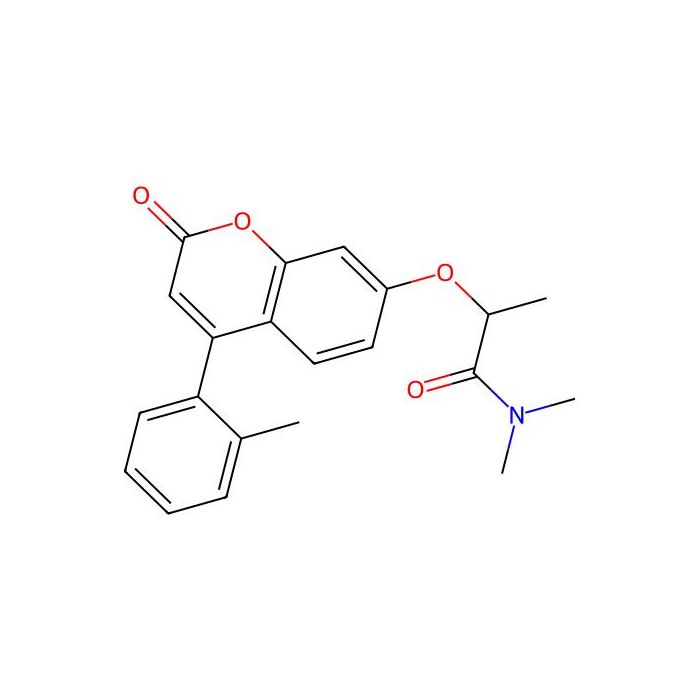
Determine the necessary mass, volume, or concentration for preparing a solution.
IMT1 - ≥98% , CAS No.2304621-31-4
주문 가능
등급 & 순도 ≥98%
Storage
Store at -20°C
Shipped In
Ice chest + Ice pads
IMT1 is a first-in-class specific and noncompetitive human mitochondrial RNA polymerase (POLRMT) inhibitor. IMT1 causes a conformational change of POLRMT, which blocks substrate binding and transcription in a dose-dependent way in vitro. IMT1 reduces deoxynucleoside triphosphate levels and citric acid cycle intermediates, resulting in a marked depletion of cellular amino acid levels. IMT1 has the potential for mitochondrial transcription disorders related diseases.
In Vitro
IMT1 (0.00001-10 μM; 0-168 h) has a dose-dependent decrease in cell viability in A2780, A549 and HeLa cells. IMT1 shows a strong decrease in cell viability in about one third of the cancer cell lines, 89 cancer cell lines and primary cells (IMR90 lung fibroblasts and human peripheral blood mononuclear cells (PBMCs)), whereas primary cells remained unresponsive. IMT1 (0.01-10 μM; for 24-200 h) causes a dose-dependent decrease in the levels of mitochondrial transcripts and gradual depletion of mtDNA in HeLa cells. There is a dose-dependent decrease in the levels of subunits (NDUFB8, UQCRC2 and COXI) of respiratory chain complexes I, III and IV. IMT1 reveals a time-dependent and marked increase in the levels of mono- and diphosphate nucleotides that results in a considerable increase in the AMP/ATP ratio and levels of phosphorylated AMPK in A2780 cells. IMT1 severely impairs mtDNA gene expression in A2780 cells that express wild-type POLRMT, whereas cells that express mutant POLRMT (L796Q or L816Q) are resistant. POLRMT is essential for mtDNA transcription and biogenesis of the oxidative phosphorylation (OXPHOS) system. MCE has not independently confirmed the accuracy of these methods. They are for reference only. Cell Viability AssayCell Line: A2780, A549 and HeLa cells Concentration: 0.00001-10 μM Incubation Time: 0-168 hours Result: Had a dose-dependent decrease in cell viability in A2780, A549 and HeLa cells, but had not cytotoxic to human PBMCs or pooled primary human hepatocytes.
Form:Solid
Taxonomy Tree
| Kingdom | Organic compounds |
|---|---|
| Superclass | Phenylpropanoids and polyketides |
| 분류 | Neoflavonoids |
| Subclass | Neoflavones |
| Intermediate Tree Nodes | Not available |
| Direct Parent | Neoflavones |
| Alternative Parents | Coumarins and derivatives 1-benzopyrans Pyranones and derivatives Alkyl aryl ethers Benzene and substituted derivatives Tertiary carboxylic acid amides Heteroaromatic compounds Lactones Oxacyclic compounds Organopnictogen compounds Organonitrogen compounds Organic oxides Hydrocarbon derivatives |
| Molecular Framework | Aromatic heteropolycyclic compounds |
| Substituents | 4-phenylcoumarin - Coumarin - 1-benzopyran - Benzopyran - Pyranone - Alkyl aryl ether - Benzenoid - Pyran - Monocyclic benzene moiety - Heteroaromatic compound - Tertiary carboxylic acid amide - Lactone - Carboxamide group - Oxacycle - Organoheterocyclic compound - Ether - Carboxylic acid derivative - Organic nitrogen compound - Organic oxygen compound - Organopnictogen compound - Organic oxide - Hydrocarbon derivative - Organooxygen compound - Organonitrogen compound - Aromatic heteropolycyclic compound |
| 설명 | This compound belongs to the class of organic compounds known as neoflavones. These are neoflavonoids with a structure based on the 4-phenylcoumarin skeleton. |
| External Descriptors | Not available |
| 용해성 | DMSO : 50 mg/mL (142.29 mM; Need ultrasonic) |
|---|
No vendor-validated application protocols are provided for this item.
General protocol suggestions for small-molecule screening (research use only)
Note
Item-specific biological roles: Not specified for this item; no target or pathway annotations are provided in the Product Data.
General context for small-molecule research tools (general knowledge)
Guidance
This product is a small-molecule library member and not a buffering agent.
Applicability
Practical note
Green chemistry considerations apply primarily to solvent choice and handling, as the specific compound structure is not disclosed.
Greener solvent considerations (general)
Example comparison (general guidance)
Operational green practices
Item-specific note
No pharmacopeial status, excipient role, or manufacturing use is specified for this item.
General guidance (non-clinical)
Research Use Note
No definitive physical constants are provided for this specific item.
Item-specific physical data
General guidance for small-molecule screening compounds (general knowledge)
Notes on data sources
Item-specific grade/purity: Not specified for this item; refer to CoA/Spec Sheet.
Interpreting quality for screening compounds (general knowledge)
What is specific to this item
Recommendations
Manufacturer Applications: Not specified for this item; refer to catalog updates. The product is categorized under small molecules/compound libraries and is typically intended for discovery research workflows.
Likely research contexts (general guidance for library members)
Not a typical synthetic reagent
Practical tips
No reaction conditions can be recommended for this specific compound in the absence of structural information.
General laboratory handling of small molecules (non-reactive context)
If synthetic transformations are intended
Definitive GHS data are not provided in the Product Data for this item. Always consult the SDS for authoritative guidance.
Item-specific safety fields
General laboratory precautions for small organic molecules (general guidance)
Transport & stability
Because the structure and polarity are not specified, initial solubility scouting is advised.
Practical solvent strategy (general guidance)
Miscibility and materials compatibility
Small comparison (general)
Item-specific note
Item-specific storage
Reconstitution (general guidance)
Aliquoting and stability
Shelf-life
Specifications not provided
Item-specific data available in this listing are insufficient to detail the molecular structure.
Item-specific identifiers (from Product Data)
Structural features (general guidance)
Best practices
This item is listed as a small-molecule library member with no disclosed structure; it is therefore not positioned as a general-purpose synthetic reagent or building block.
Applicability
Alternative approach (general guidance)
Not applicable. This product is not supplied as a biological macromolecule (e.g., antibody, enzyme) and no target annotations are provided for the small molecule.