Indium oxide - PrimorTrace™, ≥99.99% metals basis, <100 nm(TEM) , CAS No.1312-43-2

CAS: 1312-43-2 Cat. No.: I105867 분자식: In2O3 분자량: 277.64 EC 번호: 215-193-9
주문 가능
GRADE & PURITY PrimorTrace™ ? PrimorTrace™ — Aladdin's trace-metal-analysis line with ultra-low metal background. Use for ICP/AAS trace-metal work where contamination must be minimal. ≥99.99% metals basis <100 nm(TEM)
Synonyms
indium sesquioxide
Shipped In
Normal
★
Size
USA
독일 (EU)*
Price
Qty
10g
I105867-10g
3 재고 있음
—
US$93.90
50g
I105867-50g
4 재고 있음
—
US$308.90
100g
I105867-100g
5 재고 있음
—
US$515.90
250g
I105867-250g
2 재고 있음
—
US$1,232.90
Enter a quantity for the sizes you want to add.
🧪
Why this grade

PrimorTrace™, ≥99.99% metals basis, <100 nm(TEM) PrimorTrace™ for sensitive chromatographic and analytical workflows requiring minimal baseline interference.

🌡

Storage & shipping

Ships Normal Check lot-specific COA for exact specifications.

📋

Quality documents

SDS, COA, datasheet, and spec sheet available for download. Lot-specific COA accessible via lot number lookup.

📚

Literature proof

Cited in 121 peer-reviewed publications across chromatography, organic synthesis, and cross-coupling reactions.

개요

Indium oxide is widely utilized as a n-type semiconductor, which is used in integrated circuits as a resistive element. It finds applications in batteries and as a part of some stain formulations. It is used as thin film coatings in optical, antistatic and infrared reflectors. It is doped with tin oxide and used as transparent conductive coatings.


Specifications

동의어
indium sesquioxide
사양 및 순도
PrimorTrace™, ≥99.99% metals basis, <100 nm(TEM)
배송
Normal
등급
PrimorTrace™
순수함
≥99.99% metals basis
이름과 식별자
분자량
277.64

Documentation

📋 Safety Data Sheet (SDS)

Comprehensive hazard, handling, storage, and regulatory compliance document.

Download SDS →

✅ Certificate of Analysis (COA)

Lot-specific quality data. Enter your lot number to retrieve the exact COA.

Look up COA →

📊 Datasheet

Quick-reference summary of product specifications and applications.

View datasheet →

🔬 Specification Sheet

Full quality attributes and acceptance criteria for this grade.

View spec sheet →

Advanced Data

인증서(CoA, COO, BSE/TSE 및 분석 차트)
C of A & Other Certificates(BSE/TSE, COO):
Analytical Chart:

Find and download the COA for your product by matching the lot number on the packaging.

17 results found

Lot NumberCertificate Type날짜항목
E2529187Certificate of AnalysisJun 04, 2025 I105867
I2021085Certificate of AnalysisJul 10, 2024 I105867
C23111071Certificate of AnalysisMar 20, 2023 I105867
C23111094Certificate of AnalysisMar 20, 2023 I105867
C23111093Certificate of AnalysisMar 20, 2023 I105867
C23111092Certificate of AnalysisMar 20, 2023 I105867
C23111078Certificate of AnalysisMar 20, 2023 I105867
C23111070Certificate of AnalysisMar 20, 2023 I105867
F1911098Certificate of AnalysisMar 08, 2023 I105867
G2220720Certificate of AnalysisJun 11, 2022 I105867
G2220721Certificate of AnalysisJun 11, 2022 I105867
G2220725Certificate of AnalysisJun 11, 2022 I105867
G2220726Certificate of AnalysisJun 11, 2022 I105867
G2220729Certificate of AnalysisJun 11, 2022 I105867
D2228033Certificate of AnalysisMar 01, 2021 I105867
E2423186Certificate of AnalysisMar 01, 2021 I105867
E2423187Certificate of AnalysisMar 01, 2021 I105867
화학 및 물리적 특성
녹는점(°C)1910℃
Citations of This Product
솔루션 계산기
리뷰

고객 리뷰

Application Protocols

No biological assay protocols are applicable to this inorganic material by default (e.g., WB/IHC/IF/FC do not apply).

Materials-oriented protocol examples (general/literature):

  • Aqueous dispersion (powder): Disperse 1–5 wt% In2O3 in deionized water with 0.1–1 wt% dispersant (e.g., PVP). Adjust pH to 9–10 for electrostatic stabilization; ultrasonicate 10–30 min while cooling; mill with zirconia media as needed. Verify stability by DLS/zeta potential.
  • Acid dissolution to InCl3 solution: To 3 M HCl at 0–10 °C, add In2O3 incrementally with stirring; maintain temperature <40 °C; after complete dissolution, filter to remove insolubles; standardize concentration by ICP-OES.
  • Film annealing (particulate coatings): Dry-coat on substrate; ramp 2–5 °C/min to 300–500 °C in air for 30–120 min; cool slowly to limit cracking.

These are generic literature-style procedures; adjust to your equipment and safety standards. Item-specific protocols for SKU I105867 are Not specified for this item; refer to CoA/Spec Sheet.

Biological Roles

Indium(III) oxide does not have a known physiological role in biological systems. The following points reflect general information and occupational hygiene considerations, not therapeutic guidance.

  • Bioinert character (literature): As an insoluble, refractory oxide, bulk In2O3 exhibits very low solubility in water and physiological media, leading to limited bioavailability under normal laboratory conditions.
  • Cellular interactions (literature): Nanoparticulate forms can interact with cells through surface adsorption and may induce oxidative stress depending on size, surface chemistry, and dose; effects are highly preparation-specific.
  • Metabolism (literature): Indium does not participate in known mammalian metabolic pathways. Soluble indium(III) salts (formed under strong acidic conditions) can display different toxicokinetics than the oxide.
  • Exposure route relevance: Inhalation of fine dust is the most relevant occupational concern; deposition in the respiratory tract should be minimized by engineering controls and PPE.

This SKU is intended for research use only. No medical, diagnostic, or clinical uses are implied or supported. Item-specific biocompatibility or endotoxin data are Not specified for this item; refer to CoA/Spec Sheet if applicable.

Buffer Applications

Indium oxide is a water-insoluble inorganic solid and does not function as an acid–base buffer system. Accordingly, no standard biochemical buffer recipes involve In2O3.

  • If preparing aqueous dispersions for materials studies, choose an external buffer (e.g., phosphate, borate) to control pH while considering surface charge: the isoelectric point of In2O3 is reported near pH 8–9 (literature). pH relative to the IEP will influence dispersion stability but In2O3 itself does not provide buffering capacity.

Item-specific recommendations for buffer composition are Not specified for this item; refer to application notes or CoA/Spec Sheet where available.

Green Alternatives

Context: Indium is a scarce, critical raw material. Greener choices focus on lifecycle, resource criticality, and processing conditions rather than acute toxicity.

Alternative materials (literature/general):

  • Transparent conductors: Consider Al-doped ZnO (AZO) or F-doped SnO2 (FTO) as indium-free TCOs for some applications.
  • Catalysis: For CO2-to-methanol, Cu/ZnO/Al2O3 remains industrial; Ga2O3- or ZnO-based systems can be explored depending on performance targets.

Greener processing of In2O3:

  • Lower-temperature film formation via solution processing (e.g., combustion synthesis, UV–ozone or plasma annealing) reduces energy demand compared with high-temperature sintering.
  • Use aqueous/ethanolic vehicles and benign dispersants for inks instead of high-VOC solvents.
  • Recycle/scrap recovery: Implement closed-loop recovery of indium from spent targets and ITO waste; hydrometallurgical leaching with controlled oxidants minimizes environmental load versus pyrometallurgy.

Comparison (general):

  • In2O3 (ITO route): Excellent optoelectronic performance; relies on a critical element (In). Processing often requires vacuum deposition and high-temperature anneals.
  • AZO/FTO: Indium-free; sometimes lower conductivity/long-term stability; can be processed with similar PVD/CVD methods; cost and availability are favorable.

Selection guidance: If performance can be met with indium-free oxides, prefer them for sustainability. Where In2O3 is required, optimize deposition energy, adopt solvent-reduced formulations, and plan for end-of-life recycling.

Item-specific environmental credentials (e.g., recycled content, RoHS/REACH statements): Not specified for this item; refer to CoA/Spec Sheet.

Pharmaceutical Uses

Indium(III) oxide is not a common pharmaceutical excipient and is not used for clinical purposes. Any uses are limited to research and materials development contexts.

  • Formulation role: None standard. Insoluble refractory oxide; not listed as a pharmacopeial excipient for oral/parenteral dosage forms.
  • Device/coating research: Transparent conductive and barrier coatings based on indium oxides are studied for diagnostics and device components, but this is outside of drug formulation.
  • Regulatory status: No pharmacopeial monograph is typically associated with In2O3 for medicinal use. RoHS/REACH-related materials declarations, if relevant to devices, are supplier- and batch-specific.

For this SKU: Item-specific compliance, bioburden/endotoxin, or residual solvent data are Not specified for this item; refer to CoA/Spec Sheet. For research use only.

Physical Properties

Only general/literature properties are provided below. Item-specific specifications (particle size, surface area, impurity profile, etc.) are not provided in the Product Data.

  • Appearance: Not specified for this item; refer to CoA/Spec Sheet. (Typically pale yellow to off-white powder; literature)
  • Phase: Crystalline solid (literature)
  • Density: ~7.18 g/cm³ at 25 °C (literature)
  • Melting point: ~1910 °C (literature; high-temperature stability; may sinter before melting)
  • Boiling/decomposition: >2000 °C (literature; negligible volatility under ambient pressure)
  • Solubility: Insoluble in water and common organic solvents; dissolves in strong acids (e.g., HCl with complexation to [InCl6]3−) and in hot concentrated alkali under specific conditions (literature)
  • Refractive index: n ~2.0 (bulk; wavelength-dependent; literature)
  • Band gap: ~2.9 eV (cubic bixbyite); wider in rhombohedral phase; optical properties vary with oxygen vacancies/doping (literature)
  • Electrical properties: Intrinsic n-type; conductivity increases markedly with oxygen deficiency or aliovalent dopants (Sn, F, etc.) (literature)
  • Thermal expansion: α ~7–9 ×10⁻⁶ K−1 (phase and density dependent; literature)
  • Magnetic: Diamagnetic (literature)

Notes

  • Values above are representative literature data for bulk In2O3. For precise specifications applicable to SKU I105867 (e.g., trace-metal limits, particle size distribution, BET surface area), Not specified for this item; refer to CoA/Spec Sheet.
Quality and Grades
  • Grade on listing: PrimorTrace™.
  • What this generally implies (general/brand context): The name suggests emphasis on trace-metal control and/or suitability for high-purity materials science workflows (e.g., electronic, optical applications). However, item-specific impurity limits (ppb/ppm), metallic contaminants, loss on ignition, carbon/sulfur, and particle metrics are Not specified for this item; refer to CoA/Spec Sheet.

How to evaluate suitability (practical guidance):

  • For electronic/optical applications (TCOs, sputter targets, ALD/CVD feedstock preparation), review:
    • Alkali/alkaline/transition metal impurities (Na, K, Fe, Cu, Ni, Cr, etc.)
    • Halides/sulfur/phosphorus/carbon; oxygen deficiency (In2O3−x)
    • Particle size distribution, specific surface area, agglomeration state
  • For catalytic applications, review:
    • Surface area (BET), acid/base site density (TPD where available), residual chloride/sulfate
  • Documentation: Request the CoA specifying analytical method (ICP-MS/ICP-OES), detection limits, and batch results. Confirm that listed values match your process windows.

Stabilizers/additives: None are indicated in the Product Data. If dispersants or binders are added for specialized forms (inks, slurries), these would be specified on the CoA. For SKU I105867: Not specified for this item; refer to CoA/Spec Sheet.

Bottom line: PrimorTrace™ likely targets high-purity use, but final acceptance should be based on the batch CoA against your application’s impurity budget.

Reaction and Applications

Indium oxide (In2O3) is a functional inorganic material with broad utility in materials chemistry and catalysis.

Materials applications (literature):

  • Transparent conducting oxides (TCOs): Base oxide for indium tin oxide (ITO). Doping with Sn (e.g., 5–10 at% Sn) yields high optical transparency and electrical conductivity for displays, photovoltaics, and touch sensors.
  • Thin films: Employed in sputter targets for PVD; precursor for ALD/CVD routes to indium oxide films. Sol–gel and spin-coating of precursor solutions followed by calcination form dense or nanocrystalline layers.
  • Sensors: Oxygen-deficient In2O3−x exhibits chemiresistive responses to reducing/oxidizing gases (e.g., H2, NOx), especially as nanowires/nanoparticles.
  • Photocatalysis/PEC: As a wide-band-gap n-type semiconductor and as a component in heterostructures (e.g., In2O3/CeO2, In2O3/ZnO) for CO2 reduction, VOC oxidation.

Catalysis (literature):

  • Hydrogenation and dehydrogenation: In2O3-based catalysts (often promoted with ZrO2) are prominent for CO2 hydrogenation to methanol; surface oxygen vacancies and formate intermediates play key roles.
  • Acid–base/redox catalysis: Active in oxidation of CO/VOCs and selective oxidative dehydrogenation when suitably doped.

Practical tips:

  • Oxygen stoichiometry strongly governs properties; annealing under O2 or vacuum/H2 tunes carrier density and catalytic activity.
  • For high-purity electronics, minimize alkali/transition metal contaminants; use cleanroom-compatible milling/handling.
  • For catalysis, pre-treatments (calcination 400–600 °C; reduction/activation under H2) adjust surface states; record mass changes (TGA) to track oxygen vacancy formation.

Manufacturer Applications: Not specified in the Product Data for this SKU; the above expands on common materials/catalytic use-cases from literature.

Reaction Conditions

General literature guidance for processing and transformations involving indium(III) oxide:

  • Acid dissolution to indium salts: In2O3 + 6 HCl → 2 InCl3 + 3 H2O (stoichiometric). Practical: Add oxide portionwise to cooled acid (3–6 M HCl) under stirring; gentle heating (40–80 °C) expedites dissolution. Avoid excess chloride if subsequent hydrolysis routes are planned.
  • Oxygen stoichiometry tuning: Anneal 300–800 °C under controlled atmospheres.
    • Oxidizing anneal (air/O2): Restores stoichiometry; decreases carrier density; improves transparency of films.
    • Reducing anneal (H2/N2, 1–10% H2): Introduces oxygen vacancies; increases n-type conductivity; typical 200–500 °C for thin films, higher for bulk.
  • Solid-state doping: Mix In2O3 with dopant sources (e.g., SnO2) followed by calcination 900–1200 °C for dense ceramics/targets; lower-temperature solution routes (impregnation with SnCl4, then calcine 400–600 °C) suit nanopowders and films.
  • Film deposition (overview):
    • PVD (sputtering): Use In2O3 or ITO targets; substrate 25–300 °C; post-anneal improves crystallinity/conductivity.
    • ALD: Indium precursors (e.g., InCp, In(thd)3, InCl3) with H2O/O3/plasma co-reactants; 100–250 °C; yields conformal In2O3.
    • Solution processing: Spin/slot-die coat indium alkoxide/organic salt solutions; UV–ozone or 200–400 °C anneal to convert to oxide.
  • Catalysis (CO2→MeOH, literature): In2O3–ZrO2 catalysts; 200–300 °C, 30–50 bar, H2/CO2 ~3:1; methanol productivity depends on defect density and promoter levels.

All conditions above are literature/general guidance. Optimize for scale, apparatus, and purity constraints. Item-specific process recommendations are Not specified for this item; refer to CoA/Spec Sheet.

Safety and Handling

Hazard classifications are not provided in the Product Data for this specific item. Always consult the SDS for authoritative guidance.

General safety considerations for indium(III) oxide (literature/general):

  • GHS classification: Often not classified as acutely hazardous; may include categories for specific target organ toxicity (repeated exposure) or respiratory irritation depending on jurisdiction and dustiness. Exact classification varies by supplier and region. Not specified for this item; refer to SDS.
  • Pictograms/Signal word/H-statements: Not specified for this item; refer to SDS.
  • Primary hazards: Nuisance dust; respiratory tract irritation; potential lung effects upon prolonged or repeated inhalation of fine particulates; mechanical eye irritation. Avoid generating dust/aerosols.
  • Incompatibilities: Reacts with strong acids (dissolution with formation of indium salts/complexes). At elevated temperatures in reducing atmospheres (H2/CO), can be reduced to metallic indium. Avoid contact with strong reducing agents at high temperature unless intended.
  • PPE: Safety glasses, lab coat, appropriate gloves (e.g., nitrile); use a dust mask/respirator if dust generation cannot be controlled (per SDS/OSHA/EN guidance). Handle powders in a fume hood or ventilated enclosure.
  • First aid (overview): Move to fresh air after inhalation exposure; rinse eyes with water for several minutes; wash skin with soap/water; seek medical attention if symptoms persist. Refer to SDS for details.
  • Fire/explosion: Nonflammable inorganic solid; use extinguishing media appropriate to surrounding fire. Dust may pose nuisance but not an explosion hazard in typical conditions.
  • Waste: Collect solids to sealed container; dispose in accordance with local regulations for metal-containing inorganic waste.
Solvent Selection

This product is a refractory inorganic solid (In2O3) and is not a solvent. Solvent selection is instead relevant to processing and dispersion.

Processing solvents (general guidance):

  • Acid dissolution: Dissolves in strong mineral acids (e.g., HCl, HNO3) to give indium(III) salts/complexes; water is the principal medium. Use corrosion-resistant vessels and control exotherm.
  • Dispersions/inks: For colloids or nanopowders, polar protic solvents (water, ethanol, isopropanol) and glycols (ethylene/diethylene glycol) are common. Surfactants/dispersants (e.g., PVP, citrate) can stabilize suspensions; optimize pH and ionic strength to avoid flocculation.
  • Thin-film processing: Alcohols, ketones, and water-based systems are frequent for sol–gel precursors (e.g., indium alkoxides followed by hydrolysis/anneal to In2O3). For particulate routes (slurry casting, tape casting), higher-boiling solvents (terpineol, butyl carbitol) may be used with polymeric binders.

Polarity/miscibility context (literature):

  • In2O3 is insoluble in organic solvents; interaction is surface-based. Zeta potential and isoelectric point (~pH 8–9, literature) guide aqueous dispersion: below IEP particles carry positive charge; above, negative.

Choice vs alternatives:

  • If dissolution is required, select acid media; if retention of oxide is required, use neutral/weakly basic aqueous or alcoholic media with dispersants.

Item-specific solvent recommendations are Not specified for this item; refer to CoA/Spec Sheet.

Storage and Reconstitution
  • Storage temperature/conditions: Not specified for this item; refer to CoA/Spec Sheet. General guidance for inorganic oxide powders: store at ambient temperature in a tightly closed container, in a dry place away from acids and volatile corrosives. Avoid conditions that generate dust.
  • Shipped in: Normal (per Product Data).
  • Shelf life: Not specified for this item; refer to CoA/Spec Sheet. In2O3 is thermodynamically stable; performance is generally preserved if kept dry and clean.
  • Reconstitution: Not applicable (solid oxide). For dispersions, use clean vessels/solvents; consider ultrasonication and dispersants as noted under Application Protocols.
  • Handling: Minimize contamination (especially for electronic applications). Use nonmetallic or compatible milling media (e.g., zirconia) if particle-size modification is required.
  • Packaging: For high-purity use, prefer double-bagging in clean environment; purge with dry air or nitrogen if moisture-sensitive downstream steps are anticipated.

For any item-specific constraints (e.g., particle size stabilization, residual moisture limits, purity hold time), Not specified for this item; refer to CoA/Spec Sheet.

Structure and Identity

Indium oxide is an inorganic metal oxide commonly encountered as indium(III) oxide.

  • Item-specific registry fields (SMILES, InChIKey): Not specified for this item; refer to CoA/Spec Sheet.
  • Molecular formula (literature): In2O3
  • Molecular weight (literature): 277.64 g/mol
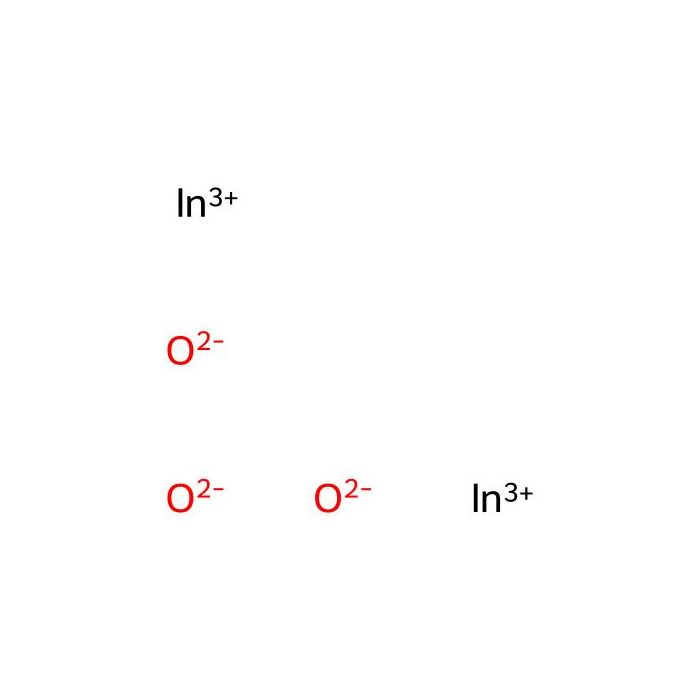
  • Oxidation state (literature): Indium is +3; oxide is O2−.
  • Structural features (literature):
    • Adopts the cubic bixbyite structure (space group Ia-3) as the thermodynamically stable phase at ambient conditions; a metastable rhombohedral (corundum-like) phase can be accessed under certain conditions.
    • 3D extended ionic/covalent lattice; no discrete molecules. Each In3+ is octahedrally coordinated by O2− with characteristic cation vacancies of the bixbyite motif.
  • Descriptive 2D representation (literature): Best depicted as a repeating In–O lattice; no meaningful line-bond “molecule.” In practical schematics, shown as In3+ nodes connected to O2− in an octahedral network.
  • Common synonyms (literature): Indium(III) oxide; diindium trioxide; indium sesquioxide.
  • Electronic/optical note (literature): Wide-band-gap n-type semiconductor; intrinsic band gap ~2.9 eV (cubic bixbyite), with defect/doping-dependent optical edges useful for transparent conductive applications.

All identifiers absent from Product Data are provided as literature/general information and are not item-specific specifications.

Synthetic Utility

While not a molecular building block, In2O3 is a versatile inorganic precursor and functional support in synthetic and materials chemistry.

  • Precursor to indium salts (literature): Dissolution in mineral acids affords indium(III) salts (e.g., InCl3, In(NO3)3) that are widely used as Lewis acids and in optoelectronic precursor chemistries. Compared with metal indium, In2O3 provides an oxidized, stable storage form.
  • Doping host (literature): Acts as the host lattice for aliovalent dopants (Sn4+, F−, Zn2+, etc.), tuning carrier densities for TCOs. Solid-state diffusion or solution-based routes (impregnation/anneal) are applied.
  • Catalyst/support (literature): In2O3 provides basic and redox-active sites; as a standalone or supported phase (e.g., In2O3/ZrO2, In2O3/CeO2), it functions in CO2 hydrogenation and oxidation reactions. Can serve as a support for noble metals (Pd, Pt), modifying electronic properties.
  • Nanostructure synthesis (literature): Hydrothermal/solvothermal, combustion, and vapor–solid (VS) methods yield nanocubes, nanowires, and porous structures; these forms offer enhanced surface areas for sensing/catalysis.
  • Retrosynthetic note: For processes requiring soluble indium(III) reagents, generating them in situ from In2O3 by acid treatment can minimize handling of corrosive anhydrous salts and enable on-demand preparation.

Practical considerations:

  • Control oxygen stoichiometry (In2O3−x) via annealing atmosphere to modulate electronic/catalytic behavior.
  • Monitor and limit extraneous metal contamination during milling/synthesis to protect electronic properties.
Target Specificity

Not applicable. This product is an inorganic oxide material, not a biological targeting reagent (e.g., antibody, ligand, or probe). No antigen/epitope/species specificity applies.

Shall we send you a message when we have discounts available?

Remind me later

Thank you! Please check your email inbox to confirm.

Oops! Notifications are disabled.