
Determine the necessary mass, volume, or concentration for preparing a solution.
| Activity Type | Activity Value -log(M) | Mechanism of Action | Activity Reference | Publications (PubMed IDs) |
|---|
Moligand™, ≥97% Moligand™ 최소한의 기준선 간섭이 필요한 민감한 크로마토그래피 및 분석 워크플로우용.
Store at -20°C Ice chest + Ice pads 출고. 정확한 사양은 로트별 COA를 확인하세요.
SDS, COA, 데이터시트, 사양서를 다운로드할 수 있습니다. 로트별 COA는 로트 번호 조회를 통해 확인할 수 있습니다.
크로마토그래피, 유기 합성 및 교차 커플링 반응 분야의 동료 심사 논문 0편에서 인용되었습니다.
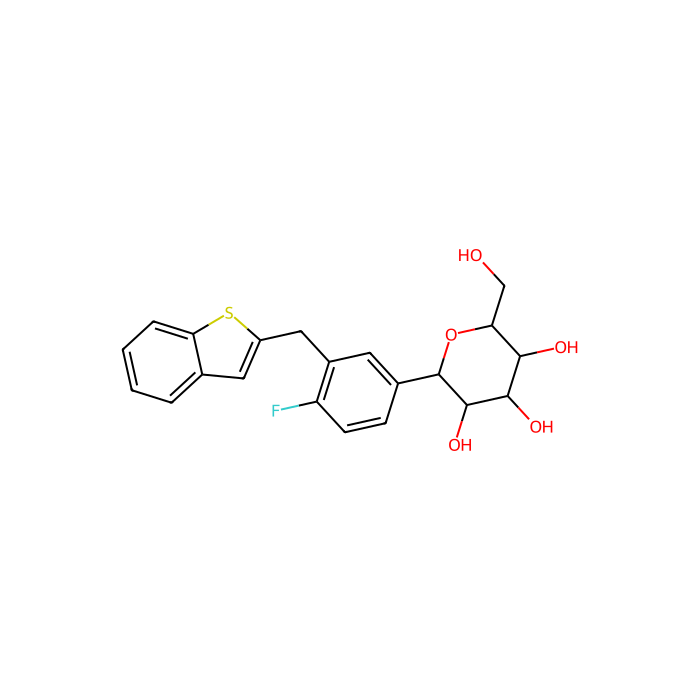
Ipragliflozin (ASP1941) is a highly potent and selective SGLT2 inhibitor with IC50 of 2.8 nM; little and NO potency for SGLT1/3/4/5/6. IC50 value: 2.8 nM Target: SGLT2 in vitro: Ipragliflozin potently and selectively inhibited human, rat, and mouse SGLT2 at nanomolar ranges and exhibited stability against intestinal glucosidases. in vivo: Ipragliflozin showed good pharmacokinetic properties following oral dosing, and dose-dependently increased urinary glucose excretion, which lasted for over 12 h in normal mice. Oral administration of ipragliflozin increased urinary glucose excretion in a dose-dependent manner, an effect which was significant at doses of 0.3 mg/kg or higher and lasted over 12 h. Single administration of ipragliflozin dose-dependently increased urinary glucose excretion, reduced blood glucose and plasma insulin levels, and improved glucose intolerance .
위험성, 취급, 보관 및 규제 준수를 포괄하는 종합 문서.
<<<<<<< HEAD SDS 다운로드 → ======= SDS 다운로드 → >>>>>>> release248-p3Taxonomy Tree
| Kingdom | Organic compounds |
|---|---|
| Superclass | Organic oxygen compounds |
| 분류 | Organooxygen compounds |
| Subclass | Carbohydrates and carbohydrate conjugates |
| Intermediate Tree Nodes | Glycosyl compounds |
| Direct Parent | Phenolic glycosides |
| Alternative Parents | Hexoses C-glycosyl compounds 1-benzothiophenes 2,3,5-trisubstituted thiophenes Fluorobenzenes Oxanes Aryl fluorides Heteroaromatic compounds Secondary alcohols Polyols Oxacyclic compounds Dialkyl ethers Primary alcohols Organofluorides Hydrocarbon derivatives |
| Molecular Framework | Aromatic heteropolycyclic compounds |
| Substituents | Phenolic glycoside - Hexose monosaccharide - C-glycosyl compound - 1-benzothiophene - Benzothiophene - 2,3,5-trisubstituted thiophene - Halobenzene - Fluorobenzene - Aryl fluoride - Monosaccharide - Aryl halide - Benzenoid - Monocyclic benzene moiety - Oxane - Heteroaromatic compound - Thiophene - Secondary alcohol - Oxacycle - Organoheterocyclic compound - Polyol - Dialkyl ether - Ether - Primary alcohol - Hydrocarbon derivative - Alcohol - Organofluoride - Organohalogen compound - Aromatic heteropolycyclic compound |
| 설명 | This compound belongs to the class of organic compounds known as phenolic glycosides. These are organic compounds containing a phenolic structure attached to a glycosyl moiety. Some examples of phenolic structures include lignans, and flavonoids. Among the sugar units found in natural glycosides are D-glucose, L-Fructose, and L rhamnose. |
| External Descriptors | Not available |
| Activity Type | Activity Value -log(M) | Mechanism of Action | Activity Reference | Publications (PubMed IDs) |
|---|
| Activity Type | Activity Value -log(M) | Mechanism of Action | Activity Reference | Publications (PubMed IDs) |
|---|
| Activity Type | Relation | Activity value | Units | Action Type | Journal | PubMed Id | doi | Assay Aladdin ID |
|---|
| Activity Type | Relation | Activity value | Units | Action Type | Journal | PubMed Id | doi | Assay Aladdin ID |
|---|
| Activity Type | Relation | Activity value | Units | Action Type | Journal | PubMed Id | doi | Assay Aladdin ID |
|---|
| Activity Type | Relation | Activity value | Units | Action Type | Journal | PubMed Id | doi | Assay Aladdin ID |
|---|
| Activity Type | Relation | Activity value | Units | Action Type | Journal | PubMed Id | doi | Assay Aladdin ID |
|---|
| Activity Type | Relation | Activity value | Units | Action Type | Journal | PubMed Id | doi | Assay Aladdin ID |
|---|
| Activity Type | Relation | Activity value | Units | Action Type | Journal | PubMed Id | doi | Assay Aladdin ID |
|---|
| Activity Type | Relation | Activity value | Units | Action Type | Journal | PubMed Id | doi | Assay Aladdin ID |
|---|
| Activity Type | Relation | Activity value | Units | Action Type | Journal | PubMed Id | doi | Assay Aladdin ID |
|---|
| Activity Type | Relation | Activity value | Units | Action Type | Journal | PubMed Id | doi | Assay Aladdin ID |
|---|
| Activity Type | Relation | Activity value | Units | Action Type | Journal | PubMed Id | doi | Assay Aladdin ID |
|---|
| Activity Type | Relation | Activity value | Units | Action Type | Journal | PubMed Id | doi | Assay Aladdin ID |
|---|
| Activity Type | Relation | Activity value | Units | Action Type | Journal | PubMed Id | doi | Assay Aladdin ID |
|---|
| Activity Type | Relation | Activity value | Units | Action Type | Journal | PubMed Id | doi | Assay Aladdin ID |
|---|
| Activity Type | Relation | Activity value | Units | Action Type | Journal | PubMed Id | doi | Assay Aladdin ID |
|---|
| Activity Type | Relation | Activity value | Units | Action Type | Journal | PubMed Id | doi | Assay Aladdin ID |
|---|
| Activity Type | Relation | Activity value | Units | Action Type | Journal | PubMed Id | doi | Assay Aladdin ID |
|---|
| Activity Type | Relation | Activity value | Units | Action Type | Journal | PubMed Id | doi | Assay Aladdin ID |
|---|
| Activity Type | Relation | Activity value | Units | Action Type | Journal | PubMed Id | doi | Assay Aladdin ID |
|---|
| Activity Type | Relation | Activity value | Units | Action Type | Journal | PubMed Id | doi | Assay Aladdin ID |
|---|
| Activity Type | Relation | Activity value | Units | Action Type | Journal | PubMed Id | doi | Assay Aladdin ID |
|---|
| Activity Type | Relation | Activity value | Units | Action Type | Journal | PubMed Id | doi | Assay Aladdin ID |
|---|
| Activity Type | Relation | Activity value | Units | Action Type | Journal | PubMed Id | doi | Assay Aladdin ID |
|---|
| Activity Type | Relation | Activity value | Units | Action Type | Journal | PubMed Id | doi | Assay Aladdin ID |
|---|
| Activity Type | Relation | Activity value | Units | Action Type | Journal | PubMed Id | doi | Assay Aladdin ID |
|---|
| Activity Type | Relation | Activity value | Units | Action Type | Journal | PubMed Id | doi | Assay Aladdin ID |
|---|
| Activity Type | Relation | Activity value | Units | Action Type | Journal | PubMed Id | doi | Assay Aladdin ID |
|---|
| Activity Type | Relation | Activity value | Units | Action Type | Journal | PubMed Id | doi | Assay Aladdin ID |
|---|
| Activity Type | Relation | Activity value | Units | Action Type | Journal | PubMed Id | doi | Assay Aladdin ID |
|---|
| Activity Type | Relation | Activity value | Units | Action Type | Journal | PubMed Id | doi | Assay Aladdin ID |
|---|
| Activity Type | Relation | Activity value | Units | Action Type | Journal | PubMed Id | doi | Assay Aladdin ID |
|---|
| Activity Type | Relation | Activity value | Units | Action Type | Journal | PubMed Id | doi | Assay Aladdin ID |
|---|
Find and download the COA for your product by matching the lot number on the packaging.
| Lot Number | Certificate Type | 날짜 | 항목 |
|---|---|---|---|
 H2022021 | Certificate of Analysis | Mar 20, 2026 | I177384 |
| H2022020 | Certificate of Analysis | Mar 20, 2026 | I177384 |
| H2022018 | Certificate of Analysis | Mar 20, 2026 | I177384 |
| E2323032 | Certificate of Analysis | Mar 11, 2026 | I177384 |
| I2418056 | Certificate of Analysis | Sep 26, 2024 | I177384 |
| H2022019 | Certificate of Analysis | Jun 09, 2023 | I177384 |
| 용해성 | DMSO : ≥ 100 mg/mL (247.25 mM) H2O : < 0.1 mg/mL (insoluble) |
|---|---|
| 분자량 | 404.500 g/mol |
| XLogP3 | 2.500 |
| Hydrogen Bond Donor Count | 4 |
| Hydrogen Bond Acceptor Count | 7 |
| Rotatable Bond Count | 4 |
| Exact Mass | 404.109 Da |
| Monoisotopic Mass | 404.109 Da |
| Topological Polar Surface Area | 118.000 Ų |
| Heavy Atom Count | 28 |
| Formal Charge | 0 |
| Complexity | 525.000 |
| Isotope Atom Count | 0 |
| Defined Atom Stereocenter Count | 5 |
| Undefined Atom Stereocenter Count | 0 |
| Defined Bond Stereocenter Count | 0 |
| Undefined Bond Stereocenter Count | 0 |
| The total count of all stereochemical bonds | 0 |
| Covalently-Bonded Unit Count | 1 |
The Product Data do not provide tested applications or protocols for this item. The following general, non-validated guidance can help initiate method development; verify and optimize in your laboratory.
General small-molecule handling (research use only):
For analytical reference standard use, develop an RP-HPLC/LC–MS method with a water–ACN or water–MeOH gradient containing volatile modifiers (e.g., 0.1% formic acid or ammonium acetate) and validate linearity, precision, and stability-in-matrix as required.
No item-specific biological role claims are provided in the Product Data. The following is general, literature-based context intended for research-planning only (not medical/clinical use).
Important limitations:
Consult current literature and your institutional guidelines for designing ethically and scientifically robust experiments.
This compound is not a buffering agent and is not used to set or maintain pH. Accordingly, classic buffer recipes (phosphate, HEPES, Tris, etc.) do not apply.
Practical guidance (general):
For buffer selection and composition, refer to the needs of your biological assay rather than the properties of this ligand.
While the molecule itself is fixed, greener choices can be made around its handling, particularly in solvent selection and cleanup.
Greener solvent considerations (general):
Comparison (general; qualitative):
Operational improvements:
Note: These are general green-chemistry recommendations; adapt to the method requirements and regulatory environment of your laboratory.
No item-specific pharmaceutical or compendial claims are provided in the Product Data. This product is supplied strictly for research use only.
General research/CMC-related contexts (non-clinical):
Important notes:
For regulatory-grade materials or pharmacopeial reference standards, consult appropriate compendia or certified suppliers and verify lot-specific documentation.
Item-specific physicochemical specifications are not provided in the Product Data and should be confirmed on the CoA/Spec Sheet for this lot.
General/literature guidance (non-spec, for planning only):
Practical tips (general):
Always treat the above as general literature expectations rather than specifications for this item.
What Moligand™ implies (general description):
Item-specific notes:
Guidance on use by grade:
Documentation to request/consult:
Manufacturer Applications: Not specified in the Product Data for this item beyond its inclusion in a small-molecule/compound library (Moligand™). The notes below expand on common research uses from the literature and general practice.
Research applications (literature/general):
Not typically used as a synthetic reagent. However, knowledge of its architecture informs:
Practical tips:
Item-specific reaction condition data are not applicable, as this compound is a target molecule rather than a reagent.
General laboratory handling conditions (for solution preparation and assays):
If pursuing chemical synthesis of analogs (general literature):
Note: The above are general guidelines and not specifications for this product.
Authoritative safety information resides in the SDS. The Product Data do not list GHS details for this item; therefore consult the SDS before use.
General laboratory precautions for small organic solids (guidance only):
Spill/cleanup:
Fire safety:
This compound is a polyhydroxylated aryl glucoside; dissolution behavior typically reflects a balance of hydrophilic OH groups and a lipophilic aromatic core.
Comparison (general):
Practical tips:
Item-specific additional storage notes:
General best practices for this compound class:
Disposal: Follow institutional and local regulations for disposal of organic chemicals and DMSO solutions.
Always defer to the product’s SDS and CoA/Spec Sheet for authoritative, lot-specific instructions.
Ipragliflozin is a small-molecule C-aryl glucoside commonly used as a selective transporter ligand in biochemical research (literature). The product is supplied as part of Aladdin’s Moligand™ collection.
Item-specific identifiers (from Product Data):
Structural features (general/literature description):
2D structure in words (literature): A polyhydroxylated six-membered carbohydrate ring bearing at C1 a para-fluorophenyl group that is benzylically tethered to a benzothiophene ring; remaining sugar positions carry hydroxyl groups in fixed stereochemical orientations.
Note: Exact structural strings (SMILES/InChI) and batch-confirmed identity parameters should be verified on the item’s CoA/Spec Sheet and SDS.
This molecule is generally not used as a reagent or building block. However, its architecture provides instructive value for synthetic and medicinal chemists.
Design and reactivity insights (general/literature):
Method benchmarking:
For routine laboratory synthesis, consult primary literature for stepwise routes, protecting group strategies, and catalyst/ligand choices compatible with carbohydrate frameworks.
Only product-data-derived target information may be listed here. The Product Data for SKU I177384 do not specify target, antigen, isoform selectivity, species reactivity, or any binding constants.
For planning purposes, consult peer-reviewed literature for transporter selectivity profiles and validate in your own assay system.
당사의 등급 선택 가이드는 카탈로그의 모든 변형 제품에 대해 순도, 안정제 상태 및 용도 적합성을 다룹니다.
Moligand™ 등급 가이드 보기 →