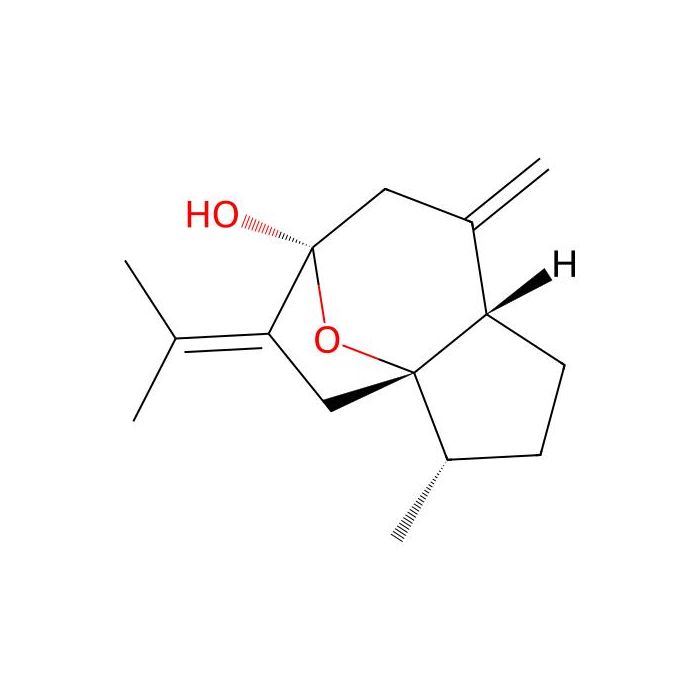
Isocurcumenol, an estrogen receptor alpha (ERα) inhibitor isolated from Curcuma zedoaria Rhizomes, possesses anti-tumor acticity, with IC 50 values of 99.1µg/mL and 178.2 µg/mL in DLA and KB cells, respectively.
In Vitro
Isocurcumenol (12.5-400 µg/mL, 24-48 h) dose-dependently inhibits cancer cells proliferation. isocurcumenol does not exhibit any significant toxicity on normal chicken embryo fibroblast cells and lymphocytes. MCE has not independently confirmed the accuracy of these methods. They are for reference only.
Form:Solid
사양
동의어
5beta-Guaia-7(11),10(14)-dien-8alpha-ol, 5,8-epoxy-, (+)- | (1S,2S,5S,8R)-2-methyl-6-methylidene-9-propan-2-ylidene-11-oxatricyclo[6.2.1.01,5]undecan-8-ol | 3S-(3alpha,3aalpha,6alpha,8abeta)-Octahydro-3-methyl-8-methylene-5-(1-methylethylidene)- 6H-3a,6-epoxyazulen-6-ol | (+)-Isocurcumenol | 6H-3a,6-Epoxyazulen-6-ol, octahydro-3-methyl-8- Show more
사양 및 순도
≥98%
생화학 및 생리적 메커니즘
Isocurcumenol, an estrogen receptor alpha (ERα) inhibitor isolated from Curcuma zedoaria Rhizomes, possesses anti-tumor acticity, with IC 50 values of 99.1µg/mL and 178.2 µg/mL in DLA and KB cells, respectively.
This compound belongs to the class of organic compounds known as guaianes. These are sesquiterpenoids with a structure based on the guaiane skeleton. Guaiane is a bicyclic compound consisting of a decahydroazulene moiety, substituted with two methyl groups and a 1-methylethyl group at the 1-, 4-, and 7-position, respectively.
External Descriptors
Not available
1. Djoumbou Feunang Y, Eisner R, Knox C, Chepelev L, Hastings J, Owen G, Fahy E, Steinbeck C, Subramanian S, Bolton E, Greiner R, and Wishart DS. ClassyFire: Automated Chemical Classification With A Comprehensive, Computable Taxonomy. Journal of Cheminformatics, 2016, 8:61.
Determine the necessary mass, volume, or concentration for preparing a solution.
Dilution Calculator
Determine the dilution needed to prepare a stock solution.
Reconstitution Calculator
리뷰
고객 리뷰
Application Protocols
No validated, product-specific application protocols are provided in the Product Data. The following are general laboratory usage notes for small-molecule library members (not product specifications):
Stock preparation
Prepare a concentrated stock in DMSO (e.g., 10–50 mM) or ethanol. Vortex and, if needed, gently sonicate. Filter through 0.2 µm PTFE for sterile applications.
Bioassay dosing
Add stock to assay medium to achieve desired final concentration, keeping vehicle ≤0.1–0.5% v/v as assay permits. Include matched vehicle controls.
Analytical setup
For LC–MS: Start with C18 column, water/ACN gradient (0.1% formic acid optional). Adjust organic content to elute hydrophobic analytes. Use amber vials and minimize residence time in autosampler at room temperature.
Stability checks
Assess short-term solution stability at room temperature and long-term at −20 °C by periodic HPLC or LC–MS to ensure integrity.
For application-specific SOPs, request the current CoA/SDS for SKU I647483 and adapt protocols to your instrumentation and assay requirements.
Biological Roles
No biological or clinical claims are made for this product; for research use only (as stated in Product Data). The following notes summarize general, literature-level context for this compound class and are not product specifications.
Natural-product context (literature)
Isocurcumenol has been reported as a sesquiterpenoid alcohol occurring in Curcuma (turmeric relatives) and related Zingiberaceae species.
Biosynthetic origin: Terpenoids are typically derived from the mevalonate (MVA) pathway via farnesyl pyrophosphate (FPP), followed by cyclization and tailored oxidation to introduce alcohol functionality.
Biochemical properties (class-level)
Hydrophobic scaffold with an oxygenated handle (–OH) that can participate in hydrogen bonding with biomolecules; lipophilicity can drive membrane association.
In chemical biology, terpenoid cores are often used as probes after derivatization (e.g., photoaffinity tags, click handles) to study protein interactions; such applications require custom synthesis and validation.
Analytical relevance
Serves as a marker in metabolomics/phytochemical profiling of Curcuma extracts; used to confirm identity/abundance via LC–MS or GC–MS (after derivatization) when appropriate reference spectra are available.
Note: Any functional in vitro or in vivo findings reported in the literature should not be extrapolated to this catalog item without independent verification. Aladdin Scientific supplies this compound strictly for laboratory research.
Buffer Applications
This compound is a hydrophobic small molecule and is not a buffering agent. It is not typically used to prepare pH buffer systems.
Practical note: If incorporating into aqueous buffered systems for bioassays, prepare concentrated stocks in DMSO or ethanol and perform serial dilutions into the buffer with vigorous mixing to avoid precipitation. Include appropriate vehicle controls.
For information on buffer composition and pH control, refer instead to dedicated buffering agents (e.g., phosphate, HEPES, Tris).
Green Alternatives
Selection of greener solvents and practices can improve the sustainability of handling lipophilic natural products like isocurcumenol (general guidance; not product specs).
Comparison (literature-based, typical behavior)
Dissolution and workup
Instead of dichloromethane (DCM), consider ethyl acetate (EtOAc) for extractions; it offers lower toxicity and is biodegradable.
Replace hexane with cyclopentyl methyl ether (CPME) or heptane where performance allows; CPME has favorable peroxide stability and water immiscibility.
Chromatography
Swap petroleum ether/hexane with greener alkanes (heptane) and partner with EtOAc or 2-MeTHF as polar modifiers.
Reactions/derivatizations
For acetylations, employ acetic anhydride with catalytic DMAP in 2-MeTHF or ethyl acetate instead of pyridine/DCM systems when feasible.
Use milder oxidants (e.g., TEMPO/bleach in biphasic systems) as alternatives to chromium-based reagents; validate to avoid over-oxidation of sensitive terpenoid motifs.
Trade-offs
Greener solvents may alter solubility and selectivity; expect to re-optimize temperatures, volumes, and eluent strength.
Some bioassays mandate DMSO for compatibility; consider minimizing DMSO percentage and validating alternative co-solvents (e.g., PEG400 or ethanol) if assay tolerant.
Practical tips
Use amber vials and minimize headspace oxygen regardless of solvent to limit oxidative changes.
Document any solvent substitutions in method SOPs to ensure reproducibility and regulatory traceability.
Pharmaceutical Uses
No pharmacopeial grade or excipient role is specified for this item. This product is supplied for research use only.
General context (not product specifications)
Natural-product reference standards: Compounds like isocurcumenol may be employed as analytical reference materials in quality control of botanical raw materials or extracts (e.g., identity confirmation by LC–MS/NMR).
Preformulation research: Lipophilic, low–water-solubility small molecules are sometimes evaluated in formulation screening (e.g., cyclodextrin inclusion, nanoemulsions) to understand solubilization strategies for discovery-stage studies. Any such work should be limited to non-clinical research.
If you require a defined pharmaceutical grade or documentation set (e.g., residual solvents, elemental impurities per ICH Q3D), contact Aladdin Scientific with SKU I647483 to discuss availability and custom QC options.
Physical Properties
Item-specific physicochemical specifications were not supplied in the Product Data. Do not treat any value below as a product specification.
Appearance (from Product Data): Not specified for this item; refer to CoA/Spec Sheet.
Molecular weight: Not specified for this item; refer to CoA/Spec Sheet.
Molecular formula: Not specified for this item; refer to CoA/Spec Sheet.
Melting point / boiling point: Not specified for this item; refer to CoA/Spec Sheet.
Density, refractive index, UV/Vis cutoff: Not specified for this item; refer to CoA/Spec Sheet.
Water content/peroxides/metal limits: Not specified for this item; refer to CoA/Spec Sheet.
General guidance (literature/context for sesquiterpenoid alcohols; not product specs)
Solubility profile: Typically sparingly soluble in water; soluble in common organic solvents (e.g., DMSO, ethanol, methanol, acetone, ethyl acetate, dichloromethane, and hexanes to varying extents). Confirm actual solubility for your lot.
Partitioning: Terpenoid alcohols usually exhibit lipophilic behavior (higher logP); expect strong retention on nonpolar chromatographic phases unless derivatized.
Spectroscopy: Alcoholic O–H stretch often appears broad in IR (ca. 3200–3600 cm⁻¹); 1H/13C NMR consistent with terpenoid motifs (allylic/olefinic resonances). Exact data are structure- and solvent-dependent.
For method development (HPLC/GC), obtain batch-specific values (purity, residual solvents, exact structure) from the CoA to define suitable detection wavelengths and temperature limits.
Quality and Grades
Grade/purity (from Product Data): Not specified for this item; refer to CoA/Spec Sheet.
How to interpret typical quality indicators (general guidance)
Library/screening grade: Often emphasizes structural identity and sufficient purity for biochemical or phenotypic screening. Verify exact assay requirements (e.g., >95% by HPLC) in your lab; refer to the CoA.
Analytical reference grade: Prioritizes high purity with comprehensive characterization (1H/13C NMR, HRMS, HPLC/GC). If you require reference-standard documentation, request the current CoA.
Stabilizers/inhibitors: None specified for this item; if present in a given lot they will be listed on the CoA.
UV background/LC suitability: Not specified for this item; for HPLC method development, check CoA for chromatographic purity and UV spectrum.
What is specific to this listing
Storage and shipping controls are defined (−20 °C, protect from light; cold pack shipment), which is consistent with maintaining integrity of oxygen- and light-sensitive small molecules.
If your application requires designated pharmacopeial grade or trace impurities data (e.g., residual solvents, water, metals), contact Aladdin Scientific with your SKU (I647483) to obtain the batch CoA and detailed Spec Sheet.
Recommendation: Before critical experiments, verify identity/purity by orthogonal methods (e.g., HPLC-UV/ELSD, NMR, HRMS) as appropriate for your use case.
Reaction and Applications
This product is categorized in a small-molecule/compound library; typical uses include analytical reference work, screening, and natural-product chemistry. No item-specific application data were provided; the points below reflect general literature practices for sesquiterpenoid alcohols (not product specifications).
Analytical/standards
Use as a reference compound for HPLC/LC–MS method development in phytochemical profiling (e.g., Curcuma spp. extracts).
Useful for validating extraction, fractionation, and dereplication workflows in natural-products discovery.
Derivatization chemistry (general for alcohol-bearing terpenoids)
Esterification: Acetylation (Ac2O/pyridine or DMAP-catalyzed) and carbonate/carbamate formation to tune polarity and chromatographic behavior.
Silylation: TMS or TBDMS protection to increase volatility for GC or to modulate reactivity.
Oxidation: Primary/secondary alcohols in terpenoids are commonly oxidized with Dess–Martin periodinane (DMP) or Swern to the corresponding carbonyls, enabling further elaboration (e.g., Wittig/Olefination).
Reactivity context
If allylic, the alcohol can undergo substitution to give allylic ethers/esters (e.g., with Mitsunobu conditions) or be leveraged in Pd-catalyzed allylic substitution (Tsuji–Trost) after conversion to a suitable leaving group.
Screening and SAR
Inclusion in phenotypic or target-based screening panels as a defined natural-product scaffold; soluble stocks typically prepared in DMSO and dispensed by acoustic or pin tools.
Note: Verify functional-group placement and stereochemistry from the CoA before planning specific transformations.
Reaction Conditions
The Product Data do not provide reaction condition specifications. The following are general, literature-level conditions commonly used for alcohol-bearing terpenoids. These are NOT specifications for this item; verify on small scale.
mCPBA (1.1–1.5 equiv), DCM, 0 °C → rt, 1–3 h; buffer with NaHCO3 to limit rearrangements.
Hydrogenation (alkenes)
Pd/C (5–10 wt%), H2 (1–3 bar), EtOAc/EtOH, rt to 40 °C, monitor closely to avoid over-reduction.
Notes
Use inert atmosphere and protect from light for sensitive terpenoids.
Work up gently to minimize isomerization (neutral to mildly basic aqueous washes).
Confirm structure before and after transformation by NMR/HRMS due to potential for rearrangements in terpenoid systems.
Safety and Handling
Safety information specific to this item is limited in the Product Data. Always consult the SDS for authoritative guidance.
GHS classification, signal word, pictograms, H-statements: Not specified for this item; refer to SDS.
Storage (from Product Data): Store at −20 °C, protected from light.
Shipping (from Product Data): Shipped in an ice chest with ice pads.
General laboratory precautions (good practice for hydrophobic natural products)
PPE: Wear lab coat, safety glasses, and appropriate chemical-resistant gloves (e.g., nitrile). Handle in a fume hood to minimize exposure to vapors/aerosols from organic solvents used for dissolution.
Handling: Avoid inhalation, ingestion, and skin/eye contact. Prevent prolonged exposure to air and light to limit potential oxidative degradation.
Incompatibilities: Strong oxidizers may react with terpenoid substrates; avoid strong acids/bases for extended periods if structural integrity must be preserved.
First aid (overview; defer to SDS): If on skin or in eyes, rinse with water for at least 15 minutes and seek medical attention. If inhaled, move to fresh air; if ingested, seek medical attention and do not induce vomiting unless directed by medical personnel.
Waste disposal: Collect solutions/solids as organic chemical waste in accordance with institutional and local regulations.
Note: Some terpenoid alcohols may be skin sensitizers in susceptible individuals; perform a small-scale risk assessment and follow your institution’s EHS policies.
Solvent Selection
Context: Isocurcumenol is a lipophilic small molecule; dissolution and handling generally follow best practices for sesquiterpenoid alcohols (literature/general guidance; not product specs).
Polarity and miscibility (general)
Expect poor water solubility; good solubility in organic solvents.
Common stock solutions: DMSO (typically up to 10–50 mM), ethanol or methanol for intermediate polarity workflows.
For normal-phase chromatography: hexane/EtOAc or hexane/DCM gradients are often effective for terpenoids.
Choosing a solvent by application
Bioassays/cell-based screening: DMSO as primary solvent; dilute into aqueous media with final DMSO ≤0.1–0.5% v/v as protocol allows. Pre-warm and vortex to minimize precipitation.
NMR: CDCl3 is often suitable for terpenoids; CD3OD or DMSO‑d6 may be used if hydrogen bonding is desired for peak resolution.
LC method development: Start with acetonitrile/water or methanol/water gradients; add 0.1% formic acid or ammonium formate if MS-coupled. Strong retention may necessitate higher organic content.
Derivatization for GC: Convert the alcohol to a volatile derivative (e.g., trimethylsilyl ether) if GC analysis is required.
Practical tips
Filter solutions through 0.2 µm PTFE for LC/assay use.
Avoid prolonged exposure to basic aqueous buffers which can promote isomerization/oxidation in some terpenoid alcohols (literature caution).
For preparative work, minimize light/air; use amber glassware and inert gas blankets where feasible.
Storage and Reconstitution
Storage conditions (from Product Data)
Store at −20 °C.
Protect from light (use amber vials/foil).
Shipped cold (ice chest + ice pads) to maintain integrity.
Container and atmosphere
Use tightly sealed, chemically compatible containers (e.g., amber glass vials with PTFE-lined caps). Where feasible, backfill with inert gas (N2/Ar) after opening to limit oxidation.
Reconstitution and stock solutions (general guidance; not product specs)
Dissolve in anhydrous DMSO, ethanol, or methanol to prepare concentrated stocks (commonly 10–50 mM depending on solubility). Warm gently (≤40 °C) and vortex/sonicate if needed.
For aqueous use, add organic stock slowly to buffer with vigorous mixing to prevent precipitation. If necessary, include a small amount of co-solvent or surfactant compatible with your assay.
Aliquoting and stability
Prepare single-use aliquots to avoid repeated freeze–thaw cycles. Store aliquots at −20 °C, protected from light.
Inspect solutions periodically (color change/precipitate) and verify by HPLC/LC–MS for long studies.
Thawing and handling
Allow vials to equilibrate to room temperature before opening to minimize moisture condensation.
Note: Any unspecified stability limits, water content, or exact solubility values are not provided for this item; refer to the batch CoA/Spec Sheet.
Structure and Identity
Brief overview: Isocurcumenol is listed as a small-molecule natural-product–like compound (library member). Item-specific identifiers are limited in the Product Data; structural details below reflect catalog data and clearly labeled literature context.
Item identifiers (from Product Data)
SKU: I647483
Product name: Isocurcumenol
CAS: 24063-71-6
InChIKey: 61029 (as provided in Product Data)
SMILES: Not specified for this item; refer to CoA/Spec Sheet.
Molecular formula: Not specified for this item; refer to CoA/Spec Sheet.
Molecular weight: Not specified for this item; refer to CoA/Spec Sheet.
Structural features (literature/general knowledge)
Isocurcumenol is reported in the literature as a sesquiterpenoid alcohol isolated from Curcuma (Zingiberaceae) species.
Typical features for this class include a C15 terpenoid backbone with at least one alcohol (–OH) functional group; exact ring topology and alkene substitution depend on the defined isomer reported by a given source.
2D structure description (general, literature)
A terpenoid carbon skeleton (15 carbons) bearing an oxygenated functionality (alcohol), often with allylic/olefinic substitution. The precise arrangement (e.g., monocyclic/bicyclic, E/Z geometry, and stereocenters) should be confirmed from the specific CoA/SDS or a primary literature standard for the batch in hand.
Note: Where exact line notations (SMILES/InChI) and elemental composition are required for method development or registration, please consult the batch CoA/Spec Sheet or request the structure file from Aladdin Scientific.
Synthetic Utility
No batch-specific reactivity data are provided; the following outlines general synthetic utility for sesquiterpenoid alcohol scaffolds (literature guidance).
Functional group leverage
Alcohol handle: Enables protection (silyl/benzyl/acetyl), oxidation to carbonyls (DMP, Swern), and conversion to leaving groups (mesylate/tosylate) for substitution or eliminations.
Terpenoid alkene(s) (if present): Amenable to epoxidation (mCPBA), hydroboration–oxidation, dihydroxylation (OsO4/NMO), and selective hydrogenations.
Scaffold elaboration
Allylic chemistry: If the OH is allylic, use Tsuji–Trost substitution or Mitsunobu inversion to access diverse ethers/esters with stereochemical control.
Cross-coupling after functionalization: Installation of halides/triflates on suitably positioned alcohol-derived intermediates can open Suzuki/Heck pathways for diversification.
Analytical derivatization
Acylation or silylation facilitates GC analysis by increasing volatility and reducing polarity.
Retrosynthetic value
As a representative sesquiterpenoid, isocurcumenol can serve as a benchmark substrate for methodology screens that target chemoselective oxidation, selective epoxidation, or C–H functionalization in complex alkenes.
Caveat: Confirm the exact position and configuration of the alcohol/alkenes for your lot from the CoA before selecting conditions, as regio- and stereochemical outcomes are strongly structure-dependent.
Target Specificity
Not applicable. This product is a small molecule, not a biological macromolecule or antibody. No target-binding specificity, clone, isotype, or species reactivity is defined in the Product Data.
자주 묻는 질문
What is the purity of this product?
This product is supplied at ≥98% purity (chemical assay). Lot-specific values are stated on the Certificate of Analysis.
How should this product be stored?
Store at ?20 °C, protected from light. The material is light-sensitive — keep it in its original opaque or amber container.
How is this product shipped?
This product ships in an insulated container with ice pads. Unpack on arrival and transfer it to the storage condition stated above.
What are the CAS number, molecular formula and molecular weight?
The CAS Number is 24063-71-6, the molecular formula is C15H22O2, and the molecular weight is 234.33 g/mol. InChIKey DEBDFZGNZTYPMF-NZBPQXDJSA-N.
What documentation is provided?
Available product documentation, including Certificates of Analysis (COA), Safety Data Sheets (SDS), and specification sheets, is shown in the product document area. Document availability and access follow the current site policy.
Products are supplied to verified businesses, institutions, and qualified professionals for research and development use only. Not for use in humans, animals, diagnosis, or therapy.