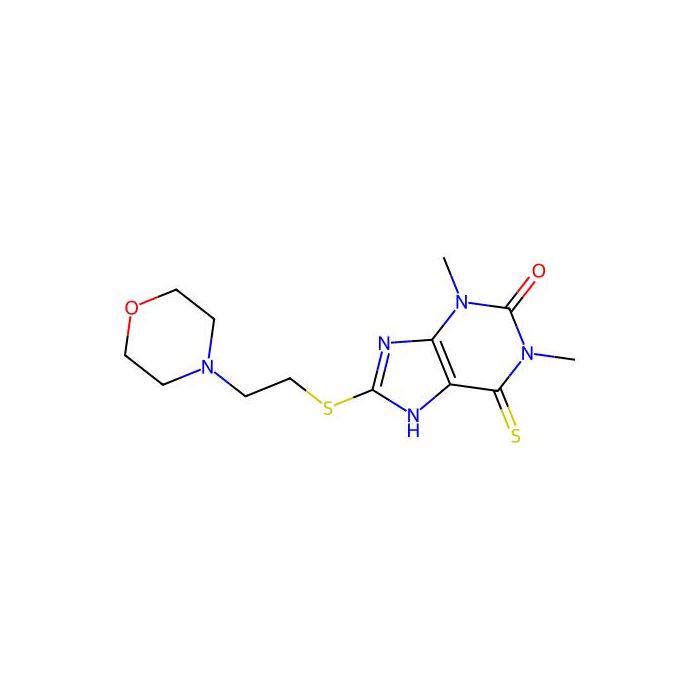
JA2131 is a small molecular inhibitor of Poly(ADP-ribose) Glycohydrolase (PARG) ( IC 50 =0.4 μM). JA2131 regulate DNA damage responses, causes replication fork stalling and cancer cell death.
In Vitro
JA2131 (10 mM; 1-2 h) induces hyperPARylation of PARP1 in PC3 cells. JA2131 (10 μM; 2 wk) inhibits colony formation of MCF-7, PC3, and MDA-MB-231 cells, and (0.1 μM-1 mM; 72 h) shows cytotoxicity to inhibit MRC-50 cells with an IC 50 value of 132 μM. JA2131 (5 μM; 72 h) inhibits PC3, and A172 glioblastoma cells viability. JA2131 (10 μM; 2 h) could be acting at the replication fork in HeLa cells. MCE has not independently confirmed the accuracy of these methods. They are for reference only. Cell Viability AssayCell Line: PC3, and A172 glioblastoma cells Concentration: 0.1 μM-10 mM Incubation Time: 72 hours Result: Inhibited cell viability with IC50s of 33.05 μM (PC3 cells) and 55.34 μM (A172 cells), respectively.
JA2131 is a small molecular inhibitor of Poly(ADP-ribose) Glycohydrolase (PARG) ( IC 50 =0.4 μM). JA2131 regulate DNA damage responses, causes replication fork stalling and cancer cell death.
This compound belongs to the class of organic compounds known as purinones. These are purines in which the purine moiety bears a C=O group. Purine is a bicyclic aromatic compound made up of a pyrimidine ring fused to an imidazole ring.
External Descriptors
Not available
1. Djoumbou Feunang Y, Eisner R, Knox C, Chepelev L, Hastings J, Owen G, Fahy E, Steinbeck C, Subramanian S, Bolton E, Greiner R, and Wishart DS. ClassyFire: Automated Chemical Classification With A Comprehensive, Computable Taxonomy. Journal of Cheminformatics, 2016, 8:61.
Determine the necessary mass, volume, or concentration for preparing a solution.
Dilution Calculator
Determine the dilution needed to prepare a stock solution.
Reconstitution Calculator
리뷰
고객 리뷰
Application Protocols
No tested application protocols are provided for JA2131 in the Product Data.
General handling for small-molecule stocks (not item-specific)
Prepare concentrated DMSO stocks (e.g., 10–50 mM) if compatible; vortex and, if necessary, sonicate briefly. Filter only if stability to filter media is confirmed.
Store aliquots at −20 °C to minimize freeze–thaw. Record exact concentrations by weight and, when possible, confirm by UV or qNMR.
For biological assays, limit final DMSO ≤0.5–1% v/v unless the assay tolerates higher levels. Include vehicle controls and verify solubility at working concentrations (no precipitation/cloudiness).
Consult the CoA/SDS for any item-specific directions once available.
Biological Roles
Item-specific biological targets, pathways, or roles for JA2131 are not provided and cannot be inferred without structural information.
General considerations for small-molecule library members (not item-specific)
Such compounds may be evaluated for modulation of enzymes, receptors, ion channels, or transporters as part of exploratory screening campaigns.
If a mechanism becomes known, results should be corroborated with orthogonal assays and, where possible, chemotype-matched controls to rule out assay interference or colloidal aggregation.
Assess potential for PAINS or reactive functional groups once the structure is disclosed; employ counter-screens to detect redox cycling, metal chelation, or covalent reactivity if suspected.
No clinical, diagnostic, or therapeutic claims are made. Use is limited to research contexts.
Buffer Applications
Not applicable based on available data. JA2131 is listed as a small-molecule library member rather than a buffering agent. No pKa or acid/base characteristics are provided.
Practical note
If aqueous work is required, buffer choice (e.g., PBS, HEPES, Tris) should be driven by the intended assay and the compound’s ionization behavior once known. Confirm compatibility by small-scale solubility and stability tests.
Green Alternatives
Because JA2131’s identity and solvent requirements are not provided, green substitution must be considered at the workflow level rather than the molecule itself.
General greener-practice guidance (not item-specific)
Prefer water or aqueous buffers where feasible; use bio-based solvents (e.g., 2-MeTHF, CPME, ethyl acetate, propylene carbonate) instead of chlorinated or highly toxic solvents when compatible with the compound’s solubility and stability.
Minimize DMSO concentration in biological assays, and consider propylene glycol, PEG 400, or cyclodextrin inclusion as alternative solubilization strategies if compatible.
Employ microscale synthesis/screening to reduce solvent use, and adopt HPLC methods with shorter gradients and greener eluents (e.g., ethanol or isopropanol in place of acetonitrile when column and detection permit).
Illustrative comparison (general; selection depends on the compound)
Acetonitrile → Ethanol/Isopropanol (trade-off: higher viscosity/backpressure, different UV cutoff)
Dichloromethane → Ethyl acetate/2-MeTHF (trade-off: selectivity and evaporation profiles)
DMF/NMP → Cyrene/GBL/propyl acetate (trade-off: polarity and reactivity differences)
Action items
Once the CoA/structure is available, map solvent needs to CHEM21 or GSK Solvent Sustainability guides to choose the least hazardous viable solvent.
Validate any green swap with small-scale trials to confirm assay or reaction performance is maintained.
Pharmaceutical Uses
No excipient role, pharmacopeial status, or formulation function is specified for JA2131.
General remarks (not item-specific)
Small-molecule screening compounds are sometimes formulated as DMSO stocks for discovery assays. If later used in pre-formulation research, assess solid form (polymorph/salt), hygroscopicity, and stability under ICH-relevant conditions. Such studies are outside the scope of the current catalog listing.
This product is for research use only and is not intended for human or veterinary use, clinical diagnostics, or as an API/excipient.
Physical Properties
Item-specific physicochemical specifications were not provided.
Appearance: Not specified for this item; refer to CoA/Spec Sheet.
Melting point (MP): Not specified for this item; refer to CoA/Spec Sheet.
Boiling point (BP): Not specified for this item; refer to CoA/Spec Sheet.
Density: Not specified for this item; refer to CoA/Spec Sheet.
Refractive index: Not specified for this item; refer to CoA/Spec Sheet.
Solubility profile: Not specified for this item; refer to CoA/Spec Sheet.
LogP/logD, pKa: Not specified for this item; refer to CoA/Spec Sheet.
General guidance (literature/practice; not item-specific)
For unknown small molecules, begin solubility screening with DMSO (analytical grade) at small volumes (e.g., 10–50 mM stock), then evaluate water-miscible cosolvents (MeOH, EtOH, acetonitrile) and buffered aqueous systems if needed.
If crystalline solid, determine approximate MP via a micro-melting point apparatus to aid identity verification (compare to CoA when available). If an oil, assess viscosity and miscibility with common organic solvents.
Record any observed hygroscopicity or deliquescence during handling; this will inform storage once CoA data are obtained.
Important: Do not treat any measured values obtained in your lab as product specifications; only the CoA/Spec Sheet defines the specification for this catalog item.
Quality and Grades
Grade/Purity: Not specified for this item; refer to CoA/Spec Sheet.
How to interpret grade (general guidance; not item-specific)
Common research grades include Technical, Laboratory/Analytical Reagent (AR), ≥95–99% purity, and HPLC/LC–MS grade for solvents. For discovery compounds, vendors may report chromatographic purity (HPLC/UPLC, UV or ELSD) and identity confirmation by NMR and/or MS.
For small-molecule library members, typical documentation includes: purity by HPLC (single method or multi-method), HRMS for M+H/M–H, and occasionally 1H NMR. Water/peroxide/metal limits are usually not applicable unless the item is a solvent or metal complex.
What to request for this item
Ask for the latest CoA indicating: assay (% area, method and wavelength), verified identity (MS/NMR), residual solvent limits (if reported), and any stabilizers or form (free base vs. salt).
If your application is analytical (e.g., reference standard), confirm impurity profile and whether a retention time and method are provided.
Stabilizers and form
Stabilizers, salt form, and counter-ions are not specified in the Product Data. If your work is sensitive to acid/base form, request confirmation (free base/acid vs. salt) to ensure accurate molarity calculations.
Reaction and Applications
Manufacturer application text is not provided for this entry.
For small-molecule library members like JA2131 (general research context; not item-specific)
Screening & discovery: Commonly used in biochemical or cell-based screening panels to probe pathways, generate structure–activity relationship (SAR) hypotheses, and rank-order hits. Ensure accurate dosing via validated stock concentrations.
Chemical biology tool development: May serve as a starting point for probe optimization (addition of reporter handles, bioorthogonal tags) once the structure is confirmed.
Analytical reference: Potential use as a comparator or internal standard in method development if identity/purity are suitably characterized.
Synthetic chemistry context (if structural data become available)
Once functional groups are known, the compound may be derivatized for analogue synthesis, linkers appended for affinity matrices, or isotopic labels introduced for MS tracing.
Practical tips
Establish a material control record: batch/lot, purity method, and storage conditions. Verify identity by LC–MS on receipt before use in critical assays.
For any reactions, begin with millimole-to-micromole scale trials, monitor by LC–MS/UPLC, and confirm that solvents/reagents do not degrade the material (forced degradation small study is recommended).
Note: Specific reactivity or target engagement for JA2131 cannot be stated without structural and mechanistic data.
Reaction Conditions
No reaction conditions can be recommended for JA2131 without knowledge of its structure and functional groups.
General guidance for exploratory transformations (not item-specific)
Start with small-scale scouting (1–10 mg) using orthogonal conditions (polar aprotic vs. protic solvents; base vs. acid catalysis) monitored by LC–MS/UPLC.
Control oxygen and moisture where relevant (dry solvents, inert atmosphere). Screen temperatures conservatively (rt → 50–80 °C) and evaluate stability via time-course sampling.
For purification, plan flash chromatography or preparative HPLC based on polarity and UV properties once known; record retention factors/RT for method transfer.
Please obtain structure-specific recommendations from the CoA or internal characterization before committing to scale.
Safety and Handling
Safety information specific to this item was not provided in the Product Data. Exercise prudent laboratory precautions.
GHS Classification / Pictograms / Signal Word / H-Statements: Not specified for this item; refer to the official SDS.
Research use: For research use only (not for human or veterinary use).
General laboratory precautions (best practice; not item-specific)
Wear appropriate PPE: lab coat, safety goggles, and chemically resistant gloves (e.g., nitrile). Use a certified fume hood for weighing, transfers, and any operations that may generate vapors, dust, or aerosols.
Avoid inhalation, ingestion, and skin/eye contact. Prevent environmental release; collect waste according to institutional protocols.
Incompatibilities: Unknown. Until known, segregate from strong oxidizers, acids/bases, and reactive metals. Store in tightly closed container under inert atmosphere if moisture/air sensitivity is suspected.
First aid (overview): In case of skin/eye contact, rinse with water for ≥15 min and seek medical attention. If inhaled, move to fresh air; if symptoms persist, get medical advice. If swallowed, rinse mouth; do not induce vomiting; seek medical attention.
Spill response: Contain with inert absorbent, avoid dust formation, and ventilate area. Dispose of cleanup materials as hazardous waste.
Always consult the product-specific SDS for authoritative hazard, exposure limits, and emergency procedures once available.
Solvent Selection
Item-specific solvent preferences and solubility are not provided.
General decision framework for small, drug-like molecules (literature/practice; not item-specific)
Start with DMSO for stock solutions (10–50 mM), then dilute into assay buffers maintaining final DMSO ≤0.5–1% v/v where compatible.
If DMSO is unsuitable, test DMF, acetonitrile, methanol, and ethanol. For hydrophobic compounds, consider co-solvent systems (e.g., 20–40% acetonitrile in buffer) or non-aqueous media for chemistry steps.
For acid/base-functional compounds, solvent choice may hinge on ionization: basic amines often dissolve better in alcohols or water with minimal acid; carboxylic acids may require a small amount of base (e.g., NaHCO3) in water.
Comparison snapshot (general)
DMSO: broad solvency, high boiling point; may interfere in some bioassays.
Acetonitrile: low viscosity, UV-transparent; less solvating for very lipophilic solids.
Methanol/Ethanol: protic; can participate in H-bonding and sometimes react in protection/esterification contexts.
Recommendation for JA2131
Because structural identity and solubility are unknown, perform a tiered solubility screen at small scale, document concentrations and clarity, and filter-sterilize only if confirmed stable and non-reactive with the filter polymer.
Consult the product’s CoA/Spec Sheet for any vendor-tested solvent compatibility.
Storage and Reconstitution
Item-specific storage and logistics
Storage Conditions: Store at −20 °C (as provided in Product Data).
Keep container tightly closed and protected from light and moisture. Allow the vial to equilibrate to room temperature in a desiccator before opening to prevent condensation.
If supplied as a solid, prepare small single-use aliquots of stock solutions (commonly in DMSO) to avoid repeated freeze–thaw. If supplied as a solution, verify solvent and concentration; aliquot under inert gas if air/moisture sensitivity is suspected.
For reconstitution: start with a small volume of a strong solvent (e.g., DMSO), then dilute with compatible co-solvent or buffer. Document final solvent composition for reproducibility.
Stability/shelf life, water content, and impurity limits: Not specified for this item; refer to CoA/Spec Sheet. Perform periodic LC–MS/HPLC checks for critical work.
Note: Always defer to the product’s CoA and SDS for definitive storage stability and handling instructions for your specific lot.
Structure and Identity
Concise overview of identifiers and what is known for this catalog entry.
Product Name (Aladdin SKU): JA2131 (SKU: J650902)
CAS: 6505-99-3
InChIKey: 418122 (as provided; note this is shorter than typical InChIKeys — verify on CoA/SDS)
SMILES: Not specified for this item; refer to CoA/Spec Sheet.
Molecular Formula: Not specified for this item; refer to CoA/Spec Sheet.
Molecular Weight: Not specified for this item; refer to CoA/Spec Sheet.
Category: Small molecules and compound library (小分子和化合物库)
Structural features
Item-specific structural description (ring systems, functional groups, stereochemistry): Not available in the provided Product Data. Without a structure (SMILES/InChI) or name, functional group analysis and 2D description cannot be provided.
Notes to users
If you require exact structure, please request the latest Certificate of Analysis (CoA) or Specification Sheet, which will include definitive identifiers (SMILES/InChI, formula, MW) suitable for ELN registration and informatics searches.
Until structural data are confirmed, treat JA2131 as an undefined small-molecule research reagent for inventory and risk assessment purposes.
Synthetic Utility
Specific synthetic utility cannot be described without the structure of JA2131. No functional groups or reactivity patterns are available from the Product Data.
General strategies once structure is available (not item-specific)
If the scaffold contains handle(s) such as aryl halides, boronates, alkynes/alkenes, amines, or carboxylic acids, common transformations include: cross-couplings (Suzuki–Miyaura, Buchwald–Hartwig), amidations/esterifications, hydrogenations, and late-stage functionalizations (C–H activation where applicable).
For analogue synthesis, consider diversity-oriented modifications at positions that tolerate substitution per SAR, and employ protecting-group strategies consistent with the functional group map.
If chiral centers exist, plan asymmetric routes or chiral resolution; document enantiomeric purity (e.g., chiral SFC/UPLC) for bioassays.
Until the CoA or structural dossier is provided, treat JA2131 as a finished screening compound rather than a synthetic intermediate.
Target Specificity
No biological target, selectivity profile, or affinity data are provided for JA2131. Without structural or assay information, target specificity cannot be assessed.
If this compound is used in screening
Confirm any apparent activity with orthogonal assays and counterscreens to exclude artifacts (e.g., fluorescence interference, redox cycling, colloidal aggregation, metal chelation).
Report full assay conditions (buffer, detergent, DMSO %, temperature, incubation times) alongside any observed potency to facilitate reproducibility.
자주 묻는 질문
What is the purity of this product?
This product is supplied at ≥99% purity (chemical assay). Lot-specific values are stated on the Certificate of Analysis.
How should this product be stored?
Store at ?20 °C. Freezer storage is required to maintain the specified shelf life.
How is this product shipped?
This product ships in an insulated container with ice pads. Unpack on arrival and transfer it to the storage condition stated above.
What are the CAS number, molecular formula and molecular weight?
The CAS Number is 6505-99-3, the molecular formula is C13H19N5O2S2, and the molecular weight is 341.45 g/mol. InChIKey XHNSOGDMSSHQFY-UHFFFAOYSA-N.
What documentation is provided?
Available product documentation, including Certificates of Analysis (COA), Safety Data Sheets (SDS), and specification sheets, is shown in the product document area. Document availability and access follow the current site policy.
Products are supplied to verified businesses, institutions, and qualified professionals for research and development use only. Not for use in humans, animals, diagnosis, or therapy.