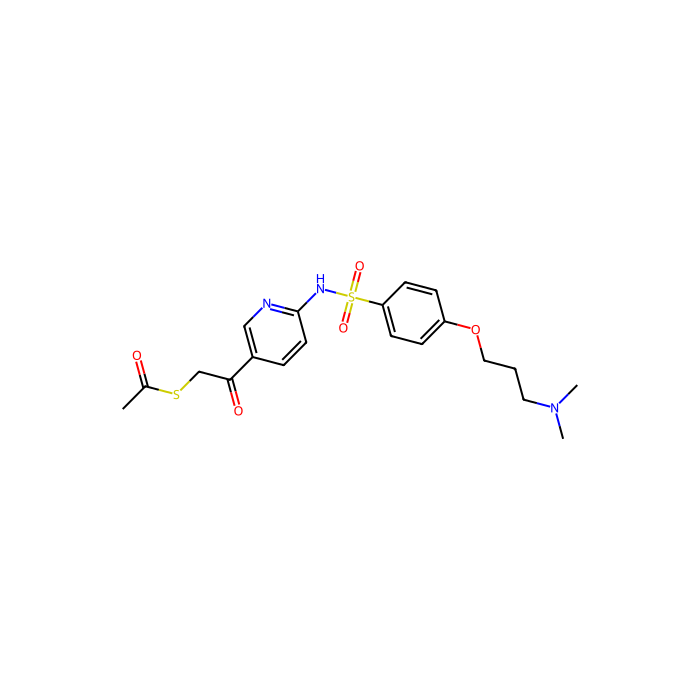
KD5170 - ≥96% , CAS No.940943-37-3

CAS: 940943-37-3 Cat. No.: K275715 분자식: C20H25N3O5S2 분자량: 451.55
주문 가능
등급 & 순도 ≥96%
Synonyms
S-(2-(6-(4-(3-(Dimethylamino)propoxy)phenylsulfonamido)pyridin-3-yl)-2-oxoethyl) ethanethioate|S-(2-(6-(4-(3-(Dimethylamino)propoxy)phenylsulfonamido)pyridin-3-yl)-2-oxoethyl)ethanethioate|N-{5-[2-(acetylsulfanyl)acetyl]pyridin-2-yl}-4-[3-(dimethylamino)propoxy]benzene-1-sulfonamide|S-(2-{6-[({4-[3-(Dimethylamino)propoxy]phenyl}sulfonyl)amino]-3-pyridinyl}-2-oxoethyl) ethanethioate|(6-((5-FLUORO-2-((3,4,5-TRIMETHOXYPHENYL)AMINO)PYRIMIDIN-4-YL)AMINO)-2,2-DIMETHYL-3-OXO-2,3-DIHYDRO-4H-PYRIDO(3,2-B)-1,4-OXAZIN-4-YL)METHYL DISODIUM PHOSPHATE|S-[2-[6-[[4-[3-(dimethylamino)propoxy]phenyl]sulfonylamino]pyridin-3-yl]-2-oxoethyl] ethanethioate|Ethanethioic acid, S-[2-[6-[[[4-[3-(dimethylamino)propoxy]phenyl]sulfonyl]amino]-3-pyridinyl]-2-oxoethyl] ester|S-[2-[6-[[[4-[3-(Dimethylamino)propoxy]phenyl]sulfonyl]amino]-3-pyridinyl]-2-oxoethyl]ethanethioc acid ester|thioacetic acid S-(2-{6-[4-(3-dimethylamino-propoxy)-benzenesulfonylamino]-pyridin-3-yl}-2-oxo-ethyl) ester|KD5170|KD-5170|S-2-(6-(4-(3-(dimethylamino)propoxy)phenylsulfonamido)pyridin-3-yl)-2-oxoethyl ethanethioate hydrobromide|KD 5170
Storage
Store at -20°C,Desiccated
Shipped In
Ice chest + Ice pads
★
크기
USA
독일 (EU)*
가격
수량
10mg
K275715-10mg
주문제작 · 8~12주
US$191.90
Enter a quantity for the sizes you want to add.

개요

Store at -20°C. Store under desiccating conditions. The product can be stored for up to 12 months.

사양

동의어
S-(2-(6-(4-(3-(Dimethylamino)propoxy)phenylsulfonamido)pyridin-3-yl)-2-oxoethyl) ethanethioate | S-(2-(6-(4-(3-(Dimethylamino)propoxy)phenylsulfonamido)pyridin-3-yl)-2-oxoethyl)ethanethioate | N-{5-[2-(acetylsulfanyl)acetyl]pyridin-2-yl}-4-[3-(dimethylamino)propoxy]benzene-1-sulfonamide | S-(2-{6-[({4-[3-(Dimethylamino)propoxy]phenyl}sulf Show more
사양 및 순도
≥96%
생화학 및 생리적 메커니즘
Potent, non-selective HDAC inhibitor (IC 50 values are 14, 20, 26 and 75 nM for HDAC6, 1, 4, and 3, respectively and 2 μM for HDAC2). Antiproliferative agent. Induces oxidative stress and oxidative DNA damage. Shows antitumor effects in vivo. Orally activ
보관 조건
Store at -20°C,Desiccated
배송
Ice chest + Ice pads
이 제품은 콜드 체인 배송이 필요합니다.지상 및 기타 경제 서비스는 사용할 수 없습니다.
작업 유형
INHIBITOR
참고
Wherever possible, you should prepare and use solutions on the same day. However, if you need to make up stock solutions in advance, we recommend that you store the solution as aliquots in tightly sealed vials at -20°C. Generally, these will be useable for up to one month. Before use, and prior to opening the vial we recommend that you allow your product to equilibrate to room temperature for at least 1 hour. Need more advice on solubility, usage and handling? Please visit our frequently asked questions (FAQ) page for more details.
순수함
≥96%
이름과 식별자
SMILES
CC(=O)SCC(=O)C1=CN=C(C=C1)NS(=O)(=O)C2=CC=C(C=C2)OCCCN(C)C
IUPAC Name
S-[2-[6-[[4-[3-(dimethylamino)propoxy]phenyl]sulfonylamino]pyridin-3-yl]-2-oxoethyl] ethanethioate
InChIKey
KXWBUKMWZKTHCV-UHFFFAOYSA-N
InChI
1S/C20H25N3O5S2/c1-15(24)29-14-19(25)16-5-10-20(21-13-16)22-30(26,27)18-8-6-17(7-9-18)28-12-4-11-23(2)3/h5-10,13H,4,11-12,14H2,1-3H3,(H,21,22)
이성체 SMILES
CC(=O)SCC(=O)C1=CN=C(C=C1)NS(=O)(=O)C2=CC=C(C=C2)OCCCN(C)C
분자량
451.55
Reaxys
12894882
Reaxys-RN_link_address
https://www.reaxys.com/reaxys/secured/hopinto.do?context=S&query=IDE.XRN=12894882&ln=

고급 데이터

Taxonomic Classification

Taxonomy Tree

KingdomOrganic compounds
SuperclassBenzenoids
분류Benzene and substituted derivatives
SubclassBenzenesulfonamides
Intermediate Tree Nodes Not available
Direct ParentBenzenesulfonamides
Alternative Parents Benzenesulfonyl compounds  Aryl alkyl ketones  Phenol ethers  Phenoxy compounds  Alkyl aryl ethers  Imidolactams  Organosulfonamides  Pyridines and derivatives  Heteroaromatic compounds  Aminosulfonyl compounds  Trialkylamines  Carbothioic S-esters  Thioesters  Amino acids and derivatives  Sulfenyl compounds  Azacyclic compounds  Hydrocarbon derivatives  Organic oxides  
Molecular FrameworkAromatic heteromonocyclic compounds
Substituents Benzenesulfonamide - Benzenesulfonyl group - Phenoxy compound - Phenol ether - Aryl alkyl ketone - Aryl ketone - Alkyl aryl ether - Pyridine - Imidolactam - Organosulfonic acid amide - Heteroaromatic compound - Organic sulfonic acid or derivatives - Organosulfonic acid or derivatives - Sulfonyl - Aminosulfonyl compound - Amino acid or derivatives - Ketone - Carbothioic s-ester - Tertiary amine - Thiocarboxylic acid ester - Tertiary aliphatic amine - Organoheterocyclic compound - Azacycle - Ether - Carboxylic acid derivative - Sulfenyl compound - Thiocarboxylic acid or derivatives - Hydrocarbon derivative - Organic oxide - Organosulfur compound - Organooxygen compound - Organonitrogen compound - Amine - Organic nitrogen compound - Organic oxygen compound - Carbonyl group - Aromatic heteromonocyclic compound
설명This compound belongs to the class of organic compounds known as benzenesulfonamides. These are organic compounds containing a sulfonamide group that is S-linked to a benzene ring.
External Descriptors Not available
3D 구조
상호 작용 화학 구조 모델


인증서(CoA, COO, BSE/TSE 및 분석 차트)
C of A & Other Certificates(BSE/TSE, COO):
Analytical Chart:
화학 및 물리적 특성
용해성Soluble in DMSO to 100 mM and in 1eq. HCl to 100 mM
분자량451.6
XLogP32.200
Hydrogen Bond Donor Count1
Hydrogen Bond Acceptor Count9
Rotatable Bond Count12
Exact Mass451.124 Da
Monoisotopic Mass451.124 Da
Topological Polar Surface Area139.000 Ų
Heavy Atom Count30
Formal Charge0
Complexity658.000
Isotope Atom Count0
Defined Atom Stereocenter Count0
Undefined Atom Stereocenter Count0
Defined Bond Stereocenter Count0
Undefined Bond Stereocenter Count0
The total count of all stereochemical bonds0
Covalently-Bonded Unit Count1
안전 및 위험(GHS)
주의 문구

P264:Wash hands [and …] thoroughly after handling.

Reaxys
12894882
Reaxys-RN_link_address
https://www.reaxys.com/reaxys/secured/hopinto.do?context=S&query=IDE.XRN=12894882&ln=
솔루션 계산기
리뷰

고객 리뷰

Application Protocols

No application protocols are supplied in the Product Data for KD5170. The product is intended for research use; protocol design should be tailored to the assay system and guided by the compound’s confirmed identity, purity, and solubility.

General protocol framework (non-item-specific):

  • Stock preparation: Prepare a concentrated stock in dry DMSO under inert atmosphere if moisture/oxidation sensitive. Record exact concentration gravimetrically or by quantitative NMR/UV if appropriate.
  • Plate handling: Dispense using calibrated liquid handlers with DMSO-tolerant tips/reservoirs. Seal plates to minimize evaporation. Control DMSO content across wells.
  • Dose–response: Use logarithmic serial dilutions (e.g., 10–12 points) spanning at least three orders of magnitude around the expected activity window.
  • Controls: Include vehicle controls and reference standards. Use orthogonal assays to confirm activity and rule out assay interference (fluorescence quenching, aggregation).

Please consult the SDS and CoA, and, if available, peer-reviewed literature specific to KD5170 before finalizing conditions.

Biological Roles

Item-specific biological targets, mechanisms, or roles for KD5170 are not provided in the Product Data. No medical or clinical claims are made; this product is for research use only.

General guidance for small-molecule library members (non-item-specific):

  • Potential roles in research: Compounds in discovery libraries are commonly used as chemical probes to interrogate biochemical pathways, modulate enzyme activity in vitro, or perturb cellular phenotypes to reveal target involvement.
  • Assay contexts: Enzyme inhibition/activation screens, receptor binding studies, phenotypic cell-based assays, or target deconvolution workflows (chemoproteomics, thermal shift profiling), subject to confirmed structure and compatibility with assay conditions.
  • Critical controls: Use appropriate positive/negative controls, concentration–response curves, and orthogonal assays. Confirm compound identity/purity before mechanistic interpretation to avoid false positives.

If you have literature on KD5170’s specific biological interactions, align your experimental design (assay format, concentration range, exposure time) with those reports, ensuring that the same salt form, purity, and solvent conditions apply. Otherwise, treat KD5170 as an uncharacterized screening hit until validated experimentally.

Buffer Applications

KD5170 is supplied as a small-molecule screening compound, not as a buffering reagent. Therefore, it is not typically used to prepare buffer systems or control solution pH.

Practical notes (general, non-item-specific):

  • If KD5170 is dosed into aqueous buffers, ensure the final co-solvent content (e.g., DMSO) is compatible with your biological assay and does not perturb buffer pH or protein stability.
  • Pre-wet plastics with buffer or include minimal surfactant if compound adsorption is suspected (verify assay compatibility).

For buffer recipes, pH ranges, and capacity calculations, consult dedicated buffering agents (e.g., phosphate, HEPES, Tris) rather than KD5170.

Green Alternatives

Given that KD5170 is offered as a small-molecule screening compound rather than a process solvent or bulk reagent, “green alternative” considerations most often pertain to formulation and handling rather than substitution of the active compound itself.

Practical green lab considerations (general guidance):

  • Solvent minimization: Use the lowest feasible DMSO/organic solvent volumes for stock preparation and assay delivery, and favor water-based buffers where compatible with solubility/stability.
  • Safer solvent choices: When a choice exists for dissolution or cleaning, prefer lower-toxicity, higher-flash-point solvents (e.g., ethanol, isopropanol) over chlorinated solvents, provided solubility permits.
  • Waste reduction: Consolidate micro-scale operations (96/384-well plates), employ sealed reservoirs to reduce solvent losses, and segregate halogenated from non-halogenated wastes.
  • Energy and storage: The Product Data specify storage at −20°C, desiccated. Use frost-free, energy-efficient freezers and batch retrieval to limit door-open time.

Note:

  • If KD5170 is essential to the experimental objective (e.g., as a defined library member), there may be no “alternative compound.” Instead, optimize solvent systems and workflows to reduce environmental and safety impacts.
Pharmaceutical Uses

No pharmacopeial status, excipient role, or manufacturing application is provided for KD5170 in the Product Data. This product is offered strictly for research use only and is not intended for human or veterinary use.

General considerations (non-item-specific):

  • Formulation studies in research: Small molecules may be solubilized in DMSO or formulated into simple vehicles (e.g., aqueous buffer with co-solvent) for in vitro testing. Any in vivo or clinical use is outside the scope of this product and is not supported.
  • Regulatory documentation: No DMF, CEP, or pharmacopeial monograph is provided for this catalog entry. If you require cGMP-grade material or regulatory documentation, contact Aladdin Scientific to discuss feasibility as a custom project.

Summary: KD5170 should be treated as a research screening compound without assigned pharmaceutical or excipient roles.

Physical Properties

Item-specific physicochemical data are not included in the Product Data for KD5170 (SKU K275715). The following fields are therefore left unspecified for this catalog entry:

  • Appearance: Not specified for this item; refer to CoA/Spec Sheet.
  • Molecular weight: Not specified for this item; refer to CoA/Spec Sheet.
  • Molecular formula: Not specified for this item; refer to CoA/Spec Sheet.
  • Melting point: Not specified for this item; refer to CoA/Spec Sheet.
  • Boiling point: Not specified for this item; refer to CoA/Spec Sheet.
  • Density: Not specified for this item; refer to CoA/Spec Sheet.
  • Refractive index: Not specified for this item; refer to CoA/Spec Sheet.
  • pKa(s): Not specified for this item; refer to CoA/Spec Sheet.
  • LogP/LogD: Not specified for this item; refer to CoA/Spec Sheet.
  • Solubility profile (water/organic): Not specified for this item; refer to CoA/Spec Sheet.

General considerations (non-item-specific):

  • For small molecules supplied for screening, a common practice is to prepare DMSO stock solutions (e.g., 10–50 mM) and perform aqueous dilutions into assay buffers containing a low percentage of DMSO. However, actual solubility and stability should be verified for KD5170 from its CoA/SDS.
  • Hygroscopicity, polymorphism, and solution stability can strongly influence handling and assay reproducibility; verify these properties from the specific lot documentation.

Always defer to the item’s CoA/Spec Sheet for authoritative specifications and to the SDS for safety-critical handling information.

Quality and Grades
  • Grade/Purity: Not specified for this item; refer to CoA/Spec Sheet.
  • Stabilizers/Inhibitors: Not specified for this item; refer to CoA/Spec Sheet.

Interpretation and implications (general guidance):

  • For screening library compounds such as KD5170, purity is commonly determined by HPLC/UPLC with orthogonal verification (MS/NMR) depending on the program stage. The actual acceptance criteria (e.g., ≥95% by HPLC) must be taken from the CoA.
  • If an “HPLC grade” or “assay ≥X%” is stated on the CoA, it typically indicates analytical verification of organic purity. Be aware that trace solvent, residual water, or counter-ions may influence the gravimetric concentration when preparing stock solutions.
  • If a stabilizer is present (e.g., to prevent hydrolysis/oxidation), this will be listed on the label/CoA; it may influence biological assays and should be accounted for during experimental design.

Recommendations:

  • Request the latest CoA for your specific lot to confirm purity method, residual solvents, water content, and identity tests (MS/NMR/IR).
  • For regulated workflows or cross-lab comparability, archive the CoA and SDS with your ELN entry, and record weighing correction factors if moisture/solvent content is reported.
Reaction and Applications

This product is categorized as a small-molecule/compound library member intended for research and screening. No synthetic reagent role or specific reaction application is provided in the Product Data.

  • Synthetic reactivity: Not specified for this item; refer to CoA/Spec Sheet if functional groups are disclosed.
  • Primary use case: Small-molecule screening, mechanism-of-action studies, or profiling in biochemical/cellular assays, subject to confirmed identity and solubility.

General guidance (non-item-specific):

  • If KD5170 is to be used as a screening probe, confirm purity and identity (HPLC/MS/NMR) and establish a clear chain-of-custody for plate mapping.
  • Prior to high-throughput screening (HTS), evaluate DMSO stock stability (freeze–thaw cycles, room-temperature assay window, light sensitivity) and potential adsorption to plastics.
  • For structure-enabled studies (e.g., SAR), ensure you have the confirmed structure and batch documentation to avoid data misannotation.

If you intend to use KD5170 as a reagent in chemical synthesis:

  • Obtain the structure and verify compatible reaction manifolds (nucleophilicity/electrophilicity, redox liabilities, protecting groups). Without structure, it is not possible to recommend specific named reactions or conditions.
Reaction Conditions

Item-specific reaction conditions are not applicable because KD5170 is not provided as a reagent for a defined chemical transformation in the Product Data.

If you intend to use KD5170 in chemical reactions (non-item-specific guidance):

  • Verify the precise structure, functional groups, and salt form from the CoA before selecting conditions.
  • Conduct micro-scale scouts to assess stability under acidic/basic, oxidative/reductive, and thermal regimes. Monitor by LC/MS to track degradation or adduct formation.
  • Solvent selection should be guided by compound solubility and stability screens (e.g., DMSO, DMF, MeCN, toluene, aqueous buffer with co-solvent), confirmed experimentally for KD5170.

Because no target reaction family (e.g., coupling, addition, condensation) is specified, no general yield or time recommendations can be responsibly provided for this product.

Safety and Handling

Safety data for KD5170 (SKU K275715) are not specified in the Product Data. The fields below should be confirmed from the SDS for the supplied lot.

  • GHS Classification: Not specified for this item; refer to SDS.
  • Signal word and H-statements: Not specified for this item; refer to SDS.
  • Pictograms: Not specified for this item; refer to SDS.

General laboratory safety guidance (non-item-specific):

  • PPE: Use appropriate laboratory PPE, including lab coat, safety glasses, and chemical-resistant gloves. Work in a chemical fume hood when handling powders, volatile solvents, or when generating aerosols.
  • Avoid inhalation, ingestion, and skin or eye contact. Wash thoroughly after handling. Ensure adequate ventilation.
  • Storage incompatibilities: In absence of item-specific data, segregate from strong oxidizers and acids/bases as a precaution. Keep container tightly closed in a desiccated environment per Product Data.
  • First aid overview: In case of skin contact, wash with soap and water. For eye contact, rinse cautiously with water for several minutes and remove contact lenses if present and easy to do. If inhaled, move to fresh air. If swallowed, rinse mouth. Seek medical attention if symptoms occur. Refer to SDS for detailed instructions.
  • Spill/leak: Avoid dust generation; collect using inert absorbent, place in a suitable container for disposal according to local regulations.

Authoritative source: Always consult the item-specific SDS provided by Aladdin Scientific for definitive hazard, handling, and disposal guidance.

Solvent Selection

Item-specific solubility and solvent compatibility data for KD5170 are not provided in the Product Data. Please consult the CoA/Spec Sheet for confirmed solubility in common solvents.

General guidance for small-molecule screening compounds (non-item-specific):

  • Primary stock solvent: DMSO is often preferred due to broad solvating power and compatibility with many biological assays at ≤0.1–1% v/v final concentration. Verify that KD5170 is soluble and stable in DMSO for your intended storage period.
  • Alternative solvents: Depending on functional groups, DMF, ethanol, methanol, or aqueous buffers (with co-solvent) may be suitable. Confirm actual solubility and chemical stability (e.g., hydrolysis sensitivity) from KD5170’s CoA/SDS.
  • Aqueous work: If aqueous delivery is required, consider forming concentrated DMSO stocks (e.g., 10–50 mM) and diluting into buffer while maintaining low final DMSO content. Use surfactants (e.g., 0.01–0.05% Tween-20) only if compatible with your assay.

Comparison considerations:

  • DMSO vs DMF: DMSO is typically less volatile and more biocompatible at low percentages, but DMF may dissolve certain challenging scaffolds. Both absorb water; store desiccated.
  • Alcohols (EtOH/MeOH): Useful for some scaffolds but may affect biological readouts at higher percentages.

Always perform a small-scale solubility/stability screen and verify by visual inspection and analytical methods (HPLC/UV/MS).

Storage and Reconstitution

From Product Data (item-specific):

  • Storage conditions: Store at −20°C, desiccated.
  • Shipping: Ice chest + ice pads.

Additional practical guidance (general, non-item-specific):

  • Container management: Upon receipt, allow the container to equilibrate to room temperature in a desiccator before opening to prevent moisture condensation. Reseal promptly; purge headspace with dry inert gas if compatible.
  • Long-term storage: Keep tightly closed in the original container or in amber vials if photosensitive (verify from SDS/CoA). Maintain a desiccant and minimize freeze–thaw cycles by preparing single-use aliquots.
  • Reconstitution: If the structure/solubility profile supports it, prepare DMSO stocks (e.g., 10–50 mM) using anhydrous solvent. Filter if particulate is present and compatible with the compound. Confirm concentration by weight and, if critical, by analytical assay (HPLC/UV/qNMR).
  • Stability checks: Periodically assess integrity by LC/MS or HPLC, particularly after multiple thaw events or prolonged storage.

Note: Where exact solvent, concentration limits, or light/moisture sensitivities are not specified in the Product Data, refer to the item’s CoA and SDS for definitive instructions.

Structure and Identity

Brief overview: KD5170 (SKU K275715; CAS 940943-37-3) is listed in our small-molecule/compound library category. Detailed structural identifiers are not provided in the product data for this specific catalog entry.

  • CAS: 940943-37-3 (from Product Data)
  • PubChem CID: 17754557 (from Product Data)
  • SKU: K275715; Product Name: KD5170 (from Product Data)
  • InChIKey: Not specified for this item; refer to CoA/Spec Sheet. (Product Data notes “192542,” which is not a valid InChIKey string; defer to official documentation.)
  • SMILES: Not specified for this item; refer to CoA/Spec Sheet.
  • Molecular formula: Not specified for this item; refer to CoA/Spec Sheet.
  • Molecular weight: Not specified for this item; refer to CoA/Spec Sheet.

Structural features (general guidance):

  • Item-specific functional groups, ring systems, and stereochemistry are Not specified for this item; refer to CoA/Spec Sheet.
  • 2D/3D description: Without a confirmed structure string, a reliable description of the scaffold (aromatics, heteroatoms, stereocenters) cannot be provided here. Please consult the SDS/CoA or structure file supplied upon request.

Notes:

  • If you require cheminformatics files (SDF/MOL), please contact support with SKU K275715 to obtain the latest structure-confirmed documentation (CoA/SDS/structure file).
Synthetic Utility

KD5170 is listed as a small-molecule/compound library member. Without a confirmed structure, specific synthetic transformations, protecting-group strategies, or named-reaction participation cannot be recommended for this item.

General strategies (non-item-specific) if structure becomes available:

  • Functional-group leverage: Identify handles for diversification (e.g., aryl halides for cross-coupling, amines/carboxylates for amide couplings, heteroatoms for SNAr). Evaluate chemoselectivity and compatibility with bases, acids, and catalysts.
  • Analog generation: If KD5170 is a screening hit, prepare close-in analogs to explore SAR (electronic/steric tuning, solubilizing groups, stereochemical variants).
  • Late-stage functionalization (LSF): Consider C–H activation or photoredox-mediated modifications if the scaffold tolerates such conditions.

Caution:

  • Avoid planning synthetic routes or transformations until the exact structure, salt form, and stereochemistry are confirmed via CoA/SDS/structure files for the specific lot.
Target Specificity

Target, binding site/epitope, and selectivity profile for KD5170 are not provided in the Product Data. No antibody or biologic attributes apply to this small-molecule catalog entry.

  • Target class: Not specified for this item; refer to CoA/Spec Sheet or published literature if available for KD5170 (CAS 940943-37-3; CID 17754557).
  • Assay-validated selectivity: Not specified for this item; refer to user-generated data or literature.

Researchers should establish target engagement using appropriate biochemical or biophysical methods (e.g., enzymatic assays, thermal shift, SPR/ITC, CETSA, chemoproteomics) once structure and assay compatibility are confirmed.

자주 묻는 질문

What is the purity of this product?
This product is supplied at ≥96% purity (chemical assay). Lot-specific values are stated on the Certificate of Analysis.
How should this product be stored?
Store at ?20 °C, desiccated. Keep the container tightly closed with desiccant — the material is moisture-sensitive.
How is this product shipped?
This product ships in an insulated container with ice pads. Unpack on arrival and transfer it to the storage condition stated above.
What are the CAS number, molecular formula and molecular weight?
The CAS Number is 940943-37-3, the molecular formula is C20H25N3O5S2, and the molecular weight is 451.55 g/mol. InChIKey KXWBUKMWZKTHCV-UHFFFAOYSA-N.
What documentation is provided?
Available product documentation, including Certificates of Analysis (COA), Safety Data Sheets (SDS), and specification sheets, is shown in the product document area. Document availability and access follow the current site policy.

Shall we send you a message when we have discounts available?

Remind me later

Thank you! Please check your email inbox to confirm.

Oops! Notifications are disabled.