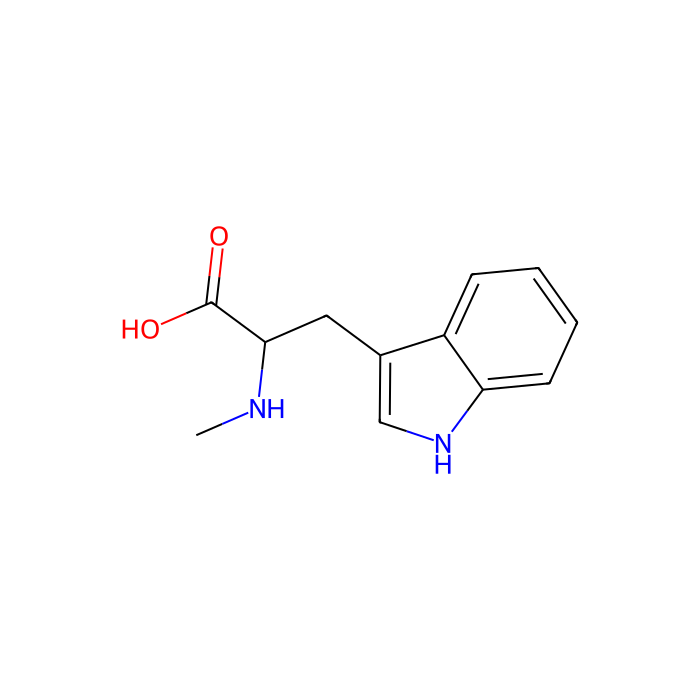
This compound belongs to the class of organic compounds known as l-alpha-amino acids. These are alpha amino acids which have the L-configuration of the alpha-carbon atom.
1. Djoumbou Feunang Y, Eisner R, Knox C, Chepelev L, Hastings J, Owen G, Fahy E, Steinbeck C, Subramanian S, Bolton E, Greiner R, and Wishart DS. ClassyFire: Automated Chemical Classification With A Comprehensive, Computable Taxonomy. Journal of Cheminformatics, 2016, 8:61.
Determine the necessary mass, volume, or concentration for preparing a solution.
Dilution Calculator
Determine the dilution needed to prepare a stock solution.
Reconstitution Calculator
리뷰
고객 리뷰
Application Protocols
Item‑specific tested applications, recommended dilutions, or assay validations are not provided in the Product Data for SKU L424517.
General laboratory usage examples (informational only; adjust to your system):
Preparation of aqueous stock: Dissolve L‑Abrine in water or 10–50 mM phosphate buffer at pH 8.0 to 10–100 mM, filter (0.22 μm), and store aliquots at −20 to −80 °C protected from light.
LC‑MS reference standard: Prepare 1–10 mM in water:acetonitrile (1:1) with 0.1% formic acid; store at −20 °C. Use multiple calibration points spanning expected analyte range.
Amide coupling test reaction: In anhydrous DMF (0.1 M), combine carboxyl‑activated abrine derivative (HATU, 1.2 equiv) with an amine nucleophile (1.5 equiv) and DIPEA (3 equiv) at rt for 2 h; monitor by LC‑MS; quench and purify by RP‑HPLC.
For validated, product‑specific protocols, please consult the CoA or contact Aladdin Scientific technical support.
Biological Roles
General literature information (not product specifications; no medical claims):
Natural occurrence: Abrine (N‑methyl‑L‑tryptophan) has been reported as a naturally occurring indole alkaloid in seeds of Abrus precatorius and some Acacia species, where it serves as a characteristic small‑molecule marker of botanical origin.
Relation to tryptophan metabolism: Structurally analogous to L‑tryptophan, abrine can interact differently with amino acid transport systems owing to N‑methylation (secondary amine), which typically reduces basicity and may alter transporter affinity and enzyme recognition in pathways handling aromatic amino acids.
Analytical biomarker: Because of its distinctive presence in specific plant matrices, abrine is utilized in laboratory studies for authenticity testing and exposure assessment to plant materials (forensic/toxicology research contexts). It provides a robust UV/MS signature due to the indole chromophore and protonatable sites.
Spectroscopic properties: The indole ring supports fluorescence (typically excitation ~280 nm, emission ~350 nm) enabling sensitive detection in bioanalytical assays (literature), though quenching effects depend on environment.
Biocompatibility considerations: As an amino acid analog, abrine’s zwitterionic character facilitates aqueous handling; however, it is not a canonical proteinogenic amino acid, and incorporation into proteins requires engineered systems or chemical synthesis.
Note: The above reflects general biochemical knowledge. This product is for research use only, and no biological efficacy or clinical utility is claimed.
Buffer Applications
L‑Abrine is not itself a buffering agent and is not typically used to establish buffer capacity.
Practical guidance for handling in buffers (general):
Stock solutions: Prepare in deionized water or appropriate physiological buffers (e.g., phosphate, HEPES) at pH 7.4–8.5 to enhance solubility while limiting base‑catalyzed side reactions. Filter‑sterilize through 0.22 μm if sterility is required for downstream assays.
Concentration: Indole‑containing amino acids may have moderate aqueous solubility; empirically determine solubility limits. Mild warming (≤37 °C) and sonication aid dissolution. Avoid strong bases that could promote racemization at the α‑center.
Compatibility: Phosphate, HEPES, and ammonium bicarbonate are commonly compatible with LC‑MS workflows (AB at volatile concentrations). For fluorescence detection, choose buffers with minimal background fluorescence.
Storage of solutions: Short‑term at 2–8 °C protected from light; for long‑term, aliquot and store frozen (see Storage tab). Minimize freeze–thaw cycles to preserve integrity.
Item‑specific buffer recommendations and validated recipes are not provided in the Product Data for SKU L424517; consult the CoA or perform small‑scale solubility/pH tolerance studies as needed.
Green Alternatives
Context: L‑Abrine is a solid molecular reagent, not a solvent. Green considerations relate to the choice of media and reagents used with it, particularly in synthesis, purification, and analysis.
Greener choices (literature/guidance):
Solvents for dissolution/analysis:
Prefer water and aqueous buffers where feasible (biochemical assays, UV/LC‑MS).
Replace DMF/NMP with 2‑MeTHF or ethanol/water for certain derivatizations when compatible.
Coupling reagents:
Traditional uronium/phosphonium reagents (HATU/HBTU/PyBOP) have safety and waste concerns. Consider carbodiimide chemistries (EDC/OxymaPure) in water‑lean aqueous media, or green peptide coupling platforms (DEPBT alternatives, COMU), balancing efficiency for secondary amines.
Purification:
Favor reverse‑phase preparative chromatography with water/ethanol or water/acetonitrile (recycled), minimizing chlorinated solvents.
Cons: solubility limits for zwitterionic substrates may necessitate co‑solvents.
Note: Select greener options consistent with performance requirements (e.g., double coupling for secondary amines) and verify compatibility with indole‑containing substrates.
Pharmaceutical Uses
No pharmaceutical grade or pharmacopeial status is provided for this item; it is supplied for research use only.
General, non‑clinical laboratory contexts (literature/guidance):
Reference standard: Utilized as an analytical reference material in quality control or forensic laboratories investigating botanical materials containing indole alkaloids. Calibration curves can be established by UV or LC‑MS owing to the indole chromophore.
Process development research: Serves as a model N‑methyl amino acid for evaluating peptide coupling methodologies, protecting group strategies, and purification workflows.
Excipient roles: Not typical. As a small‑molecule amino acid analog, abrine is generally not formulated as an excipient.
Important: This product is not intended for human or veterinary use, drug substance or excipient manufacture, or clinical diagnostics. No therapeutic claims are made. For cGMP or pharmacopeial applications, request appropriate documentation and supply chain qualification; otherwise, use under standard research laboratory QA/QC.
Physical Properties
Item‑specific specifications:
Appearance: Not specified for this item; refer to CoA/Spec Sheet.
Molecular formula: Not specified for this item; refer to CoA/Spec Sheet.
Molecular weight: Not specified for this item; refer to CoA/Spec Sheet.
Literature/general properties (informational; not product specifications):
Acid–base behavior: Zwitterionic near neutral pH; carboxyl group deprotonates first upon basification; secondary ammonium deprotonates upon alkalinization. Reported pKa values for related N‑methylated amino acids place pKa1 (carboxyl) ~2–3 and pKa2 (ammonium) often slightly lower than the primary amine analog (tryptophan ~9.4), i.e., secondary amines commonly ~7–9 (literature ranges; consult primary sources for exact values for abrine).
Solubility: Generally water‑soluble as a zwitterion/salt; solubility increases in mildly basic aqueous media (e.g., pH 8–9). Poorly soluble in nonpolar organic solvents; soluble in polar protic solvents and aqueous buffers (literature).
UV absorbance: Indole chromophore shows π–π* absorption, typically with a strong band ~280 nm and additional bands in the UV (literature). Useful for UV detection/quantitation.
Optical rotation: L‑configured amino acids are typically optically active; specific rotation depends on solvent and concentration (literature; verify per CoA if critical).
Thermal behavior: Amino acid–like solids often melt with decomposition rather than giving a sharp melting point (literature). Use DSC/TGA if needed.
Note: Where precise numerical values (mp, bp, density, logP, refractive index) are required, consult peer‑reviewed literature or request the item’s CoA/Spec Sheet.
Quality and Grades
Item‑specific quality details:
Grade/Purity: Not specified for this item; refer to CoA/Spec Sheet.
Appearance: Not specified for this item; refer to CoA/Spec Sheet.
General guidance on quality for L‑amino acid derivatives (informational):
Purity assessment: Amino acid derivatives are commonly qualified by NMR (1H/13C), HPLC purity (UV at 220–280 nm to capture indole absorbance), MS, and optical rotation to confirm L‑configuration. For chiral materials, enantiomeric excess (ee) determination by chiral HPLC is often included.
Residual solvents/water: Karl Fischer for water and GC for solvents are standard; specifications are material‑ and grade‑dependent. For moisture‑sensitive coupling applications, low water content is preferred.
Inorganic/metal content: Typically low for small‑molecule organics; ICP/elemental analysis can be provided on request depending on grade.
Stabilizers: Not typically required for solid amino acids; however, desiccants and inert atmosphere packaging may be used to maintain dryness and prevent oxidative discoloration of indole‑containing compounds.
Use suitability: For peptide synthesis and bioconjugation, grades emphasizing low inorganic content and high chemical purity with documented ee are recommended. For analytical reference use, a tightly quantified assay and verified identity (MS/HRMS, NMR) are prioritized.
Contact Aladdin Scientific for the Certificate of Analysis (CoA) corresponding to SKU L424517 for exact, item‑specific quality parameters.
Reaction and Applications
Use domains (literature/general guidance):
Chiral building block: L‑Abrine (N‑methyl‑L‑tryptophan) serves as a precursor for incorporation of N‑methyl tryptophan residues into peptides and peptidomimetics, enhancing conformational rigidity and proteolytic stability.
Bioconjugation: Carboxyl activation (e.g., via HATU/EDC/NHS) enables amide coupling to amines on scaffolds, surfaces, or dye labels; the secondary α‑amine can be selectively protected or leveraged for further derivatization.
Analytical reference: Used as a marker/standard for seeds of Abrus/Acacia species in forensic and food authenticity research due to its occurrence as a characteristic alkaloid (no clinical claims).
Structure–activity studies: Substrate/ligand in transporter or enzyme assays related to aromatic amino acid handling; N‑methylation modulates transporter affinity compared to tryptophan.
Practical tips:
Protection strategy: For peptide synthesis, Fmoc protection of the secondary amine is typically supplied commercially (Fmoc‑NMe‑Trp derivatives). The free amino acid can be converted to protected derivatives; the indole NH is often left unprotected but may be Boc‑protected if required to suppress side reactions in strongly activating conditions.
Coupling considerations: Secondary amines are less nucleophilic; employ stronger/rapid coupling reagents (HATU, PyBOP) with bases like DIPEA, and consider double coupling to ensure completion.
Indole sensitivity: Avoid strong oxidants and prolonged light exposure; work under inert atmosphere for sensitive transformations (e.g., metal‑catalyzed chemistry).
Manufacturer Applications: Not provided in Product Data; users commonly apply abrine in peptide/peptoid synthesis, metabolomics standards, and botanical authenticity assays (literature context).
Reaction Conditions
General conditions from literature for transformations involving N‑methyl‑L‑tryptophan (guidance; optimize per system):
Amide coupling (to form dipeptides/amide conjugates):
Solvent: Anhydrous DMF or NMP; for greener options, DMA or mixed DMF/EtOAc. Concentration 0.05–0.2 M.
Reagents: HATU (1.1–1.5 equiv) or COMU (1.1–1.5 equiv), base DIPEA (2–4 equiv). For carbodiimide systems, EDC·HCl (1.2–1.5 equiv) + OxymaPure (1.2–1.5 equiv). Secondary amine coupling may benefit from HOAt/Oxyma additives.
Temperature/time: 20–25 °C, 1–4 h; if sluggish, 40 °C or recouple. Monitor by LC‑MS/HPLC.
Esterification (to methyl ester):
Solvent: MeOH saturated with HCl (or MeOH/H2SO4 catalytic).
Conditions: 0–25 °C, 2–12 h. Protect indole if harsh conditions risk side reactions. Neutralize and isolate as HCl salt of amine if generated; subsequent basification liberates free amine.
Protection strategies:
Indole protection: Boc2O (1.2–1.5 equiv), DMAP cat., DCM or THF, 0–25 °C.
Amine protection: Fmoc‑Cl (1.2–1.5 equiv), Na2CO3/aqueous dioxane; note the amine is secondary, Fmoc installation is feasible but may require extended time.
Oxidation/side reactions:
Avoid strong oxidants; indoles can undergo oxidation to colored byproducts. Work under nitrogen/argon, protect from light.
Expected yields: Highly substrate‑ and method‑dependent; peptide couplings to secondary amines often achieve 60–90% per step after optimization (literature ranges).
Safety and Handling
Item‑specific safety information:
GHS Classification: Not specified for this item; refer to SDS.
Signal Word: Not specified for this item; refer to SDS.
H‑Statements: Not specified for this item; refer to SDS.
Pictograms: Not specified for this item; refer to SDS.
General laboratory safety guidance for amino acid derivatives (informational; defer to SDS as authoritative):
Hazards: Solid amino acid derivatives are typically of low volatility; treat as laboratory chemicals that may cause irritation to skin, eyes, and respiratory tract. Avoid dust generation and inhalation of particulates.
PPE: Use lab coat, safety glasses, and suitable gloves (e.g., nitrile). Employ a dust mask or work in a fume hood if handling powders prone to aerosolization.
Handling: Minimize moisture uptake; many amino acids are hygroscopic to a degree and may cake or take up water. Avoid contact with strong oxidizers. For weighing, allow container to equilibrate to room temperature in a desiccator after removal from cold storage to prevent condensation.
First aid (overview): If inhaled, move to fresh air; for skin/eye contact, rinse with water for several minutes; if ingested, rinse mouth. Seek medical attention per SDS recommendations.
Spill response: Avoid raising dust; collect mechanically and dispose per institutional and local regulations. Wet‑wipe residues.
Fire safety: Combustible organic solid; use water spray, CO2, dry chemical, or foam. Combustion may produce nitrogen oxides and carbon oxides.
Always consult the product‑specific SDS provided by Aladdin Scientific for definitive hazard and response information.
Solvent Selection
Applicability: L‑Abrine is an indole‑containing, N‑methylated amino acid and is best handled in aqueous or polar protic media. It is not a general‑purpose organic solvent.
General solvent compatibility (literature/guidance):
Aqueous buffers: Highly suitable. Solubility improves at mildly basic pH (e.g., pH 8–9) where the carboxyl is deprotonated yet the secondary amine may remain partially protonated.
Polar protic solvents: Methanol, ethanol, and water/alcohol mixtures can assist dissolution for stock solutions. Avoid prolonged storage in alcohols if esterification is a concern.
Polar aprotic solvents: DMSO can dissolve many amino acids at moderate concentrations and is useful for preparing concentrated stock solutions for biological assays; DMF is common for coupling chemistry but less desirable for bioassays.
Nonpolar solvents: Generally poor solubility.
Selection tips:
For analytical stocks: Use water or aqueous buffer; adjust pH to 7.4–8.5 to maximize solubility while maintaining stability of the indole ring.
For peptide coupling: Use anhydrous DMF, NMP, or DCM/DMF mixtures with appropriate coupling reagents (HATU/HBTU/PyBOP + base) when derivatized/protected forms are employed.
UV detection: Water/ACN with 0.1% formic acid (LC‑MS) supports good chromatographic behavior and stable ionization; indole absorbs ~280 nm for UV detection.
Note: For this specific item, exact solubility parameters and recommended solvents are Not specified for this item; refer to CoA/Spec Sheet.
Storage and Reconstitution
Item‑specific conditions (from Product Data):
Storage: Store at −80 °C.
Shipped in: Dry ice packs + Cold packs.
Research use only.
Best practices (general guidance for indole‑containing amino acids):
Upon receipt: Keep frozen. Before opening, allow the sealed container to equilibrate to room temperature in a desiccator to avoid condensation.
Solid stability: Store tightly capped, protected from light and moisture. Consider using a desiccant and inert gas backfill if frequent access is expected.
Aliquoting: If supplied as a solid, portion into single‑use aliquots to minimize cumulative freeze–thaw and ambient exposure.
Reconstitution: Dissolve in water, buffer (e.g., phosphate, HEPES), or DMSO depending on application. Solubility generally improves at mildly basic pH (7.5–8.5). Avoid strong base and prolonged exposure to high temperature to minimize racemization or indole oxidation.
Solution storage: For short‑term (hours to days), 2–8 °C protected from light. For long‑term, aliquot and store at −20 to −80 °C. Avoid repeated freeze–thaw; discard aliquots showing discoloration or precipitation.
If precise stability/shelf‑life data are required, or to obtain the recommended diluent and concentration for this specific lot, refer to the item’s CoA/Spec Sheet and SDS.
Structure and Identity
L‑Abrine is commonly known in the literature as N‑methyl‑L‑tryptophan, an indole‑containing amino acid derivative.
Item‑specific facts (from Product Data):
SKU: L424517
CAS: 526-31-8
InChIKey: 57382 (as provided; appears truncated—consult CoA/SDS for the full key)
SMILES: Not specified for this item; refer to CoA/Spec Sheet.
Literature/General structural information (for reference only; not item specifications):
Synonym: N‑methyl‑L‑tryptophan (L‑abrine)
Typical molecular formula (literature): C12H14N2O2
Core scaffold: an indole ring (fused benzene + pyrrole) attached at C‑3 to a 2‑amino‑2‑carboxyethyl side chain.
Functional groups: secondary amine at the α‑position (N‑methylated), carboxylic acid, indole NH (weakly acidic), aromatic π‑system.
Stereochemistry: L‑configuration at the α‑carbon (S absolute configuration in the CIP system for natural L‑amino acids in this family).
2D structural description (literature):
An indole ring with the side chain –CH2–CH(N(CH3))–CO2H at the 3‑position. The α‑amino is N‑methylated, yielding a secondary amine; the carboxyl remains free (acid). The indole N is embedded in the pyrrolic ring and is typically non-basic. The molecule is zwitterionic near neutral pH (carboxylate anion and protonated secondary ammonium).
Synthetic Utility
L‑Abrine (N‑methyl‑L‑tryptophan) is a versatile chiral building block for constructing indole‑containing peptidomimetics and small molecules.
Key functional elements and reactivity (literature):
Secondary α‑amine (N‑methyl): Less nucleophilic than primary amines; amide bond formation typically requires potent coupling systems (HATU/HOAt, PyBOP, COMU) and sometimes double coupling. Racemization can occur under strongly basic/activated conditions—use OxymaPure or HOAt to suppress.
Carboxylic acid: Amenable to esterification (MeOH/HCl or Fischer conditions) to generate methyl esters for SPPS compatibility; also forms active esters (NHS, pNP) for conjugation.
Indole NH: Weakly acidic and nucleophilic; generally left unprotected, but can be protected (e.g., Boc, SEM) if electrophilic conditions risk undesired substitution/oxidation.
Side‑chain chemistry: Electrophilic substitution at indole C‑2/C‑3 can be leveraged post‑assembly; metal‑catalyzed C–H functionalization (Ir/Rh) strategies exist but require indole protection.
Applications:
SPPS/LPPS: Incorporation of N‑methyl‑Trp residues to modulate peptide conformation and protease resistance; often via Fmoc‑NMe‑Trp(Prot)‑OH derivatives.
Bioconjugation: Formation of amide linkages to amines on polymers, nanoparticles, or dyes for probe design.
Analytical derivatization: Creation of isotope‑labeled standards or reporter‑tagged derivatives for LC‑MS method development.
Tip: Maintain anhydrous conditions for coupling, limit base strength (e.g., DIPEA 2–4 equiv), and monitor by LC‑MS; extend coupling time or repeat coupling for complete conversion with secondary amines.
Target Specificity
Not applicable. This product is a small‑molecule amino acid derivative, not an antibody, enzyme, or targeted biological reagent.
Item‑specific targeting details (clone, isotype, species reactivity, epitope) are not provided in the Product Data and are not relevant to L‑Abrine.
자주 묻는 질문
How should this product be stored?
Store at ?80 °C. Ultra-low temperature storage is required to maintain the specified shelf life.
How is this product shipped?
This product ships frozen with dry ice and cold packs. Unpack on arrival and transfer it to the storage condition stated above; handle dry ice with insulated gloves in a ventilated area.
What are the CAS number, molecular formula and molecular weight?
The CAS Number is 526-31-8, the molecular formula is C12H14N2O2, and the molecular weight is 218.26 g/mol. InChIKey CZCIKBSVHDNIDH-NSHDSACASA-N.
What documentation is provided?
Available product documentation, including Certificates of Analysis (COA), Safety Data Sheets (SDS), and specification sheets, is shown in the product document area. Document availability and access follow the current site policy.
Products are supplied to verified businesses, institutions, and qualified professionals for research and development use only. Not for use in humans, animals, diagnosis, or therapy.