This compound belongs to the class of organic compounds known as l-alpha-amino acids. These are alpha amino acids which have the L-configuration of the alpha-carbon atom.
1. Djoumbou Feunang Y, Eisner R, Knox C, Chepelev L, Hastings J, Owen G, Fahy E, Steinbeck C, Subramanian S, Bolton E, Greiner R, and Wishart DS. ClassyFire: Automated Chemical Classification With A Comprehensive, Computable Taxonomy. Journal of Cheminformatics, 2016, 8:61.
Determine the necessary mass, volume, or concentration for preparing a solution.
Dilution Calculator
Determine the dilution needed to prepare a stock solution.
Reconstitution Calculator
리뷰
고객 리뷰
Application Protocols
No item-specific validated application protocols are provided in the Product Data. For research use, the following literature-style outlines can be adapted:
Preparation of aqueous stock solution (analytical standard):
Dissolve L-cysteic acid in ultrapure water to 100 mM; adjust pH to ~7.0 with NaOH to ensure full dissolution; bring to volume; filter sterilize (0.22 µm); store cold.
Protein hydrolysate amino acid analysis (AAA) including cysteine as cysteic acid (overview):
Oxidize protein/peptide with performic acid on ice (1–2 h), quench, evaporate acid, hydrolyze with 6 M HCl (110 °C, 20–24 h), neutralize, and analyze by ion-exchange or RP-HPLC with pre-column derivatization (AQC). Use L-cysteic acid standards for calibration.
Peptide coupling in mixed aqueous media:
Protect amine (Fmoc), activate carboxyl with HATU in water/DMF (1:1), add DIPEA (2–3 equiv), couple to amine-bearing partner at 0–25 °C for 1–4 h. Work up by dilution in water and purification via ion-exchange.
Adjust conditions to your system and validate analytically before scale-up. Always consult peer-reviewed procedures and your institutional SOPs.
Biological Roles
General biochemical context (literature; no clinical claims):
L-Cysteic acid is a fully oxidized derivative of L-cysteine with a β-sulfonic acid. In biological systems, cysteine typically undergoes oxygenation to cysteine sulfinic acid (cysteinesulfinate), which can further oxidize to cysteic acid under strong oxidative conditions.
It is relevant as a metabolic branch-point analogue in the taurine biosynthetic pathway: cysteine → cysteine sulfinic acid → decarboxylation to hypotaurine → oxidation to taurine. Cysteic acid itself is not the principal enzymatic intermediate but is observed in oxidative stress/processing conditions.
In protein chemistry, cysteic acid residues can arise from over-oxidation of cysteine (or disulfides) and are resistant to reduction, thereby altering protein charge and structure.
Physicochemical/biological properties:
The sulfonate is permanently negative at physiological pH, conferring strong hydrophilicity and ionic interactions with basic residues and metal ions.
Replacement of cysteine with cysteic acid in peptides eliminates thiol reactivity and disulfide formation, stabilizing certain conformations.
Analytical implications:
Cysteic acid is routinely quantified in protein hydrolysates to estimate original cysteine content after performic acid oxidation, using ion-exchange or RP-HPLC after derivatization (e.g., OPA, AQC).
These roles make L-cysteic acid a useful standard and probe in redox biochemistry and protein modification studies.
Buffer Applications
L-Cysteic acid is not commonly employed as a primary buffering agent.
Rationale:
The sulfonic acid group is a strong acid (fully dissociated above very low pH), and the carboxyl group has a low pKa (~2). As such, practical buffering capacity is limited to a narrow acidic range and to the ammonium/amine couple near pH ~9, where competing deprotonations complicate buffer behavior.
Practical guidance:
For routine biochemical buffers, use established systems such as acetate (pH 3.6–5.6), MES (pH 5.5–6.7), MOPS (pH 6.5–7.9), HEPES (pH 6.8–8.2), or CAPS (pH 9.7–11.1) according to the target pH.
L-Cysteic acid can be included as a charged additive to modulate ionic strength or mimic negatively charged residues in formulation studies, but it is not preferred as the principal buffer component.
If a cysteic-acid–containing buffer is specifically desired (method development, ion-exchange), titrate with NaOH/KOH to the working pH and validate buffering capacity empirically.
Green Alternatives
As a solid amino sulfonic acid building block, L-cysteic acid is not a solvent; “green alternatives” refer to greener reagents/conditions surrounding its use.
When oxidizing cysteine to cysteic acid in proteins/peptides (literature):
Traditional: Performic acid (generated in situ from H2O2 + formic acid) gives complete oxidation but is corrosive and generates acidic waste.
Greener options:
Hydrogen peroxide in buffered/metal-catalyzed systems (e.g., H2O2/VO catalysts) can effect cysteine oxidation under milder, aqueous conditions with less hazardous waste.
Oxone (2KHSO5·KHSO4·K2SO4) in water provides selective oxidation while avoiding volatile organics; workup by simple filtration/neutralization.
Electrochemical oxidation in water reduces chemical oxidant load and can be tuned to minimize over-oxidation of other residues.
Solvent and process considerations:
Favor aqueous media for dissolving and processing L-cysteic acid; avoid unnecessary organic co-solvents.
Use salt forms (Na+/K+) to enhance water solubility, reducing need for dipolar aprotics.
Comparison (general tradeoffs):
Performic acid: high efficacy, harsher conditions, corrosive waste.
H2O2-based systems: greener, may require catalysts/longer times.
Select conditions based on substrate sensitivity, waste profile, and available quench/neutralization infrastructure.
Pharmaceutical Uses
Item-specific pharmacopeial/grade status: Not specified for this item; refer to CoA/Spec Sheet.
General, non-clinical context (no therapeutic claims):
L-Cysteic acid may be employed as a functional excipient or process aid in research formulations where a permanently anionic, highly hydrophilic amino acid residue is desired (e.g., to modulate osmolarity, ionic strength, or charge interactions).
In analytical development for biologics, cysteic acid can serve as a reference standard or system suitability component for amino acid analysis after performic acid oxidation of samples.
In drug delivery/materials science, incorporation of cysteic acid motifs can impart zwitterionic/antifouling character to peptide-based materials; such use remains within research and pre-formulation domains.
Regulatory note:
No specific USP/Ph. Eur. monograph for L-cysteic acid is commonly cited. For any application approaching regulated use, define and qualify specifications (assay, impurities, heavy metals, endotoxin/bioburden if applicable) with your QA team.
Always confirm suitability and quality attributes via the lot-specific CoA.
Physical Properties
Item-specific (from Product Data):
Molecular Formula: Not specified for this item; refer to CoA/Spec Sheet.
Molecular Weight: Not specified for this item; refer to CoA/Spec Sheet.
Appearance: Not specified for this item; refer to CoA/Spec Sheet.
Literature/typical values (for reference; not item specifications):
Molecular formula: C3H7NO5S
Molecular weight: 169.16 g/mol
Physical form: white to off-white crystalline solid (typical for amino sulfonic acids)
Melting point: often reported as > 240–250 °C (dec.) (literature)
pKa values (25 °C, water; approximate literature):
pKa1 (carboxyl): ~1.9–2.1
pKa2 (ammonium ⇌ amine): ~8.6–9.0
Sulfonic acid is a strong acid (pKa << 0; essentially fully deprotonated in water above very low pH)
Solubility: highly soluble in water; poorly soluble in most organic solvents (MeOH/EtOH limited; virtually insoluble in nonpolars) (literature)
LogP (octanol/water): strongly negative/very low (highly hydrophilic; literature indications)
Isoelectric point (estimated from pKa’s; literature): near the basic pH range due to permanent sulfonate; reported pI typically around ~5–6 depending on ionic strength and temperature.
Notes:
Values above are general literature guidance for L-cysteic acid and may vary with measurement conditions; consult the product CoA for item-specific specs.
Quality and Grades
Item-specific grade/purity: Not specified for this item; refer to CoA/Spec Sheet.
Interpreting grades for this compound class (general guidance):
Research/Biochemical grade material typically features low levels of inorganic salts and trace metals, suitable for enzyme assays, biochemical studies, and peptide work.
Amino acid analysis (AAA) grade emphasizes very low background contaminants and consistent hydration state, important for quantitative hydrolysate profiling.
HPLC grade (for solutes) is uncommon terminology for solids, but for amino acids it implies low UV-absorbing impurities that interfere with chromatographic detection.
Stabilizers: None are typically required for L-cysteic acid. The product is listed as argon charged (Product Data), which helps limit moisture uptake and oxidative contamination; no additional stabilizer is expected or needed.
What to check on the CoA for your application:
Assay on anhydrous basis, water content (KF), and inorganic ash/sulfate (given the sulfonate) if relevant to trace analysis.
Optical rotation or enantiomeric purity (to confirm the L-configuration) for chiral applications.
Residual solvents and UV profile if using in analytical workflows.
Note: In the absence of item-specific values, defer to the lot-specific CoA/Spec Sheet to determine suitability for regulated or high-sensitivity work.
Reaction and Applications
Analytical and protein chemistry (literature/general):
L-Cysteic acid is a key marker/residue formed by oxidation of cysteine/disulfide (e.g., performic acid or peracids). It is used in amino acid analysis (AAA) of protein hydrolysates to quantify cysteine content via its stable sulfonic acid form.
Serves as a chromatographic standard in ion-exchange or RP/derivatized HPLC methods for amino acid profiling.
Building block and materials uses:
Functions as a chiral amino sulfonic acid building block in synthesis of sulfonated peptides, zwitterionic materials, and ionomers. The persistent negative charge of the sulfonate is useful for tuning solubility and ionic conductivity.
In peptide design, the cysteic acid residue can mimic phosphorylated residues in terms of charge density and can prevent disulfide formation by replacing Cys with a non-reducible sulfonic analogue.
Synthetic transformations (general):
Carboxyl group participates in standard amide couplings (EDC/HOBt, HATU, PyBOP) to form peptide bonds. Protecting groups (e.g., Boc-/Fmoc- on the amine) are typically employed.
The sulfonic acid is usually left unprotected (highly acidic, non-nucleophilic); it forms stable salts with alkali metals and amines.
The amino group can be protected (Boc/Fmoc/CBz) for orthogonal strategy while leveraging the sulfonate as an anionic handle for ion-pairing purifications.
Practical tips:
For solid-phase peptide synthesis, use Fmoc-L-cysteic acid derivatives as needed; ensure resin and coupling conditions are compatible with the strongly acidic sulfonate.
For analytical calibrations, prepare aqueous stocks (e.g., 10–100 mM), filter-sterilize (0.22 µm) to remove particulates, and store cold; consider ionic strength to maintain solution stability.
Reaction Conditions
General literature guidance for working with L-cysteic acid in synthesis and analysis (not item-specific specifications):
Amide/peptide coupling:
Typical reagents: HATU/HBTU/EDC with additives (HOAt/HOBt or Oxyma), base DIPEA/TEA.
Solvents: Water/DMF, water/DMSO, or purely aqueous (with water-compatible carbodiimides like EDC).
Temperature: 0–25 °C for activation, up to 25–50 °C to drive sluggish couplings in water-rich media.
Time: 0.5–12 h, depending on partners and solvent.
Notes: Maintain pH 6–8 to balance amine nucleophilicity and minimize side reactions; high basicity can cause racemization at α-center.
Formation of salts/neutralization:
Convert to Na+/K+ salts by titration with standardized base to desired pH; isolate by lyophilization. Avoid strong heating during drying to prevent decomposition.
Analytical sample preparation:
Stocks: 10–100 mM in water or aqueous buffer. Filter through 0.22 µm PTFE or PVDF. Store cold and protect from microbial growth (sterile filtration, clean technique).
HPLC: Ion-exchange or RP with pre-column derivatization (e.g., AQC, OPA/ME). Mobile phases typically aqueous with gradient to modest organic; UV or fluorescence detection per tag.
Oxidation of cysteine to cysteic acid (reference protocols):
Performic acid oxidation at 0–25 °C for 1–2 h followed by hydrolysis for AAA.
H2O2/Oxone in water at ambient to 40 °C, monitoring to avoid over-oxidation of other residues.
Reported yields and times vary with substrate and setup; optimize on small scale before scale-up.
Safety and Handling
Item-specific hazard info from Product Data: Not specified for this item; refer to SDS for authoritative classification.
Signal Word: Not specified
H-Statements: Not specified
GHS Classification/Pictograms: Not specified
General safety considerations (literature/practice; not a substitute for the SDS):
Likely hazards: Irritation to eyes/skin/respiratory tract on contact or inhalation of dust; acidic solutions can cause irritation.
PPE: Lab coat, nitrile gloves, safety glasses/goggles. Avoid creating dust; handle solutions with appropriate acid-resistant gloves as needed.
Handling: Hygroscopic tendency reported for amino sulfonic acids; keep container tightly closed, minimize air exposure. Use in a fume hood when weighing powders.
Incompatibilities: Strong bases (heat on neutralization), strong oxidizers are generally not reactive hazards here (molecule is already fully oxidized at sulfur), avoid mixing with reactive acid-sensitive materials (e.g., carbonates/metals) without controls.
First aid (overview):
Skin/eye contact: Rinse with water for 15 minutes; remove contaminated clothing; seek medical attention if irritation persists.
Inhalation: Move to fresh air; seek medical attention if symptoms occur.
Ingestion: Rinse mouth; do not induce vomiting; seek medical attention.
Storage and shipping (from Product Data):
Store at 2–8 °C, argon charged. Ship on wet ice. Maintain dryness and inert atmosphere to limit moisture uptake.
Always consult the product-specific SDS for definitive hazard and response information.
Solvent Selection
L-Cysteic acid is a highly polar, zwitterionic/anion-rich amino acid derivative; solvent choice is dominated by its strong hydration and charge state.
Polarity and miscibility (literature/general):
Water: Highly soluble; primary solvent for stock solutions and analytical standards.
Aqueous buffers: Compatible across broad pH; remains anionic due to the sulfonate. Solubility can increase with slight basification (forming sodium/potassium salts).
Alcohols (MeOH/EtOH): Limited to low–moderate solubility; often requires co-solvent water.
Aprotic organics (MeCN, DMF, DMSO): Solubility varies; DMSO often dissolves better than DMF/MeCN, but water remains preferred. Small amounts of water enhance dissolution.
For preparative work, dissolve in deionized water; adjust pH to ~7–9 to ensure the amine is partially protonated while maximizing solubility of the sulfonate/carboxylate forms.
For HPLC sample prep, use water or aqueous mobile phase (e.g., water with 0.1% formic acid or suitable buffer); avoid high-organic injections which may precipitate the analyte at the column head.
For peptide coupling in mixed media, pre-form the sodium salt and use water/DMSO or water/DMF blends.
Comparison snapshot (general):
Water: best solubility, neutral conditions; DMSO: good co-solvent when water must be limited; MeOH/EtOH: marginal; Nonpolars: unsuitable.
Storage and Reconstitution
Item-specific (from Product Data):
Storage: Store at 2–8 °C, container argon charged.
Shipping: Wet ice.
General guidance (supplementary; not item-specific specifications):
Protect from moisture and air exposure to limit hygroscopic uptake; recap promptly and, if practical, maintain an inert headspace (argon or nitrogen) as supplied.
For long-term retention of solid integrity, keep in the original, tightly sealed container; avoid repeated warming/cooling cycles that can lead to condensation.
Reconstitution (for laboratory use):
Solvent: Ultrapure water is recommended; dissolve to desired concentration (e.g., 10–100 mM). Adjust pH with NaOH/KOH for rapid dissolution if necessary.
Filtration: Clarify with 0.22 µm membrane if particulate is present.
Aliquoting: Prepare single-use aliquots to minimize contamination.
Solution storage (general): Refrigerate at 2–8 °C for short term (days–weeks) in clean, sealed containers. For extended storage, many labs keep frozen aliquots (e.g., −20 °C) to limit microbial growth; verify stability under your conditions.
Research use note: For research use only. Consult the lot-specific CoA/SDS for definitive stability and handling information.
Structure and Identity
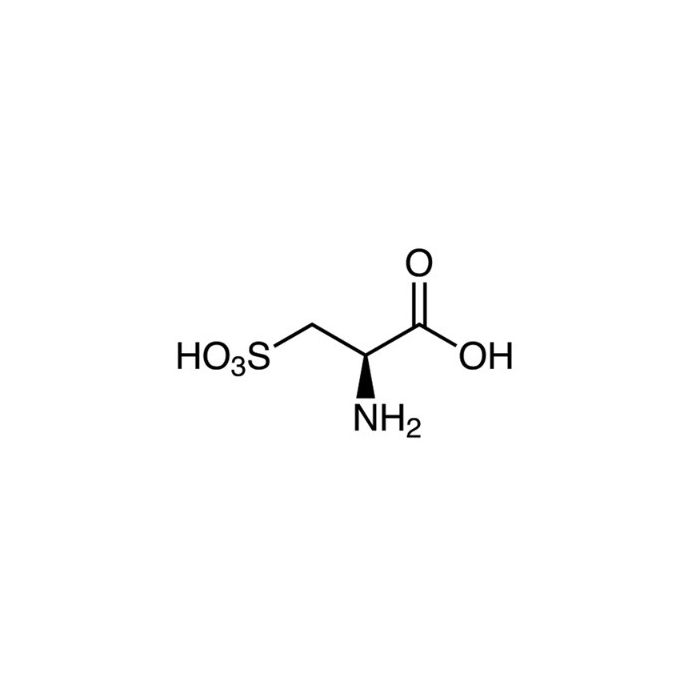
L-Cysteic acid is the fully oxidized sulfonic-acid analogue of L-cysteine, bearing a β-sulfonic acid in place of the thiol.
Item-specific (from Product Data):
Product name: L-Cysteic Acid (SKU: S161224)
CAS: 498-40-8
Storage note: Store at 2–8°C, Argon charged; shipped on wet ice
InChIKey (as provided): 428433 (format not typical for InChIKeys; see literature identifiers below)
Literature/computed identifiers (for reference; not item specifications):
Molecular formula (literature): C3H7NO5S
Molecular weight (literature): 169.16 g/mol
2D structure (descriptive): an L-α-amino acid backbone [–CH(NH2)–CO2H] bearing a β-CH2 substituent that is a sulfonic acid [–SO3H]; the sulfonate and carboxylate are strongly acidic, the α-center is L-configuration.
Functional groups: primary amine, carboxylic acid, sulfonic acid (strong acid), one chiral center at the α-carbon (L stereochemistry)
InChIKey (literature): e.g., references report an InChIKey for L-cysteic acid; consult a structure database for the exact key.
Stereochemistry (general): L-configuration at the α-carbon (C-2); β-carbon is achiral.
Note: Where item-specific identifiers are not specified, consult the product CoA/Spec Sheet for definitive information.
Synthetic Utility
Functional group landscape:
Carboxylic acid: amenable to standard amide coupling to form peptides/peptidomimetics.
Primary amine: can be protected (Fmoc/Boc/CBz) and further elaborated (e.g., ureas, sulfonamides on other partners).
Sulfonic acid: strong acid, typically non-nucleophilic; forms stable salts (Na+, K+, ammonium). Useful to confer water solubility and ionic character; rarely requires protection.
Representative applications (literature):
As an L-chiral synthon, L-cysteic acid enables access to sulfonated amino acid derivatives, zwitterionic linkers, and ion-conductive polymers.
Residue substitution in peptides: replacing Cys with Cya (cysteic acid) to abolish thiol chemistry while retaining side-chain length and adding a permanent negative charge.
Conjugation strategies: amide formation at the α-carboxyl; the amine can couple to activated esters/acid chlorides. Ion-pairing with lipophilic amines can facilitate phase-transfer extractions.
Protection/activation tips:
Protect the amine with Fmoc for SPPS; activate the carboxyl with HATU/HBTU/EDC plus base (DIPEA). The sulfonate generally remains unreactive under these conditions.
For solution-phase couplings, aqueous or mixed water/DMSO (or DMF) systems help maintain solubility. Pre-forming sodium/potassium salts aids handling and dissolution.
Purification:
Products often require ion-exchange chromatography or prep HPLC due to strong polarity. Desalting via size-exclusion or dialysis is effective for peptide constructs.
Target Specificity
This product is a small-molecule amino acid, not an antibody or affinity reagent. Target specificity parameters (antigen, epitope, clone, isotype, species reactivity) do not apply.
자주 묻는 질문
How should this product be stored?
Store at 2–8 °C under argon. It is supplied under an argon blanket; reseal under inert gas after each use.
How is this product shipped?
This product ships chilled on wet ice. Unpack on arrival and transfer it to the storage condition stated above.
What are the CAS number, molecular formula and molecular weight?
The CAS Number is 498-40-8, the molecular formula is C3H7NO5S, and the molecular weight is 169.15 g/mol. InChIKey XVOYSCVBGLVSOL-REOHCLBHSA-N.
What documentation is provided?
Available product documentation, including Certificates of Analysis (COA), Safety Data Sheets (SDS), and specification sheets, is shown in the product document area. Document availability and access follow the current site policy.
Products are supplied to verified businesses, institutions, and qualified professionals for research and development use only. Not for use in humans, animals, diagnosis, or therapy.

 F2610041