등급 & 순도Analytical standard?Analytical standard — certified-purity material for quantitative calibration. Use to prepare calibration standards and validate analytical methods.10 mM amino acid in 0.1 M HCl
This compound belongs to the class of organic compounds known as l-cysteine-s-conjugates. These are compounds containing L-cysteine where the thio-group is conjugated.
External Descriptors
Not available
1. Djoumbou Feunang Y, Eisner R, Knox C, Chepelev L, Hastings J, Owen G, Fahy E, Steinbeck C, Subramanian S, Bolton E, Greiner R, and Wishart DS. ClassyFire: Automated Chemical Classification With A Comprehensive, Computable Taxonomy. Journal of Cheminformatics, 2016, 8:61.
Determine the necessary mass, volume, or concentration for preparing a solution.
Dilution Calculator
Determine the dilution needed to prepare a stock solution.
Reconstitution Calculator
리뷰
고객 리뷰
Application Protocols
No vendor-validated application protocols are provided for this specific lot. Typical research workflows using L-cystine standards include:
LC–MS/MS calibration: prepare a series of gravimetric dilutions in water/0.1% formic acid (or as per your mobile phase). Inject alongside QCs and blanks; monitor cystine MRM transitions appropriate to your instrument.
Ion-exchange amino acid analysis: use manufacturer-recommended diluent for your analyzer; inject calibrators across the method’s linear range; verify ninhydrin response and retention time match to system suitability criteria.
Derivatization HPLC: reduce an aliquot to cysteine, derivatize with OPA/ME or FMOC-Cl, and analyze by RP-HPLC. Construct calibration curves from the lot-specific concentration.
Because concentration, solvent, and stabilizers are Not specified for this item; refer to CoA/Spec Sheet for exact preparation and dilution instructions. Always follow your laboratory’s validated SOPs.
Biological Roles
Content below provides general biochemical context for L-cystine; it is not specific to this item’s composition.
Redox pair: L-cystine is the oxidized disulfide dimer of L-cysteine. The cysteine/cystine couple constitutes a key intracellular/extracellular redox buffer and is used as a readout of oxidative stress in biological systems (literature).
Structural role: Disulfide bonds (–S–S–) derived from cystine stabilize the tertiary and quaternary structures of many secreted and membrane proteins, influencing folding, stability, and function.
Transport/metabolism: Cystine is imported via the cystine/glutamate antiporter (system xC−) and reduced to cysteine intracellularly, fueling glutathione biosynthesis and other sulfur metabolism pathways (literature).
Chemistry: The disulfide is redox-active but lacks free thiols; enzymatic and non-enzymatic pathways reduce cystine to cysteine, which participates in catalytic and structural thiol chemistry.
Analytical biomarker: Cystine concentrations in biofluids are monitored in research to assess redox status and amino acid metabolism; calibration with solution standards supports such measurements (research use only).
Note: This product is for research use only and not for clinical or diagnostic procedures. For lot-specific concentration, matrix, and stability of the supplied solution, refer to the CoA/Spec Sheet.
Buffer Applications
L-cystine hydrochloride solutions are not commonly used as primary buffering agents. While amino acids can contribute to ionic strength and weak buffering near their pKa values, cystine’s functional groups and disulfide character make it an uncommon choice for buffer formulation.
If a buffer is required for your application, select established systems (e.g., phosphate, acetate, HEPES, MOPS) appropriate to your target pH. Use the cystine standard separately for calibration or spiking studies.
Ensure that chosen buffers do not contain reducing agents if maintaining cystine (disulfide) integrity is important for the experiment.
For any composition- or pH-related details of this specific solution, Not specified for this item; refer to CoA/Spec Sheet.
Green Alternatives
For analytical standards, “green” considerations focus on solvent systems, packaging, and workflow efficiency rather than replacing the analyte itself.
Ready-to-use standard vs. in-house prep: using a certified solution standard can reduce solid handling, solvent consumption, and preparation waste, improving safety and reproducibility.
Solvent choices (general guidance):
Prefer water or water/weak acid (formic/acetic acid) over nonrenewable organic solvents where method-sensitive.
If organic modifier is required for chromatography, acetonitrile and methanol have different environmental footprints; methanol is generally considered more benign but may impact separation selectivity.
Minimizing waste: prepare only the volumes needed for the calibration run; store remaining stock under argon at 2–8°C as specified to maximize shelf life and reduce disposal.
Comparison (general considerations):
Aqueous matrices: lowest VOC emissions, best EHS profile, and typically compatible with ion-exchange and LC–MS.
Organic-rich matrices: may improve autosampler wettability but increase VOC and flammability footprints; consider lowering organic percentage when feasible.
Trade-offs:
Highly aqueous solutions can increase adsorption to vial walls; a small percentage of organic modifier or low levels of benign surfactant (if compatible with the method) may reduce losses but must be validated.
Always consult the CoA/Spec Sheet for the supplied matrix to align green choices with method compatibility.
Pharmaceutical Uses
No therapeutic or clinical claims are made. The following relates to research and quality-control contexts only.
Reference/working standard: An analytical standard of L-cystine hydrochloride solution can be used in pharmaceutical QC labs to calibrate amino acid assays (e.g., monitoring raw materials, excipient profiles, or protein/peptide hydrolysates in research contexts).
Method development: Serves as a system suitability and response factor check for methods that include oxidized sulfur amino acids among targets (e.g., post-column ninhydrin detection or LC–MS/MS quantitation after protein hydrolysis/oxidation).
Formulation studies (research): Useful for spiking studies to evaluate adsorption, recovery, and stability of disulfide-containing analytes in aqueous formulations or process streams.
Regulatory status and pharmacopeial references for this exact item are Not specified for this item; refer to CoA/Spec Sheet. If pharmacopeial traceability is required (e.g., to USP/EP monographs), verify suitability and documentation with your QA procedures.
Physical Properties
Item-specific physical data for this solution (concentration, solvent, density, pH, refractive index) are Not specified for this item; refer to CoA/Spec Sheet.
Literature values for the related solid L-cystine salts (for context only, not specifications):
Appearance (solid L-cystine·2HCl): white to off-white crystalline solid (literature)
Solubility: hydrochloride salts of basic amino acids typically exhibit high water solubility (literature). L-cystine as the neutral zwitterion is only sparingly soluble in water, but protonation increases solubility significantly (qualitative, literature).
pKa values (related to cysteine/cystine, literature): α-COOH ~2, α-NH3+ ~9; disulfide does not ionize but can be reduced/oxidized.
LogP: very low/negative for protonated amino acids (literature qualitative), indicating strong hydrophilicity.
Solution behavior and handling insights (general):
Ionic amino-acid solutions can exhibit modest conductivity and are fully miscible with water; miscibility with aprotic organics (e.g., acetonitrile, methanol) varies with matrix and concentration.
Disulfide functionality is stable under neutral, non-reducing conditions; reducing agents (DTT, TCEP, β-mercaptoethanol) convert cystine to cysteine, changing solution composition.
For assay setup, prepare calibrators and dilutions using the same solvent matrix noted on the CoA/Spec Sheet to minimize matrix effects.
Quality and Grades
Grade: Analytical standard (as provided). This denotes a material intended for calibration, system suitability, and QC purposes in analytical methods. Attributes typically associated with analytical standards include traceability to a reference, tight concentration tolerances, and documentation (CoA) providing concentration, uncertainty, and stability data.
What this means for this item:
Intended use: preparation of calibration curves and quality controls for amino acid quantitation workflows (e.g., ion-exchange with post-column derivatization, HPLC/UPLC with pre-column derivatization, LC–MS/MS).
Documentation: expect a CoA with nominal concentration, uncertainty/lot-specific value assignment, and storage/stability intervals. If isotopic or matrix information is required, consult the CoA/Spec Sheet.
Stabilizers: Not specified for this item; refer to CoA/Spec Sheet. If present, stabilizers or preservatives will be disclosed on the CoA and may impact certain derivatization chemistries.
Practical notes:
Use Class A glassware or gravimetric dilutions to maintain measurement uncertainty consistent with the standard’s assignment.
To maintain traceability, record lot number, preparation dates, and dilution factors in your calibration log.
If deploying in LC–MS, verify that the matrix (e.g., water, aqueous acid) is compatible with your mobile phase and ionization mode; adjust injection solvent strength to avoid peak distortion.
Reaction and Applications
As an analytical standard solution, the primary application is in quantitative analysis rather than synthesis. Common research and analytical uses include:
Amino acid quantitation: calibration for ion-exchange chromatography with post-column ninhydrin detection, or HPLC/UPLC with pre-column derivatization (e.g., OPA/ME, FMOC-Cl). Because cystine lacks a free thiol, it behaves differently from cysteine; derivatization workflows may reduce cystine to cysteine prior to labeling.
LC–MS/MS: use as a calibrator for targeted assays monitoring cystine in biological matrices; mobile phases often use water/0.1% FA and acetonitrile. Confirm that the salt/matrix is LC–MS compatible per CoA.
Oxidative folding studies: reference control for monitoring redox state and disulfide integrity when studying protein folding or redox buffers.
Redox biochemistry: benchmarking the kinetics of disulfide exchange or reduction (e.g., with DTT or TCEP) by HPLC or spectrophotometry.
Practical tips:
Maintain the argon blanket and minimize headspace during aliquoting to limit oxygen variability between calibration levels.
For methods that require cysteine response, reduce an aliquot (e.g., TCEP at pH ~7–8, literature) and prepare a separate cysteine calibration line to avoid conflating response factors.
Adsorption mitigation: pre-rinse vials and autosampler syringes with the standard solution; include 0.1% formic acid or a small amount of organic (e.g., 5% ACN) when compatible to reduce surface interaction.
Note: Always use the lot-specific concentration from the CoA to calculate calibrator levels.
Reaction Conditions
General literature guidance on reactions involving cystine/cysteine redox chemistry (context for method development; not specifications for this product):
Conditions: pH 7–8 (phosphate, HEPES) at room temperature to 37°C; minutes to 1 h. TCEP is effective at acidic pH as well and is odorless.
Oxidation of cysteine to cystine:
Reagents: Air/O2 (slow), iodine, diamide, or mild peroxides; performic acid can over-oxidize to cysteic acid (used intentionally in amino acid analysis workflows).
Conditions: neutral to slightly basic for air oxidation (hours to overnight), controlled stoichiometry for halogen oxidants (minutes) to avoid over-oxidation.
Derivatization for chromatography:
Pre-column: OPA/ME or FMOC-Cl after reducing cystine to cysteine to ensure derivatization of the thiol-containing species (typical reagent excess, ice bath to RT; quench per method SOPs).
Post-column: Ion-exchange with ninhydrin detection—cystine yields characteristic chromophores; follow column vendor’s temperature (e.g., 55–70°C reactor) and buffer recipes.
Solvent systems: water or water/organic (ACN/MeOH) with volatile acids (formic/acetic) for LC–MS; buffered aqueous phases for ion-exchange.
Always validate conditions with small-scale tests using aliquots of the standard; refer to the CoA for the exact matrix to ensure compatibility.
Safety and Handling
GHS classification, pictograms, signal word, and H-statements are Not specified for this item; refer to the product SDS for authoritative safety information.
General laboratory safety guidance for amino-acid salt solutions and disulfide-containing standards:
PPE: wear lab coat, safety glasses, and appropriate chemical-resistant gloves. Avoid inhalation of aerosols/mists and contact with eyes/skin.
Handling: use clean, non-metallic tools for aliquoting; minimize headspace and maintain the argon blanket to limit oxidative or reductive changes.
Incompatibilities: avoid contact with strong reducing agents (DTT, TCEP, sulfite) unless intended, as these will cleave the disulfide to cysteine; avoid strong oxidants or elevated pH with transition metals that can catalyze redox side reactions.
Spill/first aid (overview): wipe small spills with water; for skin/eye contact, rinse with water for at least 15 minutes. If ingested or if adverse symptoms occur, seek medical attention. Always consult the SDS for detailed procedures.
Stability considerations: disulfide bonds are generally stable near neutral pH; extreme pH, UV, or metal contamination can promote redox reactions. The argon-charged packaging helps preserve composition by limiting dissolved oxygen.
Waste: dispose in accordance with institutional and local regulations; aqueous amino-acid solutions are typically collected as non-halogenated aqueous waste unless contaminated with hazardous reagents.
Solvent Selection
This product is supplied as a solution; the exact solvent matrix is Not specified for this item; refer to CoA/Spec Sheet. The following guidance is general for L-cystine hydrochloride and amino-acid standards:
Polarity/miscibility: the hydrochloride salt is strongly hydrophilic and fully miscible with water. It is typically miscible with water-rich mobile phases and may be diluted with water, aqueous buffers, or water–acetonitrile/methanol blends as needed for chromatography.
Dielectric considerations: high-dielectric solvents (water, formic-acidified water) favor ionization and stability of the ammonium groups; strong aprotic solvents alone (e.g., acetonitrile) are generally poor solvents without added water.
Matrix matching: for quantitative methods, match the diluent to the sample/matrix or initial mobile phase (e.g., water/0.1% FA) to minimize solvent mismatch and adsorption effects.
Compatibility: avoid reducing agents or nucleophilic sulfhydryls in the solvent if the disulfide needs to remain intact. Glass or certified low-bind plastics are preferred; avoid copper- or iron-bearing contact surfaces that can catalyze redox changes.
Comparison (general):
Water or water/0.1% formic acid: optimal for LC–MS (+ESI) and ion-exchange sample prep.
Water/phosphate buffer: robust for ion-exchange with post-column ninhydrin; avoid in LC–MS due to ion suppression/salt load.
Water–acetonitrile (5–20% ACN): improves peak shape in RP-HPLC after derivatization; ensure salt compatibility.
Storage and Reconstitution
Storage conditions (as provided): Store at 2–8°C. Argon charged.
Shipping: Wet ice (as provided).
Format: Solution. Exact concentration, solvent matrix, pH, and any stabilizers are Not specified for this item; refer to CoA/Spec Sheet.
Best practices for solution standards:
Keep container tightly closed; maintain the argon headspace to limit oxygen exposure and redox drift. After opening, promptly re-charge with inert gas if possible and minimize headspace.
Aliquot upon first use into inert, low-bind vials to avoid repeated temperature cycling of the primary container.
Avoid contact with reducing agents or reactive metals to preserve the disulfide state.
Do not freeze unless explicitly supported by the CoA/Spec Sheet; freeze–thaw can change concentration via precipitation or vial adsorption.
Record open date and manage according to the lot-specific expiry and in-use stability provided on the CoA.
Reconstitution: Not applicable (supplied as a solution). For preparing working calibrators, perform volumetric or gravimetric dilutions using the diluent recommended in your analytical method and consistent with the supplied matrix (see CoA/Spec Sheet).
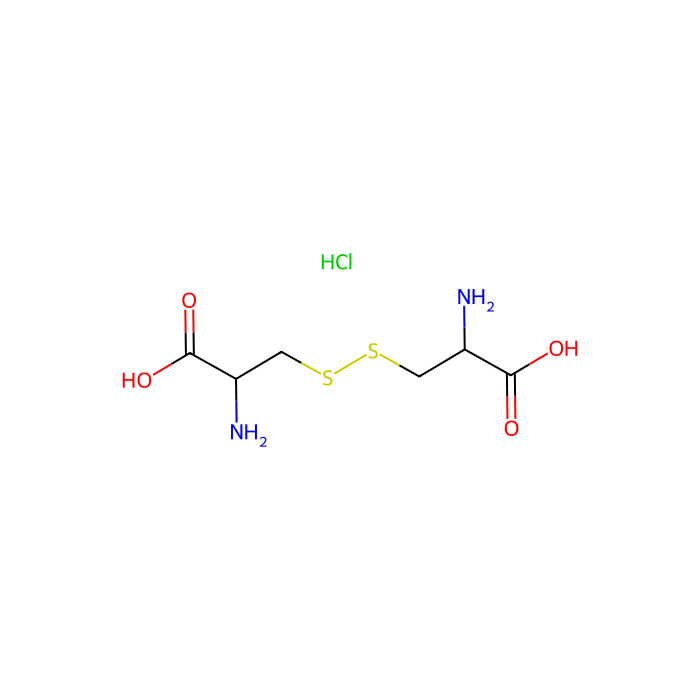
Structure and Identity
A ready-to-use analytical standard solution of the disulfide amino acid L-cystine in its hydrochloride salt form. Item-specific identifiers provided below; where missing, consult the CoA.
SKU: C298727; CAS: 34760-60-6; CID: 16217312
InChIKey (as provided): 146037
SMILES: Not specified for this item; refer to CoA/Spec Sheet.
Molecular formula: Not specified for this item; refer to CoA/Spec Sheet.
Molecular weight: Not specified for this item; refer to CoA/Spec Sheet.
Structural features (general, literature-based description of L-cystine·2HCl):
Composed of two L-cysteine residues linked by a central disulfide bond (–S–S–).
Each residue bears a protonated α-ammonium (–NH3+) and a carboxylate/carboxylic acid; in the dihydrochloride salt, counterions are chloride anions.
Stereochemistry: two chiral centers (both L, 2S,2′S configuration) on the α-carbons of each subunit.
2D structure described in words: a symmetric dimer with HOOC–CH(NH3+)–CH2–S–S–CH2–CH(NH3+)–COOH, with two Cl− counterions in the dihydrochloride form.
Computed/literature identifiers for context (not specifications for this lot):
Typical formula for L-cystine·2HCl (literature): C6H14Cl2N2O4S2
Typical MW (literature): ~313.2 g/mol for L-cystine·2HCl.
Note: This product is a solution; exact concentration, solvent matrix, and counterion state for this specific item are Not specified for this item; refer to CoA/Spec Sheet.
Synthetic Utility
While this product is supplied as an analytical standard solution rather than a reagent, the chemistry of L-cystine (disulfide of L-cysteine) underpins several synthetic concepts (general, literature-based context):
Disulfide chemistry: Cystine can serve as a disulfide source or template in peptide chemistry, guiding oxidative folding or serving as a protected dimeric form of cysteine that can be reduced on demand to liberate thiols.
Protecting-group strategy: The disulfide bond behaves as an “S–S” protecting group for thiols; selective reduction (e.g., TCEP, DTT) yields cysteine without affecting many other functionalities.
Disulfide exchange: Under basic or thiolate-generating conditions, cystine participates in exchange reactions that can install or reshuffle disulfide linkages in peptides and small molecules.
Chiral pool: The L-configuration provides a chiral backbone useful for chiral auxiliary exploration or as a building block in research-scale synthesis, though the solution format of this product is optimized for analytical use.
Caveat: Because this is an analytical standard solution with unspecified concentration and matrix, it is not typically employed as a stoichiometric reagent. Where synthetic use is intended, solid-grade reagents with known counterion forms and water content are preferred. For this item’s exact composition, Not specified for this item; refer to CoA/Spec Sheet.
Target Specificity
Not applicable. This product is a chemical analytical standard solution, not an antibody or biological targeting reagent. No antigen/epitope specificity, clone information, or species reactivity applies.
자주 묻는 질문
How is this product shipped?
This product ships chilled on wet ice. Unpack on arrival and transfer it to the storage condition stated above.
What does analytical standard mean?
analytical standard is a defined analytical purity tier suitable for quantitative analytical methods. It specifies a minimum assay percentage, controlled limits on common impurities (water, heavy metals, residue on ignition), and lot-to-lot consistency. analytical standard is one of several purity tiers — choose based on the sensitivity and regulatory requirements of your method.
How should this product be stored?
Store at 2–8 °C under argon. It is supplied under an argon blanket; reseal under inert gas after each use.
What are the CAS number, molecular formula and molecular weight?
The CAS Number is 34760-60-6, the molecular formula is C6H13ClN2O4S2, and the molecular weight is 276.76 g/mol. InChIKey IOCJWNPYGRVHLN-MMALYQPHSA-N.
What documentation is provided?
Available product documentation, including Certificates of Analysis (COA), Safety Data Sheets (SDS), and specification sheets, is shown in the product document area. Document availability and access follow the current site policy.
등급 선택에 도움이 필요하신가요?
당사의 등급 선택 가이드는 카탈로그의 모든 변형 제품에 대해 순도, 안정제 상태 및 용도 적합성을 다룹니다.
Products are supplied to verified businesses, institutions, and qualified professionals for research and development use only. Not for use in humans, animals, diagnosis, or therapy.

 K2313529