등급 & 순도Moligand™?Moligand™ — Aladdin's line of ligands and bioactive small molecules. Use for receptor, pathway, and binding studies needing defined small-molecule tools.≥97%
Determine the necessary mass, volume, or concentration for preparing a solution.
Dilution Calculator
Determine the dilution needed to prepare a stock solution.
Reconstitution Calculator
리뷰
고객 리뷰
Application Protocols
No vendor-validated application protocols are provided in the Product Data for this item. The following are general, non-binding laboratory considerations for handling lipophilic small molecules in biological assays; they are not product specifications.
Stock preparation (general):
Dissolve compound in anhydrous DMSO to a concentrated stock (e.g., 10–50 mM, as solubility permits). Vortex and, if necessary, gentle warming (<40°C) to aid dissolution. Filter through 0.22 µm PTFE if particulate remains.
Aliquot into amber vials or plates to minimize freeze–thaw and light exposure.
Working solution:
Add the DMSO stock to pre-warmed media/buffer with rapid mixing; aim for final DMSO ≤0.1–1% v/v depending on cell tolerance. Verify absence of precipitate microscopically.
Include vehicle controls matched for DMSO content.
Adsorption mitigation:
Use low-binding plasticware or glass vials; pre-condition with dilute dosing solution to reduce loss to surfaces.
Stability checks:
Establish short-term stability in your matrix by LC–MS/MS; monitor for ester hydrolysis products (e.g., corresponding alcohol) during the assay window.
For target-specific conditions (concentrations, exposure times, readouts), consult peer-reviewed literature on larixyl acetate in the relevant model system.
Biological Roles
No medical or clinical claims are made for this material. The following points summarize literature-level biological context for labdane diterpenoid acetates such as larixyl acetate.
Natural occurrence: A conifer-derived diterpenoid ester found in resins and oleoresins of larch (Larix spp.) and related taxa. Functions in plants as part of resin defense chemistry against herbivory and microbial challenge (general phytochemical role).
Molecular features relevant to biology: high lipophilicity, a masked secondary alcohol (acetate), and one or more double bonds facilitate membrane partitioning and interaction with hydrophobic protein sites.
Reported research targets (literature): natural-product ligands of transient receptor potential (TRP) channel subfamilies have been described for related labdane diterpenes; larixyl acetate has been studied as a modulator of ion channel activity in cellular systems. Use these notes only as conceptual guidance for assay design; verify the latest primary literature for specific targets.
ADME-relevant properties (general):
Strong membrane affinity; likely to adsorb to plastics and proteins, which can reduce apparent potency in vitro if not controlled.
Ester groups can be hydrolyzed enzymatically in biological matrices, releasing the corresponding alcohol (larixol); consider including esterase inhibitors or time-matched controls when mechanistic interpretation depends on the intact ester.
Always consult primary literature for the specific organism/cell line and assay format of interest; this product is for research use only.
Buffer Applications
This compound is a neutral, highly hydrophobic natural product and is not used as a buffering agent. It does not define a pKa in the biological buffering range and is essentially insoluble in water.
Practical note: For aqueous assays, dissolve first in DMSO or a suitable co-solvent and then dilute into the chosen buffer (e.g., PBS, HBSS, HEPES-buffered saline) with vigorous mixing. Maintain final organic co-solvent at a level tolerated by your system.
For buffer selection guidance related to your biological target or assay, refer instead to the Solvent Selection and Reaction & Applications sections.
Green Alternatives
As a research target compound (not a solvent or reagent used in bulk), “green alternatives” mainly concern how you process, formulate, and purify larixyl acetate rather than substituting the molecule itself.
Greener handling strategies (general guidance):
Solvent selection for workup and purification:
Prefer ethyl acetate/heptane over dichloromethane/hexanes when feasible; EtOAc offers lower toxicity and better biodegradability.
Use 2-MeTHF or CPME in place of THF/MTBE for extractions and crystallizations, provided solubility permits.
Chromatography footprint:
Reduce silica usage with optimized gradient scouting or switch to reversed-phase methods (MeOH/H2O or MeCN/H2O with small DMSO plug) for analytical/semi-preparative purification; ensure stability against hydrolysis.
Concentration/evaporation:
Employ solvent recycling systems; use parallel evaporators to minimize energy.
Stock solutions for bioassays:
Prepare higher-concentration DMSO stocks to reduce total solvent volumes transported and stored; aliquot to limit freeze–thaw cycles and waste.
Illustrative comparison (contextual; not product specs):
DCM vs EtOAc in extraction
Human/environmental hazard: higher for DCM; lower for EtOAc.
Performance: DCM maximizes solubility for very lipophilic diterpenes; EtOAc often adequate with longer contact times.
Note: Any change in solvent must be validated for chemical stability (avoid ester hydrolysis) and for compatibility with your assay or detection method.
Pharmaceutical Uses
No pharmacopeial status or excipient role is provided for this item; it is supplied strictly for research use only (per Product Data). The following context is general and non-clinical:
Discovery and development workflows (general):
Employed as a natural-product comparator or reference in analytical methods for botanicals and resin-derived materials.
Used in early-stage screening as a bioactive small molecule (ligand) to probe pathways such as ion-channel modulation, without claims of therapeutic efficacy.
Formulation research (preclinical lab):
Typical vehicles for in vitro studies include DMSO stock solutions diluted into aqueous buffers; for in vivo method development (if permitted by institutional approvals), solubilization systems may include PEG-based co-solvents or lipid carriers. Such uses require de novo method development and are outside the scope of product claims.
Item-specific regulatory designations, impurity profiles, residual solvents, or pharmacopoeial monographs: Not specified for this item; refer to CoA/Spec Sheet. This product is not intended for human or veterinary use.
Physical Properties
Item-specific numeric specifications have not been provided for this catalog entry. Do not treat the following as product specifications; consult the CoA/Spec Sheet and SDS for authoritative values.
Appearance (Product Data): Not specified for this item; refer to CoA/Spec Sheet.
Molecular weight, formula, and identifiers: Not specified for this item; refer to CoA/Spec Sheet.
Physical state: typically a colorless to pale solid or viscous oil at ambient conditions for related labdane acetate diterpenes; hydrophobic and non-ionic.
Solubility profile: high solubility in nonpolar and moderately polar aprotic organic solvents (e.g., hexanes, toluene, ethyl acetate, chloroform, dichloromethane); limited solubility in alcohols; essentially insoluble in water. Readily formulated as DMSO stock solutions for bioassays.
Volatility: very low vapor pressure relative to small-molecule solvents; non-volatile under normal handling.
Note: If assay design requires exact density, refractive index, or melting point, obtain the batch-specific CoA.
Quality and Grades
Grade provided: Moligand™ (Product Data). This denotes a research-use grade intended for chemical biology, screening, and mechanistic studies where the compound functions as a small-molecule ligand or probe candidate. It is not a clinical or GMP material.
What Moligand™ implies (general explanation):
Emphasis on identity confirmation suitable for research discovery workflows (e.g., NMR/HRMS/LC methods as provided on CoA).
Focus on batch-to-batch consistency for biological screening and structure–activity explorations.
Not a chromatography-grade solvent and not formulated for pharmacopoeial compliance.
Purity and stabilizers: Not specified for this item; refer to CoA/Spec Sheet for purity, residual solvents, and any stabilizers if used.
Analytical considerations for diterpenoid esters (general guidance):
LC–MS-friendly but can show carryover due to lipophilicity; use stronger wash solvents (e.g., MeOH/IPA with 0.1% formic acid or ammonium formate when compatible).
UV chromophore is weak to moderate (π→π* of alkenes; carbonyl n→π*), so MS or ELSD/CAD detection may be advantageous.
For quantitative work, prepare gravimetrically, use dry solvent, and limit freeze–thaw to protect integrity.
Documentation: Always consult the lot-specific Certificate of Analysis for assay purity, identity data, and recommended analytical methods.
Reaction and Applications
Manufacturer Applications (Product Data): Not specified beyond category placement (life science) and Moligand™ designation.
Research and application contexts (literature/general; no therapeutic claims):
Chemical biology: Larixyl acetate is studied as a natural-product ligand in ion-channel biology and calcium signaling research. Diterpenoid esters of this class have been reported as modulators of transient receptor potential (TRP) channels in cellular assays.
Reference standard: Employed as an analytical standard for phytochemical profiling of Larix spp. resins and conifer diterpenes.
Probe development: Serves as a scaffold for semi-synthetic derivatives to explore structure–activity relationships (SAR) around the labdane core.
Synthetic/analytical operations it participates in (general):
Hydrolysis to larixol under basic or enzymatic conditions for comparative studies of the free alcohol vs acetate.
Mild acyl migration/solvolysis testing to assess ester stability in biological matrices.
Photostability and oxidation studies on terpenoid frameworks.
Practical tips:
For cell-based assays, pre-dissolve in anhydrous DMSO and add last to media with strong vortexing to avoid microprecipitation; consider using a carrier protein or nonionic surfactant if permitted.
For target engagement analysis, use LC–MS/MS to quantify intracellular levels; include internal standards to correct for adsorption losses due to lipophilicity.
Protect from light/air during long incubations to reduce oxidative artifacts that can confound readouts.
Reaction Conditions
The following conditions are general literature guidance for the typical transformations of labdane diterpenoid acetates and are not product specifications. Optimize for your substrate and scale.
Ester hydrolysis (to larixol):
Base-catalyzed saponification: MeOH/H2O (9:1) with K2CO3 or Na2CO3, 0–25°C, 0.5–4 h; quench with NH4Cl and extract. Avoid strong base and heat to minimize double-bond isomerization.
Enzymatic deacetylation: lipases (e.g., CAL-B) in organic solvent or buffer-organic biphasic systems at ambient temperature for selective cleavage.
Transesterification:
Acidic: catalytic p-TsOH in ROH solvent under Dean–Stark or molecular sieves; monitor for dehydration or rearrangement.
Basic: catalytic NaOMe in anhydrous ROH at 0–25°C; neutralize carefully to avoid over-reaction.
Alkene functionalization (if applicable):
Epoxidation: mCPBA (1.1–1.5 eq), DCM, 0–25°C, 1–3 h; buffer with NaHCO3 to reduce epoxide opening.
Hydrogenation: H2 (1–3 bar), Pd/C (5–10 wt%), EtOAc or EtOH, rt–40°C, 1–6 h; filter through celite.
Oxidation of allylic positions:
SeO2 (0.2–0.5 eq) in dioxane or toluene, 60–100°C; or Cr-free variants (e.g., TBHP/Mn catalysts). Carefully control stoichiometry to limit over-oxidation.
Monitor by TLC with anisaldehyde or vanillin stains, which visualize terpenoids strongly.
Expected yields: highly substrate- and condition-dependent; consult primary literature for closely related labdane substrates.
Safety and Handling
Authoritative safety information must be taken from the SDS. Product-specific GHS data were not provided in the Product Data.
GHS classification, signal word, pictograms, H-statements: Not specified for this item; refer to SDS.
General laboratory safety guidance for hydrophobic natural-product esters (context, not a spec):
Likely hazards: combustible organic compound; may cause skin/eye irritation and may be harmful if swallowed. Avoid aerosol generation.
PPE: lab coat, safety glasses or face shield, and appropriate chemically resistant gloves (e.g., nitrile). Handle in a fume hood to minimize inhalation of any vapors or aerosols from solvents used for dissolution.
Handling tips:
Avoid strong acids/bases that can catalyze ester hydrolysis.
Prevent prolonged exposure to air, heat, and light that may promote oxidation/isomerization of terpenoid double bonds.
Use amber vials and inert headspace when preparing long-lived solutions.
Incompatibilities: strong oxidizers; strong acids/bases (ester cleavage risk); powerful Lewis acids in the presence of moisture may induce rearrangements.
First aid (overview; defer to SDS):
Skin/eye contact: rinse with water for at least 15 minutes; remove contaminated clothing; seek medical attention if irritation persists.
Inhalation: move to fresh air; seek attention if symptoms occur.
Ingestion: rinse mouth; do not induce vomiting unless directed by medical personnel; seek medical advice.
Spill/Fire response: absorb small spills with inert material (vermiculite); for fire, use CO2, dry chemical, or foam. Cool containers with water spray from a safe distance.
Waste disposal: Collect organic waste in halogenated/non-halogenated streams as appropriate to the solvent matrix; dispose per institutional and local regulations.
Solvent Selection
Larixyl acetate is a highly lipophilic, neutral diterpenoid ester. Solvent choice should balance solubilization, chemical stability, and intended downstream use.
Polarity/miscibility (general):
Water: effectively insoluble; avoid attempting direct aqueous dissolution.
DMSO: excellent for stock solutions (e.g., 10–50 mM typical for screening); miscible with aqueous buffers upon dilution with vigorous mixing; keep final DMSO ≤0.1–1% v/v in biological assays as tolerated.
Alcohols (EtOH, i-PrOH): moderate solubility; useful for intermediate stocks where DMSO is undesirable; verify assay compatibility.
Nonpolar/aprotic solvents (DCM, CHCl3, EtOAc, toluene, hexanes, MTBE): high solubility; preferred for synthetic manipulation and normal-phase chromatography.
Stability considerations:
Avoid strongly basic aqueous media and strong mineral acids that promote ester hydrolysis.
Limit prolonged exposure to wet alcohols; trace base catalysis can lead to transesterification over time.
Practical recommendations:
Biological assays: prepare concentrated DMSO stock; dilute into pre-warmed media with rapid mixing or surfactant carriers if permitted. Consider co-solvent systems (DMSO + PEG400 or DMSO + EtOH) for higher working concentrations.
Purification: normal-phase silica with hydrocarbon/EtOAc mixtures; guard against acid-catalyzed hydrolysis by minimizing residence time on acidic silica or by neutralizing with 0.5–1% Et3N when compatible.
Comparison (general):
DMSO vs EtOH: DMSO affords higher solubility and stability; EtOH improves volatility/removal but may precipitate upon aqueous dilution.
CHCl3/DCM vs EtOAc: chlorinated solvents maximize solubility and extraction efficiency; EtOAc is greener and often sufficient.
Storage and Reconstitution
Storage conditions (Product Data): Store at -20°C. Protect from light. Maintain in tightly sealed, inert-atmosphere containers where possible. Avoid repeated freeze–thaw cycles by aliquoting upon receipt.
Shipping (Product Data): Shipped in an ice chest with ice pads to preserve stability during transit.
Stability considerations (general guidance):
Terpenoid esters can undergo slow oxidation and isomerization on exposure to air and light. Use amber glassware and minimize headspace oxygen for long-term storage.
Moisture and extremes of pH promote ester cleavage; keep the solid neat and dry.
Reconstitution (general; not a product specification):
For biochemical use, dissolve in anhydrous DMSO to prepare a concentrated stock. Mix thoroughly (vortex/sonicate briefly). If needed, warm gently (<40°C) to assist dissolution.
For synthetic use, dissolve in a compatible organic solvent (e.g., EtOAc, CHCl3, or DCM) just prior to use. Avoid prolonged residence on acidic silica.
Freeze–thaw guidance:
Store working stocks in small amber aliquots at -20°C. Limit to ≤3 thaw cycles. Discard aliquots showing visible precipitation that does not redissolve or evidence of degradation by LC–MS/NMR.
Documentation: For lot-specific stability, water content, residual solvent, and purity at release, consult the Certificate of Analysis. Research use only.
Structure and Identity
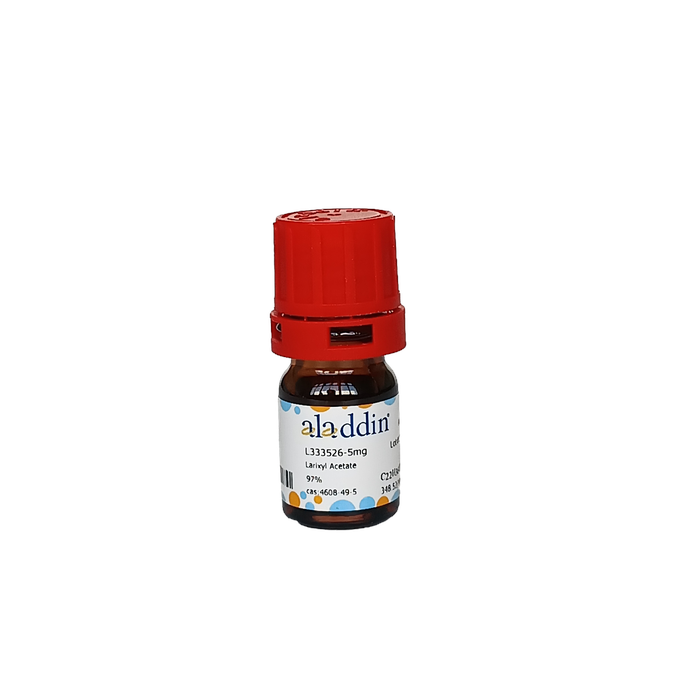
Brief description: Larixyl acetate is a plant-derived labdane-type diterpenoid ester (acetylated larixol) commonly isolated from larch (Larix spp.) resins; used as a research-grade natural-product ligand.
Item-specific identifiers (from Product Data):
SKU: L333526
CAS: 4608-49-5
Grade: Moligand™
SMILES: Not specified for this item; refer to CoA/Spec Sheet.
InChIKey: Not specified for this item; refer to CoA/Spec Sheet.
Molecular Formula: Not specified for this item; refer to CoA/Spec Sheet.
Molecular Weight: Not specified for this item; refer to CoA/Spec Sheet.
Structural features (general/literature description):
Functional groups: secondary alcohol masked as an acetate ester (–O–C(=O)CH3); typically one or more trisubstituted alkene units in the hydrocarbon framework.
Stereochemistry: multiple defined stereocenters inherent to the labdane decalin system (configuration depends on the natural product; see CoA for the specific lot/identity confirmation).
2D structure in words (general): two fused cyclohexane rings (trans-decalin) constitute the labdane core; a short side chain terminates in the acetylated oxygen substituent; one ring junction is quaternary; at least one internal double bond resides on the side chain or ring.
Synonymy and provenance (literature): often referred to as the acetate ester of larixol (a conifer diterpenoid). Sourced historically from Larix decidua and related species. Use this as general context only; confirm exact identity via the product’s analytical data.
Synthetic Utility
While typically used as a finished natural product for biological studies, larixyl acetate also serves as a versatile synthetic handle within the labdane diterpenoid family.
Functional-group reactivity (general):
Acetate ester: subject to hydrolysis (saponification) to regenerate larixol; transesterification under acidic/basic catalysis to install alternative acyl groups.
Alkenes (if present in the scaffold): engage in epoxidation (mCPBA), hydroboration–oxidation (BH3·THF then H2O2/NaOH), dihydroxylation (OsO4/NMO), hydrogenation (Pd/C), and radical additions.
Allylic positions: amenable to selective oxidation (SeO2 or Cr-free alternatives) or halogenation; potential for allylic substitution.
Derivatization avenues:
Probing SAR: vary the acyl group (acetate → propionate, benzoate, carbamate) to modulate lipophilicity, ester stability, and target engagement.
Photochemical rearrangements and singlet-oxygen ene reactions explore conformational and electronic effects typical for terpene frameworks.
Retrosynthetic value:
Provides access to the corresponding alcohol (larixol) and downstream derivatives without needing plant extraction.
Useful as a chiral pool starting point with multiple stereocenters pre-installed, enabling selective late-stage functionalizations.
Analytical/synthetic precautions:
Maintain neutral to mildly basic conditions during chromatographic purification to limit acid-catalyzed acetate cleavage.
Control oxygen and light to minimize autoxidation and isomerization pathways common in terpenes.
Target Specificity
Target/antigen/clone-specific information is not applicable to this small-molecule product and none is provided in the Product Data.
Item-specific target data: Not specified for this item; refer to primary literature for molecular target studies relevant to larixyl acetate in your assay system.
If you require a validated bioassay readout or target engagement protocol, see Application Protocols or Reaction & Applications for general guidance and consult the literature.
등급 선택에 도움이 필요하신가요?
당사의 등급 선택 가이드는 카탈로그의 모든 변형 제품에 대해 순도, 안정제 상태 및 용도 적합성을 다룹니다.
Products are supplied to verified businesses, institutions, and qualified professionals for research and development use only. Not for use in humans, animals, diagnosis, or therapy.

 C23081509