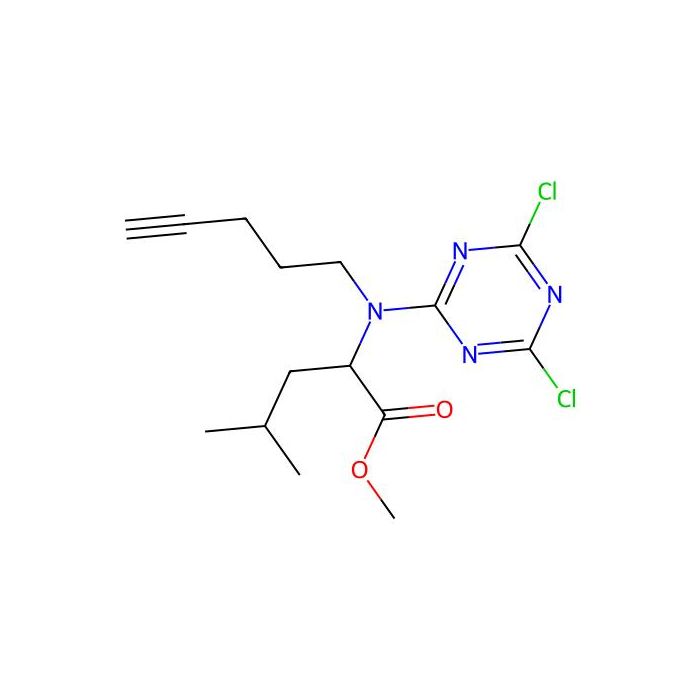
LAS17 is a potent and selective tyrosine-directed irreversible inhibitor for glutathione S-Transferase Pi ( GSTP1 ). LAS17 inhibits GSTP1 activity with an IC 50 of 0.5 µM .
In Vitro
Glutathione S-Transferase Pi (GSTP1) mediates cellular defense against reactive electrophiles. LAS17 inhibits GSTP1 activity in vitro in a concentration-dependent manner. LAS17 (10 µM; Serum-free survival 48 h) treatment in 231MFP breast cancer cells recapitulates the serum-free cell survival impairments observed with genetic inactivation of GSTP1. GSTP1 knockdown in LAS17 (10 µM) treatment in 231MFP cells results in increased levels of phosphorylated AMPK and acetyl CoA carboxylase (ACC). LAS17 treatment in 231MFP cells also shows reduced levels of ATP, lactic acid, purine nucleotides, and diacylated phospholipids and alkylacyl ether lipids and increased levels of acyl carnitines (ACs), ceramides, lysophospholipids. MCE has not independently confirmed the accuracy of these methods. They are for reference only. Cell Viability AssayCell Line: 231MFP breast cancer cells Concentration: 10 µM Incubation Time: 48 hours Result: Recapitulated the serum-free cell survival impairments observed with genetic inactivation of GSTP1. Western Blot AnalysisCell Line: 231MFP cells Concentration: 10 µM Incubation Time: Result: LAS17-treated 231MFP cells show increased levels of phosphorylated AMPK and ACC.
In Vivo
Daily administration of LAS17 (20 mg/kg ip, once per day) significantly impairs 231MFP breast tumor xenograft growth in immune-deficient mice when treatment is initiated 2 days after subcutaneous injection of cells, and LAS17 even slows tumor growth when initiated 16 days after tumor implantation, with no observable toxicity and no weight-change. MCE has not independently confirmed the accuracy of these methods. They are for reference only. Animal Model: Severe combined immunodeficiency (SCID) mice bearing 231MFP tumor xenograftDosage: 20 mg/kg (prepared in PBS:ethanol:PEG40 (18:1:1)) Administration: Daily administration i.p., once per day Result: Significantly impaired 231MFP breast tumor xenograft growth.
Form:Oil
사양
사양 및 순도
≥97%
생화학 및 생리적 메커니즘
LAS17 is a potent and selective tyrosine-directed irreversible inhibitor for glutathionexa0S-Transferase Pi ( GSTP1 ). LAS17 inhibits GSTP1 activity with an IC 50 of 0.5 µM.
Determine the necessary mass, volume, or concentration for preparing a solution.
Dilution Calculator
Determine the dilution needed to prepare a stock solution.
Reconstitution Calculator
리뷰
고객 리뷰
Application Protocols
No tested applications are listed in the Product Data. The following outlines a generic small-molecule screening workflow; tailor to your assay and compound once structural and purity data are confirmed.
Generic protocol (not item-specific)
Preparation: Equilibrate vial to room temperature in a desiccator. Briefly centrifuge to collect contents.
Stock: Dissolve in dry DMSO to 10–50 mM. Vortex and, if needed, sonicate gently. Record exact concentration and solvent lot.
Filtration: If particulates persist and chemistry allows, filter through 0.2 µm PTFE.
Working dilutions: Prepare serial dilutions in assay buffer, ensuring constant final DMSO across wells/conditions.
Controls: Include vehicle controls and appropriate positive/negative controls. Consider detergent (e.g., 0.01% Tween-20) to assess aggregation artifacts.
Data integrity: Confirm compound identity/purity before drawing mechanistic conclusions.
Note: For any specialized protocol (e.g., crystallography soaks, biophysical binding assays), consult structural data and optimize solvent/cosolvent/pH accordingly.
Biological Roles
No biological function or target information is provided for LAS17 in the Product Data. Do not infer mechanism or biological role without validated structural and pharmacological data.
General guidance for discovery use (not item-specific)
If used in biochemical or cellular assays, first establish compound identity and purity, then determine basic properties (e.g., solubility, stability in assay media, potential aggregation via detergent sensitivity or DLS).
Assess nonspecific interference risks using appropriate counterscreens (e.g., redox cycling, fluorescence quench/enhancement controls, and detergent controls for colloidal aggregation).
For putative target engagement, complement activity assays with orthogonal biophysical methods (e.g., SPR, DSF, NMR, MST) as appropriate.
Research-only statement
For research use only (per Product Data). Not for human or veterinary use.
Buffer Applications
This item is a small-molecule/compound library entry, not a buffering agent. No pKa or buffering range is provided.
Buffer system guidance: Not applicable. If dissolving LAS17 for assays, select buffers compatible with your biological system (e.g., PBS, HEPES, Tris) and verify compound stability at the chosen pH and ionic strength.
Record and report final cosolvent percentage (e.g., DMSO) and buffer composition to ensure assay reproducibility.
Green Alternatives
Item-specific environmental, safety, and health (ESH) metrics are not available. When planning work with an unknown small molecule, focus on greener solvents, minimal quantities, and waste reduction.
Greener practice suggestions (general guidance; not item-specific)
Solvent selection: Favor water, ethanol, or 2-MeTHF/EtOAc over chlorinated solvents where technically feasible for extractions and sample prep.
Analytical methods: Use UPLC with short columns and water-rich mobile phases to reduce solvent consumption.
Scale minimization: Conduct microscale assays and reactions to limit waste generation.
Energy use: Prefer ambient-temperature operations and avoid prolonged heating or cryogenic cooling unless necessary for stability.
Waste: Segregate halogenated from non-halogenated waste; neutralize acids/bases before disposal per institutional policy.
Illustrative comparison (general; not item-specific)
ACN vs MeOH (LC): MeOH offers lower toxicity and cost; ACN can provide better peak shape for some analytes—optimize to reduce total solvent volume.
DCM vs EtOAc (workup): EtOAc is generally greener and less hazardous; choose it when partitioning behavior allows.
Note: Specific hazard/biodegradability metrics for LAS17 are Not specified for this item; refer to SDS.
Pharmaceutical Uses
No excipient role, compendial status, or formulation guidance is provided for LAS17.
Pharmaceutical/clinical use: None stated. For research use only (per Product Data).
If formulation studies are intended (preclinical research only), first obtain the structure and purity data, then evaluate:
Salt/salt-forming potential, polymorphism, and hygroscopicity.
Solubility and stability across biorelevant media (FaSSIF/FeSSIF), and pH 1–8.
Vehicle compatibility for in vivo research (e.g., PEG400, Captisol, or lipid vehicles), following institutional animal care guidelines.
Note: Do not imply therapeutic claims or clinical suitability without comprehensive safety and efficacy data; none are provided here.
Physical Properties
Only limited physical data are available in the Product Data. Do not assume solvent, melting/boiling points, or ionization behavior without documentation.
Item-specific values
Molecular weight: Not specified for this item; refer to CoA/Spec Sheet.
Molecular formula: Not specified for this item; refer to CoA/Spec Sheet.
Appearance: Not specified for this item; refer to CoA/Spec Sheet.
Density: Not specified for this item; refer to CoA/Spec Sheet.
Melting point / Boiling point: Not specified for this item; refer to CoA/Spec Sheet.
LogP, pKa, refractive index: Not specified for this item; refer to CoA/Spec Sheet.
Solubility: Not specified for this item; refer to CoA/Spec Sheet.
General laboratory guidance (literature/good practice; not item-specific)
For unknown small molecules, perform a tiered solubility screen at room temperature (and 37 °C if for assay stocks): DMSO → DMF → MeOH/EtOH → acetonitrile → aqueous buffers (pH 2–10) with cosolvent 1–10%.
Use sonication and brief warming (<40 °C) to aid dissolution if chemically appropriate; avoid prolonged heating.
Record exact solvent/stock concentration and any pH adjustments for assay reproducibility.
If volatility is suspected (odor, rapid mass loss), handle in crimp/septa vials and minimize open handling.
If hygroscopicity is suspected, work quickly in a dry box or under inert gas and store with desiccant.
Quality and Grades
Item-specific quality designations are not provided in the Product Data.
Grade/purity: Not specified for this item; refer to CoA/Spec Sheet.
Appearance: Not specified for this item; refer to CoA/Spec Sheet.
Interpreting typical grades (general guidance; not item-specific)
Screening/compound library grade commonly supports medicinal chemistry and biochemical screening and is typically accompanied by LC–MS purity (e.g., AUC%) and, when relevant, 1H NMR verification. Confirm with the CoA.
Analytical/≥95–98% grades are preferred for SAR and in vitro selectivity profiling; HPLC or UPLC chromatograms should show low UV baseline drift if used in UV-detection assays.
If a stabilizer, salt form, or counter-ion is present, the CoA should state it explicitly; adjust molarity for salt content.
Recommended verifications upon receipt
Record batch/lot number and request CoA including: assay/purity method (HPLC/UPLC), residual solvent profile, water content (KF) if applicable, and identity confirmation (MS/NMR).
If the compound is moisture/air/light sensitive, confirm stabilizers and recommended handling per CoA.
Reaction and Applications
Manufacturer applications: Not provided in the Product Data.
Context and likely use (general guidance; not item-specific)
Given the Category Path (small molecules and compound library), LAS17 is most appropriately handled as a screening compound or reference standard for discovery workflows. Typical applications include biochemical/biophysical assay screening, hit confirmation, and preliminary structure–activity relationship (SAR) exploration once the structure is available.
Practical guidance for screening workflows
Identity/purity check: Verify by LC–MS (both positive and negative ESI if structure is unknown) and, where possible, by 1H NMR prior to critical studies.
Stock handling: Prepare concentrated DMSO stocks (e.g., 10–50 mM); filter through 0.2 µm PTFE if particulate is present and compatible.
Adsorption/carryover: Use low-bind plasticware or silanized glass for hydrophobic or cationic species to reduce loss to surfaces.
Stability checks: Perform short-term stability in assay media at planned temperature/time; monitor by LC–MS for hydrolysis/oxidation.
Controls: Include vehicle control (DMSO), and, if available, a mechanistically related positive control when evaluating activity.
Note: Without structural information, reaction chemistry applications (synthesis, named reactions) cannot be specified responsibly.
Reaction Conditions
No reaction condition data are provided for LAS17, and without a defined structure it is not appropriate to propose specific synthetic or transformation conditions.
General study conditions for screening compounds (not item-specific)
Stock solutions: Commonly 10–50 mM in anhydrous DMSO; store at -20 °C in aliquots to avoid freeze–thaw.
Assay working solutions: Prepare fresh dilutions into assay buffer/media; typical final DMSO 0.1–1% v/v unless system tolerates more.
Stability checks: Incubate at intended assay temperature and time; analyze by LC–MS to verify integrity (>95% peak area recommended for primary assays).
Light/oxidation sensitivity: If suspected, handle under low light and inert gas; include antioxidant scavengers only if compatible with the assay and compound chemistry is known.
Safety and Handling
Safety data are not fully specified in the Product Data. Handle under a risk-based approach suitable for unknown small molecules. Always consult the product SDS for authoritative guidance.
GHS and hazard communication (item-specific)
Signal word: Not specified for this item; refer to SDS.
H-statements: Not specified for this item; refer to SDS.
GHS classification/pictograms: Not specified for this item; refer to SDS.
General precautions (good laboratory practice)
PPE: safety glasses, lab coat, and appropriate chemically resistant gloves (e.g., nitrile). Consider double-gloving for DMSO solutions.
Engineering controls: handle powders/solutions in a fume hood; avoid inhalation of dust/aerosols.
Incompatibilities: Unknown; segregate from strong oxidizers, strong acids/bases until specific data are available.
First aid (overview): In case of skin/eye contact, rinse with water for ≥15 min and seek medical attention. If inhaled, move to fresh air. If ingested, do not induce vomiting; seek medical attention. Follow SDS-specific instructions when available.
Spill and waste
Small spills: absorb with inert material, collect in sealed container; ventilate area.
Disposal: treat as organic laboratory chemical waste per institutional and local regulations.
Storage and transport
Storage: Store at -20 °C (per Product Data). Keep tightly closed, dry, and protected from light until stability is known.
No item-specific solubility or polarity data are provided. Choose solvents empirically while minimizing compound degradation.
Suggested strategy (general guidance; not item-specific)
Stock preparation for screening: begin with an anhydrous, aprotic solvent such as DMSO (common 10–50 mM stocks). If insoluble, consider DMF or a co-solvent system (e.g., 50% DMSO in water or buffer) and gentle warming (≤40 °C).
Aqueous compatibility: Evaluate at target assay pH (e.g., 6.5–7.5 for enzyme/cell-free assays). Use ≤1–2% final DMSO in biochemical assays unless higher tolerated.
pH adjustment: For ionizable compounds, solubility may improve at low pH (bases) or high pH (acids). Prepare separate acidified/alkalinized aqueous stocks only if the compound is stable.
Volatile/unstable compounds: If volatility or hydrolysis is suspected, prepare fresh stocks immediately prior to use; use sealed vials and chilled autosampler trays for LC–MS.
Comparison notes (general; choose as applicable)
DMSO vs DMF: DMSO is broadly compatible with assays; DMF can enhance solubility for some heteroaromatics but may interfere with certain enzymes.
MeOH/EtOH: useful for quick screening but can perturb assay systems at >1–2% v/v.
ACN: good for LC–MS sample prep; lower proticity can reduce ion suppression compared to MeOH in ESI.
Storage and Reconstitution
Item-specific storage conditions are provided; reconstitution guidance is generalized for small molecules.
Storage (item-specific where provided)
Store at -20 °C (per Product Data). Keep container tightly closed in a dry, inert atmosphere; protect from light until stability is known.
Shipped in ice chest with ice pads (per Product Data).
Reconstitution and handling (general guidance; not item-specific)
Allow container to equilibrate to room temperature in a desiccator before opening to prevent moisture condensation.
Prepare concentrated stock in dry DMSO (typical 10–50 mM) or another suitable solvent after a small-scale solubility screen. Document solvent, concentration, and date.
Aliquot stocks into low-bind tubes to minimize headspace and avoid repeated freeze–thaw cycles. Store aliquots at -20 °C.
For aqueous working solutions, prepare immediately before use; verify stability if stored >1 day (monitor by LC–MS/HPLC).
If solid residues persist, avoid excessive heating; use brief sonication and confirm complete dissolution before dosing.
Additional notes
Research use only (per Product Data).
For definitive stability (long-term/short-term), impurity limits, and re-test dates, Not specified for this item; refer to CoA/Spec Sheet.
Structure and Identity
Brief overview: This listing (LAS17) is part of a small-molecule/compound library entry with limited structural disclosure in the Product Data. Provide or request the CoA/Spec Sheet for definitive identifiers before experimental use.
SKU: L647213
Product name/alias: LAS17
CAS: 2362527-67-9
PubChem CID: 156024492 (per Product Data)
InChIKey (as supplied): 369115 — note: this is non-standard in length; verify against CoA/SDS
SMILES: Not specified for this item; refer to CoA/Spec Sheet.
Molecular formula: Not specified for this item; refer to CoA/Spec Sheet.
Molecular weight: Not specified for this item; refer to CoA/Spec Sheet.
Structural features
Functional groups, ring systems, and stereochemistry: Not specified for this item; refer to CoA/Spec Sheet.
2D description: Not specified; without a SMILES/InChI, the exact functional topology cannot be summarized. Request structural disclosure if needed for computational or analytical work.
Notes for users
If you plan spectral confirmation (NMR/LC–MS), obtain the structure or a reference spectrum from the CoA to select appropriate methods (e.g., ionization mode, expected fragments).
Synthetic Utility
Synthetic reagent applications cannot be described without structural information. The Product Data categorize LAS17 as a small-molecule/compound library entry rather than a general synthetic building block.
Functional group chemistry, protecting group strategies, and named-reaction participation: Not specified for this item; refer to CoA/Spec Sheet.
General recommendation (not item-specific)
If LAS17 is to be modified for SAR, request the structure and any available synthetic route or reference. Establish a robust analytical package (1H/13C NMR, HRMS, HPLC) before derivatization.
Target Specificity
Target/epitope/clone information is not applicable; LAS17 is not an antibody or protein reagent.
Specific target(s): Not specified for this item; refer to CoA/Spec Sheet or associated screening data if available.
Species reactivity, isotype, clone: Not applicable.
자주 묻는 질문
What is the purity of this product?
This product is supplied at ≥97% purity (chemical assay). Lot-specific values are stated on the Certificate of Analysis.
How should this product be stored?
Store at ?20 °C. Freezer storage is required to maintain the specified shelf life.
How is this product shipped?
This product ships in an insulated container with ice pads. Unpack on arrival and transfer it to the storage condition stated above.
What are the CAS number, molecular formula and molecular weight?
The CAS Number is 2362527-67-9, the molecular formula is C15H20Cl2N4O2, and the molecular weight is 359.25 g/mol. InChIKey UTXOIMJGBZBFGA-LLVKDONJSA-N.
What documentation is provided?
Available product documentation, including Certificates of Analysis (COA), Safety Data Sheets (SDS), and specification sheets, is shown in the product document area. Document availability and access follow the current site policy.
Products are supplied to verified businesses, institutions, and qualified professionals for research and development use only. Not for use in humans, animals, diagnosis, or therapy.