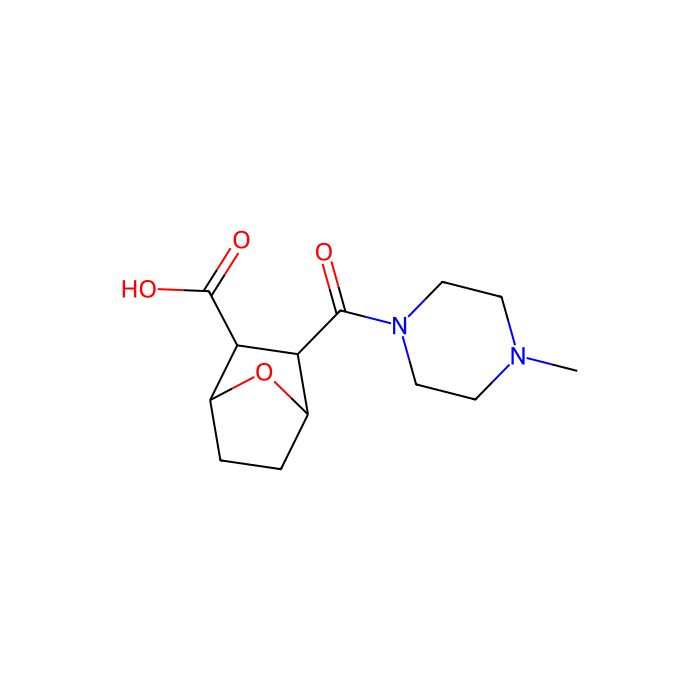
LB-100 LB-100 is a water soluble protein phosphatase 2A (PP2A) inhibitor with IC50s of 0.85 μM and 3.87 μM in BxPc-3 and Panc-1 cells.
Targets
PP2A
In vitro
LB-100 inhibits the cell growth with IC50 of 2.3 μM (in BxPc-3) or 1.7 μM (in Panc-1 cell). In BxPc-3, Panc-1, and SW1990 cells, LB-100 reduces the PP2A activity by 30-50%. LB-100 increases concentration of doxorubicin within cells (2.5 fold to control) and sensitizes tumor cells to the cytotoxicity of doxorubicin. LB-100 increaseds VEGF secretion, and thus enhances HIF-1α-VEGF mediated angiogenesis.
In vivo
In a mouse pancreatic cancer xenograft model, LB-100 (2 mg/kg, i.p.) enhances chemotherapy of doxorubicin. LB-100 causes higher density of microvessel in tumors and rapid blood flow at the surface of tumors.
This compound belongs to the class of organic compounds known as n-methylpiperazines. These are organic compounds containing a piperazine ring where the nitrogen ring atom carries a methyl group.
External Descriptors
Not available
1. Djoumbou Feunang Y, Eisner R, Knox C, Chepelev L, Hastings J, Owen G, Fahy E, Steinbeck C, Subramanian S, Bolton E, Greiner R, and Wishart DS. ClassyFire: Automated Chemical Classification With A Comprehensive, Computable Taxonomy. Journal of Cheminformatics, 2016, 8:61.
Determine the necessary mass, volume, or concentration for preparing a solution.
Dilution Calculator
Determine the dilution needed to prepare a stock solution.
Reconstitution Calculator
리뷰
고객 리뷰
Application Protocols
Item-specific (from Product Data)
No validated application protocols are provided for this product.
Guidance
Follow your laboratory’s validated SOPs for small-molecule handling and dosing in biochemical or cellular assays. Include vehicle controls and perform preliminary solubility/stability checks under assay conditions.
Documentation
Record lot number, preparation date, solvent, and concentration for each stock; attach CoA/SDS to your experiment records.
Biological Roles
Item-specific (from Product Data)
No biological target details are provided in the Product Data for this item.
Literature/general context (verify against primary sources before use)
LB-100 is widely discussed in the literature as a small-molecule tool for probing serine/threonine phosphatase–associated pathways, often with reported activity in the PP2A axis. If using this item as a pathway probe, independently verify target engagement (e.g., biochemical IC50, cellular target modulation) for your system.
Typical experimental arenas include enzymology, cell signaling, stress-response pathways, and combinations with other perturbagens to assess pathway dependencies.
Practical experimental considerations (general)
Off-target profiling: Incorporate orthogonal assays and chemical controls (inactive analogs or structurally distinct probes) to validate mechanism.
Exposure design: Use a titration series spanning sub- to supra-pharmacological levels; monitor cytotoxicity/viability as appropriate.
Kinetic vs. endpoint readouts: Confirm whether effects are immediate (direct enzyme inhibition) or require longer incubations (secondary responses).
Important note
The above is general, literature-based context. This listing provides no item-specific bioactivity guarantees. Confirm all biological properties with your own assays and the batch CoA.
Buffer Applications
This product is not a buffering reagent and has no standard role in preparing pH buffer systems.
Guidance
For biochemical assays involving LB-100, use your assay’s validated buffer (e.g., HEPES, Tris, phosphate) and confirm that any organic cosolvent percentage (e.g., DMSO) does not affect pH, ionic strength, or assay readout.
Include vehicle-only controls to account for solvent effects.
Item-specific details
No buffer recipes or pKa values are provided for this item in the Product Data.
Green Alternatives
As a bioactive probe compound, LB-100 is not a process solvent or commodity reagent where greener substitutions usually apply. However, greener practices can still be incorporated in its handling and use.
Applicable green chemistry considerations (general)
Solvent minimization: Use the minimal DMSO/organic solvent percentage compatible with assay performance.
Micro-scale workflows: Design experiments (e.g., 384/1536-well formats) to reduce material and solvent usage.
Waste management: Segregate halogenated vs. non-halogenated organic waste; neutralize and dispose per regulations.
Energy efficiency: Store at −20 °C as specified; avoid unnecessary ultra-cold storage if stability allows (confirm by CoA/stability data).
Not applicable
Replacement by a “greener” alternative compound is not typically relevant for targeted mechanism-of-action studies since biological specificity, not solvent greenness, governs selection.
Documentation and transparency
Record solvent volumes and disposal routes to support green metrics (E-factor at bench scale) where relevant.
Pharmaceutical Uses
For research use only. No clinical or therapeutic claims are made for this product.
Item-specific (from Product Data)
No pharmacopeial status or excipient roles are provided.
Research/formulation context (general)
LB-100 may be formulated as concentrated DMSO stock for in vitro testing and diluted into assay buffers or culture media. For pre-formulation or ADME studies in research settings, typical solvent systems include DMSO, ethanol, or PEG-containing vehicles; all conditions must be optimized and justified for the specific study design.
Solid-form considerations (general): confirm polymorph/solvate state; evaluate hygroscopicity and solution stability (hydrolysis/oxidation) under simulated use conditions.
Analytical control
Establish stability-indicating methods (HPLC-UV/MS) and dilution integrity across the intended concentration range.
Compliance note
This product is not supplied with regulatory filings for human or veterinary use. Any scale-up or formulation work is strictly for non-clinical research.
Physical Properties
Item-specific values are not provided in the Product Data. Do not assume specifications; consult the batch CoA/SDS for quantitative use.
Item-specific (from Product Data)
Appearance: Not specified for this item; refer to CoA/Spec Sheet.
Molecular Weight: Not specified for this item; refer to CoA/Spec Sheet.
Physical constants (literature/general; verify before use)
Melting point (MP), boiling point (BP), and density: Not consolidated here. Check primary literature or PubChem (CID 3578572) and confirm with CoA.
Solubility: Many bioactive small molecules similar to LB-100 are handled as DMSO stock solutions (e.g., 10–50 mM) and diluted into aqueous assay buffers with cosolvent ≤0.1–0.5% v/v. This is general practice, not an item-specific specification.
LogP, pKa, refractive index: Not summarized here; consult literature/computational resources and verify experimentally if these parameters affect your study design.
Practical guidance (general)
If preparing analytical standards or conducting quantitative biophysical assays, determine exact solubility and extinction coefficients under your conditions. Validate by HPLC/UPLC and record-temperature measurements.
Hygroscopicity and polymorphism, if any, should be evaluated on receipt by checking mass balance after desiccation and comparing DSC/TGA when necessary.
Quality and Grades
Item-specific (from Product Data)
Grade/Purity: Not specified for this item; refer to CoA/Spec Sheet.
How to interpret typical grades (general guidance)
Research grade: Suitable for exploratory biology/chemistry. Purity usually reported by HPLC/UPLC or NMR; impurities may include residual solvents or isomers. Confirm with CoA.
≥95–98% purity (if specified on CoA): Often adequate for cell-based assays. For in vivo model development or biophysical studies, higher purity and comprehensive impurity profiling are preferred.
Salt/form and counterions: Verify free base vs. salt, solvate/hydrate state, and polymorph on the CoA; these can alter solubility and potency.
Practical QC considerations
Identity/purity verification: Orthogonal confirmation via HPLC-UV (multi-wavelength), HRMS, and 1H/13C NMR is recommended upon receipt.
Residual solvent, water, and inorganic content: If your application is sensitive, request KF moisture and residual solvent data for the batch.
UV profile: For quantitative optical assays, obtain UV–Vis spectrum and extinction coefficients under your conditions; low-UV background solvents are recommended.
Documentation
Always use the batch-specific CoA and SDS for specifications, acceptance criteria, and handling guidance.
Reaction and Applications
This product is primarily a bioactive small molecule tool compound rather than a synthetic reagent.
Item-specific (from Product Data)
Manufacturer Applications: Not specified in the Product Data.
Typical research applications (literature/general; not item-specific specifications)
Utilized as a probe compound in biochemical and cellular studies to interrogate serine/threonine phosphatase–related pathways. Always confirm reported biological targets and potencies from primary literature and align with your assay context.
Employed in dose–response, time-course, and mechanistic studies in enzymology and signal transduction research.
Not typically used in
Stoichiometric organic synthesis or as a general solvent/reagent. For such needs, see the Synthetic Utility and Reaction Conditions sections, which are not directly applicable here.
Practical notes for laboratory use (general)
Prepare concentrated DMSO stocks (e.g., 10–50 mM) and aliquot to avoid freeze–thaw cycles.
Validate stability under assay conditions (temperature, pH, light). Assess by HPLC over the experimental timeframe.
Include vehicle controls at matching solvent percentages.
Reaction Conditions
This section is not directly applicable: LB-100 is used as a bioactive probe rather than as a reagent or catalyst in synthetic transformations.
General handling in assays (not item-specific specifications)
Stock preparation: Often prepared in DMSO (e.g., 10–50 mM) and stored as single-use aliquots at −20 °C.
Working solutions: Dilute into assay buffer immediately before use; typical final organic solvent content in biochemical assays is maintained at ≤0.1–0.5% v/v.
Temperature/light: Protect from prolonged light and elevated temperatures unless stability is verified.
If chemical transformations are undertaken (derivatization; general)
Choose anhydrous, oxygen-free conditions as needed; validate compound integrity under coupling, acylation, or click-chemistry conditions.
Monitor reactions by LC–MS and stop upon first sign of core-scaffold degradation.
Safety and Handling
Authoritative safety data must be taken from the SDS for this specific item/batch.
Item-specific (from Product Data)
Storage: Store at −20 °C.
Shipping: Shipped in ice chest with ice pads.
GHS Classification / Pictograms / Signal Word / H-Statements: Not specified for this item; refer to SDS.
General lab safety for research-use small molecules (not item-specific)
PPE: Lab coat, nitrile gloves, and eye protection recommended. Use in a chemical fume hood to minimize inhalation exposure.
Avoid: Ingestion, inhalation of dust/aerosols, and skin/eye contact. Prevent environmental release.
Handling: Minimize repeated freeze–thaw. Allow container to equilibrate to ambient temperature in a desiccator before opening to reduce moisture condensation.
Incompatibilities: Strong oxidizers and strong acids/bases may cause decomposition for many organic small molecules; consult SDS for LB-100–specific incompatibilities.
First aid overview (general)
Skin/eye contact: Rinse with water for ≥15 minutes; remove contaminated clothing; obtain medical attention.
Inhalation: Move to fresh air; support breathing as needed; seek medical attention.
Ingestion: Rinse mouth; do not induce vomiting unless directed by medical personnel; seek medical attention.
Spill/waste (general)
Absorb small spills with inert material; collect for disposal as hazardous chemical waste. Follow institutional and local regulations.
Solvent Selection
Item-specific (from Product Data)
No explicit solvent recommendations provided.
General practice for bioactive small molecules (literature/common practice; verify experimentally)
Primary stock solvent: DMSO is commonly used due to broad solvating power and compatibility with biological assays at low final percentages (typically ≤0.1–0.5% v/v).
Alternative solvents: DMF or ethanol can be used when DMSO is unsuitable; co-solvents (e.g., PEG400, cremophor) may be considered for challenging solubility.
Aqueous compatibility: Dilute DMSO stocks slowly into buffered saline or culture media with vigorous mixing to prevent precipitation. Pre-warm solutions if needed.
Filtration: 0.22 μm PVDF/nylon filters can clarify working solutions; confirm compound compatibility with membrane materials.
Decision points
Choose DMSO when you need long-term frozen aliquots and minimal hydrolysis risk.
Use ethanol or DMF when DMSO interferes with a specific assay readout.
For in vitro enzyme assays, verify that the chosen solvent percentage does not affect enzyme activity or readout.
Small comparison (general)
DMSO: highest solvency, low volatility; may affect some redox/fluorescence assays.
Ethanol: volatile, miscible with water; tighter limits in live-cell assays.
DMF: good solvency; consider cytotoxicity and hygroscopicity.
Storage and Reconstitution
Item-specific (from Product Data)
Storage Conditions: Store at −20 °C.
Shipped In: Ice chest + ice pads.
Not specified for this item; refer to CoA/Spec Sheet
Appearance, solvent of reconstitution, concentration limits, and stability window after reconstitution.
General guidance (literature/common practice; verify for your application)
Reconstitution: Prepare concentrated stock solutions in dry, oxygen-free DMSO where compatible. Mix gently to avoid foaming; sonication or brief warming (≤37 °C) may help dissolve stubborn solids.
Aliquoting: Dispense into single-use vials (amber or foil-wrapped) to avoid repeated freeze–thaw. Typical aliquots: 10–100 μL.
Storage: Keep solid tightly capped, protected from light and moisture, at −20 °C as specified. Store solutions at −20 °C or −80 °C depending on your stability data.
Stability checks: Periodically verify concentration and integrity by HPLC/LC–MS after storage; discard if precipitation, discoloration, or degradants are observed.
Thawing: Equilibrate frozen stocks to room temperature before opening to minimize moisture ingress; promptly return unused aliquots to cold storage.
Research use note
For research use only. Consult the batch-specific CoA and SDS for authoritative handling and stability information.
Structure and Identity
Brief overview: LB-100 is listed here as a research-use small molecule. Item-specific structural identifiers are largely not provided in the Product Data. Where available, identifiers are noted; otherwise refer to the CoA/Spec Sheet for authoritative details.
Item-specific (from Product Data)
Product Name: LB-100
SKU: L413773
CAS: 1026680-07-8
PubChem CID: 3578572
InChIKey: 170565 (as provided; format appears non-standard — verify on CoA/SDS)
SMILES: Not specified for this item; refer to CoA/Spec Sheet.
Molecular Formula: Not specified for this item; refer to CoA/Spec Sheet.
Molecular Weight: Not specified for this item; refer to CoA/Spec Sheet.
Literature/context (general)
LB-100 is widely referenced in the literature as a bioactive small molecule used as a phosphatase-pathway probe. Consult peer-reviewed sources for canonical structural descriptors and confirm against this item's CoA before use in quantitative work.
Descriptive structural features (general, literature-based; verify against CoA)
Reported as a compact, non-peptidic small molecule. Detailed functional groups, stereochemistry, and ring systems should be verified against the supplier’s CoA/Spec Sheet before structural or stoichiometric calculations.
Practical identity guidance
For identity confirmation in your lab, consider orthogonal methods (e.g., 1H/13C NMR, HRMS, HPLC/UPLC purity check) and compare to authentic or literature spectra where available. Always reconcile with batch-specific CoA.
Synthetic Utility
LB-100 is a finished small-molecule probe and is not typically used as a building block or reagent in multi-step organic synthesis.
Not typically applicable
As it is deployed mainly for biochemical and cell-based assays, sections on functional-group interconversion or named-reaction participation are generally irrelevant for this product.
If derivatization is desired (general advice)
Confirm the exact structure (CoA) and identify potential handles (e.g., amide, hydroxyl, carboxyl, heteroaromatic positions) for linker installation or probe derivatization.
Plan orthogonal protection strategies and assess stability to coupling conditions if creating biotinylated or fluorescent analogs for chemoproteomics.
Analytical characterization (general)
For any semi-synthesis or conjugation, verify integrity by HRMS, 1D/2D NMR, and LC–MS with photodiode-array detection to confirm chromophore retention and purity.
Target Specificity
Item-specific (from Product Data)
No target, epitope, or specificity information is provided for this item.
Note
While LB-100 is discussed in the literature as a pathway probe in serine/threonine phosphatase biology, this catalog entry does not certify target specificity. Users must establish target engagement and selectivity profiles in their own systems using validated assays (e.g., enzymatic inhibition panels, CETSA/thermal shift, chemoproteomics), and consult primary literature for context.
자주 묻는 질문
What is the purity of this product?
This product is supplied at ≥95% purity (chemical assay). Lot-specific values are stated on the Certificate of Analysis.
How should this product be stored?
Store at ?20 °C. Freezer storage is required to maintain the specified shelf life.
How is this product shipped?
This product ships in an insulated container with ice pads. Unpack on arrival and transfer it to the storage condition stated above.
What are the CAS number, molecular formula and molecular weight?
The CAS Number is 1026680-07-8, the molecular formula is C13H20N2O4, and the molecular weight is 268.31 g/mol. InChIKey JUQMLSGOTNKJKI-UHFFFAOYSA-N.
What documentation is provided?
Available product documentation, including Certificates of Analysis (COA), Safety Data Sheets (SDS), and specification sheets, is shown in the product document area. Document availability and access follow the current site policy.
Products are supplied to verified businesses, institutions, and qualified professionals for research and development use only. Not for use in humans, animals, diagnosis, or therapy.

 C2513351