Determine the necessary mass, volume, or concentration for preparing a solution.
Moligand™, 10 mM in DMSO Moligand™ for sensitive chromatographic and analytical workflows requiring minimal baseline interference.
Store at -80°C Ships Dry ice packs + Cold packs Check lot-specific COA for exact specifications.
SDS, COA, datasheet, and spec sheet available for download. Lot-specific COA accessible via lot number lookup.
Cited in 0 peer-reviewed publications across chromatography, organic synthesis, and cross-coupling reactions.
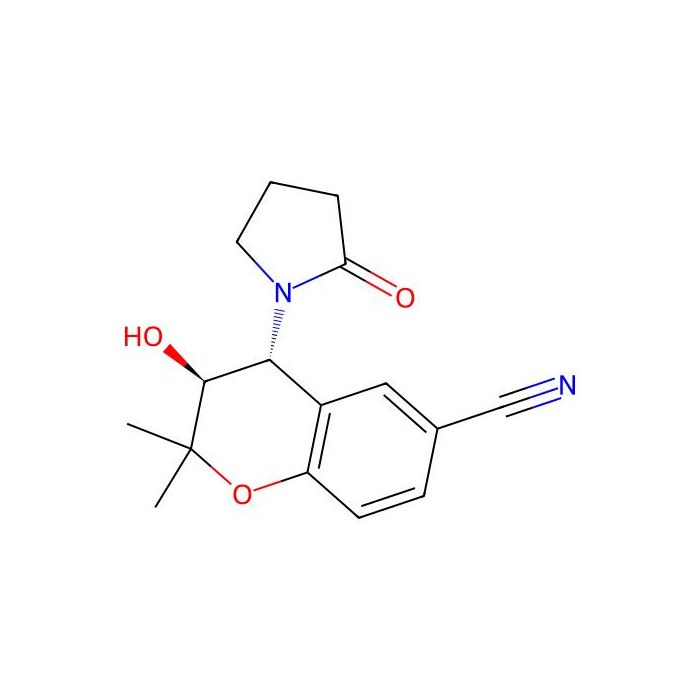
Levcromakalim ((-)-Cromakalim) is an ATP-sensitive K + channel (K ATP ) activator.
| 이성체 SMILES | CC1([C@H]([C@@H](C2=C(O1)C=CC(=C2)C#N)N3CCCC3=O)O)C |
|---|---|
| 분자량 | 286.33 |
| Reaxy-Rn | 8781733 |
| Reaxys-RN_link_address | https://www.reaxys.com/reaxys/secured/hopinto.do?context=S&query=IDE.XRN=8781733&ln= |
Comprehensive hazard, handling, storage, and regulatory compliance document.
Download SDS →Lot-specific quality data. Enter your lot number to retrieve the exact COA.
Look up COA →Full quality attributes and acceptance criteria for this grade.
View spec sheet →The following protocols are literature-informed, general examples for using levcromakalim as a research tool. They are not item-specific validations; optimize for your system.
Always include vehicle controls, replicate wells/rings/cells, and appropriate statistical analysis.
Levcromakalim is widely used as a research tool compound to activate ATP-sensitive potassium (KATP) channels.
Mechanistic context (literature/general):
Research utilities:
Notes and caveats:
All uses are for research and laboratory investigations only.
This compound is not a buffering agent and is not used to prepare pH buffer systems. Consequently, there are no standard buffer recipes or buffering ranges associated with levcromakalim.
Practical note:
This product is a targeted bioactive small molecule used as a probe/ligand rather than a process solvent or general-purpose reagent. As such, conventional “green alternative” comparisons (e.g., replacing a solvent with a greener one) are not typically applicable.
Sustainability-oriented handling suggestions (general):
If you are exploring greener paradigms for ion-channel assays:
No item-specific environmental metrics (biodegradability, aquatic toxicity, E-factor contributions) are provided; consult your institutional EHS for best practices.
This product is supplied strictly for research use. It is not intended for human or veterinary use, nor for clinical or diagnostic applications.
Laboratory/formulation contexts (research only):
Regulatory/pharmacopeial status:
Handling and documentation:
No therapeutic claims are made or implied for this product; it is provided solely for laboratory research.
Item-specific physicochemical specifications have not been provided for this catalog entry.
Literature/general notes (for context only; not specifications of this item):
Solubility guidance (practical, general):
Important: Treat all numerical physicochemical values as unknown for this specific item unless they appear on the CoA or the product Specification Sheet.
What Moligand™ generally signifies (context):
Item-specific notes:
Implications for users:
Documentation:
Chemical reaction use: This molecule is not typically employed as a reagent, catalyst, or solvent in synthetic transformations. Accordingly, there are no standard named-reaction roles where levcromakalim functions as a reactant.
Research applications (literature/general, chemistry-adjacent):
Practical laboratory tips (general):
Note: For users seeking information on chemical reactivity or building-block applications, this compound is not a common synthon; see “Biological Roles,” “Target Specificity,” and “Application Protocols” for the most relevant content.
Not typically applicable: levcromakalim is not a standard reagent for chemical reactions. There are no canonical reaction conditions where it functions as a substrate, catalyst, or solvent.
Assay preparation conditions (literature/general) relevant to its use as a probe:
These conditions are provided as general literature-informed guidance for biological testing and are not item-specific specifications. Validate and optimize for your assay system.
Safety data specific to this item are not provided in the Product Data.
General laboratory safety guidance (not a substitute for the SDS):
Storage and transport per Product Data:
Always consult the Safety Data Sheet (SDS) for authoritative hazard classification, exposure controls, and emergency measures prior to use.
Levcromakalim is a neutral, hydrophobic small molecule with heteroatoms that confer moderate polarity but generally poor intrinsic water solubility. For laboratory use it is usually formulated as concentrated stocks in organic solvents.
Practical solvent guidance (general/literature-informed):
Selection considerations:
Note: No item-specific solubility limits or solvent impurities are provided; consult the CoA/Spec Sheet and validate in your system.
Item-specific conditions (from Product Data):
General handling and reconstitution (practical guidance):
Specifications not provided:
For research use only. Consult the CoA and SDS for lot-specific guidance and safety before use.
Brief overview: Levcromakalim is the levo-enantiomer of cromakalim, a small-molecule potassium channel opener widely used as a research tool for ATP-sensitive K+ (KATP) channels.
Structural features (literature/general):
Note: Exact identifiers (SMILES/InChIKey) and elemental composition for this catalog item are not specified here; consult the item’s CoA/Spec Sheet for definitive identity data.
Levcromakalim is a finished bioactive small molecule and is not commonly used as a synthetic reagent, catalyst, or intermediate.
Context (general):
If your objective is chemical synthesis:
For practical purposes, users should consult the “Biological Roles,” “Target Specificity,” and “Application Protocols” tabs for the most relevant information on using this product in research.
Item-specific target validation data are not provided; the following reflects literature/general knowledge of the molecule’s pharmacology.
Primary target class:
Selectivity notes (literature/general):
Assay considerations:
Note: No lot-specific binding constants, EC50/IC50 values, or target panels are provided for this item. For quantitative claims, generate data under your experimental conditions and consult primary literature.
Our grade selection guide covers purity, stabilizer status, and application suitability for all variants in our catalog.
View Moligand™ grade guide →