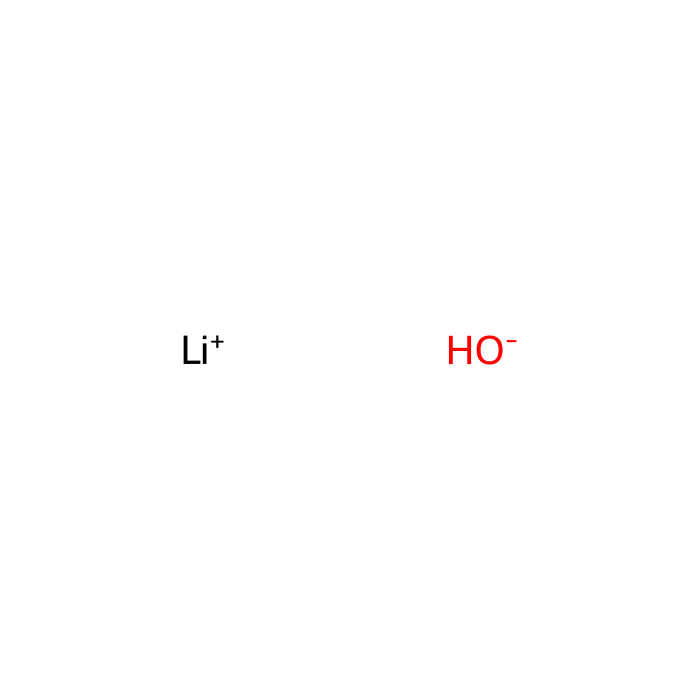
Lithium hydroxide,anhydrous - ≥98%, used for Lithium hydroxide has been used in the following processes: Synthesis of lithium-doped zinc oxide (ZnO) thin films. Preparation of lithium glyceroxide/hydroxide catalysts by reacting with glycerol. As a catalys

CAS: 1310-65-2 Cat. No.: L106770 분자식: LiOH 분자량: 23.95 EC 번호: 215-183-4
주문 가능
등급 & 순도 ≥98%
Synonyms
LiOH|Lithium hydroxide, monohydrate or lithium hydroxide, solid|Lithium Hydroxide, calcinated|lithium hydorxide|LITHIUM-6 HYDROXIDE MONOHYDRATE|Lithium hydroxide|Lithium hydroxide anhydrous
Storage
Room temperature,Argon charged,Desiccated
Shipped In
FedEx DG Service
★
크기
USA
독일 (EU)*
가격
수량
25g
L106770-25g
주문제작 · 8~12주
US$18.90
100g
L106770-100g
재고 있음 ≥10
—
US$67.90
500g
L106770-500g
6 재고 있음
—
US$276.90
Enter a quantity for the sizes you want to add.

개요

Lithium hydroxide (LiOH) is an alkali metal hydroxide. Lithium chloride solution in water on electrolysis forms LiOH. In respiratory apparatus and submarines, it is utilized to uptake carbon dioxide.A study on the redox mechanism of titanium dioxide (TiO2) using cyclic voltammetry, X-ray diffraction, X-ray photoelectron spectroscopy (XPS) and Fourier transform infrared spectroscopy (FTIR) in aqueous LiOH electrolyte has been reported.

사양

동의어
LiOH | Lithium hydroxide, monohydrate or lithium hydroxide, solid | Lithium Hydroxide, calcinated | lithium hydorxide | LITHIUM-6 HYDROXIDE MONOHYDRATE | Lithium hydroxide | Lithium hydroxide anhydrous
사양 및 순도
≥98%
애플리케이션
Lithium hydroxide has been used in the following processes: Synthesis of lithium-doped zinc oxide (ZnO) thin films. Preparation of lithium glyceroxide/hydroxide catalysts by reacting with glycerol. As a catalyst to generate unsaturated ketones via Michael
보관 조건
Room temperature,Argon charged,Desiccated
배송
FedEx DG Service
순수함
≥98%
이름과 식별자
Pubchem Sid
Pubchem Sid Url
https://pubchem.ncbi.nlm.nih.gov/substance/508813999
정식 스마일
[Li+].[OH-]
IUPAC Name
lithium;hydroxide
InChIKey
WMFOQBRAJBCJND-UHFFFAOYSA-M
INCHI
1S/Li.H2O/h;1H2/q+1;/p-1
이성체 SMILES
[Li+].[OH-]
WGK 독일
2
UN 번호
2679
포장 그룹
II
분자량
23.95
Reaxy-Rn
11342938
Reaxys-RN_link_address
https://www.reaxys.com/reaxys/secured/hopinto.do?context=S&query=IDE.XRN=11342938&ln=

고급 데이터

Taxonomic Classification

Taxonomy Tree

KingdomInorganic compounds
SuperclassMixed metal/non-metal compounds
분류Alkali metal oxoanionic compounds
SubclassAlkali metal hydroxides
Intermediate Tree Nodes Not available
Direct ParentAlkali metal hydroxides
Alternative Parents Inorganic oxides  Inorganic lithium salts  Inorganic hydrides  
Molecular FrameworkNot available
Substituents Alkali metal hydroxide - Inorganic lithium salt - Inorganic hydride - Inorganic oxide - Inorganic salt
설명This compound belongs to the class of inorganic compounds known as alkali metal hydroxides. These are inorganic compounds in which the largest oxoanion is hydroxide, and in which the heaviest atom not in an oxoanion is an alkali metal.
External Descriptors alkali metal hydroxide
3D 구조
상호 작용 화학 구조 모델


인증서(CoA, COO, BSE/TSE 및 분석 차트)
C of A & Other Certificates(BSE/TSE, COO):
Analytical Chart:

Find and download the COA for your product by matching the lot number on the packaging.

41 results found

Lot NumberCertificate Type날짜항목
J2619427J2619427Certificate of AnalysisOct 21, 2026 L106770
J2619426J2619426Certificate of AnalysisOct 21, 2026 L106770
J2619425J2619425Certificate of AnalysisOct 21, 2026 L106770
J2619424J2619424Certificate of AnalysisOct 21, 2026 L106770
H2606454H2606454Certificate of AnalysisJul 27, 2026 L106770
H2606453H2606453Certificate of AnalysisJul 27, 2026 L106770
H2606424H2606424Certificate of AnalysisJul 27, 2026 L106770
H2606301H2606301Certificate of AnalysisJul 27, 2026 L106770
C2619349C2619349Certificate of AnalysisMar 10, 2026 L106770
C2619351C2619351Certificate of AnalysisMar 10, 2026 L106770
C2619352C2619352Certificate of AnalysisMar 10, 2026 L106770
D2507533D2507533Certificate of AnalysisMar 21, 2025 L106770
D2507532D2507532Certificate of AnalysisMar 21, 2025 L106770
D2416361D2416361Certificate of AnalysisMay 06, 2024 L106770
G2415711G2415711Certificate of AnalysisApr 29, 2024 L106770
G2415713G2415713Certificate of AnalysisApr 29, 2024 L106770
D2416359D2416359Certificate of AnalysisApr 28, 2024 L106770
D2410418D2410418Certificate of AnalysisApr 27, 2024 L106770
D2410419D2410419Certificate of AnalysisApr 25, 2024 L106770
K2525118K2525118Certificate of AnalysisApr 12, 2024 L106770
C2421459C2421459Certificate of AnalysisApr 12, 2024 L106770
C2421463C2421463Certificate of AnalysisApr 12, 2024 L106770
B2418293B2418293Certificate of AnalysisFeb 20, 2024 L106770
B2418292B2418292Certificate of AnalysisFeb 20, 2024 L106770
A2429200A2429200Certificate of AnalysisFeb 20, 2024 L106770
A2429201A2429201Certificate of AnalysisFeb 20, 2024 L106770
A2429204A2429204Certificate of AnalysisFeb 20, 2024 L106770
A2429203A2429203Certificate of AnalysisFeb 20, 2024 L106770
A2429202A2429202Certificate of AnalysisFeb 20, 2024 L106770
A2423221A2423221Certificate of AnalysisFeb 04, 2024 L106770
A2423222A2423222Certificate of AnalysisFeb 04, 2024 L106770
A2423223A2423223Certificate of AnalysisFeb 04, 2024 L106770
A2423241A2423241Certificate of AnalysisFeb 04, 2024 L106770
A2423242A2423242Certificate of AnalysisFeb 04, 2024 L106770
C23151744C23151744Certificate of AnalysisNov 21, 2022 L106770
C23151756C23151756Certificate of AnalysisNov 21, 2022 L106770
G2227229G2227229Certificate of AnalysisJul 06, 2022 L106770
B2215553B2215553Certificate of AnalysisJan 04, 2022 L106770
B2215554B2215554Certificate of AnalysisJan 04, 2022 L106770
B2215556B2215556Certificate of AnalysisJan 04, 2022 L106770
B2215557B2215557Certificate of AnalysisJan 04, 2022 L106770
화학 및 물리적 특성
용해성Soluble in water; Degree of Solubility in water: 128 g/l 20 °C; Slightly soluble in Alcohol
감도Strong moisture absorption, sensitive to carbon dioxide
끓는점(°C)925°C
녹는점(°C)450°C
분자량24.000 g/mol
XLogP3
Hydrogen Bond Donor Count1
Hydrogen Bond Acceptor Count1
Rotatable Bond Count0
Exact Mass24.0187 Da
Monoisotopic Mass24.0187 Da
Topological Polar Surface Area1.000 Ų
Heavy Atom Count2
Formal Charge0
Complexity2.000
Isotope Atom Count0
Defined Atom Stereocenter Count0
Undefined Atom Stereocenter Count0
Defined Bond Stereocenter Count0
Undefined Bond Stereocenter Count0
The total count of all stereochemical bonds0
Covalently-Bonded Unit Count2
자주 묻는 질문과 기사
Elemental Analysis of Lithium Salts Utilizing ICP-MS Technology, Integrated with Argon Gas Dilution (AGD) Methodology
Utilizing ICP-OES for Evaluating the Purity Levels of Lithium Carbonate and Lithium Hydroxide
Panorama Guide to Lithium-Ion Battery Electrode Materials: Working Principles, Materials Map, and Selection Navigation (incl. Tables 1–4)
NiMH Nickel–Metal Hydride Batteries: A Full View of the MH (Metal Hydride) Negative Electrode—Working Mechanism, Materials Families, and a Selection Map (with Tables 1–2)
Selection of Common Research Salts: A Task Map for Alkali Metal Salts & Alkaline Earth Metal Salts (with Product Tables 1–6)
What Is Silica Sol: Mechanism of Action, Application Scenarios, and Selection Criteria for Nanosilica Dispersions
Screening and Replacement of Green Solvents in Metallaphotoredox Catalysis: Reaction Compatibility and Process Feasibility
Citations of This Product
솔루션 계산기
리뷰

고객 리뷰

Shall we send you a message when we have discounts available?

Remind me later

Thank you! Please check your email inbox to confirm.

Oops! Notifications are disabled.