등급 & 순도Ultra pure?Ultra-pure grade with very low impurity content across the board. Use for trace analysis, electronics, or processes intolerant of contamination.≥99.995% metals basis
Synonyms
lithium;nitrate|Nitric acid, lithium salt (1:1)|LITHIUM NITRATE 3-HYDRATE|LITHIUM NITRATE [MI]|Lithium nitrate|Nitric acid lithium salt (1:1)|Nitric acid, lithium salt
Alkali metal nitrate - Inorganic lithium salt - Inorganic oxide - Inorganic salt
설명
This compound belongs to the class of inorganic compounds known as alkali metal nitrates. These are inorganic compounds in which the largest oxoanion is nitrate, and in which the heaviest atom not in an oxoanion is an alkali metal.
External Descriptors
lithium salt - inorganic nitrate salt
1. Djoumbou Feunang Y, Eisner R, Knox C, Chepelev L, Hastings J, Owen G, Fahy E, Steinbeck C, Subramanian S, Bolton E, Greiner R, and Wishart DS. ClassyFire: Automated Chemical Classification With A Comprehensive, Computable Taxonomy. Journal of Cheminformatics, 2016, 8:61.
Determine the necessary mass, volume, or concentration for preparing a solution.
Dilution Calculator
Determine the dilution needed to prepare a stock solution.
Reconstitution Calculator
리뷰
고객 리뷰
Application Protocols
No vendor-tested biological assay protocols are specified for this item. Typical laboratory practices include:
Preparing standardized solutions: Accurately weigh LiNO3, dissolve in deionized water or selected polar solvent to desired molarity, and filter (0.2 μm) if needed.
Electrolyte additive preparation: In a dry glovebox, dissolve to target concentration in anhydrous ether-based solvent blends; stir until clear; filter through PTFE syringe filter.
Materials precursor sol preparation: Combine stoichiometric metal salts in water/alcohol, adjust pH/chelators as required, age, dry, and calcine.
For any application, consult primary literature and adapt conditions to your system. This product is for research use only.
Biological Roles
General biochemical context (literature)
Nitrate (NO3−) is a prevalent anion in the nitrogen cycle. In biological systems and environmental microbiology, nitrate can be reduced to nitrite (NO2−) and onward to gaseous nitrogen species via denitrification, or to ammonium via assimilatory/dissimilatory nitrate reduction (organism-dependent).
In aqueous physiology, nitrate is relatively inert compared with nitrite; it influences ionic strength and can modulate protein stability through Hofmeister series effects (more chaotropic than chloride).
Lithium has no established essential biological role; it can interact with enzymes and ion transporters due to its small ionic radius and high charge density, but such interactions are context- and concentration-dependent.
Laboratory relevance
Lithium nitrate solutions may be employed to probe ionic strength and chaotrope effects on macromolecules, nucleic acids, and assemblies, or as electrolyte media in bioelectrochemistry.
Important note
This product is supplied strictly for research use only (per Product Data). No medical, clinical, dietary, or diagnostic use is intended or implied. Handle with appropriate risk assessment, especially in biological settings where oxidizing properties and nitrate chemistry may interfere with assays.
Buffer Applications
Applicability
Lithium nitrate is not a buffering agent (nitrate is the conjugate base of a strong acid, HNO3), so it does not establish a controlled pH by itself.
Practical laboratory use (literature)
Ionic strength adjustment: LiNO3 can be used to set ionic strength in non-buffered or weakly buffered systems, especially where Li+ specific effects or nitrate’s chaotropic character are desired.
Protein/nucleic acid work: Nitrate can reduce water structure relative to chloride, affecting solubility and binding equilibria; validate effects experimentally.
Working solution guidance (general)
Prepare stock solutions gravimetrically using deionized water; filter sterilize (0.22 μm) if biological compatibility or low particulate load is required.
Typical ionic strength studies may use 10–500 mM ranges depending on system tolerance; confirm compatibility with your biomolecules and instruments.
Cautions
Oxidizing nature: Avoid combining concentrated LiNO3 with easily oxidizable organic buffers at elevated temperatures.
pH control: Pair with an appropriate buffer system (e.g., phosphate, HEPES, acetate) for defined pH; verify that nitrate does not interfere with your detection methods (UV, colorimetric assays).
Green Alternatives
Context: Lithium nitrate is an oxidizing inorganic salt and Li-source. “Greener” choices depend on the intended function (oxidant vs. lithium precursor vs. electrolyte component).
Possible alternatives (literature; balance of pros/cons)
As an oxidant/nitrating component:
Hydrogen peroxide or oxygen (air): Cleaner byproducts (water), broad applicability to oxidation catalysis; may require catalysts/activation and provide different selectivity.
Nitric acid (dilute, controlled): Avoids solid oxidizer handling but introduces corrosivity and aqueous waste; nitration strength adjustable via concentration.
Lithium acetate: Easier processing in organics; introduces acetate residue combusting to CO2/H2O.
As an electrolyte/additive:
Lithium bis(fluorosulfonyl)imide (LiFSI) or lithium bis(trifluoromethanesulfonyl)imide (LiTFSI): Superior conductivity/SEI behavior in many nonaqueous systems but higher cost and fluorinated waste.
Compact comparison (qualitative)
LiNO3: Strong oxidizer; high water/alcohol solubility; NOx emissions on decomposition; useful SEI additive in ethers.
H2O2/O2: Benign byproducts; may need catalysts; limited nitration capability.
Li2CO3: Non-oxidizing and abundant; lower solubility; higher calcination temps.
Green chemistry notes
Prefer catalytic aerobic oxidations over nitrate-mediated processes when feasible.
Optimize stoichiometry to minimize NOx generation and implement off-gas capture/scrubbing.
Recover and recycle nitrate-containing aqueous streams where practical.
Pharmaceutical Uses
Scope and limitations
Lithium nitrate is not commonly used as a pharmaceutical excipient due to its oxidizing properties and lithium content. It is primarily a laboratory reagent and industrial inorganic salt.
Formulation and manufacturing context (literature/general)
Potential roles are limited to research-scale processing aids or analytical reagents where nitrate counterions or lithium effects are intentionally studied.
There is no widely recognized pharmacopeial monograph for lithium nitrate as an excipient in major compendia.
Regulatory note
For research use only (per Product Data). Not for human or veterinary use. Any consideration for GMP/manufacture would require thorough risk assessment, impurity profiling, and regulatory justification, which are outside normal practice for this material.
Physical Properties
Item-specific values for this product
Appearance: Not specified for this item; refer to CoA/Spec Sheet.
Molecular weight: Not specified for this item; refer to CoA/Spec Sheet. (See literature value below.)
Literature/general values (for reference only; not specifications)
Melting point: ~252–255 °C (anhydrous; literature). Above the melt, gradual thermal decomposition occurs to Li2O/NOx at elevated T (no clear “boiling point”).
Boiling point: Not applicable; decomposes on strong heating (literature).
Density: ~2.38 g/cm³ at 20–25 °C (literature).
Solubility: Highly soluble in water; readily soluble in lower alcohols (e.g., methanol, ethanol) and some polar aprotic solvents (e.g., acetonitrile); essentially insoluble in nonpolar solvents (literature, qualitative).
pKa/logP: Not applicable to inorganic salt; nitrate is the conjugate base of a strong acid (HNO3) and does not exhibit meaningful acid–base behavior in water (literature).
Hygroscopicity: Absorbs moisture from air; may form surface hydrates (literature).
Notes for practitioners
For precise purity, water content, and trace metals for this specific lot, consult the Aladdin CoA/Spec Sheet. Do not treat the above literature values as product specifications.
Quality and Grades
Item-specific
Grade: Ultra pure (per Product Data). This denotes a high-purity reagent suitable for sensitive analytical and synthetic applications where trace ionic and organic contaminants must be minimized.
What “Ultra pure” generally implies (context; not a specification for this exact lot)
Enhanced control of trace metals, halides, and alkali/alkaline-earth cross-contaminants relative to technical or ACS grades.
Low organic residue and particulates to support applications in electrochemistry, thin film and materials synthesis, and high-precision stoichiometry.
Tight control of moisture/pH of aqueous solutions upon dissolution.
Verification for this item
Because exact impurity limits (e.g., metal ppb/ppm, water content, anion/cation profile) are lot-dependent, the definitive values are: Not specified for this item; refer to CoA/Spec Sheet.
Stabilizers and additives
Lithium nitrate is typically supplied without stabilizers. Any anticaking agents or hydrate state will be disclosed on the CoA/Spec Sheet for the lot. If your work is water-sensitive (e.g., nonaqueous electrochemistry), consider drying protocols and confirm water content analytically (KF) on receipt.
Method suitability
Ultra pure grade is well-suited for: electroanalytical research, synthesis of lithium-containing oxides, sol–gel/ceramic processing, and as an oxidant where low background ions are critical (general guidance).
Reaction and Applications
Representative research uses (literature; expand/guide—no claims about this specific lot’s performance)
Oxidizing agent: LiNO3 serves as a mild inorganic oxidant or co-oxidant in certain organic transformations (e.g., oxidative conversions under catalytic systems). Its nitrate provides nitrosating/nitrating equivalents in combination with acids or acylating agents.
Nitration media component: Salt–acid systems (e.g., nitrate salt with strong acid or acetic anhydride) generate electrophilic nitrating species for selective substrate classes; rigorous control is required to manage exotherms and overnitration.
Precursor to lithium-containing materials: Widely used to deliver Li in sol–gel, co-precipitation, or solid-state routes for oxides (e.g., LiNbO3, LiCoO2, Li2TiO3). Nitrate decomposes cleanly to Li2O/oxide frameworks while releasing volatile NOx.
Electrochemistry: Common additive/electrolyte salt in ether-based systems (e.g., for Li–S research) where LiNO3 assists in forming protective SEI on Li metal (literature). Typical concentrations span tens of mM to ~0.5 M depending on solvent and study goals.
Heat-transfer/molten salts: Component of nitrate eutectics for thermal storage/transfer studies (with NaNO3/KNO3), leveraging high heat capacity and stability.
Practical tips
Drying: If water-sensitive chemistry is planned, gently dry under vacuum at moderate temperature compatible with oxidizers; avoid contact with organics at elevated temperatures.
Addition order: For nitrating/oxidizing systems, add LiNO3 portionwise to cooled media and monitor temperature.
Off-gassing: Thermal or acidic conditions can release NOx—conduct in a fume hood with gas scrubbing where appropriate.
Reaction Conditions
General literature guidance (examples; adjust to your system—these are not specifications for this product)
Nitration via nitrate/acylating agent systems:
Reagents: LiNO3 (1.0–3.0 equiv) with acetic anhydride or trifluoroacetic anhydride; catalytic acid may be employed.
Solvent: Neat anhydride or dichloromethane/MeCN co-solvent.
Temperature: 0–25 °C during addition; may warm to 40–60 °C for completion.
Notes: Strict temperature control to limit over-nitration; work in a fume hood due to NOx.
Oxidative transformations (co-oxidant role):
Reagents: Substrate with catalytic iodine or metal salts; LiNO3 (1–5 equiv) in MeCN/AcOH or MeOH.
Temperature: Ambient to reflux depending on solvent.
Notes: Monitor by TLC/GC; adjust equivalents to minimize inorganic waste.
Materials synthesis (oxide preparation):
Method: Dissolve metal precursors (nitrates/acetates) including LiNO3 in water/alcohol; gel or co-precipitate; dry; calcine.
Calcination: 500–800 °C typical for many Li-containing oxides, under air or O2; ramp rates 1–5 °C/min to manage NOx release.
Electrolyte additive (Li–S research, ethers):
Solvent: DME/DOL or related; LiNO3 0.1–0.5 M as additive to a primary Li salt.
Notes: Prepare in anhydrous, oxygen-free glovebox; filter (0.2 μm PTFE) prior to cell assembly.
Safety reminder: All conditions above are literature examples. Validate on small scale, and follow SDS/EHS guidance.
Safety and Handling
Authoritative source: Always consult the product SDS and your institutional EHS guidance for definitive safety information.
General GHS/chemical safety (literature/common for LiNO3)
Likely GHS classification: Oxidizing solid (often Cat. 3); may cause serious eye irritation (Cat. 2A). Exact classification varies by jurisdiction and supplier.
Strong oxidizer: Can intensify fire; avoid contact with combustible/organic materials, reducing agents, metal powders, sulfides, phosphides, and strong acids (risk of toxic NOx evolution).
Thermal decomposition: Produces nitrogen oxides (NOx) and lithium oxide; avoid heating in confined spaces.
Hygroscopic: May cake or absorb water; handle quickly in ambient air if dryness is critical.
PPE and handling practices
Wear lab coat, safety goggles/face shield, and appropriate chemically resistant gloves (e.g., nitrile). Use dust control (handle as a solid oxidizer); avoid inhalation/ingestion.
Work in a well-ventilated area or fume hood, especially if heating or mixing with acids.
First-aid overview (summarized; see SDS)
Inhalation: Move to fresh air; seek medical attention if symptoms persist.
Skin/eye contact: Rinse with copious water for ≥15 minutes; remove contaminated clothing; obtain medical evaluation for eye exposure.
Ingestion: Rinse mouth; do not induce vomiting; seek medical attention.
Logistics
Shipped in: FedEx DG Service (per Product Data). Store and transport away from incompatibles.
Solvent Selection
Relevance: Lithium nitrate is an inorganic salt used as a solute. Solvent selection focuses on dissolution, reactivity control, and downstream processing.
Polarity and miscibility (literature)
Highly polar/ionic; dissolves readily in water and well in polar protic solvents (methanol, ethanol) and some polar aprotic media (acetonitrile, DMF). Insoluble in nonpolar solvents (hexanes, toluene).
Aqueous solutions exhibit high ionic strength and moderate chaotropic character relative to chloride and sulfate.
Choosing a solvent system
Aqueous systems: Default choice for general synthesis, metathesis, and inorganic processing; facilitates rapid dissolution and uniform ion distribution.
Alcoholic media: Useful for nonaqueous precipitation/metathesis or when water-sensitive substrates are present but limited water tolerance remains.
Polar aprotics (e.g., MeCN, DMSO): Beneficial for electrochemistry or organic reactions requiring low water content while maintaining salt conductivity.
Comparisons and tips
Versus NaNO3/KNO3: LiNO3 often affords higher solubility in certain organics and distinct Hofmeister effects; Li+ can influence reactivity (e.g., coordination, SEI formation in batteries).
For electrochemical studies, solvent–salt pairing governs conductivity and interfacial chemistry; dry solvents and anhydrous handling may be required. Filter solutions (0.2 μm) to remove particulates for sensitive applications.
Avoid mixtures with strong reducing organic solvents at elevated temperatures when combustible materials are present due to oxidizer risk.
Storage and Reconstitution
Storage (item-specific)
Storage conditions: Room temperature (per Product Data). Keep container tightly closed in a cool, dry, well-ventilated place away from incompatible materials (reducing agents, organics). Because lithium nitrate is hygroscopic and an oxidizer, secondary containment and desiccation are advisable for quality preservation (general good practice).
Shipping: FedEx DG Service (per Product Data).
Reconstitution/preparation (general guidance)
Aqueous solutions: Prepare gravimetrically. For 1.0 M LiNO3, dissolve 68.95 g (literature MW) per 1 L of deionized water; adjust volume after dissolution. Filter (0.2 μm) for low particulate applications. Label with concentration and date.
Nonaqueous solutions: Use anhydrous solvents; dissolve with stirring at ambient temperature. If needed, warm gently (<40 °C) to aid dissolution. Filter through solvent-compatible membranes (e.g., PTFE) under inert atmosphere for moisture-sensitive work.
Stability notes (literature)
Solid is stable under recommended storage; avoid prolonged exposure to humid air to prevent caking/hydration.
Solutions are generally stable; however, avoid contact with reducing agents/organics at elevated temperatures. For battery/electrochemical uses, prepare fresh and store under inert gas to limit moisture/oxygen uptake.
For exact shelf-life, hydrate state, and impurity controls for this lot: Not specified for this item; refer to CoA/Spec Sheet.
Structure and Identity
Item-specific (from Product Data)
SKU: L434147
Product name: Lithium nitrate
CAS: 7790-69-4
CID: 10129889
InChIKey: 141979 (as provided)
Grade: Ultra pure
General structural description (literature/computed)
Molecular formula: LiNO3 (literature)
Molecular weight: ~68.95 g/mol (literature, calculated from Li 6.94, N 14.01, O3 48.00)
InChIKey (literature): Typically corresponds to an ionic pair of Li+ and nitrate; exact hashed key may vary by representation.
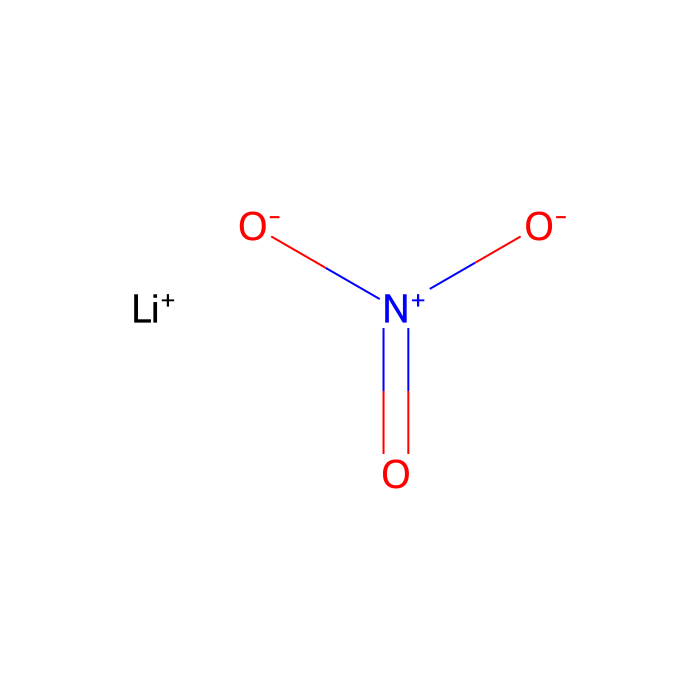
Functional groups: Inorganic salt composed of a monovalent lithium cation (Li+) and the planar trigonal nitrate anion (NO3−) bearing one N=O and two equivalent N–O− bonds in resonance.
2D structure (verbal): A discrete Li+ cation electrostatically associated with a trigonal planar nitrate anion; the N atom is centrally bound to three O atoms at ~120° each, with delocalized negative charge over the oxygens; no stereocenters present. The salt can form various hydrates, but the common laboratory material is anhydrous or low-hydrate solid depending on storage humidity (literature).
Synthetic Utility
Functional role (literature/general)
Oxidant/co-oxidant: Facilitates certain oxidative transformations (e.g., alcohol, sulfide, or aromatic oxidations) under catalytic systems, sometimes generating nitrosating/nitrating species.
Nitration component: In conjunction with strong acids or acylating agents, can generate electrophilic nitrating conditions for specific substrates, often with distinct selectivity compared to mixed-acid protocols.
Lithium source: Versatile precursor for introducing Li into inorganic solids via sol–gel, co-precipitation, and solid-state reactions; nitrate decomposes to volatile NOx, leaving Li in the lattice.
Salt metathesis: Effective in exchanging cations to prepare other nitrate salts or precipitating sparingly soluble lithium compounds (e.g., Li salts of multidentate anions).
Electrochemical additive: In ether-based electrolytes, LiNO3 is a common additive to tailor SEI formation on Li metal anodes (research on Li–S and related systems).
Retrosynthetic value
Selecting LiNO3 as the Li source enables lower-temperature decomposition relative to carbonates in some sol–gel routes, improving homogeneity of Li distribution.
Practical considerations
Control exotherms in nitration/oxidation protocols; add portionwise to cooled media.
For high-purity materials synthesis, pair with ultra pure solvents, use cleanware free of sodium/potassium to avoid cation cross-contamination, and verify anion removal by thermal treatment or washing as appropriate.
Target Specificity
Not applicable. This product is an inorganic salt reagent, not a biological targeting agent (e.g., antibody, ligand, or probe). No antigen/epitope specificity, clone, or isotype information is relevant.
Products are supplied to verified businesses, institutions, and qualified professionals for research and development use only. Not for use in humans, animals, diagnosis, or therapy.