
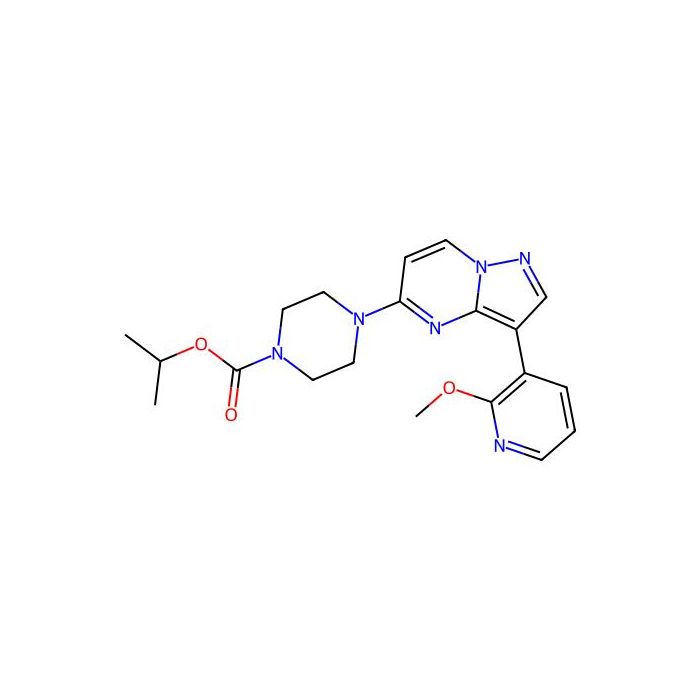
Determine the necessary mass, volume, or concentration for preparing a solution.
| Activity Type | Activity Value -log(M) | Mechanism of Action | Activity Reference | Publications (PubMed IDs) |
|---|
LP-935509 is an orally active, potent, selective, ATP-competitive and brain-penetrant inhibitor of adaptor protein-2 associated kinase 1 (AAK1) with an IC 50 of 3.3 nM and a K i of 0.9 nM, respectively. LP-935509 is also a potent inhibitor of BIKE ( IC 50 =14 nM) and a modest inhibitor of GAK ( IC 50 =320 nM). LP-935509 shows antinociceptive activity. LP-935509 can be used for neuropathic pain and SARS-CoV-2 research
In Vitro
LP-935509 inhibits μ2 phosphorylation with an IC 50 value of 2.8 ± 0.4 nM, inhibits phosphorylation of a peptide derived from the μ2 protein with an IC 50 value of 3.3 ± 0.7 nM. LP-935509 exhibits a dose-dependent inhibition of the SARS-CoV-2 S-RBD internalization into host cells. MCE has not independently confirmed the accuracy of these methods. They are for reference only.
In Vivo
LP-935509 (0-60 mg/kg; PO, single) causes a robust reduction in pain behavior . LP-935509 (0.1-30 mg/kg; PO, single dosage) causes a dose-dependent reversal of thermal hyperalgesia in CCI model . LP-935509 (IV (1 mg/kg) or orally (10 mg/kg); once) has 100% oral bioavailability and a plasma half life of 3.6 hours . MCE has not independently confirmed the accuracy of these methods. They are for reference only. Animal Model: Male C57BL/6J mice (with SNL(spinal nerve ligation) injury, n=8-10 male mice per group) Dosage: 0, 10, 30 and 60 mg/kg (10 ml/kg) Administration: PO, single Result: Caused a dose-dependent reduction in phase II paw flinches that was significantly lower than the vehicle-treated animals; exhibited a dose-dependent reversal of the mechanical allodynia; Caused a robust reduction in pain behavior. Animal Model: Male Sprague-Dawley rats (CCI (chronic constriction injury)-operated rats) Dosage: 0, 0.1, 0.3, 1, 3, 10, or 30 mg/kg Administration: PO, two daily, for 5 days Result: Caused a dose-dependent reversal of thermal hyperalgesia, cold allodynia, mechanical allodynia, and mechanical hyperalgesia in CCI animals. Reversed the behavioral deficits, with ED 50 values ranging from 2 mg/kg to 10 mg/kg. Animal Model: Male Sprague-Dawley rats Dosage: 1 mg/kg (IV), 10 mg/kg (PO) Administration: IV, PO; once (Pharmacokinetic Analysis) Result: Had 100% oral bioavailability and a plasma half life of 3.6 hours; The Cmax for the 10 mg/kg oral dose was 5.2 µM at 0.5-hour postdose; had a plasma-free fraction of 2.6% in mice. Brain drug levels exceeded plasma drug levels with a brain/plasma drug ratio typically between 3 and 4, showing that LP-935509 was highly brain-penetrant.
Form:Solid
IC50& Target:IC50: 3.3 ± 0.7 nM (AAK1), 14 nM (BIKE), 320 ± 40 nM (GAK)
Taxonomy Tree
| Kingdom | Organic compounds |
|---|---|
| Superclass | Organoheterocyclic compounds |
| 분류 | Diazinanes |
| Subclass | Piperazines |
| Intermediate Tree Nodes | Not available |
| Direct Parent | N-arylpiperazines |
| Alternative Parents | Pyrazolylpyridines Pyrazolo[1,5-a]pyrimidines Piperazine carboxylic acids Dialkylarylamines Aminopyrimidines and derivatives Alkyl aryl ethers Imidolactams Pyrazoles Heteroaromatic compounds Carbamate esters Azacyclic compounds Organic oxides Hydrocarbon derivatives Carbonyl compounds |
| Molecular Framework | Aromatic heteropolycyclic compounds |
| Substituents | N-arylpiperazine - 3-pyrazolylpyridine - Pyrazolo[1,5-a]pyrimidine - Piperazine-1-carboxylic acid - Pyrazolopyrimidine - Dialkylarylamine - Alkyl aryl ether - Aminopyrimidine - Imidolactam - Pyrimidine - Pyridine - Azole - Heteroaromatic compound - Pyrazole - Carbamic acid ester - Ether - Azacycle - Organooxygen compound - Organonitrogen compound - Organic nitrogen compound - Carbonyl group - Organic oxide - Organic oxygen compound - Hydrocarbon derivative - Amine - Aromatic heteropolycyclic compound |
| 설명 | This compound belongs to the class of organic compounds known as n-arylpiperazines. These are organic compounds containing a piperazine ring where the nitrogen ring atom carries an aryl group. |
| External Descriptors | Not available |
| Activity Type | Activity Value -log(M) | Mechanism of Action | Activity Reference | Publications (PubMed IDs) |
|---|
| 용해성 | DMSO : 50 mg/mL (126.12 mM; Need ultrasonic) |
|---|---|
| 분자량 | 396.4 |
| XLogP3 | 2.100 |
| Hydrogen Bond Donor Count | 0 |
| Hydrogen Bond Acceptor Count | 7 |
| Rotatable Bond Count | 5 |
| Exact Mass | 396.191 Da |
| Monoisotopic Mass | 396.191 Da |
| Topological Polar Surface Area | 85.100 Ų |
| Heavy Atom Count | 29 |
| Formal Charge | 0 |
| Complexity | 556.000 |
| Isotope Atom Count | 0 |
| Defined Atom Stereocenter Count | 0 |
| Undefined Atom Stereocenter Count | 0 |
| Defined Bond Stereocenter Count | 0 |
| Undefined Bond Stereocenter Count | 0 |
| The total count of all stereochemical bonds | 0 |
| Covalently-Bonded Unit Count | 1 |
No vendor-tested application protocols are provided for this item.
General protocol templates (research use only):
Documentation:
Item-specific recommendations (dilutions, positive controls, validated applications): Not specified for this item; refer to CoA/Spec Sheet or develop internally.
Item-specific biological targets, modes of action, and pathways are not provided in the Product Data. Accordingly, no claims are made regarding LP-935509’s biological role.
General context for small-molecule research tools:
Best practices:
Research Use Note: For research use only; not for human or veterinary use. For any biological conclusions, derive and document evidence with your own validated assays; no target specificity is provided here.
This product is a research small molecule, not a buffering reagent. Therefore, classical buffer-system guidance (pKa, buffering range, recipe) is not applicable.
Practical notes (assay buffer interface):
Item-specific buffer-related properties (pKa, solubility limits, stability): Not specified for this item; refer to CoA/Spec Sheet or determine empirically.
Greener handling considerations focus on solvents and workup since the compound structure and hazards are not specified.
Solvent choices (greener options; general guidance):
Illustrative comparison (general):
Operational tips to reduce environmental footprint:
Caveat: Choose greener options only after confirming compound stability and assay performance; item-specific stability/solubility are not provided and must be established experimentally.
No pharmacopeial status or formulation role is provided for this item. LP-935509 is supplied strictly for research use; no clinical or therapeutic applications are claimed or supported.
General considerations for discovery-stage compounds (nonclinical, research-only):
Compliance note:
Item-specific physicochemical specifications are not provided in the Product Data. Do not assume values for analytical method development; verify via CoA/Spec Sheet.
Practical notes (general, literature-based best practices for small-molecule tools):
Always confirm item-specific physical data with the lot-specific CoA before critical experiments.
What “library compound” typically implies (general guidance):
Recommendations for incoming QC (user side):
Note: In absence of a stated grade, treat the material as a research reagent requiring verification prior to regulated or GLP workflows.
Research applications (general for bioactive small molecules):
Methodological tips:
Synthetic chemistry context:
Note: No manufacturer application notes are provided for this item. All uses are for research only; no diagnostic or therapeutic use.
No item-specific chemical reaction conditions are applicable without the known structure. However, for common research uses (stock preparation and assay introduction), the following general, literature-based practices apply:
Stock solution preparation (typical):
Aqueous assay dilution:
Stability checks:
Note: For true synthetic reaction conditions (e.g., coupling, cycloadditions), obtain the confirmed structure and consult primary literature. None are specified for this item.
Safety data fields are not populated in the Product Data. Treat as a laboratory research chemical with unknown hazards; apply conservative controls and consult the SDS for authoritative guidance.
Item-specific data from Product Data:
General laboratory precautions (good practice):
Research Use Note: For research use only.
Given the lack of item-specific solubility data, select solvents using standard practices for heteroatom-containing drug-like small molecules.
Primary choices (general guidance):
Aqueous systems:
Small comparison (general characteristics):
Tips:
Item-specific solubility: Not specified for this item; refer to CoA/Spec Sheet.
Item-specific conditions from Product Data:
General best practices for research small molecules:
Research Use Note: For research use only. Consult CoA and SDS for any additional, lot-specific storage and handling instructions.
Brief overview: LP-935509 is supplied as a research-use small-molecule library member. Item-specific structural identifiers are largely not disclosed in the Product Data.
Structural features (general guidance):
2D structure description (general):
Item-specific functional groups and reactivity are not provided; therefore, no definitive synthetic transformations can be recommended for LP-935509.
General guidance if using this compound as a lead for analog synthesis:
Analytical support:
Caveat: All synthetic utility depends on the actual structure of LP-935509, which is not provided here. Do not infer reactivity without verified structural information.
No target, pathway, or binding specificity is provided in the Product Data for LP-935509. Accordingly, no claims are made regarding biochemical targets or selectivity profiles.
If target annotation is required for your research:
Item-specific target data: Not specified for this item; refer to CoA/Spec Sheet or your own validation.