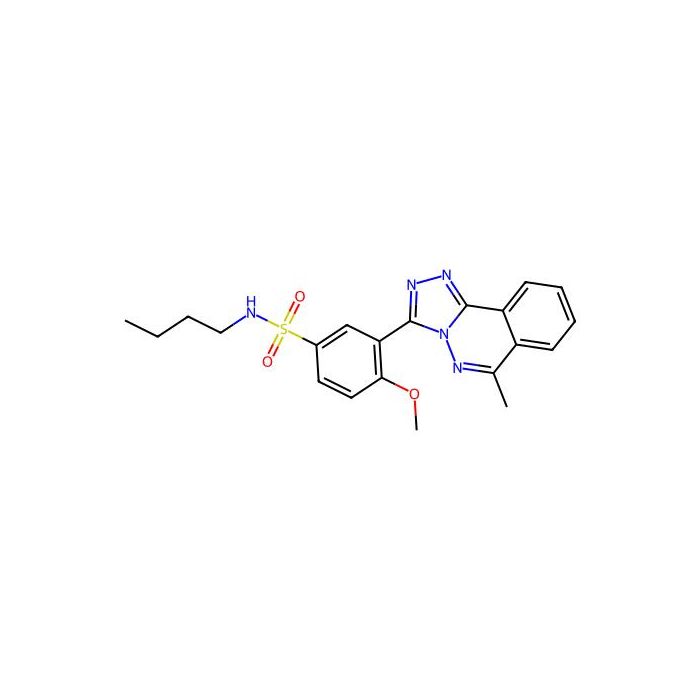
≥98% for sensitive chromatographic and analytical workflows requiring minimal baseline interference.
🌡
Storage & shipping
Store at -20°C Ships Ice chest + Ice pads Check lot-specific COA for exact specifications.
📋
Quality documents
SDS, COA, datasheet, and spec sheet available for download. Lot-specific COA accessible via lot number lookup.
📚
Literature proof
Cited in 0 peer-reviewed publications across chromatography, organic synthesis, and cross-coupling reactions.
개요
Lu AE98134, an activator of voltage-gated sodium channels , acts as a partly selective Na v 1.1 channels positive modulator. Lu AE98134 also increases the activity of Na v 1.2 and Na v 1.5 channels but not of Na v 1.4, Na v 1.6 and Na v 1.7 channels. Lu AE98134 can be used to analyze pathophysiological functions of the Na v 1.1 channel in various central nervous system diseases, including cognitive restoring in schizophrenia, et al.
In Vitro
Lu AE98134 (30 μM) promotes the current mediated by Nav v 1.1 channel, and it activates Na v 1.5 and to a lesser extent Na v 1.2 but has no effect on Na v 1.4, Na v 1.6 and Na v 1.7 currents in HEK cells expressing Na v 1.1, Na v 1.2, Na v 1.6, Na v 1.5, and Na v 1.7 by step-wise depolarizing voltages using the whole-cell patchclamp configuration. Lu AE98134 (30 μM) increases the excitability of FSINs by decreasing the threshold for action potentials.Intracellular depolarizing current pulses evokes repetitive firing of action potentials at frequencies, additionally, Lu AE98134 increases the excitability since each current pulse generated a higher number of spikes (163 spikes in control; and 230 spikes in Lu AE98134). MCE has not independently confirmed the accuracy of these methods. They are for reference only.
In Vivo
The fast spiking inhibitory interneurons (FSINs) from Dlx5/6 +/− animals exhibit abnormal excitability because of a more depolarized spike threshold and broader action potentials. Lu AE98134 (30 μM) increases the excitability of FSINs neurons from normal and Dlx5/6 +/− animals by modulating several parameters characteristic for NaV 1.1 channels. The selective activation of FSINs by Lu AE98134 restores cognitive flexibility in adult Dlx5/6 +/− mice . MCE has not independently confirmed the accuracy of these methods. They are for reference only.
Form:Solid
Specifications
사양 및 순도
≥98%
생화학 및 생리적 메커니즘
Lu AE98134, an activator of voltage-gated sodium channels , acts as a partly selective Na v 1.1 channels positive modulator. Lu AE98134 also increases the activity of Na v 1.2 and Na v 1.5 channels but not of Na v 1.4, Na v 1.6 and Na v 1.7 channels. Lu A
This compound belongs to the class of organic compounds known as 1,2,4-triazolo[3,4-a]phthalazines. These are aromatic heteropolycyclic compounds containing a 1,2,4-triazole fused to and sharing a nitrogen atom with the diazine ring of a phthalazine moiety.
External Descriptors
Not available
1. Djoumbou Feunang Y, Eisner R, Knox C, Chepelev L, Hastings J, Owen G, Fahy E, Steinbeck C, Subramanian S, Bolton E, Greiner R, and Wishart DS. ClassyFire: Automated Chemical Classification With A Comprehensive, Computable Taxonomy. Journal of Cheminformatics, 2016, 8:61.
Determine the necessary mass, volume, or concentration for preparing a solution.
Dilution Calculator
Determine the dilution needed to prepare a stock solution.
Reconstitution Calculator
리뷰
고객 리뷰
Application Protocols
Item-specific (Product Data):
No validated application protocols are provided for this item.
General lab protocol guidance for small-molecule stocks (informative):
Stock preparation: Accurately weigh compound (allow vial to equilibrate to room temperature in a desiccator to prevent moisture condensation). Dissolve in anhydrous DMSO to a convenient concentration (e.g., 10 mM), vortex, and, if needed, sonicate briefly. Record exact concentration and solvent composition.
Aliquoting: Dispense into low-bind microtubes or plates (amber if light sensitive) to single-use aliquots. Avoid repeated freeze–thaw.
Working solutions: Dilute stocks into assay buffer with vigorous mixing to the desired final concentration, ensuring final DMSO content is controlled and consistent across wells.
QC check: Verify concentration by UV (if extinction coefficient is known) or LC–MS quantitative methods. Inspect visually for precipitation; if present, adjust solvent or concentration.
Documentation: Capture lot number, preparation date, operator, and storage location in ELN/LIMS.
Biological Roles
Item-specific (Product Data):
No biological target, pathway, or endogenous role is specified for this item. Classified for research use only.
General guidance (informative):
As a synthetic small molecule, Lu AE98134 is not expected to have an endogenous biological role. In research contexts, such compounds are typically evaluated for interactions with proteins, enzymes, receptors, transporters, or pathways of interest.
Prior to biological testing, establish compound integrity (LC–MS purity, absence of reactive impurities) and confirm concentration by an orthogonal method (e.g., UV with extinction coefficient or qNMR).
Be alert to nonspecific activities: aggregation-based inhibition, redox cycling, metal chelation, or membrane perturbation can confound results. Incorporate counterscreens and detergent controls where appropriate.
If literature targets for Lu AE98134 are identified in your program, document species differences, plasma protein binding, and potential off-target panels before interpreting phenotypic outcomes.
Buffer Applications
Applicability:
Lu AE98134 is not a buffering reagent. No buffer system specifications are provided for this item.
Practical notes for assay buffers (informative):
When formulating assay media containing small-molecule stocks (often in DMSO), maintain final DMSO ≤0.5–1.0% v/v to limit cosolvent effects on proteins/cells.
Use well-characterized buffers (HEPES, PBS, Tris) at appropriate pH and ionic strength for your biological system. Validate compound solubility in the chosen buffer, with or without co-solvent.
For pH-sensitive compounds (unknown here), pre-dissolve in DMSO or ACN and add slowly to vigorously stirred buffer to avoid local supersaturation and precipitation.
Filter-sterilize final assay solutions when needed and verify recovery by analytical measurement to check for adsorption losses.
Green Alternatives
Context:
As a discrete small molecule supplied for research screening, Lu AE98134 itself is not a process solvent or bulk reagent. “Green alternatives” considerations mainly pertain to how it is handled and formulated in the lab, not replacement of the compound itself.
Greener handling strategies (informative):
Prefer aqueous-compatible co-solvent systems (e.g., minimal DMSO with phosphate-buffered saline) for assays to reduce organic solvent usage.
For purification/analytics, consider ethanol or isopropanol in place of acetonitrile or dichloromethane where compatible, and use water-rich LC gradients to minimize solvent waste.
Implement microscale experimentation and high-throughput miniaturization to reduce material and solvent consumption.
Employ closed-cap, low-dead-volume vials and 96/384-well plates to limit evaporative loss and VOC emissions.
Waste minimization:
Segregate halogenated vs non-halogenated waste streams; prefer non-halogenated systems when possible. Use solvent recycling for ACN/MeOH if available.
Tradeoffs:
Lower-toxicity solvents may alter solubility or assay performance; validate recovery and potency after any solvent change.
Pharmaceutical Uses
Item-specific (Product Data):
No excipient role, pharmacopeial status, or manufacturing use is specified. The product is labeled for research use only.
General context (informative; no therapeutic claims):
Small molecules like Lu AE98134, when used in pharmaceutical research, are typically evaluated in discovery and preformulation studies to understand solubility, stability, and compatibility with excipients. Any use beyond laboratory research would require comprehensive quality, safety, and regulatory evaluation not covered here.
If formulating for in vivo research, standard practices include salt selection, pH adjustment, and co-solvent/surfactant systems (e.g., Captisol, PEG400, Tween-80) while adhering to institutional guidelines. Such activities are outside the scope of this catalog listing.
Physical Properties
Item-specific (Product Data):
Appearance: Not specified for this item; refer to CoA/Spec Sheet.
Storage conditions: Store at -20°C (provided).
Literature/computed values:
Boiling point, melting point, density, refractive index, logP, pKa, and solubility are not provided in the Product Data. Without a confirmed structure, reliable literature values cannot be cited. Consult the CoA or primary references for Lu AE98134 for definitive physico-chemical parameters.
General guidance for small-molecule library members (informative):
Many discovery compounds are supplied as off-white to light-colored solids or as DMSO solutions. If supplied as a solid, a common approach is to prepare concentrated DMSO stocks (e.g., 10–50 mM) to support screening; verify actual solubility first.
Hygroscopicity and polymorphism can affect apparent melting behavior; measure under dry nitrogen if characterization is required.
If aqueous work is anticipated, establish pH–solubility and co-solvent dependence (DMSO, EtOH, MeCN) empirically by small-scale titration.
Quality and Grades
Item-specific (Product Data):
Grade/Purity: Not specified for this item; refer to CoA/Spec Sheet.
Guidance on interpreting grades (informative):
Discovery/screening compounds are commonly provided with a chromatographic purity (e.g., HPLC/UPLC area %) and structural confirmation (NMR/MS). If available, review the lot-specific impurity profile, residual solvents, and water content.
For bioassay work, low residual metals and defined counter-ions/salt forms reduce variability; confirm the exact form (free base vs. salt, solvate/hydrate) on the CoA.
UV transparency/absorbance may matter for optical assays (kinetics/HTS); if you plan UV-based quantitation, check the impurity cutoff or perform a baseline scan.
What to request from QA for this item:
Current CoA with purity method and conditions, salt form, residual solvent profile, and water content (if measured).
Batch-specific NMR and HRMS, and a reference spectrum for cross-checking material identity on receipt.
Reaction and Applications
Item-specific (Product Data):
Manufacturer applications: Not specified for this item beyond inclusion in a small-molecule/compound library. No synthetic or catalytic role is stated.
Applicability (informative):
Lu AE98134 is positioned as a research compound for screening and in vitro investigations rather than as a general-purpose reagent or solvent. As such, it is typically applied in target-binding/phenotypic assays, physicochemical characterization, and ADME profiling in research settings.
Practical considerations for research use:
Prepare accurately quantified stock solutions (gravimetric or qNMR) to support potency determinations.
Evaluate stability in assay media (pH 6.5–7.5), serum-containing systems, and under light exposure using LC–MS. Create freeze–thaw aliquots to prevent concentration drift.
For mechanistic studies, complementary orthogonal assays (biochemical vs. biophysical) help confirm on-target effects and detect assay interference (fluorescence quenching, redox activity, aggregation). Use appropriate controls (detergent challenge, redox counterscreens, and PAINS screening) to rule out artifacts.
Reaction Conditions
Applicability:
No synthetic or catalytic role is specified for Lu AE98134 in the Product Data; therefore, standard reaction conditions are not applicable.
Informative notes:
If used as a substrate or ligand in exploratory chemistry, conditions must be developed de novo based on its actual functional groups and stability profile (consult structure/CoA). Begin with small-scale screens, inert atmosphere if oxidation-sensitive, and mild temperatures to avoid decomposition.
For any derivatization or stability studies, employ analytical monitoring (LC–MS, HPLC-UV) and include controls for solvent, light, and pH stress.
Safety and Handling
Item-specific (Product Data):
GHS classification, signal word, H-statements, and pictograms: Not specified for this item; refer to SDS.
Storage: Store at -20°C. Shipped on ice packs in an insulated container.
General laboratory safety for small organic molecules (informative; defer to SDS):
PPE: Use lab coat, safety glasses, and appropriate chemical-resistant gloves (e.g., nitrile). Handle powders in a fume hood to avoid inhalation of dust/aerosols.
Avoid ingestion, inhalation, and skin/eye contact. Wash thoroughly after handling. Prevent environmental release; collect waste in labeled organic waste streams.
Incompatibilities: Until specific functional groups are known, segregate from strong oxidizers and strong acids/bases. Avoid prolonged exposure to heat, light, and moisture.
First aid (overview): If inhaled—move to fresh air; if on skin—wash with soap/water; if in eyes—rinse cautiously with water for several minutes; if ingested—rinse mouth and seek medical advice. Provide the SDS to medical personnel.
Thermal hazards: Do not heat in sealed containers. If compound is moisture/air sensitive (check CoA), handle under inert atmosphere.
Always consult the official SDS for Lu AE98134 for authoritative hazard classification and response measures.
Solvent Selection
Item-specific (Product Data):
No solubility profile is provided. Storage at -20°C suggests stability as a dry solid or concentrated solution; verify form on receipt.
General solvent strategy for small-molecule library compounds (informative):
Primary stock solvent: DMSO is typically preferred due to broad solvency, chemical stability, and assay compatibility at ≤1% v/v in most biochemical/cell assays.
Secondary solvents for prep/analytics: Acetonitrile and methanol for LC, and ethanol or isopropanol for biochemical handling. For water-insoluble materials, co-solvent blends (DMSO/H2O, EtOH/H2O) or inclusion of surfactants (0.01–0.05% Tween-20) may aid dispensing—validate for your assay.
pH-assisted dissolution: If an ionizable group is present (unknown here), mild acid (e.g., 0.1% formic acid) or base (ammonia/triethylamine) in aqueous-organic mixtures can improve solubility; verify stability.
Practical tips:
Warm gently (room temp to 37°C) and vortex/sonicate to aid dissolution; avoid prolonged heating.
Filter 0.22 µm if particulate persists and the compound is not adsorptive; check for loss to filters by analytical recovery.
Record exact solvent lot and composition in ELN to ensure inter-assay reproducibility.
Storage and Reconstitution
Item-specific (Product Data):
Storage: Store at -20°C.
Shipping: Shipped in an ice chest with ice pads.
Reconstitution guidance (informative):
Allow the container to warm to room temperature in a desiccator before opening to prevent moisture ingress/condensation.
If supplied as a solid: Reconstitute in dry, oxygen-free DMSO (or another validated solvent) to prepare a concentrated stock (e.g., 10–50 mM, subject to solubility). Mix thoroughly; brief sonication may help. If supplied as a solution, verify concentration on arrival and aliquot immediately.
Aliquoting and storage: Prepare single-use aliquots in tightly sealed, inert-atmosphere vials or low-bind tubes. Store aliquots at -20°C or colder. Minimize freeze–thaw cycles; use within a defined retest period determined by your internal stability study.
Stability monitoring: Periodically check integrity by LC–MS/HPLC and appearance. Protect from light if chromophores are suspected; use amber vials.
Notes:
Exact solubility, hygroscopicity, and light/air sensitivity are not specified for this item; refer to the CoA/SDS and establish laboratory-specific handling SOPs accordingly.
For research use only, not for human or veterinary use.
Structure and Identity
Item-specific (Product Data):
Product name: Lu AE98134 (SKU: L651934)
CAS: 849000-18-6
CID: 2044236
InChIKey: 183442 (as provided)
Molecular formula: Not specified for this item; refer to CoA/Spec Sheet.
Molecular weight: Not specified for this item; refer to CoA/Spec Sheet.
SMILES: Not specified for this item; refer to CoA/Spec Sheet.
Literature/general notes:
Lu AE-prefix compounds are typically small-molecule research ligands developed in discovery programs; exact structure and functional groups for Lu AE98134 should be confirmed from primary references or the certificate of analysis.
Without a confirmed structure, detailed description of ring systems, functional groups, and stereochemistry cannot be provided here.
Practical implication:
For unambiguous identification in your laboratory systems, cross-reference CAS (849000-18-6) and lot-specific CoA/SDS. Assign internal barcodes that map to both identifiers to avoid mislabeling during screening workflows.
Synthetic Utility
Applicability:
Lu AE98134 is sold as a final research compound rather than as a synthetic building block or reagent; no functional-group specification is provided.
General considerations (informative):
Without confirmed structure, specific transformations or named-reaction utility cannot be detailed. If you intend to derivatize or immobilize Lu AE98134, consult the structural data on the CoA to identify modifiable handles (e.g., aryl halides, amines, alcohols) and assess stability domains.
For analytical method development: establish LC–MS-compatible methods (acidic or basic modifiers) and, if chromophores are present, UV detection wavelengths after recording a full-spectrum scan.
If isotope labeling or biotinylation is planned for probe development, map potential conjugation sites relative to putative pharmacophores to preserve activity; SAR or docking data (if available in your program) can guide tether placement.
Target Specificity
Item-specific (Product Data):
No biological target, selectivity profile, or binding data are provided for Lu AE98134.
Guidance (informative):
If your work involves target specificity assessments, use a tiered approach: primary potency assay, orthogonal confirmation, selectivity panel against close homologs, and broader safety-panel profiling where relevant. Report assay format, conditions, and reference standards to ensure comparability between studies.
Products are supplied to verified businesses, institutions, and qualified professionals for research and development use only. Not for use in humans, animals, diagnosis, or therapy.