Determine the necessary mass, volume, or concentration for preparing a solution.
BioReagent, sterile BioReagent,불임 for sensitive chromatographic and analytical workflows requiring minimal baseline interference.
Store at 2-8°C,Protected from light Ships Wet ice Check lot-specific COA for exact specifications.
SDS, COA, datasheet, and spec sheet available for download. Lot-specific COA accessible via lot number lookup.
Cited in 0 peer-reviewed publications across chromatography, organic synthesis, and cross-coupling reactions.
Product Introduction
Malachite Green Phosphate Assay Kit is a rapid, convenient and highly sensitive kit for determining soluble free inorganic phosphate in solutions. It can be used for the quantification of phosphate concentration in various solutions.
The detection principle is based on the reaction that malachite green, molybate and free inorganic orthophosphate form a green molybdophosphoric acid complex. The absorbance of this green complex at the wavelength of 620–640 nm is directly proportional to the concentration of free inorganic phosphate in the solution.
This kit provides a reliable method for the high-sensitivity quantitative detection of free inorganic phosphate. However, it is only suitable for the direct determination of free phosphate in solutions. For phosphate bound to lipids or proteins, the phosphate must be released by appropriate methods prior to the assay.
Product Components
1.Preparation of Phosphate Standard Solution
Dilute the 5 mM phosphate standard solution to prepare a 50 μM phosphate working solution. For example, take 10 μl of the 5 mM phosphate standard solution and add 990 μl of standard diluent to obtain 1 ml of 50 μM phosphate working solution. Deionized water or double-distilled water is preferred as the standard diluent. The diluted working solution can be stable for at least one day at 4 ºC. If self-prepared reagents are used to dilute the standard solution, ensure that the reagents are free of phosphate contamination.
2.Preparation of Chromogenic Reagent
Calculate the required volume of chromogenic reagent based on the number of samples. The ratio of Malachite Green Reagent A to Malachite Green Reagent B for use is 36:17. The chromogenic reagent can be stored at 4 ºC in the dark and remains stable for one day.
Setup of Standard Curve
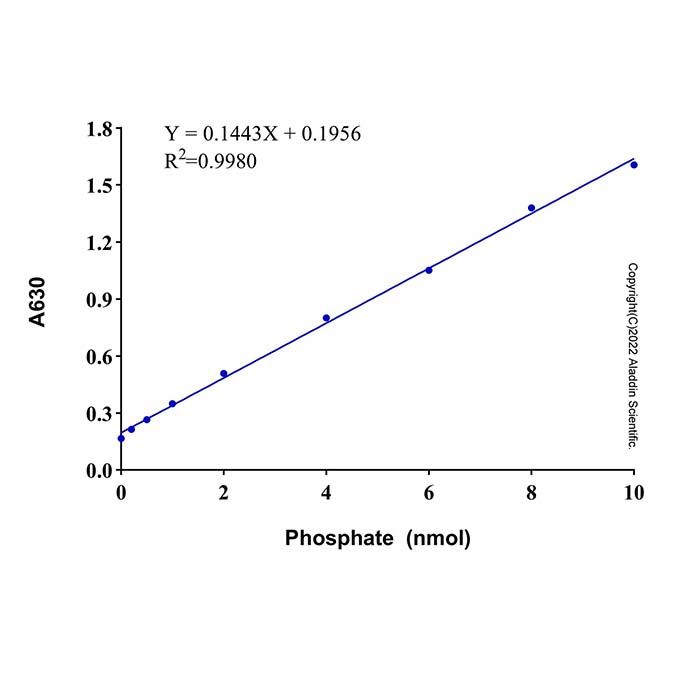
3.Prepare phosphate standard solutions at concentrations of 0, 1, 2.5, 5, 10, 20, 30, 40 and 50 μM according to the table below.
| NO | 50μM Phosphate(μl) | H₂O(μl) | Phosphate(μM) | Phosphate(nmol/200μl) |
| 1 | 0 | 200 | 0 | 0 |
| 2 | 4 | 196 | 1 | 0.2 |
| 3 | 10 | 190 | 2.5 | 0.5 |
| 4 | 20 | 180 | 5 | 1 |
| 5 | 40 | 160 | 10 | 2 |
| 6 | 80 | 120 | 20 | 4 |
| 7 | 120 | 80 | 30 | 6 |
| 8 | 160 | 40 | 40 | 8 |
| 9 | 200 | 0 | 50 | 10 |
4. Determination of Phosphate Concentration
a. Add an appropriate volume of the sample to be tested into a 1.5 ml centrifuge tube. If the sample volume is less than 200 μL, make up the volume to 200 μL with standard diluent and record the dilution factor of the sample at this time.
b. Pipette 200 μL of phosphate standard solutions with different concentrations and samples to be tested from each tube in sequence into the sample wells of a 96-well plate.
c. Add 50 μL of chromogenic reagent to each well, mix thoroughly using a multi-well plate shaker or gently by pipetting up and down, and incubate at 37 ºC for 30 minutes.
d. Measure the absorbance at 630 nm using a microplate reader.
e. Calculate the phosphate concentration of the sample based on the standard curve and the dilution factor of the sample to be tested.
Notes
1.The chromogenic reagent must be prepared and used immediately. It can be stored at 4 ºC for one day after preparation. The reagent must be equilibrated to room temperature before use.
2.The detection wavelength of this experiment ranges from 620 to 660 nm, with 630 nm being optimal. If a microplate reader is not available, a spectrophotometer can be used instead. In this case, adjust the volumes of the chromogenic reagent, samples and standard solutions proportionally to ensure the final volume to be tested meets the minimum detection volume of the cuvette.
3.The sample volumes described in this instruction manual are based on a 96-well plate. If cuvettes or 384-well plates are used, the volumes should be adjusted proportionally.
4.Laboratory detergents contain high concentrations of phosphate. Ensure that the experimental utensils are thoroughly cleaned to prevent phosphate contamination.
5.For better detection results, it is recommended to set up duplicate or triplicate wells for all phosphate standard solutions and samples to be tested.
6.If the measured absorbance is low, it may be due to the low phosphate content in the sample. Consider increasing the sample dosage within the allowable range of this kit.
7.Malachite Green Reagent A is strongly acidic and corrosive. Handle it with care during operation, ensure effective protection to avoid direct contact with the human body, and take care to prevent corrosion of other items.
8.This product is intended for scientific research use by professionals only. It is not for clinical diagnosis or treatment, nor for use in food or pharmaceuticals, and should not be stored in ordinary residential premises.
9.For your safety and health, wear a lab coat and disposable gloves during operation.
| P1506503 | Components | 500T | 1000T | 2500T | Storage |
| P1506503A | Malachite Green Reagent A | 20 mL | 40 mL | 100 mL | 2-8℃ |
| P1506503B | Malachite Green Reagent B | 10 mL | 20 mL | 50 mL | 2-8℃ |
| P1506503C | 5mM Phosphate Standard | 0.5 mL | 1 mL | 2.5 mL | 2-8℃ |
Comprehensive hazard, handling, storage, and regulatory compliance document.
Download SDS →Lot-specific quality data. Enter your lot number to retrieve the exact COA.
Look up COA →Full quality attributes and acceptance criteria for this grade.
View spec sheet →Find and download the COA for your product by matching the lot number on the packaging.
| Lot Number | Certificate Type | 날짜 | 항목 |
|---|---|---|---|
| Certificate of Analysis | Sep 28, 2026 | P1506503 | |
| Certificate of Analysis | Sep 28, 2026 | P1506503 | |
| Certificate of Analysis | Sep 28, 2026 | P1506503 | |
| Certificate of Analysis | Apr 14, 2026 | P1506503 |
The following is a general microplate protocol for malachite green phosphate detection (literature guidance). For item-specific steps, refer to the product insert/CoA.
Quality controls:
Note: Volumes/times may be adjusted to match the kit’s instructions if provided.
This section describes the biological context of the analyte detected by the kit—orthophosphate (Pi)—not the kit reagents themselves (literature, general knowledge).
Implications for assay design:
This product is not a buffer. However, buffer choice is critical for accurate phosphate detection. The following guidance is general (literature) and can improve performance:
Practical recipes (general example):
While colorimetric malachite green assays are widely adopted for Pi detection, users seeking greener or less hazardous approaches may consider the following (literature, general comparison):
Tradeoffs:
Sustainability tips with this kit:
This product is not intended for clinical or therapeutic use. No pharmacopeial monograph applies to the kit as a whole.
Relevant non-clinical, research/manufacturing contexts (general):
Regulatory note:
Item-specific physicochemical specifications (e.g., concentration, pH, absorptivity) are not provided in the Product Data.
Assay readout properties (literature, general for malachite green Pi assays):
Solubility/compatibility (literature, general):
Item-specific notes:
Best practices to preserve quality:
This kit quantifies inorganic phosphate (Pi) released or consumed in biochemical reactions via malachite green–molybdate complexation (literature, general principle). Applications include:
Assay chemistry (literature overview):
Practical tips (general):
The following conditions reflect general, literature-based guidance for malachite green phosphate assays and are not item-specific specifications.
Always consult the product’s IFU/CoA for any item-specific instructions.
Authoritative safety information must be taken from the SDS for this product. The Product Data do not list specific hazards or GHS classifications for the kit reagents.
General laboratory safety considerations (literature, typical for malachite green phosphate reagents):
Always defer to the product-specific SDS and institutional EHS guidance.
This product is an aqueous colorimetric assay kit, not a solvent. Solvent selection pertains to the sample/buffer matrix used with the kit.
Buffer/solvent compatibility (literature, general guidance):
Comparison (general):
Reconstitution/preparation:
Handling and stability (general best practice):
This product is a colorimetric assay kit for quantifying inorganic phosphate (Pi) based on the malachite green–molybdate complex. It is not a single chemical substance with a unique molecular structure.
Structural/chemical features (literature, general for malachite green assays):
2D description (assay principle, literature):
Kit composition: Not specified for this item; refer to CoA/Spec Sheet. Typical components in such kits (literature) include malachite green reagent, molybdate/acid solution, and a phosphate standard.
This item is an analytical/biochemical detection kit and is not a building block or reagent used to drive chemical transformations. Therefore, it has no direct synthetic utility.
Relevant analytical utility for synthetic workflows (literature, general):
Methodological considerations:
For classical chemical synthesis planning, refer to other tabs focusing on solvents/reagents; this kit functions strictly as a quantitative analytical readout for orthophosphate.
Not applicable. This is a colorimetric assay kit for inorganic phosphate detection and is not an antibody or affinity reagent. No antigen/epitope/clone/isotype information applies.
Our grade selection guide covers purity, stabilizer status, and application suitability for all variants in our catalog.
View BioReagent grade guide → View Sterile grade guide →