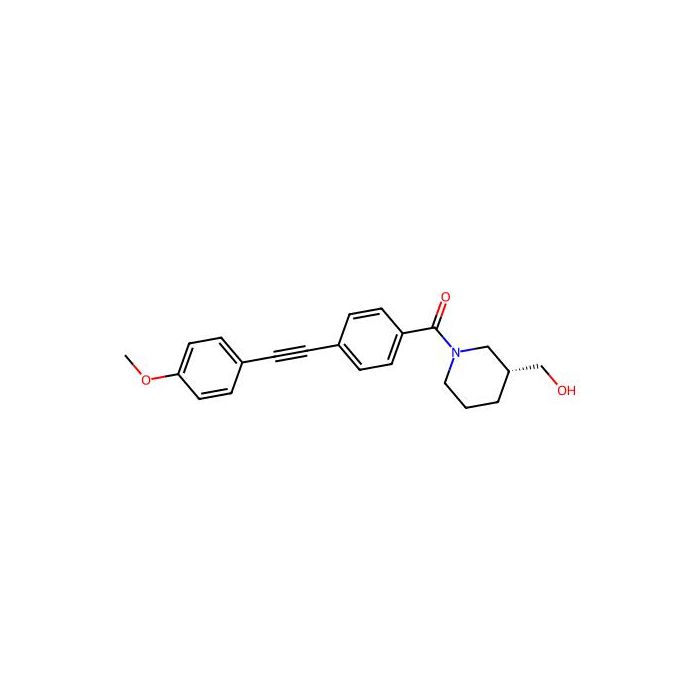
등급 & 순도Moligand™?Moligand™ — Aladdin's line of ligands and bioactive small molecules. Use for receptor, pathway, and binding studies needing defined small-molecule tools.10 mM in DMSO
ML289 (VU0463597) is a potent, selective, and CNS-penetrant mGlu3 ( IC 50 =0.66 μM) negative allosteric modulator. ML289 displays >15-fold selectivity over mGlu2 and is inactive against mGlu5. ML289 is a click chemistry reagent, it contains an Alkyne group and can undergo copper-catalyzed azide-alkyne cycloaddition (CuAAc) with molecules containing Azide groups.
Determine the necessary mass, volume, or concentration for preparing a solution.
Dilution Calculator
Determine the dilution needed to prepare a stock solution.
Reconstitution Calculator
리뷰
고객 리뷰
Application Protocols
No vendor-validated protocols are provided for ML289 in this listing.
General workflow (for small-molecule screening compounds):
Stock solution: Prepare 10 mM in dry DMSO (or the highest fully dissolved concentration). Aliquot to low-bind tubes and store at −80 °C.
Dose–response: Create serial dilutions (1:3 or 1:2) in assay buffer with constant vehicle percentage. Run in technical triplicates at minimum.
Assay controls: Include vehicle control, positive control (if available), and a non-specific control compound to assess assay interference.
Readout validation: Confirm that signal is not affected by compound autofluorescence/absorbance or quenching (test at top dose in the readout channel).
Data analysis: Fit to a four-parameter logistic model with constraints appropriate to the assay window; report IC50/EC50 with 95% CI and note the final vehicle percentage.
These steps are general good practices and not specific to ML289. For any target-directed protocol, consult field-specific methods and your institutional SOPs.
Biological Roles
No endogenous biological role is assigned to ML289; it is a synthetic small molecule intended solely for research use as a tool/ligand.
Mode of action/target: Not specified for this item; consult literature or internal screening data before assigning a mechanism.
Pathways and phenotypes: Not specified; any proposed pathway engagement should be verified under your assay conditions with appropriate controls and orthogonal readouts.
General considerations for small-molecule tool compounds:
Off-target effects can confound interpretation, especially at higher concentrations (>10× reported potency). Include counter-screens where possible.
Vehicle effects: Maintain constant DMSO (or other vehicle) across all wells/conditions to avoid artifactual responses.
Chemical stability and metabolism in cell-based assays may alter apparent potency; assess time-dependence of response and consider microsomal stability for longer incubations (literature/general).
Research use only: ML289 is not intended for diagnostic, therapeutic, or any in vivo clinical application. Any biological activity assessments should be accompanied by full documentation of lot number, solvent composition, and dosing regimen to ensure reproducibility.
Buffer Applications
ML289 is not a buffering reagent and does not define a pH range. Accordingly, there are no canonical buffer recipes associated with this product.
Practical notes for assay buffers (general):
Choose a buffer that maintains target stability and activity (e.g., HEPES or PBS for many cell-based assays; Tris for many enzymatic assays), keeping ionic strength and pH consistent across controls.
Introduce ML289 from a concentrated organic stock (commonly DMSO) into the buffer with vigorous mixing to avoid local supersaturation.
Maintain constant vehicle concentration across all wells (often 0.1–0.5% v/v DMSO) and confirm absence of precipitation by visual inspection or light scattering.
Item-specific buffer interactions, pKa, or solubility limits are not provided in this listing; refer to CoA/Spec Sheet and perform small-scale compatibility tests under intended assay conditions.
Green Alternatives
Because ML289 is a discrete screening compound, “green alternatives” pertain mainly to solvent and handling choices rather than substitution of the molecule itself.
Greener handling strategies (general):
Prefer aqueous assay buffers with minimal DMSO (≤0.1–0.5% v/v) when compatible with solubility and target biology.
When preparing intermediate stocks for non-cellular assays, consider ethanol or isopropanol over amide solvents (DMF/NMP), provided solubility and stability are adequate.
Minimize solvent volumes via higher-concentration DMSO stocks (within solubility limits) and precise acoustic/liquid handling to reduce waste.
Comparison (general solvent perspective):
DMSO: high solvency; relatively benign vs DMF/NMP; not readily biodegradable—use sparingly.
Ethanol: renewable feedstock potential; lower solvency and volatility may limit use.
2-methyltetrahydrofuran (2-MeTHF): greener for synthesis workflows but rarely suitable as a biological vehicle; avoid in live-cell assays.
Operational choices:
Use low-adsorption polypropylene plates to reduce the need for re-dosing.
Implement sealed plates and small working volumes to limit evaporative losses and VOC emissions.
Item-specific greener substitute for ML289 itself is not applicable; performance depends on its unique structure and bioactivity, which are not specified here.
Pharmaceutical Uses
This product is provided strictly for research use and is not approved for therapeutic, diagnostic, or manufacturing uses in humans or animals.
Formulation-relevant considerations (general, for preclinical research):
Role: Tool compound or reference standard in discovery assays and profiling. Not specified as a pharmacopeial substance.
Excipients/vehicles: Not specified for this item. In exploratory studies, DMSO stocks are commonly diluted into aqueous media; for in vivo research (not covered by this listing), specialized formulation strategies would be required and are outside scope.
Regulatory status: No compendial monograph or GMP status is indicated. Grade is Moligand™ (screening/analytical research grade).
Do not incorporate ML289 into any clinical or diagnostic product streams. For any translational work, independently determine impurity profiles, stability-indicating methods, and fit-for-purpose specifications beyond what is provided for research-grade materials.
Physical Properties
Item-specific data provided in this listing are limited.
Appearance: Not specified for this item; refer to CoA/Spec Sheet.
Melting point (literature/general): Not available from this listing; check structure-specific databases if needed.
Boiling point (literature/general): Not available from this listing.
Density (literature/general): Not available from this listing.
Solubility: Not specified for this item; refer to CoA/Spec Sheet. For screening compounds, dimethyl sulfoxide (DMSO) is commonly used as the primary stock solvent (general practice).
LogP/logD, pKa, refractive index: Not specified for this item; refer to CoA/Spec Sheet.
Practical guidance (general, not item-specific):
If the compound is received as a solid, evaluate solubility first in anhydrous DMSO (1–10 mg/mL) with sonication and gentle warming (<40 °C). Avoid prolonged heating.
If provided in DMSO, maintain cold-chain and minimize freeze–thaw to prevent precipitation, degradation, or water uptake.
For aqueous working solutions, introduce DMSO stocks into buffer slowly with vortexing to limit local supersaturation; typical vehicle levels in biological assays are ≤0.1–0.5% v/v (literature/general). Always verify clarity and absence of precipitate before use.
Quality and Grades
Grade: Moligand™ (Aladdin). This designation indicates the material is intended as a small-molecule tool compound for screening and chemical biology applications.
What Moligand™ typically implies (general description; not item-specific specifications):
Emphasis on structural identity and purity suitable for biochemical/cell-based assays.
Identity commonly supported by orthogonal analyses (e.g., LC–MS, and/or NMR) and purity assessment by HPLC/UPLC. Exact methods/acceptance criteria are batch-dependent and reported on CoA.
Low non-volatile residue and controlled residual solvent levels are targeted for reliable assay performance; exact limits are batch-specific and provided on the CoA.
For this specific item (ML289):
Purity/assay value: Not specified for this item; refer to CoA/Spec Sheet.
Residual solvents, water content, stabilizers, and metal limits: Not specified for this item; refer to CoA/Spec Sheet.
UV cutoff/photochemical sensitivity: Not specified for this item; refer to CoA/Spec Sheet.
Best practices:
Use freshly thawed aliquots for quantitative assays (IC50/EC50 determination) to minimize artifacts from degradation or adsorption.
Document lot number in screening data to support reproducibility and later SAR interpretation.
Reaction and Applications
This product is positioned as a research ligand/tool compound rather than a synthetic reagent. Consequently, its primary applications are in discovery biology and assay development rather than in preparative organic reactions.
Typical research uses (general for screening ligands):
Probe compound in biochemical or cell-based assays to explore pathway responses, validate assay windows, and benchmark assay sensitivity.
Concentration–response characterization (e.g., 8–12 point curves) to derive potency metrics (IC50/EC50) under defined assay conditions.
Use as a reference in high-throughput screening (HTS) or high-content imaging to control for plate-to-plate variability.
Practical tips (general):
Confirm identity/purity by LC–MS before first use in critical assays.
Determine working concentration ranges empirically, spanning at least 0.1–100× the expected potency seen in literature or internal data; if no prior data exist, begin with 10 nM–10 µM.
Include vehicle controls at matched solvent percentages and monitor for precipitation or adsorption to plastics (pre-wet tips/plates with vehicle if necessary).
Note: No target, mode of action, or potency data are specified for ML289 in this listing. Researchers should consult peer-reviewed sources or internal validation data before inferring mechanism.
Reaction Conditions
As a research ligand rather than a reagent, ML289 does not have canonical “reaction conditions” for synthesis in this listing.
Stock preparation: 1–10 mM in anhydrous DMSO, prepared under dry conditions to limit hydrolysis or hydrate formation (if applicable to the structure; not specified here).
Working concentrations: Empirically determine, typically spanning 10 nM–10 µM for target-based assays, adjusted based on observed potency and cytotoxicity (literature/general).
Temperature: Conduct biological assays at the appropriate physiological or enzyme-optimal temperature; avoid unnecessary thermal stress on the compound (keep on ice during setup, protect from light if chromophores are suspected).
Plate handling: Use low-bind tubes/plates to reduce adsorption; pre-equilibrate plates to assay temperature to minimize edge effects.
Synthesis or coupling conditions involving ML289 as a substrate are not applicable without a disclosed structure. For any chemical modification, first consult validated structural data and perform small-scale feasibility tests.
Safety and Handling
GHS classification and specific hazard statements are not supplied in this Product Data.
Signal word: Not specified for this item; refer to SDS.
GHS pictograms/H-statements: Not specified for this item; refer to SDS.
General laboratory precautions (not item-specific; follow institutional EHS policies):
Handle in a chemical fume hood with appropriate PPE: lab coat, safety glasses, and suitable gloves (e.g., nitrile). Avoid inhalation of dust/aerosols and skin/eye contact.
Prevent ingestion and environmental release. Collect waste according to your facility’s hazardous waste procedures.
First aid (general): in case of skin contact, wash with soap and water; eye exposure, rinse with water for ≥15 minutes and seek medical attention; inhalation, move to fresh air; ingestion, seek medical attention. Always consult the SDS for authoritative guidance.
Storage incompatibilities: Avoid strong oxidizers and strong acids/bases unless compatibility is verified for this specific structure (general principle for organic small molecules).
Thermal/photostability: Unknown for this item; store as directed (−80 °C) and protect from light until specific stability data are available.
For research use only. Not for human or veterinary use.
Solvent Selection
Item-specific solubility parameters are not provided. The following guidance reflects common practice for small-molecule screening compounds.
Primary stock solvent (general):
DMSO is the default choice due to broad solvating power, biological compatibility at low percentages, and stability under frozen storage.
Secondary solvents (if compatible with structure; verify experimentally):
DMF or NMP for challenging hydrophobic compounds (use with care in biology).
Ethanol or isopropanol for applications requiring lower-toxicity vehicles.
Aqueous buffers with co-solvent (0.1–0.5% DMSO or ≤5% ethanol) for final assay media.
Practical approach:
Start with 10 mM stock in dry DMSO. If solubility limits are encountered, evaluate 1–5 mM.
Use cosolvent/wetting strategies: pre-dissolve in minimal DMSO, then titrate into buffer while vortexing to reduce precipitation.
Filter 0.22 µm only if the compound is known to be stable to adsorption/shear; otherwise, centrifuge to clarify.
Comparison (general):
DMSO: highest solvency, excellent freeze–thaw tolerance; potential to modulate protein function at >1%.
Ethanol: greener, volatile; lower solubility window for many heteroaromatics.
DMF/NMP: strong solvency but less favored in live-cell systems; consider only when necessary.
Storage and Reconstitution
Storage conditions: Store at −80 °C (as provided in Product Data). Minimize freeze–thaw cycles by aliquoting upon first receipt.
Shipping: Shipped on dry ice packs + cold packs to maintain integrity during transit.
Reconstitution (general guidance; not item-specific):
If supplied as solid: Allow container to equilibrate to room temperature in a desiccator before opening to prevent moisture condensation. Dissolve initially in anhydrous DMSO to prepare a concentrated stock (e.g., 1–10 mM), using brief sonication if needed. Filter only if stability to filtration is known.
If supplied in solution: Mix gently after thawing; centrifuge briefly to collect contents. Inspect for precipitate; if present, warm to room temperature and vortex to redissolve.
Aliquoting: Dispense single-use aliquots into low-bind vials/plates; purge headspace with inert gas if oxidation is a concern (structure-specific; not specified here).
Light and moisture: Protect from light and moisture until structure-specific stability data are available.
Specifications not provided for this item:
Exact solvent, concentration, stabilizers, water content, or shelf-life: Not specified for this item; refer to CoA/Spec Sheet.
Always refer to the product’s SDS/CoA for the most authoritative, lot-specific guidance.
Structure and Identity
Brief: ML289 (SKU: M1498904) is supplied as a research-use small molecule in Aladdin's Moligand™ grade, suitable for screening and chemical biology studies.
CAS: 1382481-79-9
PubChem CID: 56587994
InChIKey: Not specified for this item; refer to CoA/Spec Sheet.
SMILES: Not specified for this item; refer to CoA/Spec Sheet.
Molecular formula: Not specified for this item; refer to CoA/Spec Sheet.
Molecular weight: Not specified for this item; refer to CoA/Spec Sheet.
Structural notes (general):
The precise functional groups, ring systems, and any stereogenic elements are not provided in the Product Data. For authoritative structural details, consult the SDS/CoA or the cited PubChem CID entry.
As a designated Moligand™ screening compound, ML289 is expected to be a discrete, well-defined organic small molecule intended as a tool ligand in assay systems. No assumptions should be made about protonation state, tautomerism, or stereochemistry without consulting the certificate of analysis.
2D structure description (general guidance):
Without an available line notation (SMILES/InChI) in this listing, a text description of ring topology, heteroatoms, or substituents cannot be provided. Researchers should reference a verified structure database before building dose–response models, computing logP, or predicting permeability.
Synthetic Utility
ML289 is offered as a finished small-molecule tool compound and is not positioned as a synthetic building block. No reactive handle, functional group profile, or protecting group strategy is provided in the Product Data.
If derivatization is desired (general advice):
Obtain and verify the structure (CoA/SDS and a trusted database) before planning any transformations.
Assess functional group compatibility and stability (e.g., to oxidation, acidic/basic conditions) via microscale tests.
For SAR studies, consider purchasing multiple lots or analogs rather than modifying the parent compound unless the scaffold chemistry is well-understood.
Analytical control (general):
Use LC–MS and 1H/13C NMR to confirm identity after any manipulation; develop a stability-indicating UPLC method to track degradation if you intend to store derived materials.
Because no structural details are supplied here, specific named reactions or retrosynthetic disconnections cannot be recommended for ML289.
Target Specificity
Target, binding mode, and selectivity data are not provided in this Product Data for ML289.
Primary target: Not specified for this item; refer to literature or internal screening results.
Off-target profile/counter-screens: Not specified for this item.
Species cross-reactivity (if relevant to target biology): Not specified for this item.
Recommendations (general):
Validate activity in at least two orthogonal assay formats (e.g., biochemical vs. cellular) to mitigate assay-specific artifacts.
Include concentration-matched vehicle controls and known positive/negative controls if available in your lab.
For claims of specificity, generate selectivity panels against related targets and report Hill slopes and confidence intervals alongside potency metrics.
Until target specificity is experimentally established under your conditions, treat ML289 as an investigational tool compound.
자주 묻는 질문
What is Moligand??
Moligand? is one of Aladdin Scientific's premium product lines, formulated for high-purity applications across multiple workflows. Compared to standard grades in the same workflow, Moligand? products typically offer tighter specifications, more rigorous QC, and stronger lot-to-lot consistency.
How should this product be stored?
Store at ?80 °C. Ultra-low temperature storage is required to maintain the specified shelf life.
How is this product shipped?
This product ships frozen with dry ice and cold packs. Unpack on arrival and transfer it to the storage condition stated above; handle dry ice with insulated gloves in a ventilated area.
What are the CAS number, molecular formula and molecular weight?
The CAS Number is 1382481-79-9, the molecular formula is C22H23NO3, and the molecular weight is 349.42 g/mol.
What documentation is provided?
Available product documentation, including Certificates of Analysis (COA), Safety Data Sheets (SDS), and specification sheets, is shown in the product document area. Document availability and access follow the current site policy.
등급 선택에 도움이 필요하신가요?
당사의 등급 선택 가이드는 카탈로그의 모든 변형 제품에 대해 순도, 안정제 상태 및 용도 적합성을 다룹니다.
Products are supplied to verified businesses, institutions, and qualified professionals for research and development use only. Not for use in humans, animals, diagnosis, or therapy.