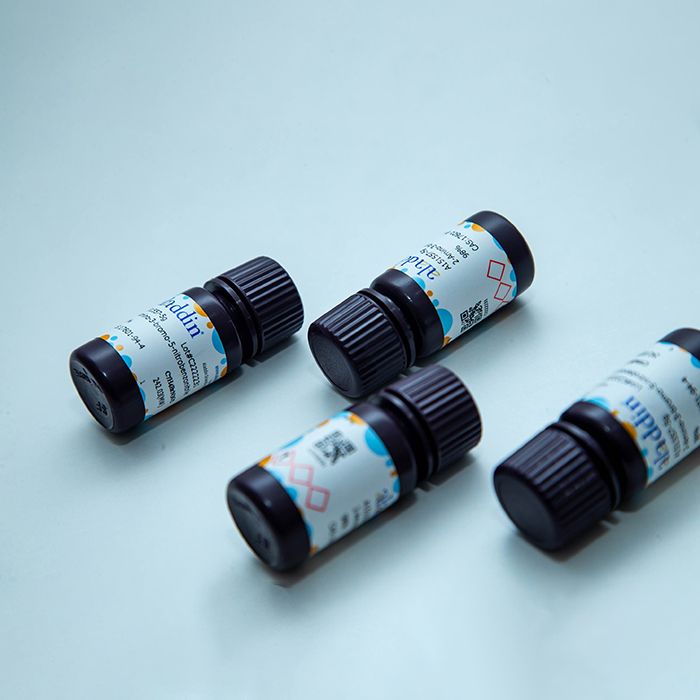
Room temperature Normal 출고. 정확한 사양은 로트별 COA를 확인하세요.
📋
품질 문서
SDS, COA, 데이터시트, 사양서를 다운로드할 수 있습니다. 로트별 COA는 로트 번호 조회를 통해 확인할 수 있습니다.
📚
문헌적 근거
크로마토그래피, 유기 합성 및 교차 커플링 반응 분야의 동료 심사 논문 0편에서 인용되었습니다.
개요
Product introduction:
NeuCode™ amino acids augment the level of multiplexing achievable for the metabolic labeling of proteins for mass spectrometry analysis. NeuCode™ Lysine-080 (3,3,4,4,5,5,6,6-D8 L-Lysine-2HCl) may also be used with traditional SILAC to improve flexibility of multiplexing options or to reduce complexity of analysis.
General features of NeuCode SILAC labeling: • Labeling efficiency—100% label incorporation into proteins of living cells without toxicity • Compatible—may be multiplexed with existing SILAC amino acids • Time-saving—not necessary to label to 100% incorporation if only using heavy amino acids • High-quality supplements—heavy amino acids with >98% isotope purity
Stable isotope labeling with amino acids in cell culture (SILAC) is a powerful method to identify and quantify relative differential changes in complex protein samples. NeuCode metabolic labeling is similar to SILAC, but differs in that the labeling only utilizes heavy amino acids. The increased multiplexing capability of NeuCode amino acids is possible through the use of mass defects from extra neutrons in the stable isotopes. These small mass differences may be resolved on high resolution mass spectrometers.Use of only heavy amino acids eliminates the need for 100% incorporation of amino acids used for SILAC (both heavy and light), and may be especially useful for studies with primary cells.
NeuCode amino acids are used together with specialized cell culture media that are deficient in essential amino acids. Heavy L-lysine is used for SILAC analysis of peptides that have been digested with trypsin or LysC. NeuCode Lysine-080 may be used with 4,4,5,5-D4 L-lysine or 13C615N2 L-lysine for duplex experiments and may be combined with light lysine for three-plex experiments.
Products are supplied to verified businesses, institutions, and qualified professionals for research and development use only. Not for use in humans, animals, diagnosis, or therapy.